
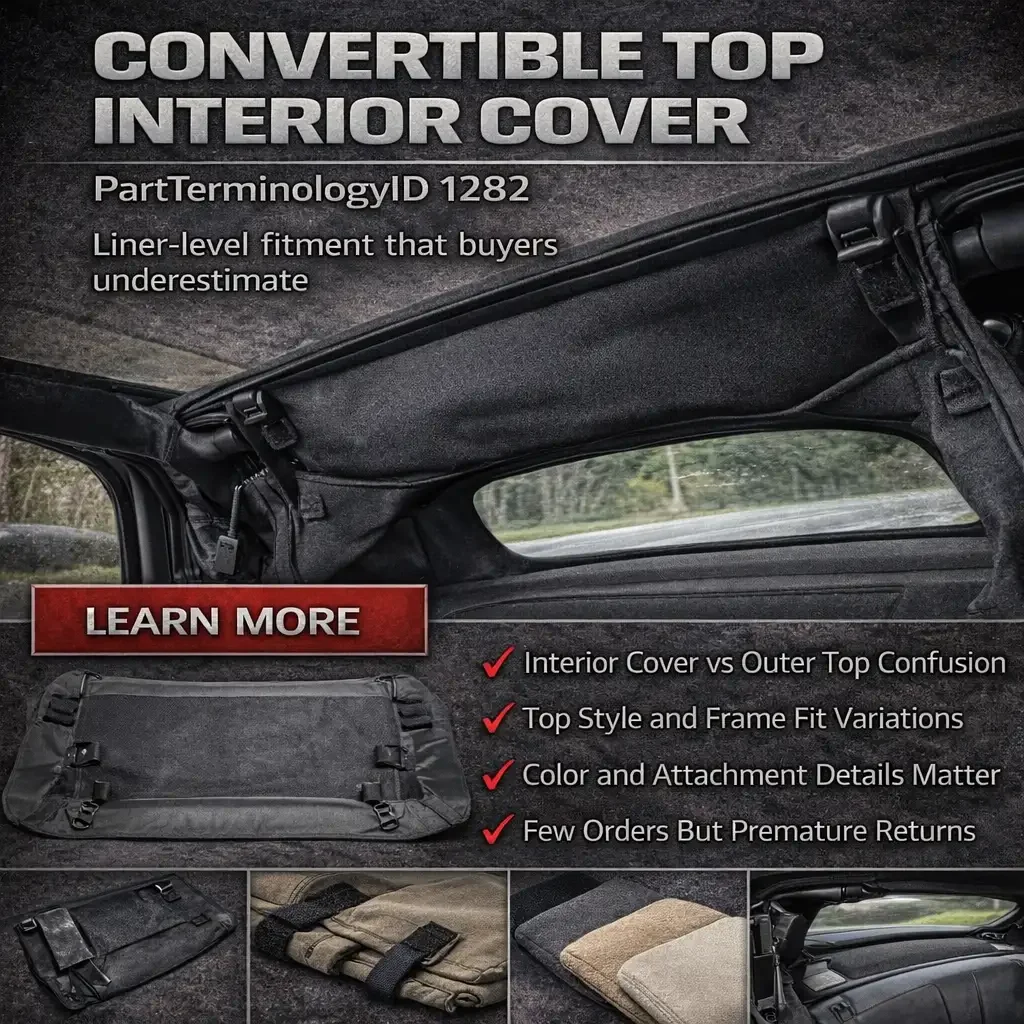
Convertible Top Interior Cover is one of those part names that sounds simple, but in real aftermarket selling it is very easy to mislist and very easy to return.
Most buyers do not use this exact term. They search for things like:
convertible top liner
inside convertible top fabric
convertible roof headliner
inner top cover
top interior trim
That creates a catalog problem right away. The official terminology may be clean, but buyer language is inconsistent. On top of that, this part is often confused with the outer convertible top skin, top pads, boot covers, and other convertible components.
PartTerminologyID 1282 needs a careful PartsAdvisory approach because this is a fitment-sensitive and appearance-sensitive category. A part can be close and still be wrong.
This post is built for aftermarket catalog teams, marketplace sellers, and buyers who want fewer mistakes, fewer returns, and better listing accuracy.
Status in New Databases
Status in New Databases
Current: PIES 7.2 + PCdb
Future: PIES 8.0 + PCdb 2.0
Status: No change
What a Convertible Top Interior Cover Actually Is
A Convertible Top Interior Cover is the interior-facing cover or liner portion associated with the convertible top assembly. It is the part visible from inside the cabin when the top is up.
In practical terms, it usually provides:
a finished interior look
concealment of frame structure and mechanisms
improved appearance over raw top material or support bows
some level of acoustic and visual refinement
Depending on the vehicle and product line, it may be:
a full inner liner panel
a sewn interior liner section
a replacement interior cover for a specific top style
a trim piece that attaches to the underside of the top assembly
This is exactly why naming matters. Buyers may think they are ordering the exterior top material when they are really buying the inside liner, or the opposite.
Why This Part Gets Mixed Up With Other Convertible Parts
Convertible categories are already complex, and this part sits right in the middle of that complexity.
Common naming confusion
Convertible Top Interior Cover vs Convertible Top (outer skin)
The outer top skin is the weather-facing material. The interior cover is the inside-facing liner or trim. Buyers often use "top cover" for both.
Convertible Top Interior Cover vs Convertible Top Headliner
These terms are often used interchangeably in buyer language. In some catalogs they may be the same thing. In others, "headliner" refers to a specific liner kit or interior finish layer. Listings need to clarify what is included.
Convertible Top Interior Cover vs Convertible Top Pad Set
Pad sets are support materials that affect shape and fit under the top skin. They are not the finished interior cover, but they are commonly confused in restoration projects.
Convertible Top Interior Cover vs Boot Cover / Tonneau Cover
Boot covers are used when the top is folded down and cover the stacked top. That is a completely different part. Many buyers still search "convertible cover" and land on the wrong product type.
Convertible Top Interior Cover vs Well Liner
The well liner covers the convertible top storage well area on some vehicles. It is not the same as the interior liner under the roof section.
This category needs exact product naming in titles, not just "Convertible Top Cover."
Why Fitment Is More Complex Than Buyers Expect
Buyers often think a convertible top interior cover is just fabric in the right shape. In reality, fitment can be very specific.
Convertible systems vary by:
body style
top frame design
top generation
window style
attachment method
interior trim package
A small mismatch in any of those areas can create wrinkles, loose edges, bad latch alignment, or a cover that simply cannot be installed correctly.
Fitment variables that drive mistakes
Top style and generation
Even within the same model name, top frame and inner liner designs can change across generations or mid-cycle updates.
Soft top frame design changes
A refresh may look similar from outside but use different bow spacing, edge channels, or attachment points under the liner.
Rear window configuration
Glass rear window vs plastic rear window setups can affect liner cutouts, zipper design, and finish shape.
Defroster and wiring provisions
Some applications need provisions for rear defroster routing or integrated trim around rear glass.
Interior trim color
Black, tan, parchment, gray, and custom restoration colors create return risk even when fit is correct.
Attachment method
Some liners use:
sewn attachment points
hook-and-loop strips
clips
snaps
staple points
listing wires
channels
A listing that ignores attachment style invites installation failure.
With padding or without padding expectation
Many buyers assume an interior cover includes pads or insulation. Often it does not.
This is why "fits your vehicle" is not enough for this category.
Major Product Variants You Should Separate in Catalog Data
Convertible Top Interior Cover is not one universal product form. Catalog teams should split the variants clearly so buyers know what they are ordering.
1) Interior Cover / Liner Only
This is the most common version for PartTerminologyID 1282. It is the visible interior-facing liner without the outer top material.
Typical buyer intent:
torn or sagging interior liner
stained or aged interior look
restoration-level interior refresh
Common return causes:
buyer expected full convertible top
wrong color
wrong attachment style
expected pads or hardware included
2) Interior Cover Included as Part of a Top Kit
Some sellers bundle the interior liner with the outer top or with a larger convertible top package.
Typical buyer intent:
complete replacement project
shop install
restoration bundle
Common return causes:
unclear package contents
buyer expected all pads and cables included
confusion about pre-sewn vs separate liner
3) Custom or Made-to-Order Interior Liner
Some specialty suppliers offer custom colors, stitch options, or restoration-style materials.
Typical buyer intent:
show car restoration
exact period-correct finish
premium interior match
Common return causes:
color expectation mismatch
lead time surprises
non-returnable custom item not understood
For catalog clarity, product form should be explicit in the title and specs, not hidden in the description.
Pros and Cons
This is not a typical bolt-on accessory, but buyers still benefit from a Pros and Cons section because they often underestimate the installation and matching requirements.
Pros
Restores the interior look of a convertible
A new interior cover or liner can dramatically improve cabin appearance.
Helps hide frame and top structure details
Gives the inside of the convertible a finished look instead of an exposed framework appearance.
Strong value in restorations
Important for classic and enthusiast vehicles where interior presentation matters.
Can improve perceived vehicle quality
A clean liner makes the whole car feel better maintained.
Useful upsell with convertible top replacement jobs
Great add-on for shops replacing outer tops.
Cons
Naming confusion causes wrong orders
Buyers often mix up liner, top skin, pads, and boot covers.
Color matching is a major return risk
Interior trim color mismatch is common, especially on older cars with faded interiors.
Installation can be more involved than expected
Attachment method and top frame access can make install difficult for DIY buyers.
Package contents are often misunderstood
Buyers may expect pads, cables, or hardware that are not included.
Low volume but high error cost
Wrong orders in convertible categories often cost more in support time and returns.
Compatibility Checklist for Buyers
For this part, a Compatibility Checklist is the right choice because fitment, top style, and installation details matter more than simple pricing.
Compatibility Checklist
1) Confirm the exact part type
Make sure you are ordering:
interior cover / liner only
and notouter convertible top skin
boot cover
well liner
pad set
This is the most important step.
2) Confirm full vehicle details
Year
Make
Model
Submodel or trim
Convertible trim differences can matter.
3) Confirm your convertible top style
soft top type
rear window type (glass or plastic if applicable)
any known top generation or frame style notes
4) Compare your existing liner layout
Check:
seam lines
rear window cutout shape
edge finish style
bow attachment points
openings or pass-through areas
Photos matter here.
5) Confirm interior color
Common issues happen with:
black vs charcoal
tan vs beige
parchment vs off-white
color fade on older interiors
If the listing offers color samples or close-ups, use them.
6) Verify what is included
Confirm whether the listing includes:
liner only
pre-sewn sections
binding/trim edges
hardware or clips
adhesive
installation instructions
Never assume pads or hardware are included.
7) Check attachment method
Ask or verify whether installation uses:
glue
staples
clips
hook-and-loop
sewn-in listing attachment
channel insertion
This affects install difficulty and compatibility.
8) Confirm custom or made-to-order status
If it is custom:
check lead time
check return policy
confirm material and color before ordering
9) Inspect the rest of the top system
If the outer top, pads, or frame are also worn, replacing only the interior cover may not deliver the result you expect.
10) Use a shop if unsure
Convertible top interior work can be very clean when done right and very frustrating when the wrong part or install method is used.
Catalog Checklist for Attributes and Structured Data
This category performs much better when the catalog is structured for convertible-specific details instead of generic interior trim logic.
Catalog Checklist for PartTerminologyID 1282 Convertible Top Interior Cover
Core naming and taxonomy
Terminology Name: Convertible Top Interior Cover
Buyer-facing synonyms:
Convertible Top Liner
Convertible Top Headliner (when applicable)
Inner Convertible Top Cover
Keep separate from:
Convertible Top (outer skin)
Convertible Boot Cover
Convertible Top Pad Set
Well Liner
Product form attributes
Interior liner only
Included in top kit
Custom / made-to-order liner
OE-style replacement yes or no
Fitment structure
Year
Make
Model
Submodel
Body style (convertible only)
Top generation/frame notes if applicable
Rear window type compatibility
Trim package notes where relevant
Material attributes
Vinyl-backed fabric
Cloth
OEM-style liner material
Premium restoration material
Texture / grain or weave style
Color attributes
Color family
Supplier color name
OE-style color note
Color disclaimer for aged interiors
Color should be a required field, not a hidden option.
Attachment and installation attributes
Attachment method
Adhesive required yes or no
Clips included yes or no
Hardware included yes or no
Professional installation recommended yes or no
Pre-sewn sections yes or no
Package content fields
Interior cover / liner included
Outer top skin included yes or no
Pads included yes or no
Cables included yes or no
Window section included yes or no if applicable
Instructions included yes or no
This section needs to be explicit because convertible buyers often expect more than what is in the box.
Return prevention content fields
"This is the interior cover / liner only"
"Outer convertible top not included"
"Verify rear window type and top style"
"Color may vary from aged interior trim"
"Professional installation recommended" when appropriate
Image requirements
Full laid-out view of the liner
Close-up of seams
Close-up of material texture
Edge and attachment detail
Installed interior view
Rear window opening area close-up
Convertible categories are visual and technical at the same time. Image quality is a major return prevention tool.
Common Return Causes and How to Prevent Them
1) Buyer ordered the wrong convertible part type
What happens
Buyer wanted the outer top skin or a full top kit and ordered only the interior cover.
How to prevent it
Put "Interior Cover / Liner Only" in the title and first description line. Repeat it in package contents.
2) Wrong top frame or rear window setup
What happens
The liner shape or cutout does not match the buyer's top configuration.
How to prevent it
Add frame-generation notes and rear window compatibility details where available.
3) Color mismatch
What happens
The liner fits but looks off against seats, trim, and visors.
How to prevent it
Use standardized color names, material close-ups, and a note about interior fading.
4) Installation method mismatch
What happens
Buyer expected a simple install but the product requires more advanced attachment or top disassembly.
How to prevent it
Publish the attachment method and installation expectations clearly.
5) Package contents misunderstanding
What happens
Buyer expected pads, cables, or hardware and only received the liner.
How to prevent it
List every included and excluded component in the specs and bullets.
Common Buyer Scenarios
Scenario 1: Restoration buyer wants the inside of the top to look new
The buyer is restoring a convertible and the outer top may still be acceptable, but the interior liner is stained or sagging.
What goes wrong:
They accidentally order an outer top skin
They get the wrong color shade
They underestimate the install complexity
What helps:
Clear liner-only naming
Color and material close-up photos
Installation method notes
Scenario 2: Shop is replacing a full top and wants the liner too
A shop wants to complete the job correctly with both outer top and inner liner.
What goes wrong:
Listing does not clearly show whether liner is included in the top kit
Missing package detail causes delays
What helps:
Explicit package contents
"Included in top kit" vs "sold separately" fields
Cross-sell links to matching components
Scenario 3: Buyer confuses liner with boot cover
This is common in general marketplace search traffic where "convertible top cover" can mean several things.
What goes wrong:
Wrong part arrives
Return cost is high due to oversized packaging or specialty handling
What helps:
Product type clarification at the top
Installed photo showing the liner on the inside of the roof
Search synonyms managed carefully
Scenario 4: Vintage convertible owner needs period-correct look
The buyer cares about texture, seam style, and color accuracy more than price.
What goes wrong:
Generic liner material does not match original look
Listing lacks close-up material photos
Color name is too broad
What helps:
Restoration-grade material attributes
Detail photos
Custom or OE-style notes
FAQ
Is Convertible Top Interior Cover the same as the convertible top itself?
No. The Convertible Top Interior Cover is the interior-facing liner or cover. The outer convertible top is the weather-facing material on the outside of the vehicle.
Is this the same as a convertible top headliner?
Often yes in buyer language, but not always in catalog language. Some sellers use "headliner" and "interior cover" interchangeably. The listing should clarify exactly what is included.
Is this the same as a boot cover?
No. A boot cover is used when the top is folded down and covers the stored top stack. It is a different part.
Why does fitment matter so much on an interior liner?
Because liner shape, seam layout, rear window opening, and attachment method are tied to the top frame and convertible top design. Small differences can prevent a proper install.
What causes the most returns for this category?
The biggest return causes are wrong product type, wrong top configuration, color mismatch, and unclear package contents.
Does the interior cover usually include pads or hardware?
Not always. Many listings are liner only. Buyers should always check whether pads, clips, cables, or adhesive are included.
Can I install a convertible top interior cover myself?
Some experienced DIY buyers can, but many installs are better handled by upholstery or convertible top professionals, especially if the top frame or outer top is also being serviced.
How should sellers reduce returns on this part?
Use clear product type naming, publish color and material details, list attachment methods, show seam and edge close-ups, and make package contents very explicit.
Final Take for Aftermarket Teams
Convertible Top Interior Cover (PartTerminologyID 1282) is a niche category, but it demands high catalog discipline.
It combines:
naming overlap
convertible-specific fitment details
interior color matching
installation complexity
high buyer expectation for appearance
That is a perfect setup for avoidable returns if listings are vague.
The best approach is practical and repeatable:
keep terminology clean
separate liner-only vs bundled top kits
capture top-style and rear-window compatibility details
treat color and material as core attributes
make attachment method and package contents obvious
use close-up images that show seams and edge details
This is exactly the kind of category where precise catalog work beats broad listing volume.