
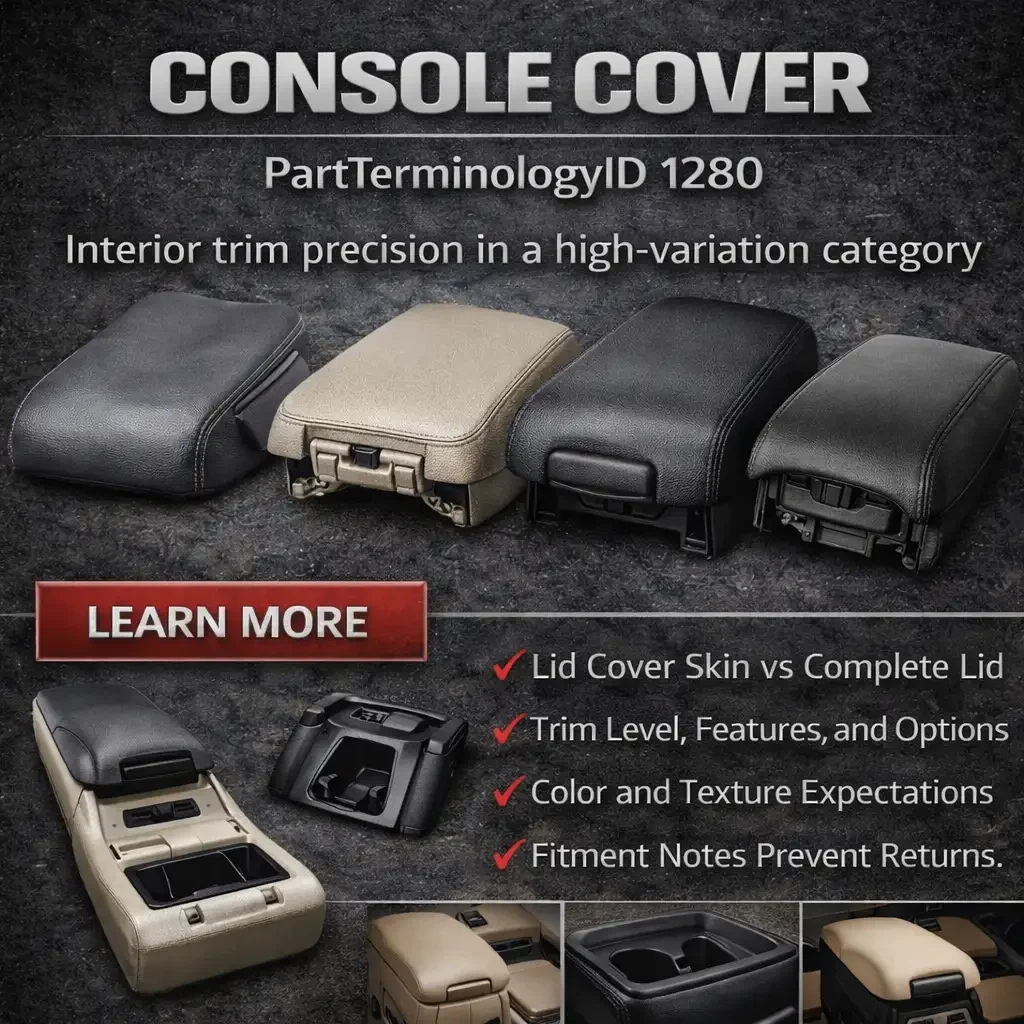
Console Cover looks like a simple interior part name, but in aftermarket cataloging it can become a return trap very quickly.
This category lives in the middle of several buyer expectations at once:
cosmetic refresh
wear and tear repair
restoration
trim replacement
interior customization
At the same time, the term "console cover" is used loosely across the market. One seller means the center console lid skin. Another means the full armrest lid. Another means a trim overlay panel around the shifter. Another means a protective slip-on accessory. All of them may use almost the same title.
That is exactly why PartTerminologyID 1280 Console Cover needs strong PartsAdvisory treatment.
This post focuses on the real catalog work that reduces mistakes:
naming clarity
variant separation
fitment details
color and material expectations
package content accuracy
return prevention
Status in New Databases
Status in New Databases
Current: PIES 7.2 + PCdb
Future: PIES 8.0 + PCdb 2.0
Status: No change
What a Console Cover Usually Means in the Aftermarket
In most aftermarket use, Console Cover refers to a cover piece associated with the center console area. The problem is that this can describe more than one product form.
Depending on brand and listing style, Console Cover may mean:
center console lid cover
armrest console cover
console top panel cover
shifter console trim cover
protective sleeve style cover
replacement upholstered console lid skin
decorative overlay cover for the console trim
This is the first big source of confusion. Buyers search by what they see and touch, not by catalog terminology. A worn armrest lid may be called "console cover," "armrest cover," "center console lid," or "console top" by different customers.
If your listing does not identify the exact part type, you will attract the wrong orders.
Why This Category Gets Misnamed So Often
Console Cover sits right next to several other interior terms, and a lot of suppliers blur them together.
Common naming confusion
Console Cover vs Console Lid
A console lid is usually the full hinged top assembly. A console cover may be just the outer skin or upper cover piece.
Console Cover vs Armrest Cover
In many vehicles, the center console lid also functions as an armrest. Buyers often search "armrest cover" when they need a console cover.
Console Cover vs Console Trim Panel
Some listings use "console cover" for rigid trim pieces around the shifter, cup holders, or infotainment controls. Those are often different parts than the upholstered lid cover.
Console Cover vs Protective Slip-On Cover
Accessory sellers often sell padded or leatherette slip-on covers that wrap the original console lid. These are not the same as direct-fit replacement covers or OE-style trim pieces.
Console Cover vs Complete Center Console Assembly
A buyer may think they are buying the whole console top section, but the listing may only include one small cover panel.
This category needs exact naming at the SKU level. "Console Cover" by itself is not enough for a title.
Why Fitment Is Harder Than It Looks
Console covers are interior parts, and many teams treat interior trim as low-risk. In reality, console covers are highly sensitive to shape, hinge design, and trim details.
Two covers can look almost identical in a thumbnail and still be completely incompatible.
Fitment variables that break compatibility
Console design changes within the same generation
Mid-cycle refreshes often change the console shape, stitching, latch, or trim edge.
Trim level differences
Base, sport, and premium trims may use different console lid materials, stitching, storage depth, or top panel layout.
Shifter layout changes
Column shift vs floor shift can change the console structure entirely. Even among floor-shift models, automatic and manual layouts can differ.
Seat and console configuration
Some trucks and SUVs have:
full center console
jump seat / fold-down center section
split bench with small console top
A console cover for one setup will not fit the others.
Feature package differences
with or without wireless charging
with or without rear climate controls
with or without rear USB ports
with or without sliding console top
with or without storage tray insert
These can affect the top cover shape and cutouts.
Material and stitch pattern differences
Even when dimensions match, a buyer may return the part if grain, stitch line, or material texture does not match the rest of the interior.
Color differences
Black, charcoal, gray, beige, saddle, and two-tone interiors create frequent mismatch complaints.
This is why console cover listings need more than basic YMM fitment and one generic photo.
Major Product Variants You Should Separate in Catalog Content
This category becomes much easier to manage when you split the common forms instead of pushing them all under one generic template.
1) Console Lid Cover Skin
This is the outer surface cover that goes over the lid or replaces the upholstered top layer.
Typical buyer intent:
cracked or worn armrest surface
peeling vinyl or leather
cosmetic refresh
Common return causes:
buyer expected full lid assembly
wrong stitch pattern
color mismatch
not clear whether staples or adhesive are required
2) Full Console Lid Cover Assembly
This is the complete top lid piece, often including the structure and hinge mounting points.
Typical buyer intent:
broken lid
failed latch area
severe damage
Common return causes:
wrong hinge style
latch mismatch
wrong storage depth or lid shape
buyer expected just the skin at a lower price
3) Console Trim Cover Panel
This is a hard trim cover around the shifter or cup holder area, often made of plastic or decorative finish material.
Typical buyer intent:
cracked trim
worn finish
cosmetic upgrade
Common return causes:
wrong cutout layout
wrong transmission layout
mismatch in finish (woodgrain, brushed, gloss black, matte)
4) Slip-On Protective Console Cover
This is an accessory cover that wraps over the existing console lid for protection or comfort.
Typical buyer intent:
protect original armrest
add padding
hide wear
Common return causes:
loose fit
wrong size
buyer expected OE-style replacement
material does not match interior
This variant separation should be visible in your product titles, not only buried in long descriptions.
Pros and Cons
Console Cover is an accessory and trim-focused category, so Pros and Cons are useful for both buyers and sellers.
Pros
Affordable interior refresh
A console cover can improve cabin appearance without replacing the full console assembly.
Strong cosmetic demand
This is a common wear area, especially on daily drivers and fleet vehicles.
Multiple product types for different budgets
Buyers can choose slip-on protection, replacement skins, or full assemblies.
Good category for upsell and bundles
Pairs well with seat covers, floor mats, shift boots, and interior trim refresh products.
High visual impact
A clean console top makes the whole interior look newer.
Cons
Naming confusion is constant
Buyers often mix up cover skin, lid assembly, and trim panel.
Color and texture mismatch returns are common
Fit can be correct but the look still fails buyer expectations.
Interior feature variations matter
Charging pads, cup holder layouts, and trim packages can change the shape.
Marketplace photos often hide the details
Small differences in latch shape or edge contour are hard to see in generic images.
Installation expectations vary
Some covers slip on, some require adhesive, and some require removing the lid or trim panel.
Compatibility Checklist for Buyers
For Console Cover, a Compatibility Checklist is the best choice because shape, trim features, and part type all matter.
Compatibility Checklist
1) Confirm what type of console cover you need
lid skin only
full lid assembly
hard trim panel cover
slip-on protective cover
This is the most important step.
2) Confirm vehicle details
Year
Make
Model
Submodel or trim
Trim level often changes interior layout.
3) Confirm your console style
full center console
jump seat / fold-down center section
bench seat center armrest style
Do not assume all trims use the same console.
4) Check features that affect shape
floor shifter or column shifter
wireless charging pad
cup holder position
rear climate controls
rear USB ports
sliding console lid or fixed lid
5) Compare lid shape and latch area
For lid covers and lid assemblies, compare:
edge contour
latch cutout
hinge side shape
overall length and width
6) Confirm color and material
Check:
black, charcoal, gray, tan, beige, saddle
vinyl, leather, leatherette, cloth
stitch pattern and thread color if visible
7) Confirm what is included
cover only
lid assembly
adhesive strips
clips
hardware
installation instructions
Never assume hardware is included.
8) Check installation type
slip-on
adhesive install
staple-on skin
full replacement with lid removal
trim panel snap-in replacement
9) Review photos carefully
Best listings show:
top view
side profile
underside or mounting points
latch area close-up
color/texture close-up
10) For cosmetic match, ask before ordering
If the interior color or material is hard to confirm from photos, ask the seller for a closer match note.
Catalog Checklist for Attributes and Structured Data
Console Cover is exactly the kind of category where a strong attribute model prevents chaos. If your catalog only stores a title and broad fitment, returns will follow.
Catalog Checklist for PartTerminologyID 1280 Console Cover
Core naming and taxonomy
Terminology Name: Console Cover
Required product form attribute:
Lid Skin
Lid Assembly
Trim Panel Cover
Slip-On Protective Cover
Controlled synonyms for search:
Center Console Cover
Armrest Cover
Console Lid Cover
Console Trim Cover
Keep synonyms searchable, but keep SKU naming precise.
Fitment structure
Year
Make
Model
Submodel
Body style
Interior trim package if needed
Console configuration notes
Shifter type where relevant
Exclusions by feature package
Position and area attributes
Front center console
Rear console section
Upper lid
Side panel
Shifter surround
Cup holder panel
This matters because one vehicle can have multiple console cover pieces.
Material attributes
Vinyl
Leather
Leatherette
Cloth
Plastic
Soft-touch trim
Finish texture (grain, smooth, patterned)
Color and appearance attributes
Color family
Manufacturer color name
Stitch color
Finish style for rigid trim (woodgrain, gloss black, brushed, matte)
Color needs to be standardized and visible.
Dimensions
For universal or slip-on products:
length
width
height
stretch range if applicable
For direct-fit products:
include dimensions where possible, especially for lid covers and slip-on variants
Feature compatibility fields
With wireless charging
Without wireless charging
With rear climate controls
With rear USB ports
With floor shifter
Without floor shifter
With full console
With fold-down center seat
These notes reduce a lot of wrong orders.
Package contents
cover only
lid assembly only
clips included yes or no
adhesive included yes or no
hardware included yes or no
instructions included yes or no
Installation fields
slip-on
adhesive
staple-on upholstery replacement
direct replacement
trimming required yes or no
professional installation recommended yes or no
Return prevention content
"This is not the complete center console assembly" when applicable
"Color may vary from aged interior surfaces"
"Verify console style before ordering"
"Compare latch and hinge shape to listing photos"
Image requirements
top view
side view
underside / mounting view
latch close-up
hinge close-up
color and material close-up
installed interior photo
This category is very visual. One extra close-up usually prevents more returns than one extra paragraph.
Common Return Causes and How to Prevent Them
1) Buyer ordered the wrong product form
What happens
Buyer wanted a full lid but ordered a cover skin, or wanted a slip-on cover but ordered a hard trim panel.
How to prevent it
Add the product form directly in the title and first bullet. Example:
Console Lid Cover Skin
Console Lid Assembly
Console Trim Panel Cover
Slip-On Console Cover
2) Wrong console configuration
What happens
The buyer enters correct YMM but has a different center console design due to trim package or seat configuration.
How to prevent it
Add console configuration notes and feature-based exclusions, not just YMM.
3) Color mismatch
What happens
Fit is correct but the new cover is darker, lighter, or a different grain than the existing interior.
How to prevent it
Use standardized color naming, close-up photos, and a note about aged interior fade.
4) Hardware or adhesive expectation mismatch
What happens
Buyer expected clips, adhesive, or a fully assembled lid but the listing included only the cover piece.
How to prevent it
Repeat package contents in title, bullets, and specs.
5) Cosmetic finish mismatch on trim panels
What happens
The panel fits, but gloss level, woodgrain, or texture does not match the rest of the console.
How to prevent it
Treat finish style as a required attribute and show close-up finish images.
Common Buyer Scenarios
Scenario 1: Worn armrest top on a daily driver
The buyer has a cracked or peeling center armrest and searches "console cover." They just want the top surface to look clean again.
What goes wrong:
They order a full lid assembly when they only needed a cover skin
They order a slip-on cover expecting OE look
Color mismatch
What helps:
Clear product form in the listing title
Material and stitch details
Side-by-side installed photo
Scenario 2: Broken console lid latch area
The buyer needs structural replacement because the lid will not close or the hinge is broken.
What goes wrong:
They buy a cosmetic cover skin
Listing does not clearly state no latch or no hinge hardware included
What helps:
"Lid Assembly" wording
Underside and hinge photos
Package contents list
Scenario 3: Shifter surround trim refresh
The buyer wants to replace a scratched console trim panel around the shifter and cup holders.
What goes wrong:
They get the wrong cutout layout for a different transmission or trim package
Finish mismatch with the dashboard trim
What helps:
Feature compatibility fields
Close-up cutout photos
Finish type attribute
Scenario 4: Buyer wants easy protection, not replacement
The buyer wants a padded protective cover for comfort and to protect the original console lid.
What goes wrong:
They accidentally order a direct-fit replacement cover
Slip-on cover arrives but they expected exact OEM texture
What helps:
"Slip-On Protective Cover" in the title
Install method callout
Dimensions and stretch-fit notes
Scenario 5: Marketplace seller imports weak supplier data
Supplier feed title says "Console Cover Black" with broad fitment and one photo.
What happens:
Lots of traffic
Low conversion
High return rate
Confused customer messages
What helps:
Enrichment rules requiring product form, color, material, and console style notes before publish
FAQ
Is Console Cover the same as a center console lid?
Not always. Console Cover may mean a lid skin, a full lid assembly, a trim panel, or a protective slip-on cover. The listing should clearly state which type it is.
Is Console Cover the same as armrest cover?
Sometimes. In many vehicles, the center console lid functions as the armrest, so buyers often use the terms interchangeably. Catalog listings should clarify the exact part form.
Why do console covers have so many fitment issues?
Because console designs vary by trim, shifter layout, seat configuration, and interior features. Small shape differences can make a cover unusable.
What causes the most returns for console covers?
The biggest causes are wrong product type, wrong console configuration, color mismatch, and unclear package contents.
How do I know if I need a lid cover skin or a full lid assembly?
If the lid structure and hinge work but the top surface is worn, you may only need a cover skin. If the lid is broken, cracked structurally, or will not latch, you may need a full lid assembly.
Are slip-on console covers a direct replacement?
No. Slip-on covers are usually protective accessories that fit over the existing lid. They do not replace the original lid or trim panel.
Why is color matching difficult on interior parts?
Interior materials fade over time, and screen colors vary. A new part can be technically correct but still look different from older surrounding trim.
What should sellers include in a good console cover listing?
Clear product type, console configuration notes, color and material details, package contents, installation method, and close-up images of hinge/latch/edges.
Final Take for Aftermarket Teams
Console Cover (PartTerminologyID 1280) is a high-variation interior category that looks simple from a distance and gets expensive when catalog detail is missing.
This is not just a fitment problem. It is a naming and expectation problem.
The best results come from a practical approach:
Separate product forms clearly
Add console configuration and feature-based compatibility notes
Treat color, texture, and finish as core attributes
Make package contents and install method obvious
Use close-up images for hinge, latch, and edge shape
If your team gets Console Cover right, you reduce returns, improve conversion, and build a stronger process for other interior trim categories with similar variation.