
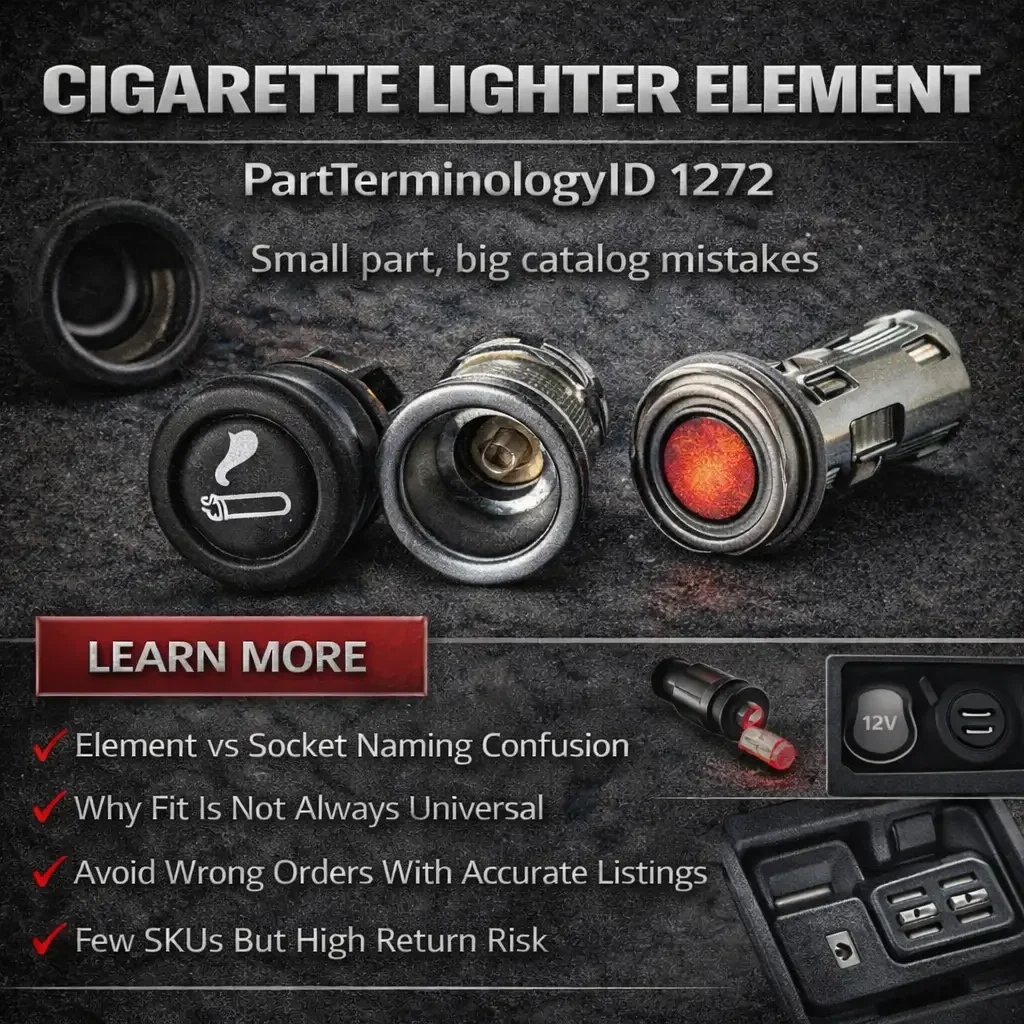
Cigarette Lighter Element is one of those tiny parts that creates oversized confusion in aftermarket catalogs.
It looks simple. It is small, inexpensive, and often treated like a generic replacement. But in real buyer behavior, this part is a frequent mismatch because people mix up the element and the socket, and many modern vehicles no longer use a true heating element setup at all.
This category also sits in a transition area. Automotive has moved toward USB, USB-C, and dedicated charging ports, but buyers still search legacy terms. Older vehicles, restorations, work trucks, and shop repairs still create demand for cigarette lighter elements. That means the part is becoming more niche in everyday use, but still important in catalogs and search.
For aftermarket teams, PartTerminologyID 1272 is a precision category. If the listing is vague, returns happen fast.
Status in New Databases
Status in New Databases
Current: PIES 7.2 + PCdb
Future: PIES 8.0 + PCdb 2.0
Status: No change
What a Cigarette Lighter Element Actually Is
The cigarette lighter element is the removable heated plug that inserts into a compatible lighter socket. It is the part with the knob or face cap that the user pushes in, heats up, and then removes.
It is not the fixed socket in the dash or console.
That one distinction is the biggest source of mistakes in this category.
The basic system has two different parts
Cigarette Lighter Element = removable heated insert
Cigarette Lighter Socket / 12V Outlet = fixed receptacle in the vehicle
Many buyers search "cigarette lighter" when they are trying to fix a dead power outlet for a phone charger. They often need the socket, not the element. If your listing does not make this obvious, the wrong orders will come in.
Why This Part Name Still Matters Even as the Use Case Fades
You are right that this is moving away from mainstream automotive use.
Most newer vehicles prioritize:
USB charging
USB-C ports
Wireless charging
12V accessory outlets without a true lighter element
But Cigarette Lighter Element still matters in aftermarket for several reasons:
Older vehicles still use it
Classic and restoration buyers want original function
Many buyers use legacy search terms
Used vehicles often have missing or damaged elements
Shops need replacement parts for complete outlet restoration jobs
So demand is smaller than it used to be, but the confusion is higher because the naming stayed while vehicle usage changed.
Naming Confusion That Causes Wrong Orders
This category has heavy naming overlap, and most mistakes start in the title.
Common naming confusion
Cigarette Lighter Element vs Cigarette Lighter Socket
The element is removable and heats up. The socket is the fixed part in the panel. Buyers often order the wrong one.
Cigarette Lighter Element vs 12V Power Plug
Some buyers think any plug-shaped 12V accessory is a lighter element. It is not. A charger plug or accessory adapter is a separate product.
Cigarette Lighter Element vs Complete Assembly
A "cigarette lighter" listing may refer to:
Element only
Socket only
Complete socket and element set
If the listing does not clearly say "Element Only," returns are common.
Cigarette Lighter Element vs Outlet Cap
Some buyers need only the face cap or trim cap and mistakenly order the full element.
The catalog fix is simple:
Keep the official part name as Cigarette Lighter Element
Add clear supporting language like "Removable Heated Insert"
Repeat "Element Only" in title, bullets, and specs
Why Fitment Is Not as Universal as People Think
Many people assume all cigarette lighter elements are the same size. That is not always true.
Even when two elements look similar, they can differ in retention, depth, knob style, and socket compatibility.
Common compatibility variables
Element diameter and fit in socket
A slight size difference can cause a loose fit, poor contact, or no heating.
Overall length and insertion depth
Some elements sit deeper or shallower in the socket. Wrong depth can affect heating and pop-out function.
Retention design
The element needs to lock and release properly in the socket. If the shape or spring tension is wrong, it may not stay in or may not pop out correctly.
Knob face style and size
A buyer may want the correct OE look, icon, or face shape for restoration. Functional fit is not always enough.
Voltage and application type
Most passenger vehicles are 12V, but some products may be listed broadly and create confusion with non-standard applications.
Heat performance and fuse design
Some replacement elements include internal fuse protection or different heating characteristics. Low-quality options can underperform or fail quickly.
Socket condition
A new element will not fix a damaged socket. Buyers often order an element when the real failure is in the outlet receptacle.
This is why Cigarette Lighter Element needs a compatibility-first listing, not a generic "fits many" shortcut.
Pros and Cons
Cigarette Lighter Element is a legacy accessory component, so a Pros and Cons section helps buyers and sellers set expectations.
Pros
Simple low-cost replacement
If the socket is still good, replacing the element can restore function quickly.
Useful for restorations and older vehicles
Important for buyers who want original interior function and appearance.
Strong legacy search demand
Many buyers still search this exact term.
Small part, easy to stock
Good add-on item for interior electrical catalogs and repair assortments.
Helps complete a full outlet repair
When sold with clear matching socket options, it can improve attach rate.
Cons
High naming confusion
Buyers often need the socket, not the element.
Compatibility is often assumed
Not all elements fit all sockets properly.
Declining mainstream use
Many modern vehicles no longer use true lighter elements.
Quality varies heavily
Cheap replacements may heat poorly or fail fast.
Safety expectations matter
A mismatched or poor-quality element can create heat issues, blown fuses, or buyer concern.
Compatibility Checklist for Buyers
For this part, a Compatibility Checklist is the best fit because the main problem is not price or styling. It is whether the element matches the socket and the buyer actually needs the element.
Compatibility Checklist
1) Confirm you need the element, not the socket
If your issue is no power to a phone charger, the problem may be:
Blown fuse
Damaged socket
Wiring issue
The element only helps if you are replacing the removable heated insert.
2) Confirm your vehicle has a true lighter-style socket
Some vehicles have a 12V accessory outlet that is not designed for a heating element.
3) Confirm vehicle details
Year
Make
Model
Submodel or trim
This helps reduce mismatch, especially on newer vehicles with mixed outlet types.
4) Compare the original element shape
Check:
Face style
Knob size
Overall length
Tip and side contact design
A visual match matters.
5) Verify socket compatibility
If the listing provides dimensions, compare against your socket opening and depth.
6) Check if the listing is element only
Do not assume it includes:
Socket
Trim ring
Cap
Wiring
Retaining hardware
7) Check voltage and application notes
Most are 12V automotive. Make sure the listing is for your intended use.
8) Inspect the socket condition before ordering
If the socket is corroded, melted, or loose, replacing only the element may not solve the problem.
9) Confirm OE-style appearance if this is a restoration
If appearance matters, check icon style, knob finish, and face design.
10) Use a quality replacement
Low-cost generic elements may fit poorly or heat inconsistently. For frequent use, quality matters.
Catalog Checklist for Attributes and Structured Data
This category is small in size but should still be cataloged carefully. Good structure reduces returns immediately.
Catalog Checklist for PartTerminologyID 1272 Cigarette Lighter Element
Core naming and taxonomy
Terminology Name: Cigarette Lighter Element
Buyer-facing clarification: Removable Heated Insert
Controlled synonyms: Lighter Insert, Lighter Plug Element
Keep separate from:
Cigarette Lighter Socket
12V Accessory Outlet
USB Charging Port
Product type clarity
Element only flag required
Complete assembly flag should be false for this category
Include "Element Only" in title and short description
Fitment and compatibility
Year
Make
Model
Submodel
Position if relevant (front dash, console, rear)
Socket type compatibility notes if available
Physical attributes
Overall length
Face diameter
Insert body diameter
Knob style
Finish color
Face icon style (cigarette icon, plain, OE-style text)
Electrical and performance attributes
Voltage rating (typically 12V)
Fused element yes or no
Heating coil type if provided
OEM-style replacement yes or no
Package contents
Element included yes
Socket included no
Cap included no unless specifically included
Quantity per package
Make these fields explicit to prevent assumption-based returns.
Return prevention content
"This is the removable lighter element only"
"Socket not included"
"For compatible lighter sockets only"
Troubleshooting note: if no outlet power, check fuse and socket condition
Visual content requirements
Front view
Side view
Tip and contact view
Comparison or installed-in-socket image if available
Package contents image
This is a category where one extra image can save a lot of returns.
Common Buyer Scenarios
Scenario 1: Buyer wants to restore lighter function in an older vehicle
The buyer has an older car or truck and wants the original lighter function back.
What goes wrong:
They order a socket instead of the element
They order the wrong face style for the interior
The socket is actually the failed part, not the element
What helps:
"Element Only" in the title
OE-style face image
Socket compatibility note
Basic troubleshooting note in the listing
Scenario 2: Buyer thinks the 12V outlet is broken
They plug in a charger and it does not work, so they search for "cigarette lighter."
What goes wrong:
They order a lighter element, but their issue is a blown fuse or dead socket
They leave a negative review because the part did not solve the problem
What helps:
Buyer-facing note: "If your charger has no power, check fuse and socket first"
Clear differentiation between element and socket
Scenario 3: Marketplace seller publishes vague title
The listing title just says "Cigarette Lighter" with no component detail.
What happens:
Good search visibility
Bad order quality
Returns for incomplete expectation
Customer service messages asking what is included
What helps:
Required listing rule: include component type in title
Package contents field shown above the fold
Rear and side images
Scenario 4: Restoration buyer cares about exact look
This buyer wants the correct knob style or symbol for an older vehicle interior.
What goes wrong:
Generic replacement works but looks wrong
Buyer returns it for cosmetic mismatch
What helps:
Face icon details
Finish details
Multiple product photos
OE-style note when true
FAQ
Is a cigarette lighter element the same as a cigarette lighter socket?
No. The element is the removable heated insert. The socket is the fixed receptacle mounted in the dash or console.
Will a cigarette lighter element fix a dead 12V power outlet?
Not always. If your outlet has no power, the issue may be a blown fuse, damaged socket, or wiring problem. The element only fixes the removable insert part.
Do all cigarette lighter elements fit all vehicles?
No. Many look similar, but size, depth, and socket compatibility can vary. Always compare the original part and check listing details.
Is this part still used in modern vehicles?
Less often than before. Many newer vehicles use 12V outlets, USB ports, or wireless charging. However, legacy search demand and older vehicle replacements still make this an active aftermarket part.
Does a Cigarette Lighter Element listing include the socket?
Usually no, unless the listing explicitly says it includes a complete assembly. Most listings for this category should be element only.
Why does my replacement element not heat up?
Possible causes include a blown fuse, damaged socket contacts, poor socket fit, wiring issues, or a low-quality element.
Can I use a generic lighter element in any 12V outlet?
Not necessarily. Some 12V outlets are accessory-only and may not be designed for a heating element. Compatibility should be confirmed first.
What should sellers do to reduce returns on this part?
Use exact naming, label it as element only, show multiple angles, and clearly separate it from sockets and complete assemblies.
Final Take for Aftermarket Teams
Cigarette Lighter Element (PartTerminologyID 1272) is a small legacy component that still creates outsized catalog and return problems.
The demand is more niche than it used to be, but the search behavior remains broad and outdated. That means buyers still come in using old terms, and listings need to be extra clear.
The winning strategy is simple:
Keep the terminology standard
Make "Element Only" impossible to miss
Separate element vs socket vs assembly
Add dimensions and visual detail
Include a quick troubleshooting note for dead outlets
Support both restoration buyers and practical repair buyers
This part is a good reminder that small components still need strong catalog discipline, especially when the market language has changed faster than the terminology.