
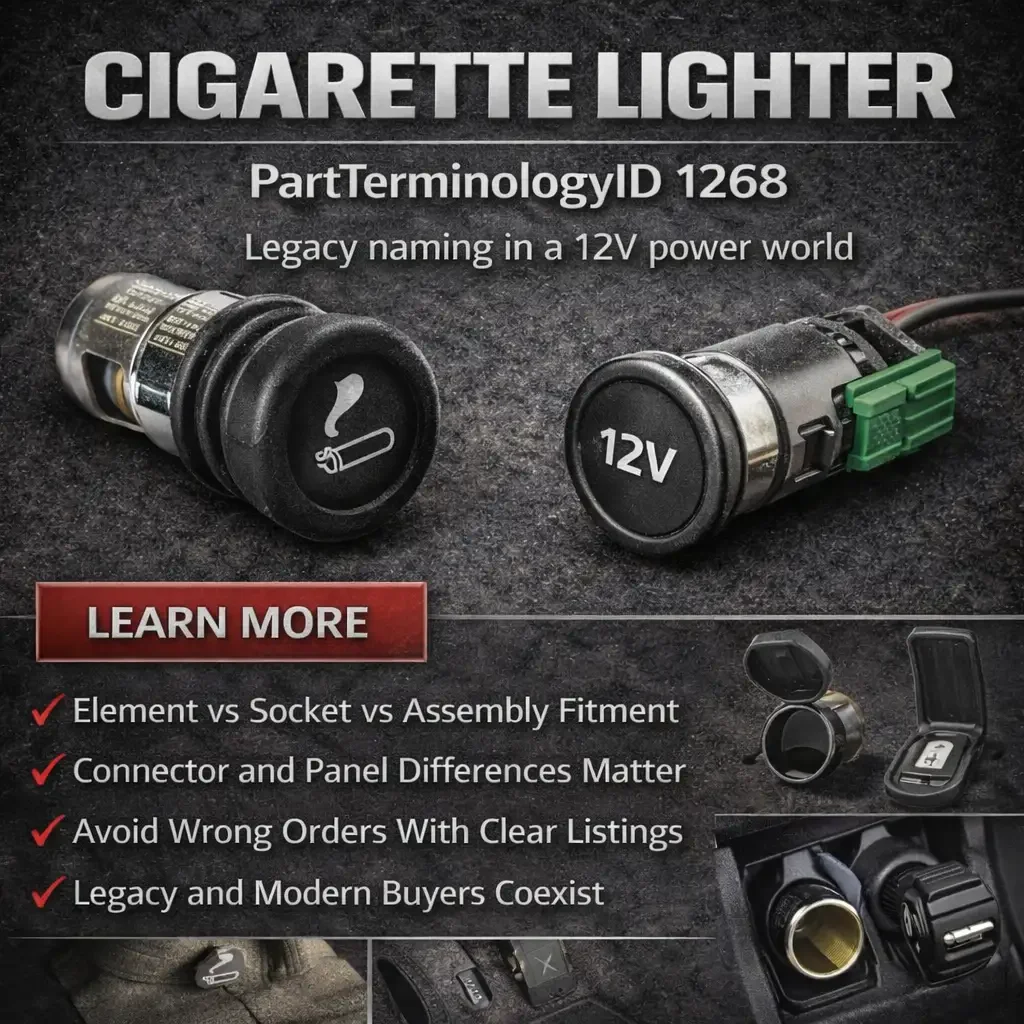
Cigarette Lighter is one of those part names that still matters in automotive catalogs, even though the vehicle use case has changed.
In older vehicles, this part was exactly what the name says. It heated a removable lighter element for smoking use. In modern vehicles, the same location is often used as a 12V accessory outlet for phone chargers, dash cams, tire inflators, and other electronics. Some vehicles still use the legacy naming in catalogs, service language, and buyer searches. Others label it as a power outlet, accessory socket, or 12V receptacle.
That shift creates a catalog problem.
Buyers search one term, sellers list another, and suppliers may mix the element, socket, housing, bezel, cap, and wiring pigtail under the same name. The part is small, but the error rate can be high because fitment and electrical details matter.
PartTerminologyID 1268 Cigarette Lighter is a great example of a category that is slowly changing function while keeping old terminology. If aftermarket teams do not manage naming and attributes correctly, returns and compatibility complaints follow.
Status in New Databases
Status in New Databases
Current: PIES 7.2 + PCdb
Future: PIES 8.0 + PCdb 2.0
Status: No change
Why This Part Name Still Matters
Even if fewer drivers use a heated lighter element, the part name remains highly relevant because buyers and catalogs still use it for several related products:
Lighter element only
Lighter socket or receptacle
12V outlet assembly
Outlet cap
Retaining nut
Illumination ring
Panel bezel
Wiring pigtail or connector repair lead
This is exactly where confusion starts. Many listings say "cigarette lighter" but only include one sub-component. Buyers often expect a complete assembly and receive just the metal heating element or just the socket shell.
From a PartsAdvisory perspective, this is a naming precision issue first, then a fitment issue.
Naming Confusion That Causes Real Returns
Cigarette Lighter overlaps with multiple terms in the market. Sellers need to support search behavior without collapsing different products into one vague listing.
Common naming overlap
Cigarette Lighter vs 12V Power Outlet
In many vehicles, the same opening is used for a power outlet, but it may not include a heating element. Buyers often search "cigarette lighter" when they really need the outlet socket.
Cigarette Lighter vs Lighter Element
The lighter element is the removable plug that heats up. The socket is the fixed receptacle in the dash or console. A buyer needing the socket will return an element-only order.
Cigarette Lighter vs Accessory Socket
Accessory socket is often the better modern term, especially for vehicles marketed as non-smoking packages. Many buyers still use legacy wording.
Cigarette Lighter vs Power Point
Some brands use "power point" or similar terms. If synonyms are missing, search coverage suffers.
Cigarette Lighter vs USB Port
This is a common buyer misunderstanding in newer vehicles. Buyers may think the part category includes USB charging modules. It does not. USB modules are a separate product and should not be mixed into cigarette lighter listings.
The catalog fix is simple:
Keep the official terminology as Cigarette Lighter for PartTerminologyID 1268
Use controlled synonyms for discovery
Separate element, socket, and complete assembly clearly in titles and specs
This Category Is Shrinking in Original Use, But Growing in Catalog Complexity
Your note is exactly right. In automotive, "cigarette lighter" as a smoking feature is fading. Many vehicles now prioritize USB-A, USB-C, and wireless charging. But the category still stays active because:
Older vehicles need replacements
Buyers still use the old term for 12V outlets
Commercial and utility vehicles still rely on 12V sockets
Dash cams and power accessories keep the socket relevant
Repair shops still replace damaged sockets, caps, and connectors
So even if the lifestyle use is declining, the aftermarket demand remains, especially for repair and power-access use.
This creates a transition category, which is where naming and catalog structure matter the most.
What Actually Varies in Cigarette Lighter Parts
A lot of teams treat this as a simple electrical part. In reality, there are several compatibility points that can break fitment or function.
1) Element only vs socket only vs complete assembly
This is the biggest issue.
Element only is the removable heated plug
Socket only is the panel-mounted receptacle
Complete assembly may include socket, housing, bezel, cap, and wiring lead
If the listing does not state this clearly, return risk is high.
2) Front dash vs center console vs rear outlet location
Many vehicles have multiple outlets:
Dash outlet
Console outlet
Rear console outlet
Cargo area outlet
They may look similar but use different connectors, mount depth, or trim bezels.
3) Connector style and wiring polarity
Electrical fitment matters:
Different terminals
Different connector housings
Pigtail included or not included
Grounding method differences
A socket that physically fits the opening may still not plug into the factory harness.
4) Mounting style and panel thickness
Some sockets use:
Retaining nut from the back
Snap-in mount
Bracket mount
Integrated trim panel assembly
Panel thickness and mount depth can vary, especially across aftermarket universal products.
5) Illumination and ring style
Some outlets have:
Illuminated rings
Non-illuminated housings
Different lamp or LED connector styles
If a buyer expects the lighted version and gets a plain socket, they often return it.
6) Weather cap or sealing features
This matters in:
Trucks
Utility vehicles
Marine-style crossover parts
Off-road and powersports style listings
A covered outlet and an open outlet are not interchangeable in buyer expectations, even if the electrical function is similar.
Pros and Cons
Cigarette Lighter is a legacy accessory and power access part, so a Pros and Cons section is useful here, especially because the use case has shifted.
Pros
Supports 12V accessories
Still useful for chargers, inflators, dash cams, and portable devices.
High replacement demand in older vehicles
Common failure point due to age, corrosion, overheating, or misuse.
Small part with strong practical value
A low-cost repair can restore convenience and utility.
Legacy search demand remains strong
Many buyers still search "cigarette lighter" even when they mean power outlet.
Good category for catalog cleanup wins
Clear naming and component separation can reduce returns quickly.
Cons
Naming confusion is constant
Buyers mix up element, socket, and outlet assembly all the time.
Electrical differences are easy to miss
Connector and wiring variations cause wrong-part complaints.
Category language is outdated
Modern buyers may be looking for a charging outlet, not a heated lighter.
Universal products create expectation gaps
They may fit physically but require wiring work or panel modification.
Heat and safety concerns matter
If used as a true lighter, damaged sockets or poor quality replacements can create safety issues.
Compatibility Checklist for Buyers
For this category, a Compatibility Checklist is the best choice because physical fit, electrical connection, and component type all matter.
Compatibility Checklist
1) Confirm what you actually need
Lighter element only
Socket/receptacle only
Complete assembly
Cap, bezel, or trim ring only
Wiring pigtail repair connector
This single step prevents a lot of returns.
2) Confirm the outlet location
Dash
Center console
Rear console
Cargo area
Some vehicles have multiple outlets with different part numbers.
3) Confirm vehicle details
Year
Make
Model
Submodel or trim
Electrical and interior trim differences can change the part.
4) Check connector style
Compare the back of the socket or harness connector:
Number of terminals
Connector shape
Pigtail required or not
If possible, match against listing photos.
5) Check mounting style
Snap-in
Retaining nut
Bracket mounted
Integrated panel module
A socket can look right from the front and still not mount properly.
6) Verify illuminated vs non-illuminated
If your original outlet lights up, confirm the replacement supports that feature.
7) Check if the listing is universal or direct-fit
Direct-fit usually installs easier
Universal often requires wiring or panel adaptation
8) Confirm what is included
Socket only
Element included
Cap included
Retaining nut included
Wiring pigtail included
Do not assume "complete" unless the listing explicitly says it.
9) Inspect the fuse and circuit before ordering
If your outlet stopped working, the issue may be:
Blown fuse
Wiring fault
Damaged socket
Failed element
This helps avoid ordering the wrong part.
10) For modern vehicles, confirm you are not ordering a USB module by mistake
Cigarette lighter and USB charging modules are separate parts in most systems.
Catalog Checklist for Attributes and Structured Data
This is where aftermarket teams can clean up a lot of noise in a small category.
Catalog Checklist for PartTerminologyID 1268 Cigarette Lighter
Core naming and taxonomy
Terminology Name: Cigarette Lighter
Controlled synonyms: 12V Power Outlet, Accessory Socket, Lighter Socket, Power Receptacle
Separate child product type or attribute for:
Element
Socket
Assembly
Cap/Bezel
Pigtail/Connector
Do not force all variants under one generic item title.
Fitment and position data
Year
Make
Model
Submodel
Position/location (Dash, Front Console, Rear Console, Cargo)
Notes for smoking package vs power outlet package if applicable
Electrical attributes
Voltage rating (12V)
Terminal count
Connector style
Polarity notes if provided
Illumination support yes or no
Bulb/LED included yes or no if illuminated
Physical attributes
Mounting style
Mounting hole diameter
Panel thickness compatibility
Socket depth
Material and finish color (black, chrome ring, etc.)
Package content
Socket included yes or no
Element included yes or no
Cap included yes or no
Retaining nut included yes or no
Wiring pigtail included yes or no
These should be explicit, not implied.
Usage classification
OEM-style replacement
Direct-fit
Universal
Universal with modification required
Buyer-facing return prevention fields
"What this part includes" line at top
"This is not a USB port module" note where needed
Installation note for universal products
Fuse check note for troubleshooting
Visual content requirements
Front view
Rear connector view
Side view showing mounting style
Package contents image
Installed location photo if possible
This category looks simple, but the best listings are very specific.
Common Buyer Scenarios
Scenario 1: Buyer wants a phone charger outlet, searches "cigarette lighter"
This is extremely common. The buyer is not a smoker and does not care about the heated element. They just want the 12V outlet to power accessories.
What goes wrong:
They order a lighter element only
They order a cap
They order a universal socket without the right connector
What helps:
Clear sub-type naming in the title
"Socket only" or "Complete outlet assembly" wording
Rear connector photos
Direct-fit vs universal flag
Scenario 2: Shop replaces a burned or melted outlet socket
The shop sees heat damage and needs a quick replacement. They may need the socket and a repair pigtail if the connector is damaged.
What goes wrong:
Listing includes socket only, no pigtail
Wrong terminal style
Mounting depth interferes with dash panel
What helps:
Package contents called out clearly
Connector style details
Mounting dimensions
Related repair pigtail cross reference
Scenario 3: Buyer with older vehicle wants true cigarette lighter function
Some classic or older vehicle owners want the actual heated element, not just a power outlet.
What goes wrong:
They buy a socket assembly with no element
They buy a modern accessory socket not intended for lighter use
The listing does not state element compatibility
What helps:
Clear statement whether lighter element is included
Element compatibility note
Heat-rated or lighter-capable note where applicable
Scenario 4: Marketplace seller copies supplier title "Cigarette Lighter"
The supplier title is too short and does not say what is in the box.
What happens:
Good traffic, poor conversion
High returns
Negative reviews saying "not complete"
What helps:
Enrichment rule that requires sub-type and package contents
Required images for connector and rear view
Position fitment note
Modern search synonyms in content
FAQ
Is a cigarette lighter the same as a 12V power outlet?
Sometimes the terms are used interchangeably, but not always. A traditional cigarette lighter system includes a socket plus a removable heated element. Many modern vehicles use the same style opening as a 12V accessory outlet without a lighter element.
What is the difference between a lighter element and a lighter socket?
The element is the removable heated plug. The socket is the fixed receptacle mounted in the dash or console. Buyers often need the socket, not the element.
Why does this part still matter if smoking use is declining?
Because the same outlet is still widely used for 12V accessories like chargers, dash cams, and inflators. The function changed, but the demand for the part remains.
Can I replace a cigarette lighter socket with a universal socket?
Sometimes yes, but universal units may require wiring changes or panel modification. Direct-fit replacements usually reduce installation risk.
Why did my outlet stop working?
Common causes include a blown fuse, damaged socket, corrosion, melted contacts, or wiring issues. It is smart to check the fuse before replacing the part.
Do all cigarette lighter sockets fit the same opening?
No. Mounting style, panel thickness, socket depth, and connector design can vary. This is a common source of fitment errors.
Does a listing labeled "cigarette lighter" include the cap and bezel?
Not always. Some listings include only one component. Always check package contents carefully.
Is a cigarette lighter part the same as a USB port module?
No. USB charging modules are separate parts and should be listed separately from cigarette lighter or 12V accessory sockets.
Final Take for Aftermarket Teams
Cigarette Lighter (PartTerminologyID 1268) is a legacy name in a category that has shifted from smoking accessory to power access hardware.
That makes it a high-confusion, medium-complexity category for catalogs and marketplaces.
The best way to manage it is straightforward:
Keep the terminology standard, but support modern synonyms
Separate element, socket, and assembly clearly
Add location and connector detail, not just YMM
Make package contents impossible to miss
Use direct-fit vs universal flags consistently
Include visual proof of connector and mounting style
This part may be smaller than many interior categories, but it is a strong example of how precise naming and structured data protect conversion and reduce returns.