
Floor Carpet (PartTerminologyID 1264): SKU Scale, Fitment Detail, and Buyer Accuracy
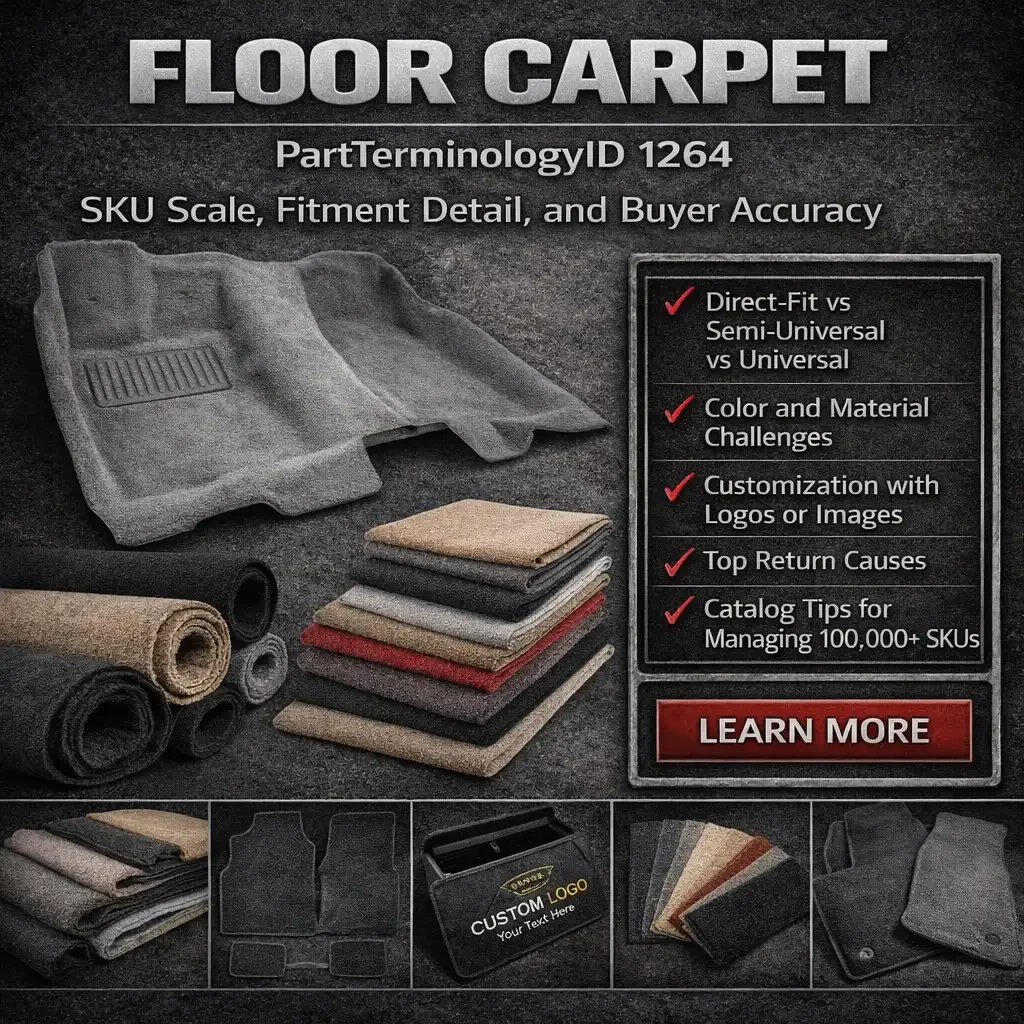
Floor Carpet is one of the biggest part names in the auto industry, and it is one of the easiest places for catalogs to lose control.
This category can explode into massive SKU counts because every variable multiplies the catalog:
Year, make, model
Body style
Cab style
Wheelbase
Drivetrain floor shape
Transmission hump shape
Color
Material
Backing
Pre-cut or molded design
Universal, semi-universal, or direct-fit
Optional heel pad
Optional logo or custom image
Front only, rear only, or full set coverage
That is how teams end up with hundreds of thousands of records, and in large catalogs, well over a million SKU combinations when all options and coverage variants are included.
This is exactly why PartTerminologyID 1264 needs a disciplined PartsAdvisory approach. Floor Carpet is not just a soft trim item. It is a fitment, color, material, and expectation management problem.
This post is built for aftermarket catalog teams, marketplace sellers, and buyers who want fewer mistakes and fewer returns.
Status in New Databases
Status in New Databases
Current: PIES 7.2 + PCdb
Future: PIES 8.0 + PCdb 2.0
Status: No change
What Floor Carpet Means in the Aftermarket
Floor Carpet usually refers to the carpet material or carpet assembly used on the vehicle floor area. In aftermarket reality, this can show up in a few different product forms:
Full molded replacement floor carpet for the passenger cabin
Pre-cut carpet kits for specific areas
Universal carpet rolls or sheets
Semi-universal trim-to-fit carpet pieces
Cargo area carpet pieces or trunk carpet sections
Custom carpet products with color choices and optional branding
This is the first place catalogs go wrong. Buyers often use "floor carpet" to mean different things:
Some mean a full molded replacement carpet like OEM
Some mean carpet floor mats
Some mean trunk carpet
Some mean custom carpet material for a build
Some mean a cut-to-fit interior carpet kit
If the listing title and structured data do not define the product form clearly, buyers will order the wrong type.
Why This Category Creates So Many SKUs
Floor Carpet is a classic SKU multiplier category. A catalog team can start with one vehicle application and quickly create dozens of sellable variations.
Here is what drives the SKU explosion.
Vehicle-specific fitment layers
A carpet for a 2-door coupe is different from a carpet for a 4-door sedan, even in the same model year range. Add trim differences, console layout, and drivetrain tunnel shape, and you already have multiple patterns.
Material options
Customers may choose from:
Cut pile
Loop
Mass-backed carpet
Standard backing
OE-style carpet
Performance or heavy-duty carpet variants
Each material type can create a separate SKU path.
Color options
Interior color is a major purchase driver and a major return driver. A single fitment can be offered in many shades:
Black
Charcoal
Gray
Light gray
Tan
Beige
Saddle
Red
Blue
Custom colors
Even if two colors look close online, buyers treat them as different products.
Coverage options
Some sellers offer:
Front cabin only
Rear section only
Full passenger compartment
Trunk or cargo section
Full interior restoration coverage bundles
This creates more combinations.
Universal and semi-universal offerings
When you add universal and semi-universal lines, the catalog gets wider, not just deeper. These parts are not tied to one strict YMM application, so they need dimensional attributes and use-case content instead of pure fitment records.
Custom branding and personalization
Some carpet products are offered with:
Embroidered logos
Custom text
Printed graphics or images
Fleet branding
That adds a non-fitment attribute layer that still changes the buyable SKU or variant selection.
This is why Floor Carpet can become one of the largest and hardest-to-manage categories in an aftermarket catalog.
Naming Confusion That Causes Buyer Mistakes
Floor Carpet is a broad term, and that creates overlap with nearby categories. This is where bad titles and weak taxonomy create return problems.
Floor Carpet vs Floor Mat
This is the biggest confusion point.
A floor carpet is typically the installed carpet surface or replacement carpet assembly for the cabin floor. A floor mat is a removable accessory that sits on top of the carpet.
Buyers often search "car carpet" when they really want mats, or search "floor mats" and click a carpet listing because the title uses broad keywords.
If your product is replacement carpet, the listing must say that clearly.
Floor Carpet vs Trunk Carpet
Some buyers use "floor carpet" for cargo area carpet. Others mean the front and rear passenger floor. If your SKU is trunk carpet or cargo area carpet, call that out clearly instead of relying on "floor carpet" alone.
Floor Carpet vs Insulation or Underlayment
Some restoration buyers expect jute padding, sound deadener, or insulation to be included. Others expect carpet only.
Package content confusion is common in this category and leads to avoidable returns.
Floor Carpet vs Trim-to-Fit Carpet Roll
A universal carpet roll and a molded direct-fit floor carpet are very different products. If your images are generic and your title is vague, buyers assume the product is pre-shaped when it is not.
Floor Carpet vs Carpet Kit
"Kit" can mean many things:
Carpet only
Carpet plus padding
Carpet plus heel pad
Carpet plus trunk section
Carpet plus hardware
Do not use "kit" unless the contents are clearly listed.
The Three Fit Types You Need to Separate
Your user note is exactly right to call out universal and semi-universal. This category cannot be managed well unless these fit types are separated in both catalog logic and buyer-facing content.
Direct-Fit Floor Carpet
This is the closest to OE-style replacement. It is usually molded or patterned for a specific application.
Best for
Restoration projects
OE-style replacement
Buyers who want a clean factory-like fit
Typical fitment needs
Exact year range
Make and model
Body style
Transmission type or floor hump shape
Seat and console configuration
Drivetrain notes in some platforms
Common issues
Wrong color selected
Wrong floor hump pattern
Wrong cab or body style
Buyer expected padding included
Semi-Universal Floor Carpet
Semi-universal products are designed for a range of vehicles but still require trimming, shaping, or adaptation. This is common in budget and custom install scenarios.
Best for
Value-focused buyers
Older vehicles with limited direct-fit availability
Custom projects
Shops doing interior work
Typical fitment needs
Basic dimensional guidance
Vehicle type compatibility
Trimming instructions
Material and thickness expectations
Common issues
Buyer expected drop-in fit
Product too small for actual floor area
Edges do not finish cleanly without extra work
Installation effort not understood
Universal Floor Carpet
Universal carpet is usually sold by size or roll dimensions and is often used for custom installations, restorations, trunk builds, or specialty applications.
Best for
Custom fabrication
Trunk builds and audio installs
Fleet use
Upholstery and interior shops
Typical fitment needs
Length and width
Material type
Color
Thickness
Backing type
Common issues
Buyer does not measure correctly
Wrong material selected for intended use
Color mismatch
Buyer expects molded shaping
The main catalog rule is simple: never let a universal or semi-universal SKU inherit the same buyer messaging as a direct-fit molded carpet.
Color, Material, and Finish Are Not Small Details
For Floor Carpet, color and material are not cosmetic extras. They are primary fitment-adjacent attributes.
A carpet can physically fit and still be returned because it looks wrong or feels wrong.
Color issues that cause returns
"Gray" looks too dark or too light
"Charcoal" and "black" are treated as interchangeable in the listing
OEM interior names do not match aftermarket color names
Photos are shot under inconsistent lighting
Aged original interior makes the new carpet look off even when the color is technically correct
Material issues that cause returns
Buyer expected cut pile but received loop
Carpet thickness feels too thin
Backing is stiffer or softer than expected
Buyer expected mass backing and received standard backing
The finish does not match the rest of the interior trim level
Practical catalog fix
Your catalog should treat color and material as high-importance attributes, not optional notes buried in a description.
For large catalogs, that means:
Controlled color vocabulary
Standardized material names
Clear product photos in neutral lighting
A visible statement about what is included and what is not
Logos and Custom Image Options
You also called out logo or image, which is important because customization can turn a standard carpet listing into a made-to-order product.
This happens in several aftermarket segments:
Fleet and commercial branding
Dealer-branded interior products
Show cars and custom builds
Personalized interior projects
Where catalogs usually fail on customization
They do not mark the SKU as custom or made-to-order
They do not explain non-returnable policy for customized items
They do not specify embroidery vs print method
They do not provide placement options
They do not define size limits for logo artwork
They do not address trademark restrictions
Catalog attributes that matter for custom carpet programs
If your Floor Carpet line includes logo or image options, add structured fields for:
Customizable yes or no
Custom method (embroidery, printed, patch)
Logo placement area
Artwork file requirements
Color restrictions for artwork
Lead time
Return policy for custom items
Licensing approval required yes or no
This is especially important on marketplaces because buyers assume all variants are quick-ship unless told otherwise.
Top Return Causes in Floor Carpet
Floor Carpet returns are usually not random. They follow the same patterns over and over.
1) Wrong product type
Buyer wanted floor mats but ordered replacement floor carpet, or wanted a molded carpet but ordered universal carpet material.
Prevention
Use product form in the title and bullets
Add a "What this product is" line near the top
Use clear installed vs raw material photos
2) Wrong fitment pattern
The carpet is correct for the model family but wrong for body style, cab style, or transmission hump pattern.
Prevention
Add more than YMM fitment
Include body style and configuration notes
Include fitment exclusions
Show pattern shape callouts when possible
3) Color mismatch
The buyer chooses the right fit but the wrong shade.
Prevention
Use consistent color naming
Add real-world color notes
Include multiple color images or swatches
Tell buyers aged interiors may look different than new carpet
4) Material expectation mismatch
The buyer expected OE-style heavy material and received a thinner universal-grade product.
Prevention
Publish material type and backing
State thickness or grade when available
Do not mix OE-style and universal content language
5) Package content confusion
Buyer expected padding, clips, or insulation.
Prevention
State "carpet only" or list all included components
Repeat package contents in specs and bullets
Add a package contents image if possible
6) Installation effort misunderstood
Buyer thought the carpet would drop in with no trimming or no seat removal.
Prevention
Add installation expectation notes
Mark trim-to-fit products clearly
Note if professional installation is recommended
Compatibility Checklist for Buyers
For Floor Carpet, a Compatibility Checklist is the right choice because fitment and configuration details decide whether the part is usable.
Compatibility Checklist
1) Confirm the exact product type
Full replacement molded floor carpet
Semi-universal trim-to-fit carpet
Universal carpet roll or sheet
Cargo or trunk carpet only
Carpet kit with multiple sections
Do not skip this step.
2) Confirm full vehicle details
Year
Make
Model
Submodel or trim
Body style
For trucks and vans, also confirm:
Cab style
Bed length if it affects cabin floor pattern on that platform
Passenger or cargo configuration where applicable
3) Check floor configuration details
Automatic or manual transmission
Floor shifter or column shifter when relevant
Bench seat or bucket seat
Full console or no console
2WD or 4WD where floor hump shape differs
These details matter more than buyers expect.
4) Verify front, rear, or full coverage
Make sure you know whether the listing covers:
Front only
Rear only
Full cabin
Trunk or cargo section
Additional tunnel or side pieces
5) Confirm color before ordering
Use the listing color name and compare against your interior. If unsure, ask the seller for the closest OEM-style color match.
6) Confirm material and backing
Cut pile or loop
Standard or mass backing
Carpet thickness level if listed
This affects both appearance and feel.
7) Check what is included
Carpet only
Padding included
Heel pad included
Clips or hardware included
Insulation included or not included
8) Review installation expectations
Pre-molded direct-fit
Trim-to-fit required
Professional installation recommended
Adhesive required or not required
9) For universal or semi-universal options, measure first
Measure your available area and compare to product dimensions. A universal carpet that is too small is one of the most common return cases.
10) If adding a logo or image, confirm custom order terms
Proof approval process
Lead time
Non-returnable policy
Artwork format requirements
Catalog Checklist for Attributes and Structured Data
This is the most important section for aftermarket teams because Floor Carpet can become unmanageable without strong structure.
Catalog Checklist for PartTerminologyID 1264 Floor Carpet
Core taxonomy and naming
Terminology Name: Floor Carpet
Product form attribute required: Molded Replacement, Semi-Universal, Universal Material, Carpet Kit, Cargo Carpet
Controlled synonyms for search support only, not title stuffing
Keep Floor Carpet separate from Floor Mat and Cargo Mat categories unless the product is truly combined
Fitment structure for direct-fit products
Year
Make
Model
Submodel
Body style
Cab style
Transmission type
Drivetrain where floor pan differs
Seat configuration
Console configuration
Trim restrictions
Notes for special floor pan variations
Compatibility structure for semi-universal and universal products
Universal fit flag
Vehicle class guidance
Recommended application types
Dimensional compatibility notes
Trimming required flag
Dimensions
Overall length
Overall width
Coverage area
Thickness
Tunnel coverage dimensions where relevant
Roll dimensions for universal carpet
Dimensions should be standardized and searchable.
Material attributes
Carpet type (cut pile, loop, other)
Fiber type if known
Backing type
Mass-backed yes or no
Sound-deadening properties if applicable
Water resistance if applicable
Color attributes
Standardized color family
Manufacturer color name
OEM-style match notes where supported
Swatch image or color reference image
Coverage and package content
Coverage area (front, rear, full, cargo)
Includes padding yes or no
Includes heel pad yes or no
Includes insulation yes or no
Includes hardware yes or no
Piece count
Installation and prep
Trim-to-fit yes or no
Adhesive required yes or no
Professional installation recommended yes or no
Seat removal likely yes or no
Installation instructions included yes or no
Customization fields for logo or image programs
Customizable yes or no
Embroidery or print method
Logo placement area
Artwork upload required
Proof required
Production lead time
Custom order return policy
Licensing restrictions
Return prevention content fields
Product type clarification at top of listing
Color disclaimer
Installation effort note
What is included and not included
Fitment exclusions and pattern notes
Image requirements
Main hero image
Installed view
Pattern or shape view
Color swatch view
Material close-up
Package contents image
Dimension image
Custom logo sample image if customization is offered
For million-SKU categories, structure is not optional. It is the only way to keep marketplaces, webstore filters, and customer service aligned.
Common Buyer Scenarios
Scenario 1: Restoration customer replacing original cabin carpet
The buyer wants an OE-style replacement for an older vehicle. They care about pattern shape, tunnel fit, color, and material type.
What goes wrong:
They order a universal carpet because the title looked broad
They receive the right pattern but wrong color
They expected padding included
What helps:
Clear "Molded Direct-Fit Replacement" wording
Configuration notes in fitment
Material and color clarity
Package content list
Scenario 2: Budget buyer wants a clean interior refresh
The buyer has an older daily driver and wants a better interior but not a full restoration. Semi-universal trim-to-fit carpet is often a good option.
What goes wrong:
They expect drop-in fit
They do not measure first
They are not ready for trimming and install work
What helps:
"Semi-Universal Trim-to-Fit" in the title
Measured dimensions
Installation expectations
Before and after style photos
Scenario 3: Marketplace seller publishes supplier feed without enrichment
The seller loads thousands of SKUs with short names like "Floor Carpet Black" and no material, coverage, or pattern attributes.
What goes wrong:
High click volume with poor conversion
High return rate
Customer service burden increases
Reviews complain about mismatch
What helps:
Enrichment rules before publish
Required fields for color, material, coverage, and product type
Fitment notes beyond YMM
Universal vs direct-fit separation
Scenario 4: Custom shop wants branded carpet with logo
A shop or fleet buyer wants carpet with a logo or image added.
What goes wrong:
They assume same-day ship
They do not know artwork requirements
They expect returns on a custom item
The listing does not show placement area
What helps:
Custom fields in the product setup
Proofing workflow
Lead time visibility
Non-returnable custom policy
Sample image of placement options
Scenario 5: Buyer mixes up floor carpet and mats
This is very common in search and marketplace traffic.
What goes wrong:
Buyer orders replacement carpet thinking it is a removable mat set
Seller ships correctly but still gets a return
What helps:
First line description: "This is replacement floor carpet, not floor mats"
Installed carpet image plus close-up pattern view
Category breadcrumbs and filters that separate mats from carpet
FAQ
Is Floor Carpet the same as floor mats?
No. Floor Carpet usually refers to the carpet installed on the vehicle floor or a replacement carpet product. Floor mats are removable accessories that sit on top of the carpet.
What is the difference between direct-fit, semi-universal, and universal floor carpet?
Direct-fit is molded or patterned for a specific vehicle setup. Semi-universal is made to fit a range of vehicles but usually needs trimming. Universal is sold by dimensions or general application and is often used for custom installs.
Why is color so important for floor carpet?
Because color mismatch is one of the top return reasons. Even if the carpet fits, buyers will return it if the shade looks wrong against seats, trim, and panels.
What causes the most returns in this category?
The biggest return causes are wrong product type, wrong fitment pattern, color mismatch, material mismatch, and unclear package contents.
Do floor carpet listings usually include padding or insulation?
Not always. Some include carpet only. Others include padding, heel pads, or insulation. Always check package contents.
Can I install a direct-fit molded carpet myself?
Some buyers can, but many installs require trim removal, seat removal, and careful fitting. Listings should state whether professional installation is recommended.
If a product says universal fit, does that mean it will look OEM?
Usually no. Universal fit means broad compatibility, not custom fit. Buyers should expect measuring and possible trimming.
Can I add a logo or custom image to floor carpet?
Some product lines support this, usually through embroidery or printing. If customization is offered, confirm artwork requirements, lead time, and return policy before ordering.
How should sellers structure this category to reduce mistakes?
Separate product types first, then build strong attributes for fitment, dimensions, material, color, coverage, and package contents. Floor Carpet needs more structure than a simple title and fitment map.
Final Take for Aftermarket Teams
Floor Carpet (PartTerminologyID 1264) is one of the largest interior categories in the industry because it combines fitment complexity with color, material, and customization choices.
This is exactly the kind of category where weak catalog structure creates expensive problems:
Bad conversion
High returns
Confused buyers
Marketplace listing noise
Customer service overload
The winning approach is practical:
Separate direct-fit, semi-universal, and universal products
Treat color and material as core attributes
Clarify product type at the top of every listing
Publish dimensions and package contents clearly
Build customization fields properly for logo and image programs
Enrich fitment beyond basic YMM for direct-fit carpets
If your team gets Floor Carpet right, you are not just fixing one category. You are building a repeatable catalog discipline that scales across other high-variation interior parts too.