
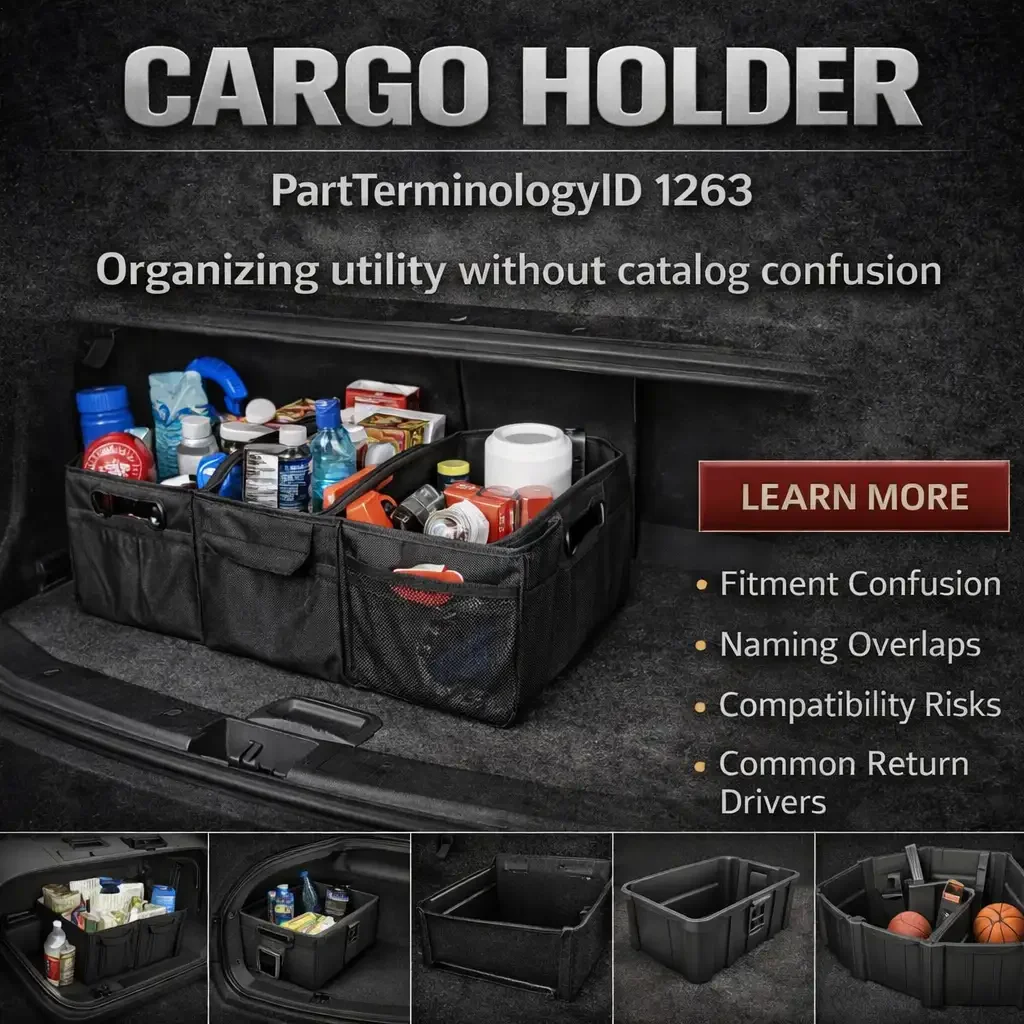
Cargo Holder sounds straightforward, but this is one of those aftermarket categories that gets messy fast.
Teams often treat it as a generic accessory bucket. Buyers search using broad terms like trunk organizer, cargo bin, cargo tray, cargo net, cargo tote, or storage box. Marketplace sellers copy supplier names with little detail. Listings get published with weak attributes and no clear compatibility notes. Then the returns start.
PartTerminologyID 1263 Cargo Holder sits in a category where naming clarity and structured data matter a lot. This is especially true when you sell across marketplaces, where buyers skim photos and titles before they read fitment notes.
This post breaks down what Cargo Holder usually means in aftermarket use, where the naming confusion happens, which variants cause mistakes, and how catalog teams can reduce returns.
Status in New Databases
Status in New Databases
Current: PIES 7.2 + PCdb
Future: PIES 8.0 + PCdb 2.0
Status: No change
What a Cargo Holder Actually Is
A Cargo Holder is an accessory used to keep items stable, separated, or contained in a vehicle cargo area. In practical terms, it helps prevent groceries, tools, emergency gear, and other loose items from sliding around in the trunk or rear cargo area.
Depending on the product design, a cargo holder may be:
A collapsible storage organizer
A fixed or semi-rigid compartment unit
A trunk side storage holder
A cargo area divider style holder
A tie-down compatible holder system
A vehicle-specific molded holder insert
This is where the catalog challenge starts. Buyers think in terms of function, not terminology. They may search for "trunk organizer" while your listing uses "cargo holder." If your content does not bridge those search terms clearly, you lose visibility. If your content is too broad, you attract the wrong buyers.
Why Cargo Holder Gets Confused With Other Parts
Cargo Holder is a broad phrase, and that creates overlap with other accessory categories.
Common naming confusion
Cargo Holder vs Cargo Net
A cargo net restrains items. A cargo holder usually contains or organizes items in compartments or a fixed form. Buyers often use these terms interchangeably even though the products function differently.
Cargo Holder vs Cargo Tray
A cargo tray is usually a floor liner style product for protecting the cargo area surface. A cargo holder is more about organization and containment. Listings often mix these up because both are used in the same area.
Cargo Holder vs Cargo Cover
Cargo cover hides items from view. Cargo holder keeps items organized. Both live in the rear cargo area, so short titles can confuse buyers.
Cargo Holder vs Trunk Organizer
These may refer to the same type of product depending on brand language. This is one of the most common synonym cases and should be handled in product content and tags.
Cargo Holder vs Storage Bin or Tote
Some products are removable bins. Others are vehicle-mounted or shaped for a specific side panel. If the listing does not explain this, buyers assume more flexibility than the product actually offers.
For PartTerminologyID 1263, keep the official naming as Cargo Holder, then support buyer search behavior with clean synonym strategy in titles, bullets, and backend content.
Why This Category Creates Returns
Cargo holders are often seen as low-risk accessories. In reality, they generate avoidable returns for a few predictable reasons.
1) Buyers assume universal fit
Many cargo holders are universal, but many are not. Some are molded, shaped, or sized for a specific vehicle cargo area, side wall, or floor contour. When listings do not clearly say universal or direct fit, buyers guess.
2) Product dimensions are missing or unclear
A cargo holder can technically fit a vehicle but still fail the buyer if it is too tall for the cargo cover, too wide for the trunk opening, or too small to be useful. Dimensions are critical in this category.
3) Mounting method is not explained
Some holders use straps, hook-and-loop pads, anchor points, or tie-down hooks. Others are freestanding. If the listing does not explain mounting, buyers make the wrong assumption about stability.
4) Photos do not show actual capacity
A product might look large in a studio image but hold very little in real use. Buyers then return it because it does not fit their intended load.
5) The listing title overpromises
Titles like "Cargo Holder Organizer Fits Most SUVs and Cars" can drive clicks, but they also drive returns. This category needs precision more than broad claim language.
Variants You Need to Separate in Catalog Data
Cargo Holder is not one single product shape. Strong catalogs separate the common variants instead of lumping everything into one generic content template.
Soft collapsible organizers
These are common for everyday use and usually made of fabric with internal dividers. They may collapse flat when not in use.
Typical buyer expectations:
Lightweight
Portable
Multiple compartments
Grocery friendly
Common return causes:
Too small
Flimsy walls
Slides during driving
No secure mounting
Rigid or semi-rigid cargo holders
These use reinforced panels or molded materials for structure. They are often better for tools and heavier items.
Typical buyer expectations:
Better shape retention
More durability
Less sagging
Common return causes:
Does not fit under cargo cover
Hard shell dimensions too large
Buyer expected collapsible design
Vehicle-specific molded cargo holders
These are shaped for a particular cargo area or side compartment. They usually need tight fitment and clearer notes.
Typical buyer expectations:
OEM style fit
Clean look
Secure placement
Common return causes:
Wrong trim or body style
Floor shape mismatch
Interference with spare tire floor or side trim
Divider style cargo holders
These separate the cargo area into zones, often using adjustable dividers or anchored bars.
Typical buyer expectations:
Keeps cargo from shifting
Flexible layout
Common return causes:
Anchor points not compatible
Buyer expected enclosed compartments
Hardware not included
This is why Cargo Holder content should not be copied from one SKU to another. The product style affects both search language and buyer expectations.
Pros and Cons
Cargo Holder is clearly an accessory category, so adding Pros and Cons helps buyers and reduces mismatched expectations.
Pros
Improves cargo organization
Keeps groceries, tools, cleaning supplies, and emergency gear separated and easier to reach.
Reduces movement during driving
Helps prevent loose items from sliding and tipping over in turns or braking.
Cleaner vehicle interior
Makes the cargo area look more organized and intentional.
Flexible options available
Buyers can choose collapsible, rigid, or vehicle-specific styles based on use.
Useful in daily and work vehicles
Works for commuters, families, field techs, delivery drivers, and road trips.
Cons
Category naming is broad
Buyers may order the wrong type because "cargo holder" can describe many product forms.
Dimensions matter more than buyers expect
A holder that looks right online may be too large, too small, or too tall for the vehicle setup.
Universal products can still perform poorly
A universal fit product may technically fit but slide around or waste space.
Material quality varies widely
Two similar-looking cargo holders can feel completely different in durability.
Mounting expectations cause returns
If a buyer expects straps or anchors and receives a freestanding unit, they often return it.
Buyer Checklist
For Cargo Holder, a Buyer Checklist works best because the purchase decision depends on both compatibility and use case. Fitment matters, but function and size matter just as much.
Buyer Checklist for Cargo Holder
1) Decide what you are storing
Groceries
Tools
Car care products
Emergency kit
Sports gear
Work supplies
This determines whether you need soft compartments, rigid walls, or heavy-duty design.
2) Measure your cargo area
Width
Depth
Height
Space under cargo cover if you use one
Do not rely on photos alone. Dimensions are one of the top return prevention points.
3) Confirm vehicle setup
Sedan trunk, hatchback, wagon, SUV, or crossover
Flat load floor or stepped floor
Third row folded or in use
Cargo cover present or not
4) Check universal vs direct fit
Universal organizer
Vehicle-specific holder
Side compartment fit
Floor contour fit
This should be clearly stated in the listing.
5) Verify mounting method
Freestanding
Tie-down straps
Hook-and-loop base
Anchor point attachment
Side wall mounting
If you need a secure setup for heavier items, this step matters a lot.
6) Check compartment layout
Open bins
Dividers
Lids
Bottle holders
Tool pockets
A product can fit the vehicle and still be wrong for the buyer's actual use.
7) Review material and load expectations
Fabric
Reinforced fabric
Plastic
Composite
Water-resistant materials
Look for realistic use claims instead of generic marketing terms.
8) Confirm folded or collapsed size
If you only use it sometimes, check whether it folds flat and how easy it is to store.
9) Check what is included
Straps
Anchors
Dividers
Lid
Non-slip pads
Package content should be clear.
10) Compare listing photos to real use
Best listings show the product installed and loaded, not just a studio shot.
Catalog Checklist for Attributes and Structured Data
Cargo Holder is a category where structure directly impacts conversion and return rate. A strong catalog tells buyers what the product is, how it works, and whether it fits their use case.
Catalog Checklist for PartTerminologyID 1263 Cargo Holder
Core naming and taxonomy
Terminology Name: Cargo Holder
Controlled synonyms: Trunk Organizer, Cargo Organizer, Cargo Storage Holder, Trunk Storage Organizer
Keep "Cargo Net" and "Cargo Tray" separate unless the product actually combines those features
Fitment and compatibility
Universal or Direct Fit flag
Year, Make, Model for direct fit products
Submodel and body style where needed
Cargo area position (floor, side wall, rear compartment)
Fit notes for third row use or folded seat configuration
Dimensions
Overall width
Overall depth
Overall height
Folded dimensions
Internal compartment dimensions if relevant
Dimensions should be visible and consistent across title, specs, and images.
Product type and design
Organizer style (Soft, Rigid, Semi-rigid, Molded)
Number of compartments
Divider type (Fixed or Adjustable)
Lid or no lid
Collapsible yes or no
Material and finish
Material type
Water-resistant yes or no
Reinforced panel yes or no
Base grip type (non-slip, hook-and-loop, flat base)
Mounting and stability
Freestanding or mounted
Includes straps yes or no
Tie-down compatible yes or no
Anchor hardware included yes or no
Package contents
Main holder
Dividers
Straps
Anchors
Insert trays
Instruction sheet
Buyer-facing return prevention content
Real world storage examples
Weight handling guidance if available
Fits under cargo cover note
Best for sedan trunk or SUV cargo area note
Clear disclaimer if universal fit does not mean custom fit
Visual content requirements
Installed photo in vehicle
Empty interior view
Loaded example photo
Folded and unfolded photo
Dimension callout image
This category performs better when content answers practical questions before the buyer has to ask them.
Common Buyer Scenarios
Scenario 1: Family buyer wants grocery stability
The buyer wants to stop grocery bags from tipping over in an SUV cargo area. They search "cargo holder" but see cargo nets, trays, and organizers mixed together.
A good listing wins by clearly stating:
Organizer type
Compartment count
Dimensions
Non-slip or anchor method
Grocery use example photo
A weak listing loses the sale or creates a return because the buyer receives a small tote instead of a stable organizer.
Scenario 2: Work vehicle user needs tool storage
A contractor or field tech wants a cargo holder for tools and supplies. They need structure and stability, not a lightweight grocery organizer.
If the listing does not call out material strength and mounting method, the buyer may order a soft collapsible model and return it after one week of use.
For this scenario, product style and load expectation must be obvious.
Scenario 3: Buyer wants OEM-looking side cargo storage
Some buyers want a clean interior look and prefer a molded or vehicle-specific cargo holder. They search broad terms and accidentally order a universal fabric organizer.
This happens when marketplace listings are keyword heavy but type-light. Use "Vehicle-Specific Molded Cargo Holder" in content, and include fit notes beyond just YMM.
Scenario 4: Buyer uses a cargo cover and needs low profile storage
This is a very common issue. The buyer wants a cargo holder that fits under an existing cargo cover. If height is not listed, they guess.
The return is almost guaranteed if the holder is too tall. Height and "fits under cargo cover" notes can save the order.
FAQ
Is Cargo Holder the same as a trunk organizer?
Sometimes yes. Many sellers and buyers use those terms interchangeably. In catalog systems, Cargo Holder may be the standardized terminology while "trunk organizer" is a buyer-facing synonym.
Are cargo holders universal?
Some are universal and some are vehicle-specific. Even universal products should include dimensions and mounting details because real-world fit and usability vary by vehicle.
Why do cargo holder listings need dimensions if they are universal?
Because universal fit does not mean ideal fit. Size determines whether the product fits the buyer's cargo area, works under a cargo cover, and holds the intended items.
What causes the most returns for cargo holders?
The top causes are unclear dimensions, wrong product type, missing mounting information, and vague universal fit claims.
Should sellers list Cargo Holder and Cargo Net together?
Only if the product truly combines both functions. If they are separate products, combining them in one listing creates confusion and increases returns.
What is the best image setup for a cargo holder listing?
Use a hero product image, an installed vehicle photo, a loaded use photo, and a dimension image. If collapsible, show folded and unfolded views.
Do vehicle-specific cargo holders need trim-level notes?
Yes. If the shape or mounting depends on interior trim, side panels, or floor configuration, trim notes are important for return prevention.
How can catalog teams improve conversion on Cargo Holder products?
Use controlled naming, clear dimensions, product style attributes, mounting details, and buyer-focused use cases. This category rewards practical content.
Final Take for Aftermarket Teams
Cargo Holder (PartTerminologyID 1263) is a category where broad naming creates hidden risk.
Buyers search by function, but returns happen because listings fail on specificity. The winning approach is simple:
Standardize the terminology
Support common search synonyms
Separate variants by style and use case
Publish dimensions and mounting details clearly
Show real photos that match buyer expectations
If your team treats Cargo Holder like a generic accessory, you will get generic results. If you treat it like a fitment and content discipline problem, you can improve conversion and reduce returns at the same time.