
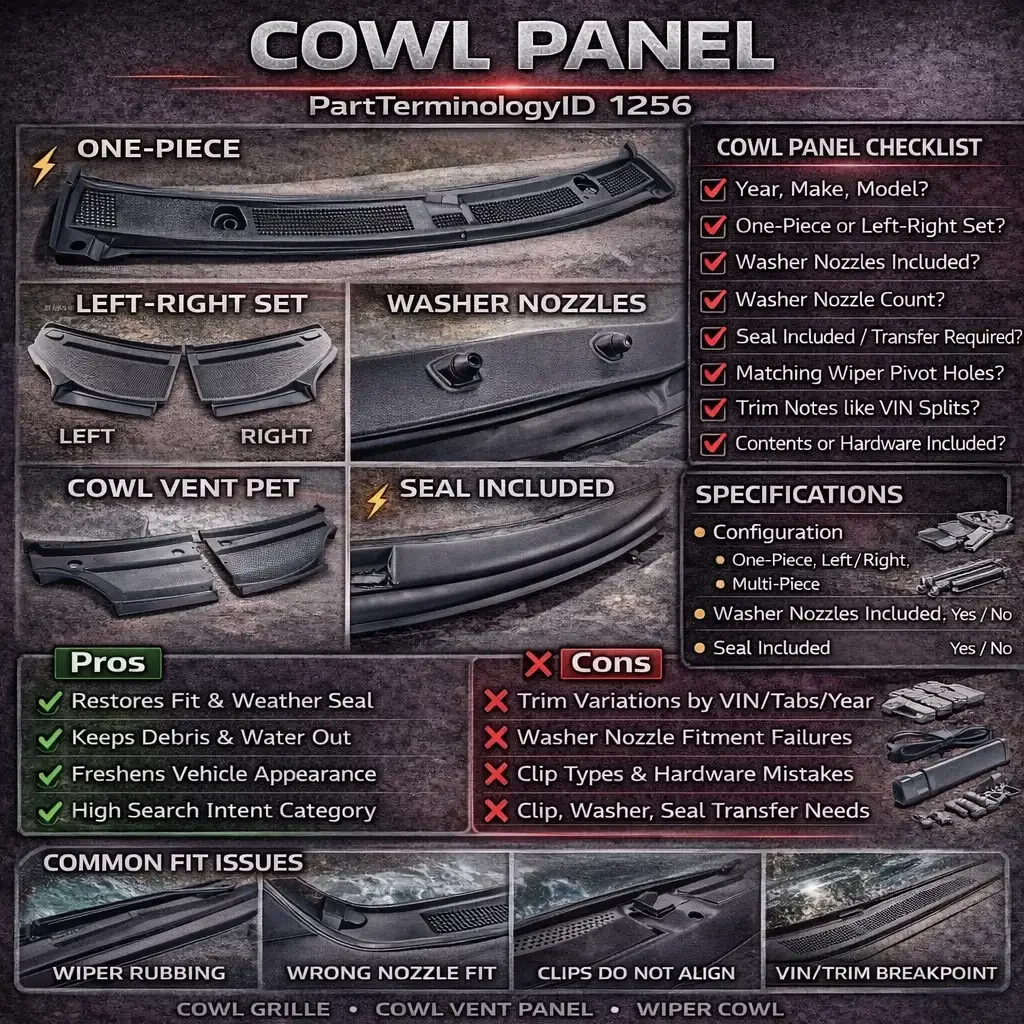
Cowl Panel is a deceptively high-impact body part.
Most buyers do not think about it until it cracks, warps, goes missing, or starts letting water and debris where it should not go. Then it becomes urgent, because the symptoms are annoying and visible:
leaves and water pooling at the base of the windshield
washer nozzles aimed wrong or missing
wiper arms rubbing or not clearing
wind noise or rattling clips
water getting into the HVAC intake area on some vehicles
an ugly, sun-baked panel making the whole front of the car look older
In the aftermarket, Cowl Panel returns are usually not about quality. They are about mismatch. The part is trim-sensitive, configuration-sensitive, and wiper-system-sensitive. Small differences in hole locations, wiper arm clearance, clip layout, or washer nozzle style can turn an otherwise correct listing into an install failure.
That is why PartTerminologyID 1256 needs strong catalog discipline.
This PartsAdvisory post is written for catalog teams and sellers who want fewer wrong orders, fewer “does not fit” claims, and fewer water-leak complaints after installation.
What a Cowl Panel Usually Means
In aftermarket catalog language, Cowl Panel typically refers to the exterior panel at the base of the windshield that covers the cowl area and often serves as a screen or grille for air intake and drainage management.
Depending on vehicle design, the Cowl Panel may also be called:
Cowl Grille Panel
Cowl Vent Panel
Windshield Cowl
Wiper Cowl
Cowl Cover
Some designs include integrated features:
washer nozzles or nozzle openings
a molded grille area for HVAC fresh air intake
seals that interface with the windshield glass
clip points and hinge-style edges that align to fenders or cowl structure
cutouts for wiper arm pivots
rubber lips that reduce water intrusion and wind noise
What it usually is not:
Wiper Arm
Wiper Linkage
Wiper Motor Cover (some vehicles blur this, but most do not)
Hood panel or hood cowl seal by itself
Windshield molding or reveal molding
Under-cowl structural panel (the metal cowl structure)
Your listing should make it obvious that this is the exterior cowl cover at the base of the windshield, not an internal wiper system component.
Why Cowl Panel Creates Catalog Confusion
Cowl Panels fail in catalogs for three consistent reasons: naming overlap, configuration breakpoints, and hardware differences.
1) Naming overlap with “cowl grille” and “cowl vent”
Some catalogs treat these as separate part names. Some suppliers use them interchangeably. Buyers search both ways.
If your listing uses only “Cowl Panel,” buyers searching “cowl grille” may miss it. If your listing uses “cowl grille” only, buyers may confuse it with an interior vent piece. The solution is not to rename the part incorrectly. The solution is to keep the official terminology correct and use buyer-friendly synonyms in the listing copy and metadata.
2) One-piece vs multi-piece designs
Many vehicles use:
a one-piece cowl panel
Others use:left and right panels
a center section and side fillers
separate end caps
separate grille inserts
If your listing does not clearly state the configuration and quantity included, you will get returns.
3) Washer nozzle, wiper pivot, and trim variation
Cowl panels often vary by:
washer nozzle style and placement
number of washer nozzles
nozzle mounting method (snap-in, grommet, integrated)
wiper pivot opening size and position
presence of rain sensor related molding shapes on some designs
hood line and fender contour changes across facelifts
under-hood insulation and seal interfaces
These are not cosmetic differences only. They change whether the panel fits.
Status in New Databases
Status in New Databases
PartTerminologyID: 1256
Terminology Name: Cowl Panel
Current: PIES 7.2 + PCdb
Future: PIES 8.0 + PCdb 2.0
Status: No change
The term remains stable. The return reduction work happens in how you represent configuration, washer nozzle compatibility, position, and included hardware.
The Cowl Panel Variants You Must Separate
This is where catalogs either become reliable or become return factories.
1) One-piece cowl panel
Common on many sedans and crossovers.
Key attributes to capture:
one-piece yes
washer nozzle openings count
wiper pivot openings count
grille style (open grille vs more solid cover depending on model)
Common return trigger:
Buyer receives a one-piece panel but their vehicle uses a multi-piece set, or vice versa.
2) Two-piece left and right cowl panels
Common on trucks, older platforms, and some SUVs.
Key attributes to capture:
position (Left, Right)
sold as single side or pair
end cap or corner trim included yes or no
Common return trigger:
Buyer thinks they are ordering a full set but receives one side.
3) Cowl panel with integrated washer nozzles vs without
Some listings sell:
panel only, reusing existing nozzles
Others include:nozzles pre-installed
Or require:separate nozzle parts
Key attributes to capture:
washer nozzles included yes or no
nozzle type compatible
number of nozzles supported
Common return trigger:
Buyer expects nozzles included, or their nozzles do not transfer cleanly.
4) Cowl panel with integrated seal vs seal sold separately
Some panels come with a bonded rubber lip or foam seal.
Some require separate seal pieces.
Key attributes to capture:
seal included yes or no
seal type (rubber lip, foam, molded)
adhesive-backed seal required yes or no
Common return trigger:
Buyer installs without the correct seal and complains about noise, water, or poor fit.
5) Facelift and trim breakpoints
Cowl panels frequently change at mid-cycle refresh points because hood, fender, and windshield trim change.
Key attributes to capture:
exact year breakpoints
trim notes if provided
VIN split if provided
Common return trigger:
Catalog overextends year range because the vehicle looks similar.
Fitment Realities That Cause Returns
Cowl Panel is a body fitment part, but the failure modes look like functional issues.
Wiper arm clearance
If the cowl panel contour is wrong, wiper arms can:
rub on the panel
sit too high or too low
interfere near the pivot point
contact the panel during operation
Catalog action:
Surface notes for wiper system variations if supplier provides them. Do not ignore “with wide wiper arm base” or similar notes. Those matter.
Washer nozzle alignment
Wrong nozzle openings can cause:
nozzles not seating
spray aiming wrong due to angle mismatch
missing hole or wrong hole count
loose nozzles that leak
Catalog action:
Capture nozzle count and whether nozzles are included. If the supplier specifies nozzle compatibility, keep it visible.
HVAC intake grille differences
Some panels have different grille patterns because the fresh air intake is shaped differently, or because of cabin filter access differences.
Catalog action:
Treat grille pattern differences as real fitment differentiators when supplier data indicates separate part numbers.
Clip and fastener differences
Cowl panels are often retained by:
plastic push clips
screws
hidden clips under weatherstrip
snap tabs near fenders
integrated clip points
Common complaint:
“It fits but it will not clip down” or “gaps at the corners.”
Catalog action:
If hardware is included, say so. If not, say “hardware not included” clearly. Also identify whether corner end caps are included.
Paint and finish expectations
Most cowl panels are black plastic. Some are textured. Some are smoother. Buyers notice.
Catalog action:
Publish finish type: textured black, smooth black, paintable if applicable.
Buyer Checklist for Cowl Panel Orders
This is the checklist that prevents most wrong purchases and supports better installs.
Buyer Checklist
Confirm year, make, model
Confirm whether your vehicle uses a one-piece cowl panel or multi-piece
Confirm position if applicable (Left, Right, Center)
Confirm quantity included (single panel vs set)
Confirm washer nozzle openings and nozzle count
Confirm whether washer nozzles are included
Confirm wiper pivot openings match your vehicle
Confirm whether a seal is included or must be transferred
Confirm finish type (textured vs smooth)
Confirm any trim notes or year breakpoints listed
Plan for clip transfer or replacement if clips are brittle
If a listing does not make these items clear, the buyer is forced to guess.
Catalog Checklist for Structured Data and Attributes
PartTerminologyID 1256 is a great example of why structured attributes matter more than long descriptions.
Catalog Checklist
Use PartTerminologyID 1256 and exact term Cowl Panel
Add searchable synonyms in copy:
Cowl Grille Panel
Cowl Vent Panel
Windshield Cowl
Wiper Cowl
Populate configuration:
One-piece
Two-piece
Multi-piece
Populate position:
Left
Right
Center
Full assembly
Populate quantity included
Populate washer nozzle openings count
Populate washer nozzles included yes or no
Populate seal included yes or no
Populate hardware included yes or no
Populate finish (textured, smooth, paintable)
Populate material (typically plastic)
Add fitment notes for:
VIN split if provided
facelift year breakpoints
wiper system variation notes if provided
trim-specific grille differences if provided
Add a plain-language Contents Included line
Add a plain-language Transfer Required line when needed:
transfer nozzles
transfer clips
transfer seal
A strong QA rule for Cowl Panel listings: if configuration and washer nozzle count are missing, do not publish.
Common Buyer Scenarios and How to Prevent Returns
Scenario 1: Buyer received one side only
They thought they were ordering a full set.
Prevention:
Put “Left only,” “Right only,” or “Set” in the title and first bullet.
Scenario 2: Wrong nozzle hole count
The panel shows one nozzle opening but the vehicle needs two.
Prevention:
Make nozzle count a structured attribute and repeat it in bullets.
Scenario 3: Wipers rub after install
The panel contour is wrong for the trim or year breakpoint.
Prevention:
Do not overextend year ranges. Respect facelift breaks. Include wiper system notes if available.
Scenario 4: Panel does not clip down or gaps at corners
Clip layout or end cap design differs.
Prevention:
Clarify whether corner pieces and end caps are included. Clarify hardware included vs not included.
Scenario 5: Buyer expected nozzles included
They got panel only and feel it is incomplete.
Prevention:
Add a clear contents line: “Panel only. Washer nozzles not included” or “Includes washer nozzles.”
Scenario 6: Water or wind noise after install
Seal was missing, not transferred, or wrong.
Prevention:
State seal included yes or no and add a transfer note if needed.
Scenario 7: Buyer ordered “cowl grille” but wanted a different part
They actually needed windshield molding or a wiper arm.
Prevention:
Add a short clarification line near the top: “Exterior cowl cover at base of windshield.”
Best Practices for Marketplace Titles and Bullets
Cowl Panel is not a keyword-stuffed category. It is a clarity category.
Strong title pattern:
Cowl Panel, One-Piece, With Washer Nozzle Openings, Textured Black
Cowl Panel Left, With Nozzle Hole, Hardware Not Included
Cowl Panel Set, Left and Right, Nozzles Not Included
First bullets should answer:
configuration and position
nozzle hole count and nozzle inclusion
hardware and seal inclusion
That is enough to prevent most wrong clicks.
FAQ
Is a Cowl Panel the same as a cowl grille panel?
Often yes. Many buyers and suppliers use the terms interchangeably. In catalogs, keep the official term as Cowl Panel and use “cowl grille” as a synonym in copy where helpful.
Does the cowl panel include washer nozzles?
Sometimes. Many listings are panel only. Always check the “washer nozzles included” field.
Why do Cowl Panels vary by trim?
Small changes in wiper pivots, nozzle placement, grille pattern, or hood and fender contour can create separate part numbers. These differences matter.
What is the biggest catalog mistake for Cowl Panel?
Publishing a listing without configuration (one-piece vs multi-piece) and without washer nozzle hole count.
Do I need new clips and hardware?
Often you can reuse clips, but many are brittle. If hardware is not included, buyers may need to reuse or purchase new fasteners.
Can the wrong cowl panel cause water issues?
Yes. A poor seal or wrong fit can allow water and debris to enter areas it should not, especially around the HVAC intake zone on some vehicles.
Is Cowl Panel a body part or wiper part?
It is a body exterior trim panel that interfaces with the wiper system openings, but it is not a wiper mechanism part.
Should finish be listed for cowl panels?
Yes. Texture and finish are visible and buyers notice. It also helps avoid “does not match” dissatisfaction.
Final Takeaway for Catalog Teams and Sellers
PartTerminologyID 1256 Cowl Panel is a high-leverage listing category because the part is simple, but the fitment is not.
If you want low returns:
lock down configuration and position
publish nozzle count and nozzle inclusion
respect facelift year breaks
be explicit about seals and hardware
use clear contents and transfer notes
Do that, and Cowl Panel becomes a clean, repeatable category instead of a support headache.