
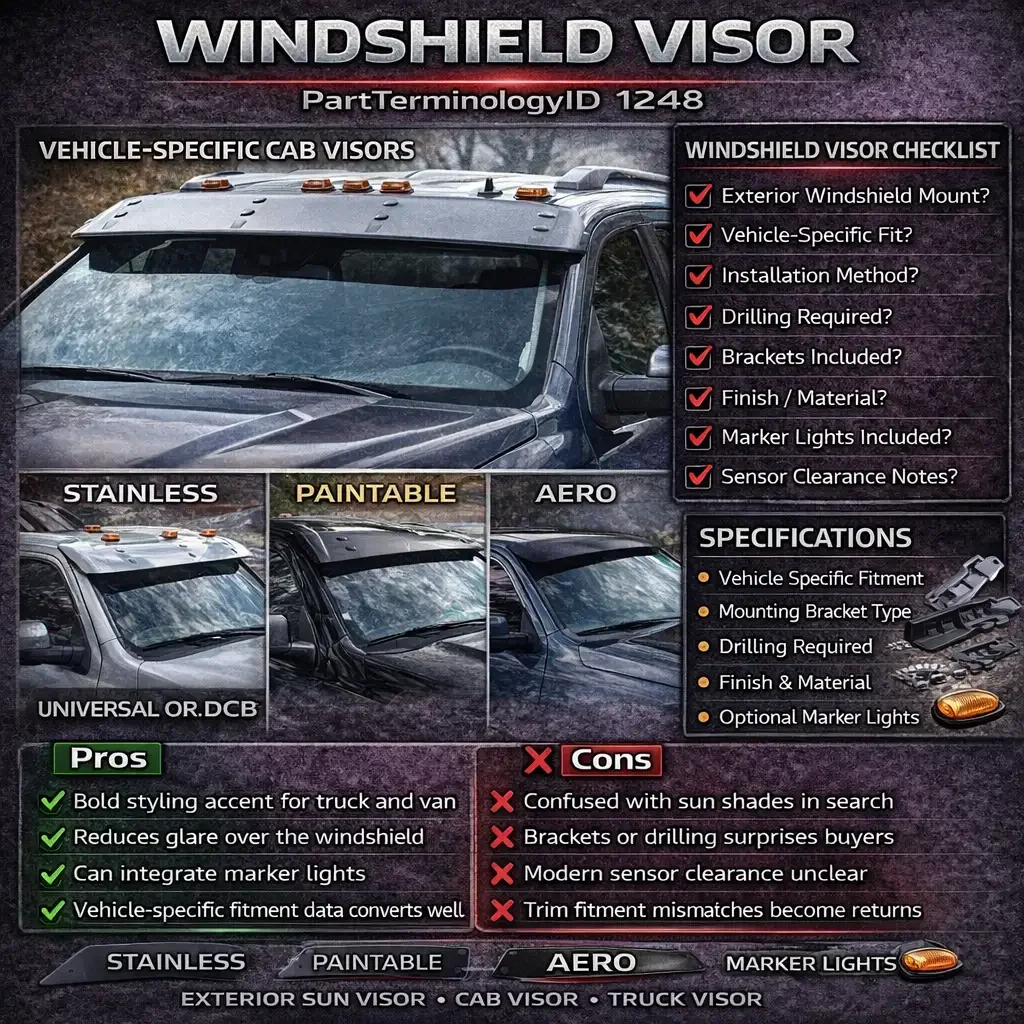
Windshield Visor is one of those accessory terms that causes confusion the second it hits a marketplace search bar.
To a buyer, “windshield visor” might mean:
an exterior cab visor above the windshield on a truck or van
an interior windshield sun shade
a clip-on glare visor extension inside the cabin
a windshield eyebrow spoiler style trim
To a catalog team, PartTerminologyID 1248 Windshield Visor is typically the exterior visor accessory that mounts above the windshield, usually on trucks, vans, and some SUVs, often to reduce glare and add styling.
If your listing does not clarify that immediately, you will get the wrong buyer clicking the wrong product. That leads to fast returns.
Even when the buyer is in the right category, fitment is not simple. These visors are highly vehicle-specific because mounting points, roof contours, door frame shapes, and windshield header areas vary. Brackets and hardware matter. Clearance matters. And in modern vehicles, cameras and sensors around the windshield can change what “fits” means.
This PartsAdvisory guide is built for aftermarket catalog teams and sellers who want to publish Windshield Visor listings that match buyer intent, install correctly, and generate fewer returns.
What Windshield Visor Usually Means
In aftermarket catalog use, Windshield Visor typically refers to an exterior visor that mounts above the windshield, often at the roof header or A-pillar area.
Common product descriptions include:
exterior sun visor
cab visor
truck visor
windshield visor
stainless visor
acrylic visor
Common reasons buyers want one:
reduce sun glare and improve visibility
reduce rain streaking and wind noise in some setups
styling and classic truck appearance
add a mounting area for marker lights on some products
What it usually includes:
visor panel
mounting brackets (varies)
mounting hardware (varies)
instructions (varies)
What it usually does not include:
vehicle body drilling templates beyond basic instructions
electrical harness for marker lights unless noted
paint supplies
replacement windshield trim parts
This category is not the same as:
windshield sun shade panels
interior visor extenders
windshield tint strip film
window rain guards
Those are separate categories and should not be blended into a Windshield Visor listing.
Why Windshield Visor Creates Catalog Confusion
This category has two main problems: naming and fitment.
Naming confusion
“Windshield visor” gets used casually for multiple product types. Marketplace search behavior makes it worse.
If your title and images do not quickly show an exterior visor installed above the windshield, buyers shopping for interior sun shades will click and return.
Fitment confusion
Exterior visors are not universal:
roof contour differs
door frame and A-pillar geometry differs
mounting points differ
mirror and marker light layouts differ
trim packages differ
Many visors require drilling. Some use clamp or bracket systems. If your listing does not make install method clear, buyers may return it as soon as they realize it is not a quick adhesive accessory.
Status in New Databases
Status in New Databases
PartTerminologyID: 1248
Terminology Name: Windshield Visor
Current: PIES 7.2 + PCdb
Future: PIES 8.0 + PCdb 2.0
Status: No change
The term remains stable. The improvement is in clarifying exterior visor classification, vehicle-specific fitment, and installation requirements.
Core Windshield Visor Variants and Why They Need Separate Catalog Handling
This category is not huge like tonneau covers, but it does have meaningful variants that must be separated for clean listings.
1) Vehicle-Specific Cab Visors
These are designed for specific trucks or vans with bracket systems and mounting alignment to the roof header and A-pillars.
Common confusion:
buyer assumes one visor fits multiple body styles
buyer ignores cab type differences (regular cab vs crew cab does not always matter, but roof profile and mounting may)
buyer overlooks model year breakpoints and facelift changes
Catalog details that matter:
vehicle-specific fitment mapping
bracket kit included yes or no
install method
finish and material
marker light integration yes or no
2) Visors With Integrated Marker Lights
Some visors include cutouts or provisions for marker lights.
Common confusion:
buyer expects lights included when visor has light cutouts
buyer expects wiring included
buyer does not want lights but ordered a visor with holes
Catalog details that matter:
marker lights included yes or no
light provisions present yes or no
wiring included yes or no
voltage type if lights included
3) Paintable or Color-Matched Visors
Some visors are sold raw or primer-ready for paint.
Common confusion:
buyer expects gloss black and receives paintable raw surface
buyer assumes paintable means prepped and sanded
Catalog details that matter:
paintable yes or no
finish type
material type
surface prep notes if supplied
4) Stainless or Chrome-Style Visors
Common for classic truck styling.
Common confusion:
buyer expects true stainless and receives chrome-look plastic
buyer expects polished finish but receives brushed
Catalog details that matter:
material
finish (polished, brushed, chrome look)
corrosion resistance claims
5) Aero-Style Visors
Lower profile designs that focus on a cleaner look.
Common confusion:
buyer expects heavy visor depth and gets a slim profile
buyer expects max shade coverage
Catalog details that matter:
profile depth or style note
intended look and coverage note
install method
Pros and Cons for Buyers and Sellers
Windshield Visor is an accessory category, so Pros and Cons helps align expectations.
Pros
Strong styling and functional appeal for truck and van owners
Clear differentiation when installed photos are used
Potential attachment sales with marker lights and wiring kits
Vehicle-specific listings can convert with low return rates when fitment is clear
Cons
High risk of buyer confusion with interior sun shades
Installation complexity and drilling can trigger returns
Trim and roof contour differences create fitment issues
Sensor and camera clearance concerns on newer vehicles can complicate installs
Finish and material expectations can cause returns if not labeled precisely
This category sells best when your listing shows installed photos and clearly states install method.
Fitment and Installation Details That Matter Most
This is where most Windshield Visor returns come from.
1) Mounting method
Windshield Visors are commonly:
bracket mounted with drilling
bracket mounted using existing mounting points on some vehicles
clamp style systems in some product lines
Catalog best practice:
State clearly:
drilling required yes or no
bracket kit included yes or no
hardware included yes or no
2) Roof and A-pillar contour alignment
Even within the same model family, year breakpoints can change roof header geometry.
Catalog best practice:
Do not over-broaden fitment. If the manufacturer lists 2015 to 2018 only, do not extend it to 2019 because “it looks the same.”
3) Door clearance and weatherstrip contact
Some visors sit near the top of the door frame and can create interference if not designed for that vehicle.
Catalog best practice:
Surface any door clearance notes and keep them visible.
4) Marker lights and wiring expectations
If the visor includes lights, buyers need to know what wiring is required.
If it has light cutouts but no lights, buyers need to know that too.
Catalog best practice:
Publish included components clearly.
5) Sensors and cameras on modern vehicles
Many modern vehicles have windshield-mounted sensors, but exterior visors are above the windshield and may not directly interfere. The buyer concern is still real, and some vehicles have camera pods near the windshield header area.
Catalog best practice:
Only use manufacturer guidance. Do not invent “sensor safe” claims. If no data is provided, add a neutral note:
Verify clearance for vehicles equipped with windshield camera or sensor housings.
Keep it practical.
Buyer Checklist for Windshield Visor Orders
Buyer Checklist
Confirm you are buying an exterior windshield visor, not an interior sun shade
Confirm year, make, model, and body style
Confirm whether the visor is vehicle-specific or universal
Confirm installation method and whether drilling is required
Confirm brackets included and hardware included
Confirm finish and material:
stainless
acrylic
paintable
gloss or textured
Confirm whether marker lights are included or only provisions are present
Confirm whether wiring is included if lights are included
Verify clearance if your vehicle has roof accessories or unusual trim
Read all install notes before ordering
This checklist prevents the most common wrong purchases.
Catalog Checklist for Structured Data and Attributes
PartTerminologyID 1248 performs well when the listing has structured clarity.
Catalog Checklist
Use PartTerminologyID 1248 and exact term Windshield Visor
Add required Visor Type attribute:
Exterior Cab Visor
Aero Visor
Populate vehicle-specific fitment or clearly label universal
Populate installation method
Populate drilling required yes or no
Populate brackets included yes or no
Populate hardware included yes or no
Populate material
Populate finish
Populate paintable yes or no
Populate marker lights included yes or no
Populate marker light provisions yes or no
Populate wiring included yes or no
Add a plain-language Contents Included field
Add a plain-language What You May Still Need field
Use images that show:
installed view above windshield
side profile and visor depth
bracket hardware and mounting points
A strong internal QA rule for this category is simple. If install method and bracket inclusion are missing, do not publish.
Common Buyer Scenarios and How to Prevent Returns
Scenario 1: Buyer wanted an interior sun shade
They searched “windshield visor” and clicked your listing.
Prevention: Use installed exterior photos and include “Exterior” in the title and bullets.
Scenario 2: Buyer did not expect drilling
They return the visor before installation.
Prevention: Put “drilling required” or “no drill” clearly in the first bullet.
Scenario 3: Buyer expected marker lights included
They received visor only.
Prevention: Publish marker light included yes or no and list contents clearly.
Scenario 4: Finish mismatch
They expected polished stainless and received paintable black.
Prevention: Put finish and paintable status in the title and use finish-specific photos.
Scenario 5: Wrong year range
Visor does not align with roof contour or mounting points.
Prevention: Keep fitment mapping tight and follow manufacturer year breakpoints.
Scenario 6: Brackets missing or misunderstood
They assumed brackets were included or did not understand they need a separate bracket kit.
Prevention: Put “brackets included” in specs and contents section. If brackets sold separately, say it clearly.
Scenario 7: Clearance concern with camera pod or roof accessories
They are unsure and return it.
Prevention: Add a practical clearance note and show installed photos on the same vehicle generation when possible.
Naming Best Practices for Listings
In the catalog record
Use the exact term:
Windshield Visor
In listing titles
Add the clarifier buyers need:
Exterior Windshield Visor Cab Visor
Then add finish and key install info:Exterior Windshield Visor, Stainless, Brackets Included
Exterior Windshield Visor, Paintable, Drilling Required
This prevents confusion with interior products.
In product descriptions
Add one expectation-setting line near the top:
“This listing is for an exterior Windshield Visor that mounts above the windshield. Please confirm vehicle fitment, bracket inclusion, and drilling requirements before ordering.”
That line prevents a lot of wrong-intent orders.
FAQ
Is a Windshield Visor the same as a windshield sun shade?
No. Windshield Visor is typically an exterior visor mounted above the windshield. A sun shade is an interior panel or shade.
Do Windshield Visors require drilling?
Some do and some do not. Many vehicle-specific visors use brackets and may require drilling. The listing should state this clearly.
Are Windshield Visors universal?
Most are vehicle-specific. Universal options exist but often require custom fitting. Always verify fitment.
Do Windshield Visors include marker lights?
Some include lights, some have provisions, and some include neither. Always check the contents section.
What is the biggest catalog mistake in this category?
Not clarifying that it is an exterior visor and not stating installation method and bracket inclusion.
Will it interfere with windshield sensors or cameras?
It depends on the vehicle and design. Follow manufacturer guidance and verify clearance if your vehicle has windshield camera housings near the header area.
What attributes matter most for Windshield Visor?
Vehicle fitment, install method, drilling required, brackets included, finish, and marker light inclusion are the key fields.
Why do returns happen so often here?
Most returns are caused by wrong buyer intent, drilling surprises, or fitment mismatch from year-range overreach.
Final Takeaway for Catalog Teams and Sellers
PartTerminologyID 1248 Windshield Visor is a great example of a category where a generic name creates wrong clicks.
The listings that win do three things:
clearly show it is an exterior visor
clearly explain install method and bracket inclusion
keep fitment mapping tight to the correct vehicle generation
Do that, and Windshield Visor becomes a clean accessory category instead of a return magnet.