
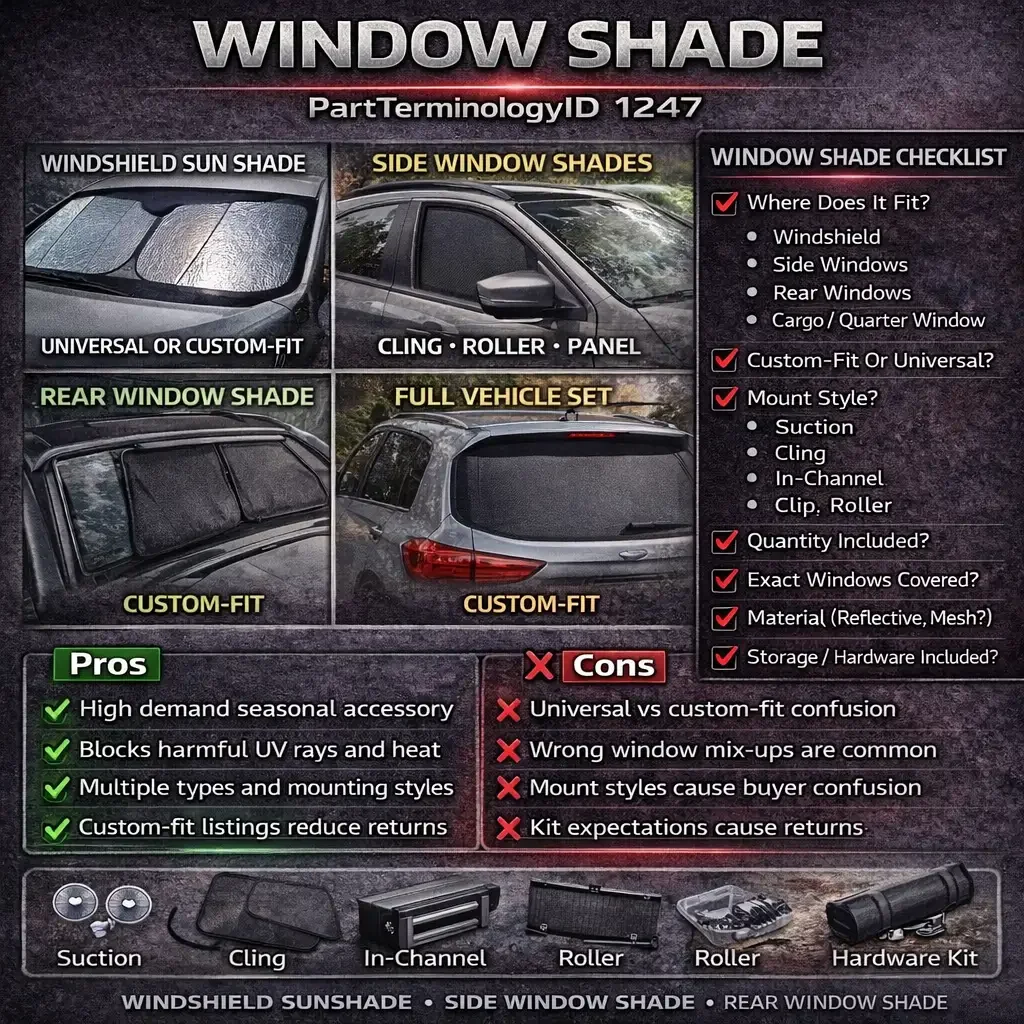
Window Shade is a deceptively broad accessory category.
Buyers search it in a hurry because the pain is immediate. The vehicle is hot. The sun is brutal. The kids are in the back seat. The interior is fading. The buyer wants a quick solution.
That means conversion can be strong. It also means returns can spike when the listing is vague.
PartTerminologyID 1247 becomes return-prone for one main reason: Window Shade is not one product type. The term covers multiple designs with completely different fit expectations:
windshield sun shades
side window shades
rear window shades
full set kits
retractable or roller style shades
suction cup shades
in-channel custom-fit shades
mesh shades
reflective fold-up shades
If your catalog does not clearly define which shade type is being sold, buyers assume it fits their need and then it arrives and does not match their window, does not cover enough glass, blocks sensors, or does not mount the way they expected.
This PartsAdvisory guide is built for aftermarket catalog teams and marketplace sellers who want to classify Window Shade products correctly, publish the right fitment and coverage data, and reduce avoidable returns.
What a Window Shade Usually Means
In aftermarket catalog use, Window Shade generally refers to an interior shade accessory designed to block sunlight, reduce cabin heat, add privacy, and protect interior materials from UV exposure.
Window Shade products may be targeted for:
windshield
front side windows
rear side windows
rear window
cargo area windows on SUVs
van side windows
complete vehicle sets
They may be designed for:
temporary daily use
long-term semi-permanent mounting
child passenger comfort
privacy coverage
UV and heat reduction
Window Shade is usually not:
window tint film
exterior car cover
windshield visor strip
window rain guards
exterior shades that attach outside the glass (unless clearly marketed as such)
Because buyers search broadly, your listing needs to clarify what window location and mounting style the product supports.
Why Window Shade Creates Catalog Confusion
Window Shade has three recurring confusion zones.
1) Window location confusion
Many returns happen because the buyer orders:
a windshield shade expecting a side window shade
a rear side window kit expecting a full set
a rear window shade expecting cargo area coverage
The name Window Shade does not tell the buyer the window location. The listing must.
2) Universal vs custom-fit confusion
Some shades are universal and rely on suction cups or adjustable dimensions. Others are custom-fit for a specific vehicle and window shape.
Buyers strongly prefer custom-fit for clean coverage. But many listings use “custom” as marketing language when the product is not truly vehicle-specific.
If the listing does not clearly state whether it is universal or custom-fit, returns follow.
3) Mount style confusion
Mount style drives buyer satisfaction.
A buyer who hates suction cups will return a suction cup shade even if it technically works. A buyer who needs a quick removable shade may return an in-channel shade that installs more like a semi-permanent accessory.
Mount style must be visible in both attributes and copy.
Status in New Databases
Status in New Databases
PartTerminologyID: 1247
Terminology Name: Window Shade
Current: PIES 7.2 + PCdb
Future: PIES 8.0 + PCdb 2.0
Status: No change
The term remains stable. The main catalog value is in clearly describing shade location, fit type, and mounting method.
Core Window Shade Types and Why They Need Separate Catalog Handling
This is the category split that prevents the most returns.
1) Windshield Sun Shades
These are designed to block sunlight through the windshield and reduce heat load in the cabin.
Common styles:
fold-up reflective panels
accordion fold shades
roll-up shades
custom-fit rigid or semi-rigid shapes
Common confusion:
buyer expects full windshield coverage but the shade is smaller
buyer expects a custom-fit contour but receives a universal rectangle
buyer expects a storage bag and it is not included
Catalog details that matter:
windshield application
universal vs custom-fit
shade dimensions or coverage notes
fold type
reflective vs mesh
storage included yes or no
2) Side Window Shades
These are common for rear passengers, kids, and privacy use.
Common styles:
suction cup mesh shades
static cling shades
in-channel frame shades that press into window trim
roller shades that attach to glass or door trim
Common confusion:
buyer expects rear side windows but orders front
buyer expects both sides but receives one
buyer expects in-channel custom-fit and receives suction cup universal
buyer expects legal visibility compliance for driving and receives a shade not intended for use while driving
Catalog details that matter:
window position (front side, rear side, rear quarter)
left and right quantity
mount style
custom-fit vs universal
intended use notes (parked vs driving) if supplied
3) Rear Window Shades
These target rear glass on sedans, hatchbacks, and SUVs.
Common styles:
suction or cling style shades
rear roller shades
custom-fit interior panel shades
Common confusion:
buyer expects SUV rear hatch glass but orders a sedan rear window shade
buyer expects full coverage but the shade is a partial coverage style
Catalog details that matter:
rear window application
vehicle body style notes if relevant
coverage size or custom-fit classification
mount style
4) Full Set Kits
These kits may include multiple shade pieces for a vehicle.
Common confusion:
buyer expects full set but the kit covers only rear windows
buyer expects windshield included but it is not
buyer expects all shades match the same material but kit includes mixed styles
Catalog details that matter:
kit scope (which windows are covered)
quantity included
window positions included
match set design notes
5) Retractable and Roller Shades
These often appeal to buyers wanting a cleaner installed look.
Common confusion:
buyer expects OE-style integrated roller function but product is an add-on
buyer does not understand install complexity
buyer expects no tools but the kit needs mounting clips or drilling
Catalog details that matter:
retractable yes or no
install method
hardware included
semi-permanent vs removable design
Pros and Cons for Buyers and Sellers
Window Shade is a pure accessory category, so this section helps reduce expectation gaps.
Pros
High search demand and impulse conversion potential
Strong seasonal sales patterns
Low shipping complexity compared to bulky exterior accessories
Easy attachment category with interior protection products
Clear product type listings can reduce returns significantly
Cons
Universal vs custom-fit confusion is common
Coverage expectation mismatch drives returns
Mount style preference mismatch drives returns
Kits often cause misunderstanding about included windows
Some buyers expect shades to be legal for use while driving in all positions, which varies by product intent and local rules
This category sells best when you are very explicit about what windows are covered and how the shade mounts.
Coverage and Fitment Details That Matter Most
Window Shade is less about vehicle mechanical fitment and more about coverage fitment.
1) Custom-fit vs universal
If the shade is custom-fit, call it out clearly and use vehicle-specific fitment mapping.
If the shade is universal, avoid language that implies precise contour fit.
2) Dimensions and coverage
For universal shades, publish dimensions or a clear size note.
For custom-fit shades, clarify that coverage follows the vehicle glass contour.
3) Quantity included
This is a major return trigger.
Make it obvious whether the buyer receives:
one shade
a pair for left and right
a full set
rear windows only set
4) Mount style and removability
The same buyer who wants quick removal will hate in-channel inserts. The buyer who wants clean look will hate suction cups.
Mount style should be visible:
suction
static cling
in-channel press-fit frame
clips
roller hardware
5) Sensor and visibility considerations
Some modern vehicles have windshield sensors, rear cameras, and visibility features.
For windshield shades, some buyers want cutouts for mirror mounts or sensor areas, or they simply want the shade to sit flat.
Catalog best practice:
If the manufacturer provides sensor or mirror fit notes, include them.
Do not invent claims.
Buyer Checklist for Window Shade Orders
This is the checklist that prevents the most wrong purchases.
Buyer Checklist
Confirm which window you are shading:
windshield
front side windows
rear side windows
rear window
cargo or quarter windows
Confirm whether the product is custom-fit for your vehicle or universal
Confirm the mount style (suction, cling, in-channel, roller, clips)
Confirm quantity included (one, pair, full kit)
Confirm which windows are included if buying a kit
Confirm material type:
reflective
mesh
privacy shade
Confirm storage method and whether a storage bag is included
If installing semi-permanent roller shades, confirm installation requirements and hardware
Confirm any mirror or sensor fit notes for windshield shades
Read the intended use notes if provided (parked use versus driving use)
Catalog Checklist for Structured Data and Attributes
PartTerminologyID 1247 is a structured-data driven category. Buyers filter by window location and mount style more than by brand.
Catalog Checklist
Use PartTerminologyID 1247 and exact term Window Shade
Add required Window Location attribute:
Windshield
Front Side
Rear Side
Rear Window
Quarter/Cargo
Full Set
Add required Fit Type attribute:
Custom-Fit Vehicle Specific
Universal
Add required Mount Style attribute:
Suction
Static Cling
In-Channel Press Fit
Roller Retractable
Clip Mount
Populate quantity included
Populate kit coverage list in plain language for kits
Populate shade material (reflective, mesh, privacy)
Populate color when applicable
Populate dimensions for universal shades
Populate storage included yes or no
Populate hardware included yes or no for roller or clip systems
Add mirror or sensor cutout notes when supplied
Use images that clearly show mounting style and coverage area
A strong internal QA rule for Window Shade is simple. If window location, mount style, and quantity included are missing, the listing should not publish.
Common Buyer Scenarios and How to Prevent Returns
Scenario 1: Buyer ordered a windshield shade expecting side shades
They searched “window shade” and clicked the first listing.
Prevention: Put window location in the title and first bullet.
Scenario 2: Buyer expected custom-fit coverage and received universal
The listing used “custom” as marketing language without vehicle-specific fitment.
Prevention: Use explicit fit type fields and do not blur universal and custom-fit language.
Scenario 3: Buyer expected a pair but received one
Listing photos show both windows covered.
Prevention: Make quantity included visible in title or bullet and in attributes.
Scenario 4: Buyer expected a full set
They received rear side shades only.
Prevention: List the exact windows covered in a plain language kit coverage line.
Scenario 5: Suction cups do not work well on their glass
They dislike the mount style.
Prevention: Put mount style in the first bullet and show a close-up photo of the mounting method.
Scenario 6: Shade interferes with mirror or sensors
The buyer wants a cutout design.
Prevention: Include mirror and sensor fit notes when supplied and show product photos that confirm shape.
Scenario 7: Buyer expected a retractable shade but received a fold-up panel
The product family name used “shade” broadly.
Prevention: Add a shade type field and use it in titles: fold-up, roll-up, retractable.
Naming Best Practices for Listings
In the catalog record
Use the exact term:
Window Shade
In listing titles
Add the three decision fields:
window location
fit type
mount style
Examples:
Window Shade Windshield Custom-Fit Reflective
Window Shade Rear Side Windows Pair In-Channel
Window Shade Side Window Universal Mesh Suction Mount
Window Shade Full Set Rear Windows Kit Static Cling
This immediately reduces wrong purchases.
In product descriptions
Use one clear expectation-setting line near the top:
“This listing is for the window shade set described below. Please confirm window location, mount style, and quantity included before ordering.”
That line prevents the most common buyer mistakes.
FAQ
Is a window shade the same as window tint?
No. Window shade is a removable or semi-permanent accessory. Tint film is a different product category and installation type.
Are window shades vehicle-specific?
Some are custom-fit, some are universal. The listing should clearly state which.
What is the biggest catalog mistake in this category?
Publishing a listing without window location and mount style. Quantity included is the next most common missing detail.
Do side window shades come as a pair?
Often they do, but not always. Always confirm quantity included.
Are suction mount shades safe to use while driving?
It depends on the product and intended use. Many are designed for parked use or rear passenger use. Follow the manufacturer guidance and local rules.
Do windshield shades fit around mirrors and sensors?
Some do and some do not. Custom-fit windshield shades may include cutouts or contours, but the listing should state this clearly.
What attributes matter most for window shade listings?
Window location, fit type, mount style, and quantity included are the most important.
Why do returns happen so often on window shades?
Most returns are due to expectation mismatch: wrong window location, wrong mount style, or coverage smaller than expected.
Final Takeaway for Catalog Teams and Sellers
PartTerminologyID 1247 Window Shade is a strong accessory category when you treat it like a structured choice, not a generic product.
The winning listings make three things obvious:
which window the shade is for
how it mounts
what quantity and coverage the buyer will receive
Do that consistently, and Window Shade becomes a low-support, high-conversion category.