
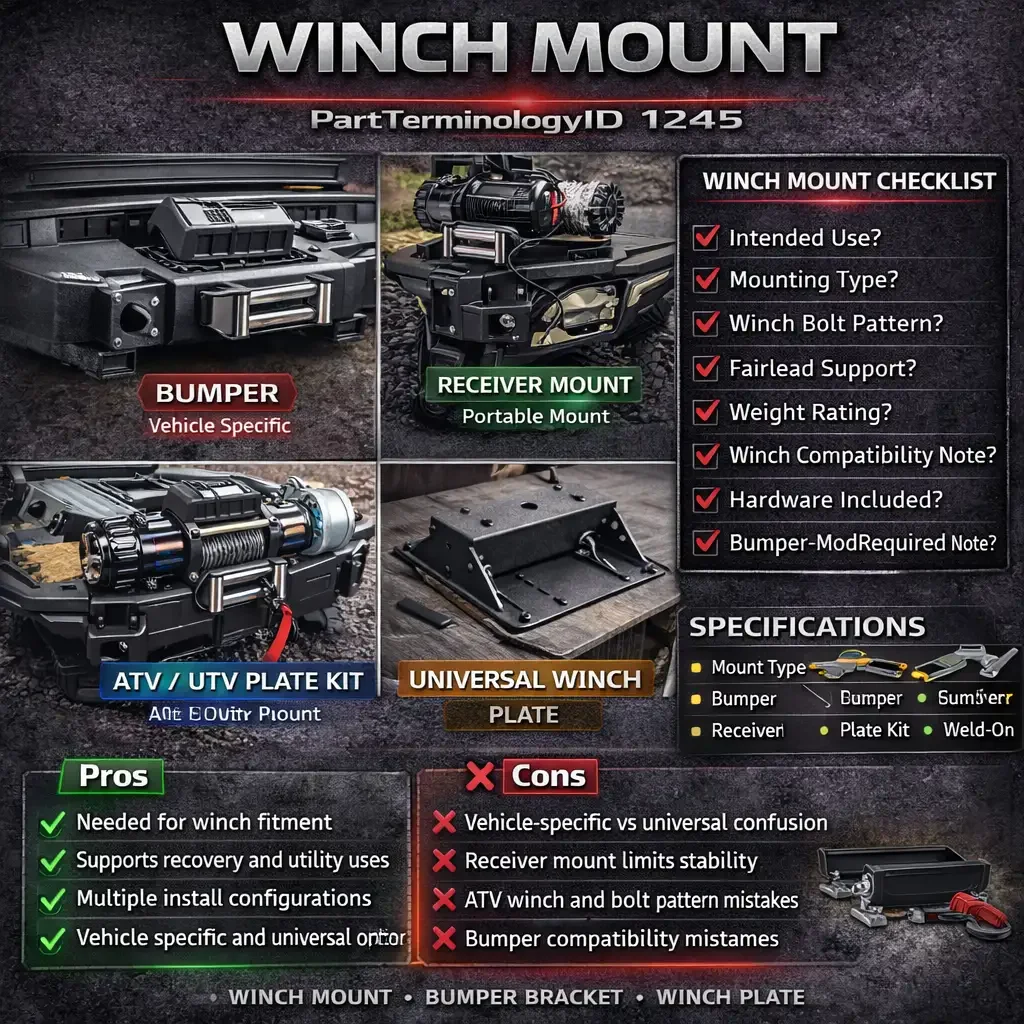
Winch Mount is the part that determines whether a winch install is possible at all.
In the aftermarket, buyers often do this in the wrong order. They buy the winch first, then scramble to find a mount that fits their vehicle and bumper. Or they buy a mount that looks right, then realize their winch bolt pattern does not match. Or they buy a receiver mount expecting a stable bumper-style setup and get disappointed.
That is why PartTerminologyID 1245 is a return-prone category when catalog data is thin.
Winch mounts are not universal, even when sellers try to market them that way. The mount has to match:
the vehicle mounting points or bumper design
the winch footprint and bolt pattern
the fairlead opening and mounting spacing
the control box placement and clearance
the intended use and stability expectations
When listings do not answer those questions clearly, buyers guess. When buyers guess, installs fail and returns follow.
This PartsAdvisory guide is built for aftermarket catalog teams and sellers who want to classify Winch Mount products correctly, publish the right fitment and compatibility attributes, and reduce avoidable returns.
What a Winch Mount Usually Means
In aftermarket catalog use, Winch Mount typically refers to the mounting structure that supports a winch and positions it correctly for use.
It may be sold as:
a winch mount plate
a bumper-integrated winch mount solution
a receiver-mounted portable winch tray
an ATV/UTV mount plate kit
a vehicle-specific bracket system
It usually does not include:
the winch itself
the fairlead (varies by kit)
the control box relocation kit (varies)
wiring and quick disconnect kit (varies)
recovery accessories like shackles and straps
This category also gets mixed up with:
Winch (PartTerminologyID 1240)
Bumper (winch-ready bumper categories)
Bumper brackets
Receiver hitch accessories
Universal mounting plates that are not vehicle specific
Your catalog needs to clearly distinguish Winch Mount from Winch, and then clarify what mount type it is.
Why Winch Mount Creates Catalog Confusion
Winch Mount is a space conflict and bolt pattern category.
Naming confusion
Supplier feeds may call similar products:
Winch Mount
Winch Plate
Winch Tray
Winch Carrier
Winch Mounting Bracket
Winch Mount Bumper Plate
If you do not normalize these into a consistent product taxonomy, buyers will not know what they are ordering.
Vehicle-specific vs universal confusion
This is the biggest issue.
Some Winch Mounts are vehicle-specific. They bolt to factory frame points or are designed for a specific bumper model.
Some Winch Mounts are universal plates. They require fabrication or drilling to fit the vehicle or bumper.
Some are receiver mount trays intended for portability, not permanent heavy recovery.
If your listing does not clearly state which one it is, buyers will assume it fits their truck and be wrong.
Winch bolt pattern confusion
Winches have mounting footprints and bolt patterns. If the mount does not match the winch, the install fails even if the mount fits the vehicle.
Fairlead opening confusion
A winch mount plate needs the correct fairlead opening and mounting spacing.
If the mount is not designed for the fairlead type or spacing the buyer has, the install becomes a modification project.
Status in New Databases
Status in New Databases
PartTerminologyID: 1245
Terminology Name: Winch Mount
Current: PIES 7.2 + PCdb
Future: PIES 8.0 + PCdb 2.0
Status: No change
The term remains stable. The real improvement is in publishing the mount type, compatibility, bolt pattern support, and clearance notes consistently.
Core Winch Mount Types and Why They Need Separate Catalog Handling
If you treat all Winch Mounts as one product type, buyers will compare apples to oranges. This category must be split by mount style.
1) Vehicle-Specific Bumper Mount Systems
These are designed for a specific vehicle and usually integrate with a winch-ready bumper or dedicated mounting structure.
Common features:
vehicle-specific mounting points
strong stability for recovery use
designed for proper fairlead positioning
often supports common recovery winch sizes
Common confusion:
buyer assumes it fits any bumper for that vehicle
buyer does not check control box clearance
buyer does not check winch footprint compatibility
Catalog details that matter:
vehicle-specific designation
compatible bumper models if applicable
mounting points and required hardware
winch bolt pattern support
fairlead compatibility
control box placement notes
2) Standalone Winch Mount Plates
These are plates that mount behind a bumper or on a vehicle structure to support a winch.
Common features:
may be vehicle-specific or semi-universal
positions winch behind bumper opening
often requires fairlead opening alignment
some require drilling
Common confusion:
buyer assumes no drilling
buyer assumes plate is compatible with all winch sizes
buyer expects fairlead included
Catalog details that matter:
vehicle-specific vs universal classification
drilling required yes or no
winch bolt pattern compatibility
winch size class supported
fairlead opening and mounting spacing
hardware included
3) Receiver-Mounted Winch Trays
These are portable mounts that slide into a receiver hitch.
Common features:
portability across vehicles
useful for utility and occasional recovery scenarios
may support front or rear receiver use depending on vehicle setup
Common confusion:
buyer expects bumper-mount stability and permanent mount behavior
buyer assumes receiver size compatibility without checking
buyer assumes quick disconnect wiring is included
Catalog details that matter:
receiver size compatibility (2 inch vs other)
intended use note (portable mount)
winch bolt pattern support
fairlead support
wiring kit included yes or no
load and stability notes when provided
4) ATV and UTV Mount Kits
These are smaller mounts designed for powersports platforms.
Common features:
platform-specific mount geometry
designed around ATV/UTV frames
often paired with smaller winch ratings
Common confusion:
buyer buys a universal plate that does not fit their ATV
buyer does not match bolt pattern
buyer assumes one kit fits all trim packages
Catalog details that matter:
ATV/UTV classification
vehicle-specific fitment notes
bolt pattern compatibility
included hardware
fairlead and opening compatibility
5) Universal Fabrication Plates
These are generic plates intended for custom builds.
Common features:
requires drilling, welding, or fabrication
used for custom bumpers and rigs
often sold with minimal fitment claims
Common confusion:
buyer expects vehicle-specific bolt-on
buyer assumes included hardware and instructions are complete
Catalog details that matter:
universal fabrication classification
drilling required yes
intended for custom applications note
bolt pattern support
plate thickness and material
Pros and Cons for Buyers and Sellers
Winch Mount is an accessory category, so a Pros and Cons section helps set expectations and reduce returns.
Pros
Required category for winch installation and compatibility
Strong attachment sales with winches, fairleads, wiring kits, and bumpers
Vehicle-specific mounts can convert well with low return rates when data is clear
Receiver mounts offer portable value for some buyers
Premium mounts support higher margins when positioned correctly
Cons
Vehicle-specific vs universal confusion creates high return risk
Bolt pattern mismatch causes install failure
Fairlead opening mismatch causes install failure
Control box clearance issues cause install surprises
Receiver mounts can create stability expectation complaints if marketed like bumper mounts
This category needs clarity more than hype.
The Four Critical Compatibility Dimensions
Winch Mount listings should always answer these four questions.
1) Vehicle fitment or bumper compatibility
Does the mount bolt to a specific vehicle, or does it require custom work?
If vehicle-specific:
list supported vehicles clearly
list compatible bumpers or mounting systems if required
If universal:
clearly state that fabrication or drilling may be required
2) Winch bolt pattern and footprint support
The mount must match the winch mounting footprint.
Best practice:
publish the supported bolt pattern
publish the supported winch size class if the supplier provides it
3) Fairlead compatibility and opening position
Winch mounts must align the fairlead correctly.
Best practice:
publish fairlead type compatibility
publish fairlead mounting spacing if available
confirm whether fairlead is included
4) Control box and clearance details
Modern winches often have integrated control packs.
Best practice:
state whether the mount supports integrated control box placement
include notes about relocation requirements if provided
note whether additional relocation kits may be required depending on bumper setup
This is a major source of post-sale frustration.
Compatibility Checklist for Winch Mount Buyers
This checklist belongs high on the page because it prevents the most common wrong orders.
Compatibility Checklist
Confirm the product is a Winch Mount and not a winch
Confirm your intended setup:
bumper mount
mount plate behind bumper
receiver mount tray
ATV/UTV mount kit
custom fabrication plate
Confirm vehicle-specific fitment or custom work requirements
Confirm receiver size if buying a receiver mount tray
Confirm winch bolt pattern compatibility
Confirm the mount supports your winch size class
Confirm fairlead type compatibility and mounting spacing
Confirm whether fairlead is included
Confirm control box clearance and whether relocation is required
Confirm hardware included
Confirm finish and corrosion resistance for exposed mounts
Read all install notes before ordering
If the listing does not provide enough detail to complete this checklist, the listing is not ready to publish.
Catalog Checklist for Structured Data and Attributes
PartTerminologyID 1245 is a structured-data heavy category. These are the fields that reduce returns.
Catalog Checklist
Use PartTerminologyID 1245 and exact term Winch Mount
Add required Mount Type attribute:
Vehicle-Specific Bumper Mount
Winch Mount Plate
Receiver Winch Tray
ATV/UTV Mount Kit
Universal Fabrication Plate
Populate vehicle fitment or add a clear universal custom application note
Populate receiver size for receiver trays
Populate winch bolt pattern supported
Populate supported winch size class if supplied
Populate plate thickness and material if supplied
Populate finish and corrosion coating
Populate fairlead compatibility
Populate fairlead included yes or no
Populate control box compatibility and relocation note if supplied
Populate hardware included yes or no
Add plain language Contents Included
Add plain language What You May Still Need
Use images that show the mount hole pattern and fairlead opening clearly
Use at least one installed-view image when possible
A strong internal QA rule for Winch Mount is simple. If mount type and bolt pattern support are missing, do not publish.
Common Buyer Scenarios and How to Prevent Returns
Scenario 1: Buyer thought the mount was universal bolt-on
They bought a universal plate expecting a no-drill install.
Prevention: Clearly label universal fabrication vs vehicle-specific bolt-on in the title and first bullets.
Scenario 2: Winch bolt pattern does not match the mount
They bought a mount that fits their vehicle, but their winch footprint does not match.
Prevention: Publish winch bolt pattern compatibility clearly and do not hide it in a PDF link.
Scenario 3: Fairlead opening does not align with bumper
The mount fits the vehicle but the fairlead position does not match the bumper opening.
Prevention: Add fairlead opening alignment notes and show installed-view images.
Scenario 4: Control box cannot be installed as expected
The winch control pack hits the grille or bumper structure.
Prevention: State whether the mount supports integrated control box placement and whether relocation may be required.
Scenario 5: Buyer ordered a receiver winch tray expecting bumper stability
They expected a permanent recovery mount.
Prevention: Clearly describe receiver trays as portable mounts and set stability expectations.
Scenario 6: Buyer expected fairlead included
The photos show a fairlead, but the mount is plate only.
Prevention: Include fairlead included yes or no line in the bullets and contents list.
Scenario 7: Buyer expected hardware included
The mount shipped without installation hardware.
Prevention: Clearly state hardware included or not included and list what is in the box.
Naming Best Practices for Listings
In the catalog record
Use the exact term:
Winch Mount
In listing titles
Add the mount type and key compatibility field:
Winch Mount Plate, Vehicle-Specific, Fits [Vehicle], Fairlead Compatible
Receiver Winch Mount Tray, 2 Inch Receiver, Portable, Winch Bolt Pattern Support
ATV/UTV Winch Mount Kit, Fits [Model], Hardware Included
The goal is to help the buyer identify the correct mount style fast.
In product descriptions
Use one expectation-setting line near the top:
“This listing is for the Winch Mount only. Please confirm mount type, bolt pattern compatibility, and fairlead and control box clearance before ordering.”
That line reduces a large percentage of wrong expectations.
FAQ
Is a Winch Mount the same as a winch plate?
Often yes in buyer language. Many sellers use winch mount and winch plate interchangeably. The listing should clarify whether it is vehicle-specific or universal.
Does a Winch Mount include the winch?
No. A Winch Mount is typically the mounting structure only. The winch is sold separately unless the listing explicitly states it is a bundled kit.
Are Winch Mounts universal?
Some are universal fabrication plates, but many are vehicle-specific. A listing should clearly state which one it is.
What is the biggest catalog mistake for Winch Mount?
The biggest mistake is not stating mount type and bolt pattern support. The second biggest mistake is not clarifying vehicle-specific vs universal.
Why does bolt pattern matter?
If the winch footprint does not match the mount plate pattern, the winch cannot be installed without modification.
What about fairlead compatibility?
The mount must support the fairlead type and align with the bumper opening. If this is wrong, the install may fail or require modification.
Do receiver winch trays work for recovery?
Some buyers use them for recovery, but they are portable and depend on receiver setup. Listings should set correct expectations and clarify receiver size and stability notes.
Does the mount include hardware?
Some do and some do not. Always check the contents included section.
What attributes matter most for Winch Mount?
Mount type, vehicle compatibility, winch bolt pattern, fairlead compatibility, and control box clearance are the most important fields.
Final Takeaway for Catalog Teams and Sellers
PartTerminologyID 1245 Winch Mount is a perfect example of a category where a short product title is not enough.
The buyers who return Winch Mounts are usually missing one of four things:
wrong mount type for their setup
wrong bolt pattern for their winch
wrong fairlead opening and alignment for their bumper
unexpected control box clearance issues
Your catalog can prevent all four by publishing the right structured attributes and repeating the key compatibility details in plain language.