
Wheel Dust Shield (PartTerminologyID 1236): Naming Confusion, Brake Side Fitment, and Catalog Controls
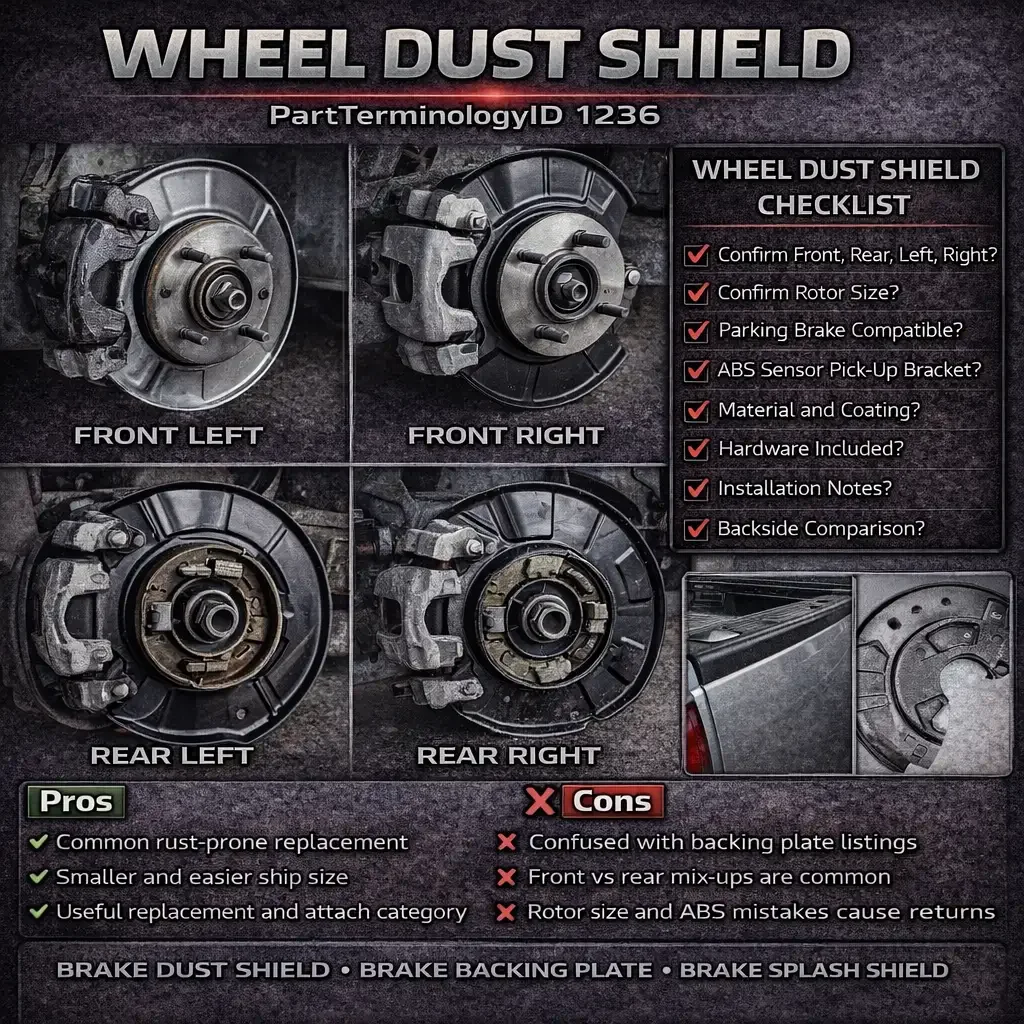
Wheel Dust Shield is one of those part names that sounds simple until a buyer tries to install it.
At first glance, it looks like a basic stamped metal piece behind the brake rotor. Many buyers assume it is universal or at least interchangeable across trims of the same vehicle. Sellers often assume a short title and one photo are enough.
That is where the returns start.
PartTerminologyID 1236 is a fitment-sensitive category. The part sits in a tight area around the rotor, hub, caliper bracket, parking brake components on many rear applications, and sometimes ABS sensor routing. Small differences matter. Left and right matter. Front and rear matter. Rotor diameter matters. Hardware and corrosion coating matter. Even naming matters because buyers and supplier feeds often call the same thing by different names.
This is exactly why Wheel Dust Shield needs a disciplined PartsAdvisory catalog setup.
If your listing is clear, this category can be a reliable replacement part with good buyer confidence. If your listing is vague, you will get the same support messages every time:
Does this fit front or rear
Is this left or right
Is this the same as a backing plate
Does it fit with parking brake shoes
Does it come with hardware
Why does the shape look different than mine
This guide is built for aftermarket catalog teams and sellers who want to reduce wrong orders and publish cleaner Wheel Dust Shield listings.
What a Wheel Dust Shield Usually Means
In aftermarket catalog use, Wheel Dust Shield usually refers to the brake-side shield mounted behind the brake rotor or drum area to help protect components from road debris, water splash, and brake dust movement.
Depending on the vehicle and supplier, this part may also be called:
Brake Dust Shield
Brake Splash Shield
Rotor Dust Shield
Brake Backing Plate
Disc Brake Backing Plate
Brake Shield
These terms overlap in the market, but they are not always used consistently.
That inconsistency is the first catalog problem.
Some suppliers use "backing plate" for rear disc applications where the plate also supports parking brake hardware. Others use "dust shield" for front plates that are mostly protective. Some sellers incorrectly mix this with wheelhouse splash shields or underbody splash shields, which are completely different parts.
What it is not
Wheel Dust Shield is usually not:
Inner fender liner
Wheelhouse splash shield
Engine splash shield
Brake caliper bracket
Wheel speed sensor shield unless specifically listed
Full parking brake hardware kit
Your listing needs to make this distinction obvious because buyers search broadly and often use the wrong term.
Why Wheel Dust Shield Creates Catalog Confusion
This category creates avoidable returns because it combines naming confusion with tight fitment tolerances.
Naming confusion
A buyer may search "brake backing plate" while your listing uses only "Wheel Dust Shield." Another buyer may search "rotor splash shield." If the title and attributes are too narrow, they miss the correct part. If they are too broad, they buy the wrong part.
Side and axle confusion
Wheel Dust Shields are commonly position-specific:
Front Left
Front Right
Rear Left
Rear Right
A listing that just says "Wheel Dust Shield" is not enough.
Brake system variation confusion
Even within the same year, make, and model, vehicles may have:
Different rotor diameters
Different brake packages
Different rear parking brake arrangements
Different ABS sensor routing or clip locations
Different hub and knuckle configurations
This is where weak fitment data creates install failures.
Status in New Databases
Status in New Databases
PartTerminologyID: 1236
Terminology Name: Wheel Dust Shield
Current: PIES 7.2 + PCdb
Future: PIES 8.0 + PCdb 2.0
Status: No change
The terminology remains stable. The biggest opportunity is improving the catalog attributes and fitment notes around position, brake setup, and hardware details.
Core Wheel Dust Shield Variants and Why They Need Separate Catalog Handling
If your catalog treats all Wheel Dust Shields the same, buyers will compare the wrong parts. This category needs clear variant handling.
1) Front Wheel Dust Shields
These are typically mounted behind the front brake rotor and help protect the rotor and nearby brake components from road debris and splash.
Common confusion:
Buyer assumes front and rear are the same
Buyer does not check rotor size
Buyer expects hardware included
Catalog details that matter:
Front Left or Front Right
Rotor diameter compatibility
ABS sensor or harness clip provisions if applicable
Hardware included yes or no
Material and coating
2) Rear Wheel Dust Shields
Rear shields can be more complicated because many rear disc systems include integrated parking brake support features.
Common confusion:
Buyer expects a simple splash shield but needs a backing plate style with parking brake hardware mounting points
Buyer does not check parking brake configuration
Buyer assumes rear left and rear right mirror exactly but mounting differences exist
Catalog details that matter:
Rear Left or Rear Right
Rear disc with parking brake shoe compatibility if applicable
Rotor size
Parking brake hardware support features
Sensor and cable routing provisions
Hardware included
3) OE Style Replacement Shields
These are the most common aftermarket listings and are intended to restore factory fit and function.
Common confusion:
Buyer expects "universal trim-to-fit"
Buyer compares shape visually but not by position and brake size
Buyer expects coating to match OE finish exactly
Catalog details that matter:
OE style replacement designation
Position
Brake package or rotor compatibility
Coating type
Mounting holes and provisions
4) Coated and Corrosion Resistant Replacement Shields
Some suppliers differentiate by coating or material protection because this part commonly rusts out in harsh climates.
Common confusion:
Buyer assumes all shields are the same stamped steel
Buyer does not understand coating differences and chooses by price only
Seller does not surface corrosion protection as a value point
Catalog details that matter:
Material
Coating type
Corrosion-resistant feature claims
Regional fitment or usage notes if supplied
Pros and Cons for Buyers and Sellers
Wheel Dust Shield is a replacement category with very practical buying intent. This section helps set expectations and reduce avoidable returns.
Pros
Common replacement need on rust-prone vehicles
Strong search intent when buyers hear brake scraping from rusted shields
Usually smaller and easier to ship than larger brake components
Good attachment opportunity with rotors, pads, and hardware
Catalog clarity can dramatically reduce wrong-side and wrong-axle returns
Cons
Buyers often confuse it with backing plate, splash shield, or inner fender parts
Left and right mistakes are common
Front and rear mistakes are common
Rotor size and brake package differences are often missed
Some installs require extra disassembly that buyers do not expect
This category sells well when your listing answers position and brake configuration questions early.
Fitment Details That Matter Most for Wheel Dust Shield
This is the section that determines whether the order succeeds or fails.
1) Position is non-negotiable
Always identify:
Front Left
Front Right
Rear Left
Rear Right
Do not rely on abbreviations alone. Spell it out in the title and specs.
2) Rotor size compatibility
Many vehicles have more than one rotor size depending on trim, engine, or package. A dust shield shaped for one rotor may not clear another correctly.
Best practice:
Publish rotor diameter compatibility when supplied
If supplier uses a brake package note, surface it clearly
3) Rear parking brake design compatibility
On many rear disc setups, the backing plate style dust shield also supports parking brake shoes and related hardware.
Best practice:
State whether the shield is for rear disc applications with integrated parking brake hardware support
Include any parking brake-specific fitment notes
4) ABS sensor and harness provisions
Some shields include tabs, holes, or routing points for sensor wiring or clips.
Best practice:
Include these provisions in the attributes or notes if the supplier specifies them
This is especially helpful for installers comparing old and new parts during repair
5) Hardware included vs not included
A very common support question.
Best practice:
Add clear lines for:
Mounting hardware included yes or no
Clips included yes or no
Parking brake hardware included yes or no
If the part is shield only, say it directly.
6) Install complexity expectations
Some applications require more disassembly than buyers expect, including hub or bearing-related removal steps on certain vehicles.
Best practice:
Do not over-instruct, but add a realistic install note if the manufacturer provides one. This helps reduce returns from buyers who thought it was a quick bolt-on.
Compatibility Checklist for Wheel Dust Shield Buyers
Use this high on the product page and in marketplace bullets.
Compatibility Checklist
Confirm year, make, model, and trim
Confirm position (Front Left, Front Right, Rear Left, Rear Right)
Confirm front or rear axle
Confirm rotor size or brake package compatibility
Confirm rear parking brake configuration if buying rear shields
Confirm the listing is for a Wheel Dust Shield / Brake Backing Plate, not an inner fender splash shield
Confirm hardware included and clips included if needed
Confirm material and coating (standard steel, coated, corrosion resistant)
Compare the mounting shape and provisions to your original part
Read all fitment notes before ordering
This checklist prevents the most common wrong orders in this category.
Catalog Checklist for Structured Data and Attributes
PartTerminologyID 1236 needs strong structured data because buyers often shop by symptom and vague part names.
Catalog Checklist
Use PartTerminologyID 1236 and exact term Wheel Dust Shield
Add alternate search terms in listing content where appropriate:
Brake Dust Shield
Brake Backing Plate
Brake Splash Shield
Populate position (Front Left, Front Right, Rear Left, Rear Right)
Populate axle (Front or Rear)
Populate rotor diameter compatibility if available
Populate brake package or system notes if supplied
Populate rear parking brake support yes or no where applicable
Populate hardware included yes or no
Populate clips included yes or no
Populate material
Populate coating/finish
Populate corrosion-resistant feature claims if supplied
Add a plain language Contents Included field
Add fitment notes for sensor clips, cable routing, or bracket provisions if provided
Use images that show the actual mounting face and shield contour clearly
Include finish-accurate photos if multiple coating options exist
A strong internal QA rule for Wheel Dust Shield is simple. If position is missing, do not publish. If rotor size or brake package data exists from the supplier, surface it visibly.
Common Buyer Scenarios and How to Prevent Returns
Scenario 1: Buyer ordered the wrong side
They searched "brake dust shield" and picked the first listing without checking left or right.
Prevention: Put the full position in the title and first bullet, not just in hidden specs.
Scenario 2: Buyer ordered front instead of rear
They knew the part name but not the axle location.
Prevention: Always include axle and position in both title and attributes.
Scenario 3: Buyer expected a full parking brake backing plate kit
The listing was shield only.
Prevention: Add a clear contents line and specify whether parking brake hardware is included.
Scenario 4: Buyer has a different rotor size
The shield shape or clearance does not match their brake package.
Prevention: Surface rotor size or brake package compatibility in visible fields.
Scenario 5: Buyer confused Wheel Dust Shield with wheelhouse splash shield
The part name "dust shield" caused a wrong order.
Prevention: Add a short note near the top clarifying this is the brake-side shield behind the rotor.
Scenario 6: Buyer expected hardware included
The supplier image showed bolts, but the part listing did not clarify what comes in the box.
Prevention: Use a plain language contents block and do not rely only on images.
Scenario 7: Buyer expected a quick install
Their vehicle requires more disassembly than expected.
Prevention: Add a practical install note when the supplier documentation mentions hub or related disassembly.
Naming Best Practices for Listings
In the catalog record
Use the exact term:
Wheel Dust Shield
In listing titles
Use buyer language and fitment detail together:
Wheel Dust Shield Front Left Brake Backing Plate
Wheel Dust Shield Rear Right Brake Backing Plate with Parking Brake Support
Wheel Dust Shield Front Right Rotor Splash Shield Coated Steel
This helps capture search behavior while keeping the terminology accurate.
In product descriptions
Use one clear expectation-setting line near the top:
“This listing is for the brake-side Wheel Dust Shield only. Please confirm axle, position, and brake setup before ordering.”
That one line prevents a lot of wrong orders.
FAQ
Is Wheel Dust Shield the same as a brake backing plate?
Often yes in buyer language, but supplier naming varies. Many listings use the terms interchangeably, especially for disc brake applications.
Is this the same as an inner fender splash shield?
No. Wheel Dust Shield is the brake-side shield behind the rotor or brake assembly, not the wheelhouse liner.
Why do left and right matter for Wheel Dust Shield?
The mounting holes, sensor provisions, and contour are usually position-specific, so left and right are not interchangeable in most applications.
Do I need to match rotor size?
Yes. Many vehicles have multiple brake setups, and the shield shape and clearance can vary by rotor size.
What is the biggest catalog mistake in this category?
The biggest mistake is listing Wheel Dust Shield without position and axle. The next biggest mistake is missing brake package or rotor size compatibility.
Does a Wheel Dust Shield come with hardware?
Some do and some do not. Always check the contents included section.
Why do some rear shields look more complex?
Many rear shields also support parking brake hardware, so they may be listed as backing plates and include more mounting features.
What attributes matter most for Wheel Dust Shield?
Position, axle, rotor compatibility, parking brake compatibility, and hardware included are the most important fields.
Final Takeaway for Catalog Teams and Sellers
PartTerminologyID 1236 Wheel Dust Shield is a good example of a small part that creates big return problems when the listing is too generic.
The fix is straightforward:
Make position obvious
Make axle obvious
Surface rotor or brake package compatibility
Clarify backing plate vs splash shield naming
State exactly what is included
Do that consistently, and Wheel Dust Shield becomes a clean replacement category instead of a support-heavy one.