
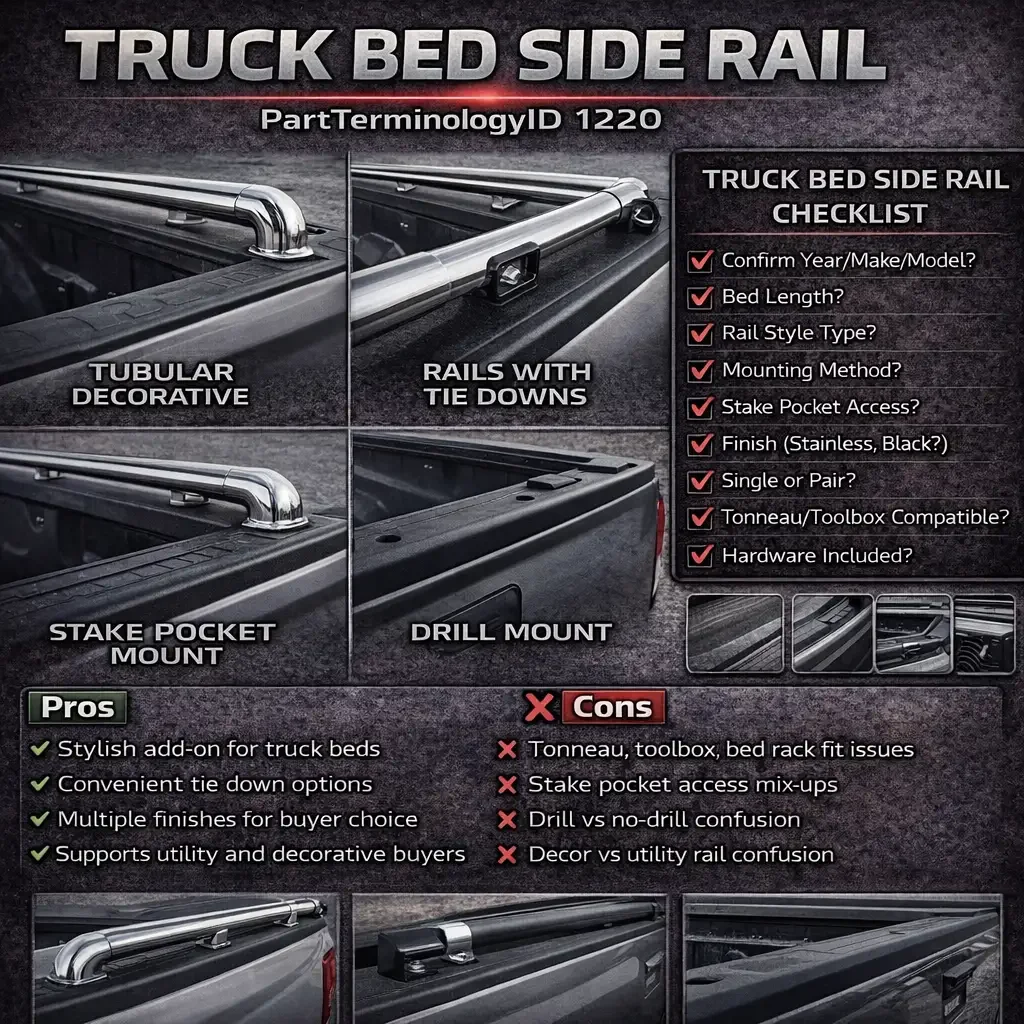
ruck Bed Side Rail looks simple in a listing, but it is one of those truck accessory categories that creates fast returns when the setup details are not clear.
Buyers usually shop this category for one of three reasons:
They want a cleaner truck bed look
They want added utility or tie down points
They want a rail style that works with existing accessories
The problem is that the phrase Truck Bed Side Rail is broad. Different suppliers use it for different products. Some are decorative tubular bed rails. Some are tie down rail systems. Some are stake pocket mounted rails. Some are low profile side rails. Some listings even get mixed with tonneau cover side rails or bed rail caps, which are not the same thing.
That is why PartTerminologyID 1220 needs a clear catalog structure.
This category performs well when the listing answers the right questions early:
What style is it
How does it mount
Is it a pair or single side
What finish and material is it
Does it work with tonneau covers, toolboxes, and bed caps
Does it require drilling
When those answers are missing, buyers guess. When buyers guess, returns go up.
This PartsAdvisory guide is built for aftermarket catalog teams, marketplace sellers, and truck accessory operators who want cleaner Truck Bed Side Rail listings, better buyer confidence, and fewer fitment mistakes.
What Truck Bed Side Rail Usually Means
In most aftermarket truck accessory catalogs, Truck Bed Side Rail refers to an accessory rail mounted along the top edge or upper side area of the pickup bed.
Depending on the product line, it may be:
Tubular bed side rails
Stake pocket mounted side rails
Side rails with integrated tie down loops
Decorative side rails
Utility style side rails for cargo tie down support
It usually is not:
Tonneau cover side rails
Bed rail caps
Bed rack side rails
Ladder rack uprights
Bedside sheet metal repair panels
Cargo management tracks inside the bed wall (unless specifically marketed as a side rail system)
This distinction matters because buyers search loosely. They may type bed rails, truck rails, side rails, bed top rails, or tie down rails. Your catalog record needs to stay clean, and your listing content needs to clarify exactly what kind of rail it is.
Why Truck Bed Side Rail Creates Catalog Confusion
This category has a naming problem and a compatibility problem.
Naming confusion
Truck Bed Side Rail gets mixed up with:
Bed Rail
Bed Rail Cap
Tonneau Side Rail
Cargo Rail
Bed Rack Rail
Bedside Molding
Stake Pocket Rail
These are not all the same product.
A buyer who wants polished tubular bed rails may click on a listing for a tonneau rail kit if the catalog title is too generic. A buyer who wants tie down utility rails may order decorative rails with no real tie down function if the feature data is weak.
Compatibility confusion
Even if the buyer has the correct truck, the rails may still not fit as expected because of:
Bed length differences
Stake pocket layout
Bed rail cap style
Existing tonneau cover rails
Toolbox position
Factory cargo track systems
Bed rack hardware
Drilling requirements
Trim package differences around the bed rail top surface
Truck Bed Side Rail is a space conflict category. The rail itself may fit the truck, but not fit the truck plus the buyer's existing accessories.
That is where good catalog content makes the difference.
Status in New Databases
Status in New Databases
PartTerminologyID: 1220
Terminology Name: Truck Bed Side Rail
Current: PIES 7.2 + PCdb
Future: PIES 8.0 + PCdb 2.0
Status: No change
The terminology remains stable. The real opportunity is improving the product data around rail style, mount method, finish, and compatibility with tonneau covers and other truck bed accessories.
Core Truck Bed Side Rail Types and Why They Need Separate Catalog Handling
This is the most important setup decision for PartTerminologyID 1220. If your catalog treats all bed side rails as one generic product type, buyers will compare the wrong products.
1) Tubular Decorative Bed Side Rails
These are one of the most common styles. They usually mount near the bed rail top and are chosen for appearance first.
Common features:
Polished or black tubular design
Raised rail look
Vehicle specific contour
Often sold as a pair
Common confusion:
Buyer assumes they are heavy duty tie down rails
Buyer assumes they fit with any tonneau cover
Buyer does not check if mounting uses stake pockets or drilling
Catalog details that matter:
Tube shape and size
Material
Finish
Mounting method
Pair or single
Tie down function yes or no
2) Bed Side Rails With Integrated Tie Downs
These look similar to decorative rails but include tie down loops or anchor points.
Common features:
Integrated tie down points
More utility focused than decorative rails
Often sold as side pair
Common on trucks used for light cargo securing
Common confusion:
Buyer expects a published tie down load rating and it is not listed
Buyer assumes all loops are equal in capacity
Buyer assumes compatibility with tonneau covers because the rails look low profile
Catalog details that matter:
Tie down loops included
Tie down point count
Capacity per tie down point if provided
Mounting method
Finish and corrosion resistance
Compatibility with tonneau covers and toolboxes
3) Stake Pocket Mount Bed Side Rails
These mount using existing stake pocket openings and are often marketed as no-drill or low-drill options.
Common features:
Cleaner install on compatible trucks
Often easier installation
Common in chrome or black finishes
Common confusion:
Buyer does not know whether their truck has open or usable stake pockets
Buyer has bed rail caps covering stake pocket access
Buyer assumes all stake pocket locations are the same across trims
Catalog details that matter:
Stake pocket mount yes or no
Number of mounting points
Open stake pocket required yes or no
Fitment notes for bed caps or covered stake pockets
Hardware included
4) Drill Mount or Bracket Mount Side Rails
Some rails require drilling or use specific bracket hardware.
Common features:
More secure or specific mounting geometry
May fit applications without stake pocket access
Often stronger visual fit on certain bed designs
Common confusion:
Buyer expects no-drill install because similar rails use stake pockets
Buyer does not read install notes
Buyer expects hardware in box and it is not included
Catalog details that matter:
Drilling required yes or no
Bracket included yes or no
Hardware included
Install difficulty notes if supplied
Vehicle specific fitment restrictions
5) Low Profile or Flush Style Bed Side Rails
Some products are designed to sit lower and cleaner to improve accessory compatibility or appearance.
Common features:
Less visible profile
Clean truck bed edge look
Better compatibility in some setups
Common confusion:
Buyer assumes low profile means universal tonneau compatibility
Buyer expects hidden mounting with no visible hardware
Buyer assumes all low profile rails support tie down use
Catalog details that matter:
Profile style
Rail height
Tonneau compatibility notes
Tie down functionality
Finish and material
Pros and Cons for Buyers and Sellers
Truck Bed Side Rail is an accessory category, so a Pros and Cons section helps set realistic expectations and reduce avoidable returns.
Pros
Strong visual upgrade for truck bed appearance
Useful utility category when integrated tie down points are included
Good attachment category with bed accessories and truck styling products
Multiple finishes and styles support broad buyer preferences
Vehicle specific rails can convert well when fitment and mount details are clear
Cons
High compatibility risk with tonneau covers, toolboxes, and bed racks
Buyers often confuse decorative rails with tie down utility rails
Stake pocket access issues are common on trucks with bed rail caps
Drilling requirements can trigger returns if not stated clearly
Finish expectations can cause returns when chrome, polished, and black styles are not labeled properly
This category sells best when the listing makes clear whether the rail is for style, utility, or both.
Materials, Finish, and Corrosion Resistance
Truck Bed Side Rail is a visible truck accessory, so finish and material are major buying factors.
Common materials
Stainless steel
Carbon steel with coating
Aluminum in some product lines
Common finishes
Polished stainless
Chrome look
Black powder coated
Textured black
Satin or brushed finishes on some styles
Why finish causes returns
Buyers often compare product photos, not spec fields. If the listing title says black rail but the photo looks glossy, or if the product is polished stainless and the listing just says metal, the buyer may feel they received the wrong item.
Catalog best practice
Make finish visible in:
Title
Structured attributes
Product bullets
Variant images
If the rails are sold in multiple finishes, use separate variant images and do not reuse one generic image across all finishes.
Mounting Fitment Details That Make or Break This Category
This is where most Truck Bed Side Rail issues happen.
1) Bed length and bed style still matter
Even though rails run along the bed sides, they are not universal by truck family.
Best practice:
Use precise vehicle fitment
Add bed length qualifiers when applicable
Do not rely only on short bed or long bed wording if the supplier gives more exact fitment notes
2) Stake pocket access and bed rail caps
This is a major return trigger.
Some trucks have bed rail caps that:
Cover the stake pocket openings
Have molded cutouts
Require trimming or removal to access mounting points
Best practice:
Add a visible fitment note:
Requires accessible stake pockets
Not compatible with covered stake pockets unless modified
Use exact supplier language where possible.
3) Tonneau cover compatibility
This is the biggest conflict in this category.
Truck Bed Side Rails and tonneau covers often want the same space:
Top rail surface
Inner rail clamp area
Stake pocket area
Best practice:
Add a clear compatibility field:
Tonneau compatible yes or no
If yes, add style-specific notes when available:Compatible with select inside mount tonneau covers
Not compatible with top mount tonneau rail systems
Requires spacing kit if supplied by manufacturer
4) Toolbox compatibility
Cross-bed toolboxes often sit near the front bed rail area where side rails also mount.
Best practice:
State whether the rail system:
Works with cross-bed toolboxes
May interfere with toolbox lid or brackets
Requires clearance verification
5) Bed rack and ladder rack compatibility
This is another common conflict because racks often clamp to the same rail edges.
Best practice:
Add rack compatibility notes and avoid generic “fits all bed accessories” wording.
6) Drilling and bracket installs
Drilling is a major buyer decision point.
Best practice:
Put install type near the top:
Stake pocket mount
Clamp mount
Drill mount
Combination mount
If drilling is required, say it clearly in the first bullets.
Compatibility Checklist for Truck Bed Side Rail Buyers
Use this high on the listing and product page. It prevents the most common wrong orders.
Compatibility Checklist
Confirm year, make, model, and bed length
Confirm the product type is Truck Bed Side Rail and not a tonneau rail or bed rail cap
Confirm whether the rail is decorative, utility tie down, or both
Confirm mounting type (stake pocket, clamp, drill mount, bracket mount)
Confirm your truck has accessible stake pockets if stake pocket mount is required
Confirm finish and material (polished stainless, black powder coat, etc.)
Confirm whether the product is single rail or pair
Confirm whether tie down loops are included and any capacity notes
Confirm tonneau cover compatibility if you already have a bed cover
Confirm toolbox compatibility if you run a cross-bed toolbox
Confirm rack or ladder rack compatibility
Confirm hardware included
Read all installation notes before ordering
This checklist is especially useful for marketplace listings where buyers move fast and do not open the full spec section.
Catalog Checklist for Structured Data and Attributes
PartTerminologyID 1220 is a category where naming alone is not enough. The attributes carry the listing.
Catalog Checklist
Use PartTerminologyID 1220 and exact term Truck Bed Side Rail
Add a required Rail Style attribute:
Tubular Decorative
Tubular with Tie Downs
Stake Pocket Rail
Low Profile Rail
Utility Side Rail
Populate mounting type:
Stake Pocket
Clamp
Drill Mount
Bracket Mount
Populate material
Populate finish and color
Populate tube shape/size or rail profile details when supplied
Populate quantity included (single or pair)
Populate tie down points included yes or no
Populate tie down point count
Populate tie down capacity if provided by manufacturer
Populate hardware included yes or no
Populate stake pocket access required yes or no
Add tonneau cover compatibility notes
Add toolbox compatibility notes
Add rack compatibility notes
Add a plain language Contents Included field
Add a plain language Installation Type field
Use accurate finish-specific images and at least one installed-view image
A strong internal QA rule for this category is simple. If rail style, mounting type, and finish are missing, the listing should not publish.
Common Buyer Scenarios and How to Prevent Returns
Scenario 1: Buyer ordered decorative rails expecting tie down use
The listing said bed side rail but did not clarify function.
Prevention: Clearly identify decorative vs utility tie down rail in the title and first bullets.
Scenario 2: Buyer has covered stake pockets
The rail requires stake pocket access, but the truck has bed caps covering the openings.
Prevention: Add a visible note about accessible stake pockets and bed cap restrictions.
Scenario 3: Buyer already has a tonneau cover
The side rails and tonneau system compete for the same rail space.
Prevention: Add a clear tonneau compatibility field and style-specific notes when available.
Scenario 4: Buyer expected a pair but received one rail
The listing image showed both rails on a truck, but the product was single side.
Prevention: Put “Pair” or “Single Side Rail” in the title and bullets.
Scenario 5: Buyer expected no-drill install
Their rail kit requires drilling and they return it before installation.
Prevention: Put install type in the first bullets and repeat in the specs.
Scenario 6: Buyer expected polished stainless and received black finish
The variant image was generic and the finish field was weak.
Prevention: Use finish-specific images and include finish in the title.
Scenario 7: Buyer expected toolbox compatibility
The front rail section interferes with toolbox placement.
Prevention: Add toolbox compatibility notes and make buyers verify clearance.
Naming Best Practices for Listings
In the catalog record
Use the exact term:
Truck Bed Side Rail
In listing titles
Add the buyer decision details early:
Truck Bed Side Rail, Stainless, Stake Pocket Mount, Pair
Truck Bed Side Rail with Tie Downs, Black Powder Coat, Pair
Low Profile Truck Bed Side Rail, Drill Mount, Polished Stainless
This helps buyers quickly sort style, finish, and install type without reading the full description first.
In product descriptions
Use one expectation-setting line near the top:
“This listing is for Truck Bed Side Rails only. Please confirm mount style, stake pocket access, and tonneau or toolbox compatibility before ordering.”
That one line prevents a lot of wrong-fit orders.
FAQ
Is Truck Bed Side Rail the same as a tonneau cover rail?
No. Truck Bed Side Rail is typically a separate bed accessory rail. Tonneau cover rails are part of a bed cover system and are cataloged differently.
Are Truck Bed Side Rails universal?
No. Most are vehicle specific and may also depend on bed length, stake pocket layout, and accessory clearance.
Do Truck Bed Side Rails always include tie down points?
No. Some are decorative only, and some include integrated tie down loops. The listing should state this clearly.
What is the biggest catalog mistake in this category?
The biggest mistake is listing Truck Bed Side Rail without rail style and mounting type. Tonneau compatibility is the next most common missing detail.
Do I need open stake pockets for bed side rails?
Some rails require accessible stake pockets. Others use drilling or different brackets. Always check the mounting type.
Will Truck Bed Side Rails work with my tonneau cover?
Some will and some will not. The rail and tonneau often use the same mounting area, so compatibility must be checked.
Are Truck Bed Side Rails sold as a pair?
Many are sold as a pair, but not all. Some listings are single side. Always confirm quantity included.
Do these rails require drilling?
Some do, some do not. The install type should be clearly listed as stake pocket, clamp, or drill mount.
What attributes matter most for Truck Bed Side Rail?
Rail style, mounting type, finish, quantity included, and tonneau compatibility are the most important fields.
Should finish be in the title?
Yes. This is a highly visible accessory category, so finish is a major buying decision and should be visible early.
Final Takeaway for Catalog Teams and Sellers
PartTerminologyID 1220 Truck Bed Side Rail is a strong truck accessory category, but it is not a one-line listing category.
The listings that perform best do three things well:
They clearly define the rail style and intended use
They clearly explain the mounting method
They clearly call out compatibility with tonneau covers, toolboxes, and stake pocket access
Do that consistently, and Truck Bed Side Rail becomes a reliable category for both conversion and lower return rates.