
Trailer Hitch (PartTerminologyID 1212): Receiver Classes, Capacity Limits, and Fitment Rules
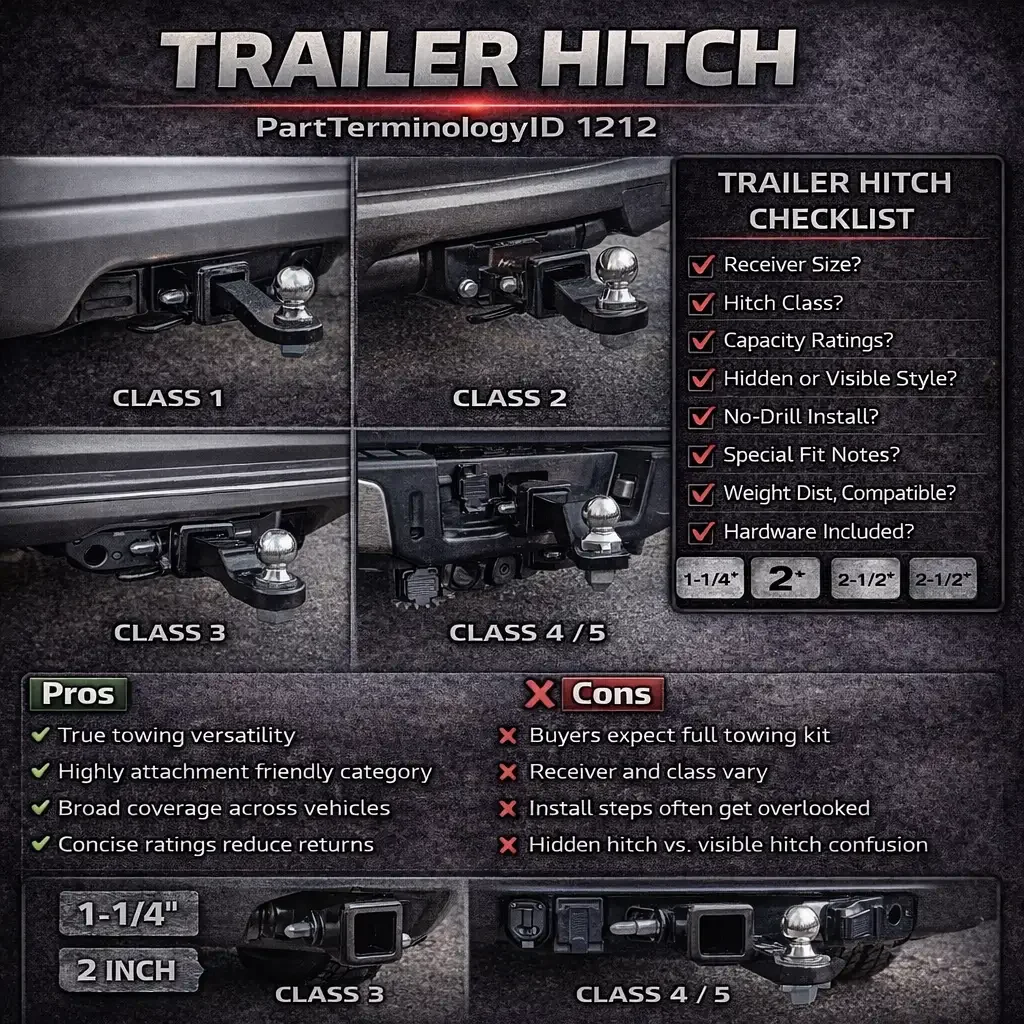
Trailer Hitch is one of the most searched towing categories in the aftermarket, and one of the easiest to miscatalog if your data is too generic.
Buyers think they are buying one thing. In reality, they are choosing a system foundation. Receiver size, hitch class, towing capacity, tongue weight, frame fitment, fascia clearance, spare tire clearance, wiring setup, and accessory compatibility all come into play before the trailer even moves.
That is why PartTerminologyID 1212 needs a stricter catalog approach than most accessory categories.
When Trailer Hitch listings are thin, the same problems repeat:
Buyer orders the wrong receiver size
Buyer assumes the hitch includes ball mount and wiring
Buyer has a trim package with fascia interference
Buyer expects no drilling but their application requires modification
Buyer does not realize weight distribution is required for their load
Buyer assumes all Class 3 hitches for the same vehicle fit the same
Buyer expects a hidden hitch look but receives a visible cross tube design
This category can perform extremely well for marketplace sellers and e-commerce teams because purchase intent is strong. People shopping Trailer Hitches usually need one now. But they need the right one, and your listing has to help them choose it correctly.
This PartsAdvisory guide is built for catalog teams, marketplace operators, and aftermarket sellers who want Trailer Hitch listings that convert cleanly, install correctly, and generate fewer returns.
What a Trailer Hitch Usually Means
In aftermarket catalog use, Trailer Hitch typically refers to the receiver hitch assembly that mounts to the vehicle frame or body mounting points and provides a receiver opening for towing and hitch-mounted accessories.
It commonly includes:
Hitch receiver assembly
Mounting brackets integrated into the hitch structure
Installation hardware on many products
It usually does not include:
Ball mount
Hitch ball
Wiring harness
Trailer connector bracket
Weight distribution hardware
Brake controller
Hitch pin and lock (varies by listing)
Trailer sway control components
That distinction matters because buyers often search “trailer hitch” and assume they are buying a complete towing kit. If the listing does not clearly state what is included, the order may be technically correct but still feel incomplete.
Trailer Hitch also gets confused with:
Tow Bar (flat towing category)
Ball Mount
Draw Bar
Tow Hook
Hitch Cover
Rear bumper tow package components
Your catalog record needs to keep Trailer Hitch classified correctly, then the listing needs to explain receiver size, class, and capacity clearly.
Why Trailer Hitch Creates Catalog Confusion
Trailer Hitch is a broad category, but the fitment is highly specific.
Naming confusion
The same product can be described in supplier feeds as:
Trailer Hitch
Receiver Hitch
Hitch Receiver
Receiver Trailer Hitch
Tow Hitch
Those are often valid search terms, but not all hitches are equivalent even when they fit the same vehicle.
Two hitches may both fit a vehicle but differ in:
Receiver opening size
Hitch class
Capacity ratings
Hidden vs visible design
Weight distribution compatibility
Fascia trimming requirements
If your catalog treats all “hitches” as the same product type without those differentiators, buyers compare the wrong products and returns go up.
Fitment confusion
Trailer Hitch fitment can vary by:
Year, make, model
Trim level
Bumper style
Factory tow package
Dual exhaust vs single exhaust
Spare tire size and location
Ground effects packages
Hybrid or EV drivetrain packaging
Existing rear sensors and liftgate features
A buyer can have the correct vehicle and still order the wrong Trailer Hitch if the fitment notes are incomplete.
Status in New Databases
Status in New Databases
PartTerminologyID: 1212
Terminology Name: Trailer Hitch
Current: PIES 7.2 + PCdb
Future: PIES 8.0 + PCdb 2.0
Status: No change
The term remains stable across current and future database versions. The bigger catalog opportunity is improving the structured attributes around receiver size, class, rating, and installation qualifiers.
Core Trailer Hitch Types and Why They Need Separate Catalog Handling
This is where many catalogs lose accuracy. Buyers search “Trailer Hitch,” but they actually need a specific hitch style and receiver class.
1) Rear Receiver Hitches
This is the most common category and the one most buyers mean when they search Trailer Hitch.
Common features:
Mounts to rear frame points
Receiver opening for towing and accessories
Available in multiple classes and receiver sizes
Often supports bike racks, cargo carriers, and trailer towing
Common confusion:
Buyer assumes all rear hitches for the vehicle have the same capacity
Buyer assumes the receiver is always 2 inch
Buyer expects hidden design when cross tube is visible
Catalog details that matter:
Receiver size
Hitch class
GTW and TW ratings
Weight distribution rating support
Visible vs concealed cross tube
Installation notes and modification requirements
2) Front Mount Hitches
These are less common but important for some truck and SUV users.
Common features:
Mounts at the front of the vehicle
Used for accessory carriers, winch mounts, and specialty towing maneuvers
Different use case than rear towing hitches
Common confusion:
Buyer expects rear towing function
Buyer assumes all accessories fit without front fascia clearance issues
Buyer overlooks front ground clearance impact
Catalog details that matter:
Front mount classification
Receiver size
Vertical load limits if supplied
Fascia and air dam modification notes
Ground clearance notes
3) Concealed or Hidden Cross Tube Hitches
A design style category that matters a lot for modern buyers.
Common features:
Cleaner appearance
Receiver opening visible while cross tube is tucked higher
Popular on newer SUVs and crossovers
Common confusion:
Buyer assumes “hidden” means zero visible hardware
Buyer compares it directly to a standard hitch without noticing capacity differences
Buyer expects no fascia trimming
Catalog details that matter:
Concealed design yes or no
Any visible components
Fascia trimming requirements
Receiver location and clearance
4) Standard Visible Cross Tube Hitches
These are common and often lower cost.
Common features:
Visible cross tube under bumper
Wide vehicle coverage
Strong value option for towing and accessories
Common confusion:
Buyer expects the cleaner look from concealed hitch photos
Buyer assumes same exact bumper clearance as hidden designs
Buyer overlooks finish differences
Catalog details that matter:
Visible cross tube design
Finish type
Receiver drop position
Installation and clearance notes
Hitch Classes, Receiver Sizes, and Capacity Ratings
This is the most important technical section in Trailer Hitch listings.
Buyers often focus on vehicle fitment first, but towing capability and receiver size are just as important.
Hitch class matters
Trailer Hitches are commonly sold by class. The class indicates typical receiver size and rating range, but buyers should still rely on the specific product rating, not class label alone.
Common buyer mistakes:
Assuming Class 3 always means the same capacity across all vehicles
Assuming a higher class automatically matches their vehicle application
Choosing by class without checking receiver size
Receiver size matters
Receiver size is a major decision factor because it affects:
Ball mount compatibility
Accessory compatibility
Hitch-mounted rack compatibility
Common buyer mistakes:
Assuming every hitch is 2 inch
Buying an accessory before confirming receiver size
Confusing adapter use with ideal fit
Capacity ratings matter
Trailer Hitch listings should clearly show:
Gross trailer weight rating (GTW) if provided
Tongue weight rating (TW) if provided
Weight distribution ratings if applicable
Common buyer mistakes:
Assuming the hitch rating alone determines towing capacity
Ignoring vehicle towing limits
Ignoring whether weight distribution is required for heavier loads
Catalog best practice
Capacity data should appear in:
Structured attributes
Visible bullets
Product description
Comparison filters if your site supports them
If class, receiver size, or rating is missing, the Trailer Hitch listing is not ready to publish.
Pros and Cons for Buyers and Sellers
Trailer Hitch is an accessory category with high purchase intent, so a Pros and Cons section helps buyers choose correctly and helps sellers reduce returns.
Pros
High-demand category with clear buyer intent
Strong attachment sales with wiring, ball mounts, and towing accessories
Useful for towing and non-towing uses like bike racks and cargo carriers
Wide application coverage across trucks, SUVs, and crossovers
Clear spec-based listing content can significantly reduce returns
Cons
Buyers often assume the hitch includes wiring and ball mount components
Receiver size and class confusion causes wrong orders
Trim, fascia, exhaust, and spare tire fitment notes are often missed
Hidden versus visible hitch design expectations can cause dissatisfaction
Installation complexity varies more than buyers expect
For Trailer Hitch, most avoidable returns come from missing spec clarity, not bad product quality.
Installation and Fitment Details That Usually Get Missed
Trailer Hitch is a category where install reality matters. Buyers need to know what they are signing up for before checkout.
1) No-drill vs drilling required
Many hitches are marketed as no-drill, but not all applications are the same.
Common confusion:
Buyer sees “no drill” on a similar product and assumes all fitments are no-drill
Buyer does not expect fascia trimming or heat shield adjustment
Catalog best practice:
State installation method clearly and keep it vehicle-specific when necessary:
Bolt-on
No-drill for most applications
Minor trimming required
Heat shield modification may be required
Only use claims that match the manufacturer instructions.
2) Fascia and bumper trimming
This is a major return trigger on SUVs and crossovers.
Common confusion:
Buyer expects invisible installation with no bumper cutting
Buyer sees a stock vehicle photo and does not realize trim differs
Catalog best practice:
Add a visible note if trimming is required. Do not bury it in a PDF link only.
3) Exhaust clearance
Dual exhaust and trim-specific exhaust routing can affect fit.
Common confusion:
Buyer assumes all trims share the same exhaust layout
Buyer does not check hangers and pipe clearance notes
Catalog best practice:
Include exhaust-specific fitment notes when supplied:
Single exhaust only
Dual exhaust compatible
Excludes specific performance trim exhaust setups
4) Spare tire clearance
A common issue on trucks and SUVs.
Common confusion:
Buyer has oversized spare tire
Buyer does not expect temporary spare relocation during install
Buyer assumes all factory spare sizes are identical
Catalog best practice:
Add spare tire notes when relevant, especially if the manufacturer specifies size restrictions or installation steps.
5) Sensors and hands-free liftgate features
Modern vehicles add another layer of complexity.
Common confusion:
Buyer installs hitch and the hands-free liftgate sensor behavior changes
Buyer expects OE function to remain unchanged
Catalog best practice:
Add a practical note if the manufacturer mentions sensor relocation or reduced hands-free functionality.
6) Hardware and torque expectations
Buyers often underestimate installation requirements.
Catalog best practice:
Clarify what is included and what is not:
Installation hardware included
Hitch pin sold separately
Wiring not included
Ball mount not included
This prevents “incomplete kit” complaints.
Trailer Hitch Compatibility Checklist
Use this high on the listing and product page. It solves a large percentage of pre-sale questions.
Compatibility Checklist
Confirm year, make, model, and trim
Confirm rear hitch or front mount hitch type
Confirm receiver size (for example, 1-1/4 inch or 2 inch)
Confirm hitch class
Confirm GTW and TW ratings match your use case
Confirm whether weight distribution is supported or required for your setup
Confirm hidden/concealed vs visible cross tube design preference
Confirm fitment notes for dual exhaust, ground effects, or special trims
Confirm fitment notes for spare tire and rear underbody clearance
Confirm whether fascia trimming or modification is required
Confirm whether hardware is included
Confirm whether ball mount, hitch ball, and wiring are included or sold separately
Confirm hands-free liftgate sensor impact notes if your vehicle uses one
Read all installation notes before ordering
This checklist is especially helpful on marketplaces where buyers move fast and skip detailed specs.
Catalog Checklist for Structured Data and Attributes
PartTerminologyID 1212 is a category where structured data drives both conversion and return reduction.
Catalog Checklist
Use PartTerminologyID 1212 and exact term Trailer Hitch
Add required Hitch Type attribute:
Rear Receiver Hitch
Front Mount Hitch
Populate receiver size
Populate hitch class
Populate GTW rating and TW rating
Populate weight distribution compatible yes or no, and rating if supplied
Populate concealed/hidden design yes or no
Populate cross tube visibility (concealed or visible)
Populate finish and corrosion-resistant coating details
Populate hardware included yes or no
Populate hitch pin included yes or no
Add ball mount included yes or no
Add wiring included yes or no
Add vehicle-specific notes for:
Exhaust configuration
Fascia trimming
Spare tire
Ground effects
Sensor/liftgate behavior
Add a plain-language Contents Included field
Add a plain-language What You Still Need field
Use accurate installed-view images on the actual vehicle body style when possible
Include a product-only image that clearly shows receiver and cross tube design
A strong internal QA rule for Trailer Hitch is simple. If receiver size, class, and ratings are missing, the listing should not publish.
Common Buyer Scenarios and How to Prevent Returns
Scenario 1: Buyer expected a complete towing kit
They ordered a Trailer Hitch and expected wiring, ball mount, and hitch ball in the box.
Prevention: Add a visible “What is included” and “What you still need” section near the top.
Scenario 2: Buyer ordered the wrong receiver size
They planned to use an accessory or ball mount they already own and assumed the hitch receiver would match.
Prevention: Put receiver size in the title or first bullet and in structured attributes.
Scenario 3: Buyer wanted a hidden look and received a visible cross tube hitch
They chose by price and did not realize the design style difference.
Prevention: Clearly label concealed vs visible design and include installed photos.
Scenario 4: Buyer has a trim package with fascia interference
The hitch technically fits the vehicle family, but their trim requires cutting or has incompatible lower fascia design.
Prevention: Put trim and fascia notes in visible fitment bullets, not just buried in long copy.
Scenario 5: Buyer has dual exhaust and the hitch does not clear as expected
They assumed all trims shared the same exhaust routing.
Prevention: Add exhaust-specific compatibility notes and exclusions.
Scenario 6: Buyer uses the hitch for towing beyond their setup
They rely on the hitch rating only and do not consider vehicle limits or weight distribution.
Prevention: Present hitch ratings clearly and add a practical note reminding buyers to follow vehicle towing limits and required towing components.
Scenario 7: Buyer expected no-drill install
Their application requires trimming or minor modification and they feel misled.
Prevention: Use exact install language from manufacturer instructions and keep it visible.
Naming Best Practices for Listings
In the catalog record
Use the exact term:
Trailer Hitch
In listing titles
Add the spec details buyers need quickly:
Trailer Hitch, Class 3, 2 Inch Receiver, Rear
Trailer Hitch, Concealed Receiver, Class 3, 2 Inch
Front Mount Trailer Hitch, 2 Inch Receiver
The title should not try to do everything, but it should answer the biggest questions:
What type
What class
What receiver size
In the product description
Use an expectation-setting line:
“This listing is for the Trailer Hitch receiver assembly only. Ball mount, hitch ball, and wiring are sold separately unless stated otherwise.”
That one line prevents a lot of avoidable returns and support messages.
FAQ
Is a Trailer Hitch the same as a Tow Bar?
No. A Trailer Hitch is a receiver hitch assembly for towing trailers or using hitch accessories. A Tow Bar is a separate flat towing category used to tow a vehicle behind another vehicle.
Does a Trailer Hitch include the ball mount and wiring?
Usually not. Many listings include the hitch receiver and hardware only. Always check the contents included section.
What is the biggest Trailer Hitch catalog mistake?
The biggest mistake is publishing a generic listing without receiver size, hitch class, and capacity ratings.
Why does receiver size matter?
Receiver size affects which ball mounts and hitch accessories fit correctly. Buyers often assume all hitches are 2 inch, which causes wrong orders.
Are all hitches for the same vehicle the same?
No. Different hitches can vary in capacity, receiver size, design style, and installation requirements even for the same vehicle.
What does concealed hitch mean?
It usually means the cross tube is less visible and the receiver opening is more cleanly integrated, but some hardware may still be visible depending on vehicle and hitch design.
Can trim level affect hitch fitment?
Yes. Bumper design, exhaust layout, and ground effects can change fitment requirements and installation steps.
What if the listing says Class 3?
Class 3 helps identify the hitch type, but you still need to confirm the actual product ratings and your vehicle’s towing limits.
Do I need weight distribution equipment?
It depends on your towing setup and the hitch/vehicle requirements. The hitch listing should state whether weight distribution is supported and provide the related ratings if applicable.
What attributes matter most for Trailer Hitch?
Hitch type, receiver size, hitch class, GTW/TW ratings, design style, and vehicle-specific install notes are the most important fields.
Final Takeaway for Catalog Teams and Sellers
PartTerminologyID 1212 Trailer Hitch is a core towing category with strong buyer intent and strong attachment potential, but it only performs well when the catalog answers the real buying questions.
The teams that reduce returns in this category do the basics consistently:
Publish receiver size and hitch class clearly
Show real capacity ratings
Separate concealed and visible hitch designs
Explain what is included and what is not
Surface trim, fascia, exhaust, and install notes where buyers can actually see them
When your Trailer Hitch listings do that, buyers trust the catalog, installs go smoother, and your support team spends less time fixing preventable mistakes.