
Tow Hook (PartTerminologyID 1202): Recovery Types, Mounting Fitment, and Catalog Safety Checks
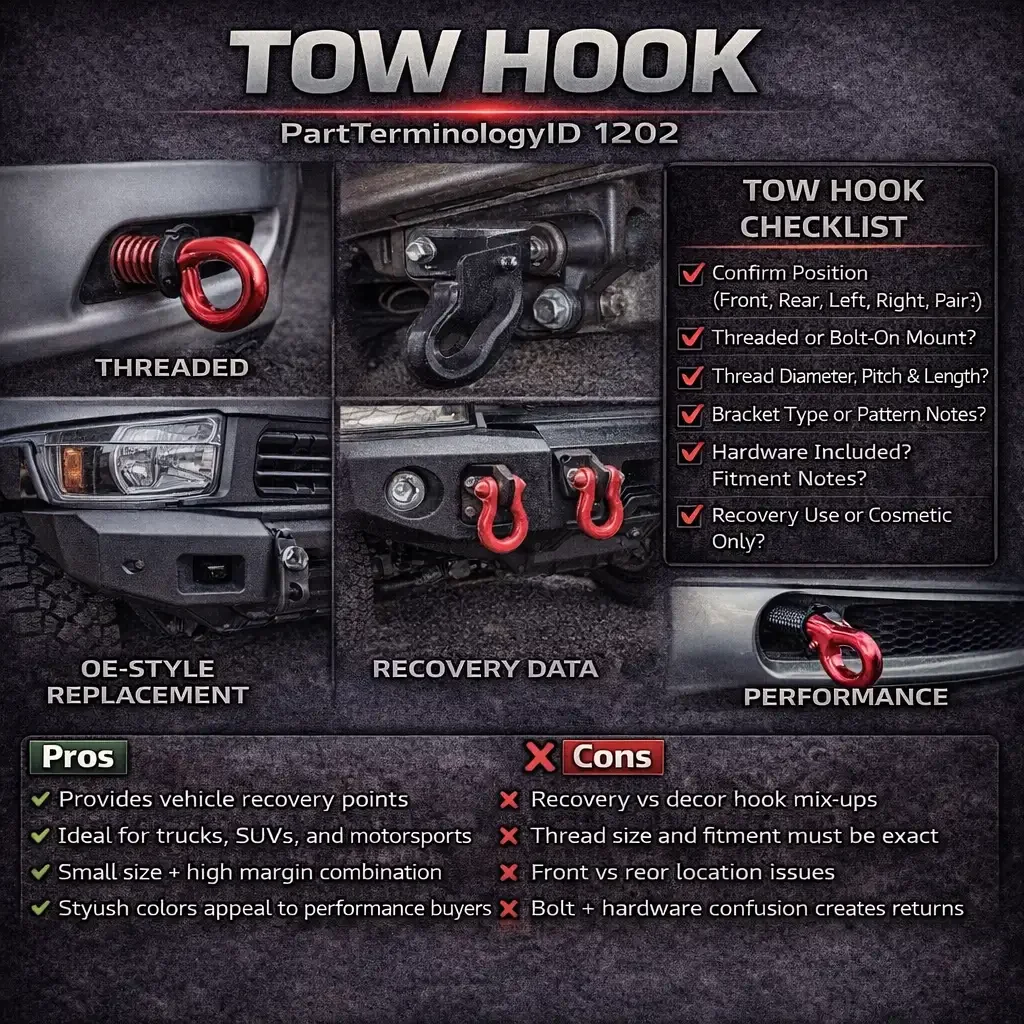
Tow Hook is a short part name with a long list of ways to get the listing wrong.
It looks simple. It is just a hook. Buyers assume it should fit. Sellers assume the product photo explains everything. Catalog teams often receive supplier files that call multiple products by the same name even though they mount completely differently.
That is exactly why PartTerminologyID 1202 needs strong catalog discipline.
Tow Hook is a category where small fitment details matter a lot. Front vs rear. Threaded vs bolt-on. OE replacement vs decorative racing style. Recovery use vs tie-down use. Thread diameter and pitch. Bumper cutout clearance. Bracket location. Finish. Hardware included.
If the listing is vague, the buyer orders fast and discovers the problem during install. The hook does not thread in. The bumper opening is wrong. The bracket pattern does not match. The buyer expected a recovery-rated hook and got a cosmetic hook. Or they expected a pair and received one.
This PartsAdvisory guide is built for aftermarket catalog teams and sellers who want Tow Hook listings that convert cleanly and generate fewer returns.
What a Tow Hook Usually Means
In aftermarket automotive catalogs, Tow Hook usually refers to a hook component used as a towing or recovery attachment point. The exact product style depends on vehicle platform and product type.
Tow Hook products commonly include:
OE-style front tow hooks
OE-style rear tow hooks
Bolt-on frame or bumper-mounted tow hooks
Threaded screw-in tow hooks used with bumper access ports
Aftermarket recovery hooks
Decorative or track-style threaded tow hooks
Hook kits sold in pairs
Single replacement hooks
Tow Hook is usually not:
A trailer hitch receiver
A tow bar for flat towing
A tow strap
A shackle or D-ring (unless included in a kit)
A hitch ball mount
A tie-down anchor by itself
That distinction matters because buyers often search broad terms like tow, towing hook, recovery hook, or race tow hook. Your catalog needs to classify the part correctly and then clearly explain what kind of Tow Hook it is.
Why Tow Hook Creates Catalog Confusion
Tow Hook is one of those categories where the naming looks universal but the fitment is not.
Common naming confusion
Tow Hook often gets mixed up with:
Recovery hook
Tow eye
Tow loop
Tow point
Screw-in tow hook
Track tow hook
Trailer hook accessories
Some platforms use “tow eye” in OE language while aftermarket sellers list similar products as Tow Hook. Some racing-style products are marketed as tow hooks but are not intended for the same use as OE recovery components. If your catalog imports supplier naming without review, you can end up mixing functional categories and creating safety confusion.
Common fitment confusion
Tow Hook fitment varies by:
Front or rear location
Threaded mount vs bolt-on mount
Thread size and thread pitch
Left vs right side on some OE applications
Bracket spacing
Bumper cover opening and clearance
Trim package differences
Presence of factory tow package or recovery points
A buyer can have the correct year, make, and model and still get the wrong Tow Hook if the listing does not include the mounting details.
Status in New Databases
Status in New Databases
PartTerminologyID: 1202
Terminology Name: Tow Hook
Current: PIES 7.2 + PCdb
Future: PIES 8.0 + PCdb 2.0
Status: No change
The terminology remains stable. That is good for continuity. The real improvement opportunity is the structured data around mounting style, position, thread specification, and included hardware.
Why Tow Hook Listings Get Returned So Often
Most Tow Hook returns are not because the part is defective. They happen because the listing leaves too much to assumption.
Common buyer assumptions:
“Tow Hook” means universal
All screw-in tow hooks use the same thread
Any hook shown in a bumper opening is recovery-ready
Front and rear hooks are interchangeable
The product includes the bracket or hardware
The listing includes a pair
The finish color is the same as the photo
The hook is rated for recovery because it looks strong
Tow Hook is a category where the product image alone is not enough. The catalog needs to answer exact fit and use questions before checkout.
Core Tow Hook Types and Why They Need Separate Catalog Handling
This is the most important catalog section for PartTerminologyID 1202. If your product records treat all Tow Hooks as one generic family, buyers will compare the wrong products.
1) Threaded Screw-In Tow Hooks
These are common on many modern passenger cars and performance vehicles. They thread into a factory receiver point behind a bumper cover access cap.
Common features:
Threaded shaft
Front or rear use depending on vehicle
Compact design
Sometimes OE replacement
Sometimes aftermarket track or cosmetic styles
Common confusion:
Buyer does not know thread size or pitch
Buyer assumes all brands use the same threaded fit
Buyer expects it to fit both front and rear
Buyer buys a decorative hook expecting OE recovery use
Catalog details that matter:
Thread diameter
Thread pitch
Shaft length
Front, rear, or both
OE replacement vs aftermarket style
Finish
Hardware included
2) Bolt-On Frame or Bracket Tow Hooks
These mount with bolts to frame points, crossmembers, or dedicated brackets.
Common features:
More traditional truck and SUV applications
Often sold as left, right, or pair
May include brackets and hardware
OE replacement and aftermarket upgrade options exist
Common confusion:
Buyer assumes one hook fits either side
Buyer expects hardware included
Buyer does not check bracket pattern
Buyer assumes the hook fits all trims without bumper interference
Catalog details that matter:
Position (front left, front right, rear, pair)
Bolt pattern or bracket style
Hardware included
Mounting bracket included yes or no
Vehicle trim restrictions
Finish and corrosion resistance
3) OE-Style Replacement Tow Hooks
These are intended to restore factory function or replace damaged/missing hooks.
Common features:
Vehicle-specific design
OE-like shape and mount geometry
Standard finish
Often used on trucks and utility vehicles
Common confusion:
Buyer sees a performance-style image elsewhere and expects a decorative hook look
Buyer assumes all trim levels used factory tow hooks
Buyer expects a pair when OE replacement is single side
Catalog details that matter:
OE replacement positioning
Side-specific details
Includes hardware yes or no
Compatible trims and tow package notes
4) Performance or Track-Style Tow Hooks
These are commonly marketed for appearance and motorsport styling, often using a threaded mount or bracket.
Common features:
Colored finishes
Loop or strap style designs
Threaded shaft or custom bracket mount
Strong visual appeal for modified vehicles
Common confusion:
Buyer assumes recovery rating is equivalent to OE tow/recovery hooks
Buyer does not check thread specs
Buyer expects legal towing use in all situations
Buyer expects universal fit because “racing tow hook” is broad marketing language
Catalog details that matter:
Decorative vs functional use notes (based on manufacturer language)
Thread spec
Position and fitment
Material
Finish color
Hardware included
5) Recovery Hook Kits and Pair Sets
Some products are sold as kits with two hooks and hardware.
Common features:
Pair packaging
Mounting hardware included
Common in truck and off-road segments
Common confusion:
Buyer expects pair but listing is one piece
Buyer expects brackets included
Buyer assumes front and rear kit when it is front pair only
Catalog details that matter:
Quantity included
Mount location
Brackets and hardware included
Fitment notes for trim and bumper compatibility
Pros and Cons for Buyers and Sellers
Tow Hook is an accessory and replacement category, so this section helps set realistic expectations and prevent wrong orders.
Pros
Useful category for OE replacement, recovery point restoration, and aftermarket upgrades
High search demand across trucks, SUVs, and performance vehicles
Good attachment category with recovery straps, shackles, and off-road accessories
Small product size often makes shipping easier than larger towing components
Strong conversion potential when mount type and thread details are clear
Cons
Very high fitment risk if thread size or mount pattern is missing
Buyers often confuse cosmetic tow hooks with recovery-rated products
Front vs rear position confusion is common
Hardware and bracket inclusion is often unclear in supplier feeds
Finish and color mismatch can drive returns in performance-style products
This category rewards precise product setup and punishes vague listings.
Thread Specs, Mounting Type, and Position Are the Core Fitment Fields
For Tow Hook, these are not optional. These are the fields that make or break catalog accuracy.
Threaded Tow Hook fitment details
For screw-in Tow Hooks, the listing should clearly identify:
Thread diameter
Thread pitch
Thread length
Front or rear position compatibility
Any vehicle platform restrictions
This is the biggest failure point in threaded Tow Hook listings. If thread specs are missing, the product is not ready to publish.
Bolt-on Tow Hook fitment details
For bolt-on Tow Hooks, the listing should identify:
Mounting position
Side-specific fitment
Bracket type or mounting location
Hardware included
Fitment notes for tow package or bumper design differences
A generic “fits [vehicle]” line is usually not enough for bolt-on hooks.
Position clarity matters
Tow Hook listings should not hide position in abbreviations only.
Use clear language:
Front Tow Hook
Rear Tow Hook
Front Left Tow Hook
Front Right Tow Hook
Pair of Front Tow Hooks
Spelling this out prevents a lot of returns from buyers who missed LH/RH shorthand.
Materials, Finish, and Corrosion Resistance
Tow Hook buyers care about function first, but material and finish still drive purchase decisions and returns.
Common materials
Forged steel
Cast steel
Fabricated steel
Aluminum in some aftermarket styles
Common finish types
Black powder coat
Painted black
Zinc coated
E-coated
Red, blue, or other colored finishes for performance-style hooks
Why finish matters
Tow Hooks are visible. Buyers notice if the finish is glossy vs matte, or if the color looks different than the photo. For trucks and off-road vehicles, corrosion resistance is also a major concern.
Catalog best practice
Include:
Material
Finish
Color
Corrosion-resistant coating details if supplied
Avoid generic wording like “heavy duty steel” unless you also give the exact mount fit and any rating or manufacturer-backed usage notes.
Load Rating and Safety Language Need Extra Care
Tow Hook listings often create risk when sellers overstate capability.
Some products are designed as OE replacement recovery hooks. Some are aftermarket recovery hooks. Some are performance-style hooks intended for transport or track use. Some are decorative.
Do not assume every Tow Hook is a recovery-rated component for every use case.
Catalog best practice for safety language
Use the manufacturer’s intended use language
Do not invent load claims if the supplier does not provide them
Clearly identify OE replacement vs performance-style accessory
Avoid vague claims that imply universal recovery capability
Common buyer misunderstanding
A buyer sees “Tow Hook” and assumes it can be used for any towing or recovery situation.
Your listing should reduce that assumption by being specific about:
Mount style
Intended use category
Included components
Position
Any manufacturer restrictions or notes
Included Components vs Bare Hook Listings
Tow Hook products vary a lot in what is included.
Some listings include:
Hook only
Hook and mounting hardware
Hook and bracket
Pair of hooks and hardware
Threaded hook with adapter hardware
Decorative strap and hardware kits
If this is unclear, buyers feel misled even when the part number is technically correct.
Catalog best practice
Use a plain language Contents Included field and repeat the key point in the bullets.
Examples:
Includes 1 Tow Hook only
Includes 2 front Tow Hooks and mounting hardware
Includes threaded Tow Hook and locking nut
Bracket sold separately
This is one of the easiest ways to reduce returns.
Compatibility Checklist for Tow Hook Buyers
Use this checklist high on the product page and in marketplace bullets.
Compatibility Checklist
Confirm year, make, and model
Confirm position (front, rear, left, right, or pair)
Confirm mounting type (threaded screw-in or bolt-on)
For threaded Tow Hooks, confirm thread diameter, pitch, and length
For bolt-on Tow Hooks, confirm bracket pattern and mounting location
Confirm whether the product is OE-style replacement or performance-style tow hook
Confirm hardware included and bracket included yes or no
Confirm quantity included (single or pair)
Confirm bumper opening or clearance if a threaded tow hook passes through a bumper access point
Confirm material and finish
Read all fitment and usage notes before ordering
This checklist is especially important for performance and threaded Tow Hook listings where buyers tend to shop quickly by appearance.
Catalog Checklist for Structured Data and Attributes
PartTerminologyID 1202 needs strict attributes because small missing details cause immediate fitment failures.
Catalog Checklist
Use PartTerminologyID 1202 and exact term Tow Hook
Add a required Tow Hook Type attribute:
Threaded Screw-In
Bolt-On
OE-Style Replacement
Performance/Track Style
Kit/Pair
Populate position (front, rear, left, right, pair)
Populate mounting type
For threaded hooks, populate:
Thread diameter
Thread pitch
Thread length
For bolt-on hooks, populate:
Mounting location
Bracket type or pattern notes
Hardware included
Populate material
Populate finish and color
Populate quantity included
Add bracket included yes or no
Add hardware included yes or no
Add a plain-language Contents Included field
Add a plain-language intended use note based on manufacturer details
Add fitment notes for trim, bumper opening, or tow package restrictions
Use product images that clearly show the mount end and hook end
Include at least one installed-view image if available
A strong internal QA rule for Tow Hook is simple. If position and mount type are missing, the listing should not publish. If threaded, thread specs must also be present.
Common Buyer Scenarios and How to Prevent Returns
Scenario 1: Buyer ordered the wrong threaded Tow Hook
They assumed all threaded tow hooks use the same thread.
Prevention: Put thread diameter and pitch in the title or first bullets for threaded products.
Scenario 2: Buyer expected a pair
The listing showed two hooks in a lifestyle image, but the product includes one.
Prevention: State “Single Tow Hook” or “Pair of Tow Hooks” in the title and bullets.
Scenario 3: Buyer expected a recovery-rated OE-style hook
They bought a performance-style tow hook for appearance and assumed it matched OE use.
Prevention: Use clear product type language and manufacturer-backed intended use notes.
Scenario 4: Buyer ordered a front hook for a rear position
The listing used generic wording and did not clearly identify location.
Prevention: Put Front or Rear in the product title and position attribute.
Scenario 5: Buyer expected hardware included
The listing image showed a complete install setup but the product was hook only.
Prevention: Add a plain-language contents list and a visible “Hardware Included: Yes/No” line.
Scenario 6: Bolt-on hook does not clear the bumper or trim
Vehicle trim or bumper design differs from what the buyer expected.
Prevention: Add trim and bumper clearance notes when the supplier provides them. Use installed-view photos when possible.
Scenario 7: Buyer expected the finish to match the photo
They ordered a glossy red performance hook and received a different tone or matte finish.
Prevention: Populate finish and color attributes and show accurate product-only images.
Naming Best Practices for Listings
In the catalog record
Use the exact term:
Tow Hook
In listing titles
Add the decision-making details buyers need first:
Tow Hook, Front Left, Bolt-On, OE-Style Replacement
Tow Hook, Threaded Screw-In, [Thread Spec], Front Bumper
Tow Hook Kit, Front Pair, Black Powder Coated, Hardware Included
In product descriptions
Use one expectation-setting line:
“This listing is for a Tow Hook only. Please confirm position, mount type, and thread or bracket fitment before ordering.”
That line prevents many wrong orders by forcing the buyer to verify the details.
FAQ
Is a Tow Hook the same as a tow bar or trailer hitch?
No. A Tow Hook is a hook-style towing or recovery attachment point. It is not a tow bar for flat towing and not a trailer hitch receiver or ball mount.
Are Tow Hooks universal?
No. Tow Hooks are often vehicle-specific and may vary by front or rear position, mount type, and thread specification.
What is the biggest Tow Hook catalog mistake?
The biggest mistake is listing Tow Hook without position and mount type. For threaded hooks, missing thread specs is the most common failure.
How do I know if I need a threaded or bolt-on Tow Hook?
Check the vehicle mounting design and the existing tow point setup. Threaded Tow Hooks use a screw-in receiver point. Bolt-on Tow Hooks use brackets or frame mounting points.
Are performance Tow Hooks the same as OE replacement Tow Hooks?
Not always. Some are OE-style replacements and some are performance-style accessories. The listing should clearly identify the product type and intended use.
Do Tow Hooks come with hardware?
Some do and some do not. Always check the contents included section.
Why does front vs rear matter so much?
Tow Hook shape, clearance, and mounting design can differ by location. A front hook often will not fit a rear mount point and vice versa.
What attributes matter most for Tow Hook?
Position, mount type, thread spec or bracket details, quantity included, hardware included, and intended use are the most important fields.
Final Takeaway for Catalog Teams and Sellers
PartTerminologyID 1202 Tow Hook is a high-opportunity category because demand is steady across trucks, SUVs, and performance vehicles, but it is also a high-return category when listings are generic.
The teams that do well with Tow Hook listings make the fitment details obvious:
Position
Mount type
Thread spec or bracket fitment
Hardware included
Product type and intended use
That is the formula.
When those details are present in structured data and repeated in plain buyer language, Tow Hook becomes a clean, reliable category instead of a support-heavy one.