
The catalog term that looks simple but causes real buyer confusion
If you sell lighting parts online, you already know this pattern. A buyer searches for a tail light. Your listing says Tail Light Cover. The product photo looks like a full lamp assembly. The buyer orders it. Then the return comes back with a note that says, “I thought this included the whole light.”
That is exactly why PartTerminologyID 1160 matters.
On paper, Tail Light Cover sounds straightforward. In practice, it is one of those terms that gets mixed up with lens, housing, bezel, trim, and complete tail lamp assembly depending on the brand, vehicle, and marketplace listing style.
For catalog teams, this is not a naming issue only. It is a margin issue. When the product type is vague, all the downstream problems show up at once:
Wrong buyer expectations
Bad listing matches
Higher return rates
Customer service friction
Fitment distrust on future orders
This guide breaks down how to handle Tail Light Cover correctly in your catalog, your listings, and your buyer-facing content.
What “Tail Light Cover” Usually Means in the Aftermarket
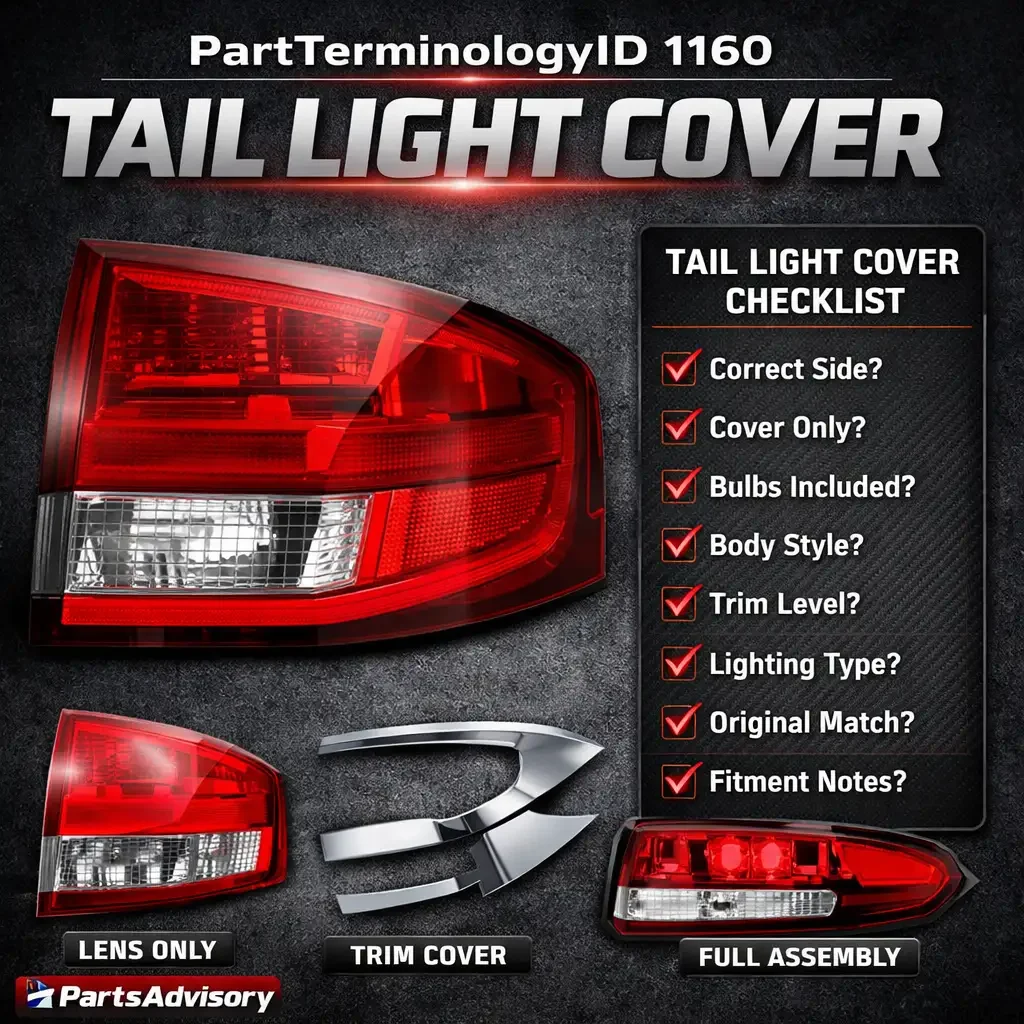
In most aftermarket catalog contexts, a Tail Light Cover refers to a component associated with the tail lamp area that is not necessarily the complete tail lamp assembly.
That is where the confusion starts.
Depending on manufacturer usage, “cover” may refer to:
The outer lens only
A decorative trim cover around the lamp
A protective overlay
A serviceable cover piece used in certain housings
A model-specific lamp access cover in some body applications
Buyers, however, often interpret “tail light” language as the complete unit. If your listing title, image, and attributes do not make the distinction obvious, you are inviting a return.
The fix is simple in principle and hard in execution. Use the exact terminology, then reinforce it with attributes, images, and notes.
Why Tail Light Cover Is a High-Confusion Catalog Term
Tail Light Cover sits in the danger zone between appearance parts and lighting assemblies. It affects both search behavior and fitment behavior.
Common naming confusion
Buyers and even some suppliers may use these terms interchangeably when they should not:
Tail light cover
Tail lamp lens
Tail lamp bezel
Tail lamp trim
Tail light housing
Tail light assembly
Those are not always the same part.
If your data feed maps a cover as an assembly, you will get orders that look great for a week and then come back as returns.
If your data feed maps an assembly as a cover, your click-through rate drops because buyers think the price is too high for “just a cover.”
Common return cause
The most common return pattern is expectation mismatch, not physical defect.
Typical buyer message:
“Did not include bulbs”
“Did not include wiring”
“Did not include full tail light”
“Does not look like my original trim”
“Wrong side”
Most of those can be prevented before checkout with better catalog structure.
Status in New Databases
Status in New Databases
PartTerminologyID: 1160
Terminology Name: Tail Light Cover
Current: PIES 7.2 + PCdb
Future: PIES 8.0 + PCdb 2.0
Status: No change
This means your core terminology label remains the same, but your team should still use this transition window to clean up synonyms, normalize attributes, and confirm product content consistency across marketplaces.
The Real Catalog Problem Is Not the Name, It Is the Missing Context
A clean part name alone is not enough for Tail Light Cover. You need supporting context in structured data and buyer-facing content.
A good listing for this part should answer these questions immediately:
Is this the left side or right side?
Is it a lens, trim cover, or another cover subtype?
Does it include bulbs, sockets, or hardware?
Is it for a body style variant such as sedan, coupe, hatchback, or wagon?
Does it fit a specific trim package or lighting option?
Is it OE style replacement or cosmetic overlay?
If even one of those answers is unclear, the buyer fills in the blank on their own. That is when returns happen.
Compatibility Checklist for Tail Light Cover
Use this checklist in your listing copy, fitment notes, or product page bullets. It helps buyers self-qualify before purchase.
Compatibility Checklist
Confirm year, make, model
Confirm body style (sedan, coupe, hatchback, wagon, SUV, truck)
Confirm side (driver/left or passenger/right)
Confirm whether the item is cover only or complete tail lamp assembly
Confirm whether bulbs, sockets, wiring, or hardware are included
Confirm trim level or lighting package requirements
Compare your original part shape to the listing photo
Check whether the vehicle has factory LED vs halogen rear lighting if applicable
Verify any notes for fleet, police, or export variants
Read the fitment notes before ordering, not after delivery
This is especially important for vehicles with mid-cycle changes where the rear lamp design changed but the model year range overlaps.
Catalog Checklist for Structured Data and Attributes
For catalog teams, Tail Light Cover performs best when the structured data is strict and buyer language is clear.
Catalog Checklist
Use PartTerminologyID 1160 and the exact terminology name Tail Light Cover
Do not merge this term with complete Tail Light Assembly records
Populate Position consistently (Left, Right, Rear, Outer, Inner when applicable)
Add Body Style qualifiers where fitment differs
Add Trim / Submodel qualifiers where lamp design differs
Add Lighting Technology notes if compatibility depends on LED or halogen systems
Clearly define contents included (cover only, no bulbs, no harness, no hardware unless included)
Use image sets that match the exact variant and side
Add marketplace-safe synonym language in descriptions, not in the core part type
Normalize supplier naming so “lens,” “trim,” and “cover” are not mixed into one product family without review
One of the best operational habits is to add an internal QA flag for any lighting item whose title includes “cover,” “lens,” or “bezel.” These are high-risk terms for buyer misunderstanding.
Common Buyer Scenarios and How to Prevent the Return
Scenario 1: Buyer wants a complete tail light
They search “tail light for 2015 [vehicle]” and your Tail Light Cover listing appears. The image is close enough to a full assembly that they order it.
Prevent it by:
Use a title and first bullet that explicitly says Cover Only. If possible, include a second product image that shows exactly what is included.
Scenario 2: Buyer orders the wrong side
They choose quickly and do not notice LH or RH abbreviations.
Prevent it by:
Spell out Driver Side (Left) or Passenger Side (Right) in the title and bullets. Avoid relying on abbreviations only.
Scenario 3: Buyer has a trim-specific lamp design
Same model year, different trim package, different rear lamp shape.
Prevent it by:
Use trim and submodel filters in fitment. Add fitment notes that call out the trim explicitly.
Scenario 4: Buyer expects bulbs or sockets
They assume a lighting part includes all electronics.
Prevent it by:
Add a clear contents statement: “Bulbs and wiring not included” if that is the case.
Scenario 5: Buyer compares only by year range
They see “2012-2016” and skip the body style note.
Prevent it by:
Repeat the body style requirement in more than one place. Title, bullets, and fitment notes should all reinforce it.
Naming Best Practices for Marketplaces and PDPs
This part category performs better when your content strategy separates catalog truth from search behavior.
In your catalog
Keep the part type precise:
Tail Light Cover
In your listing title and bullets
Add buyer-friendly clarifiers:
Tail Light Cover, Driver Side, Cover Only
Rear Lamp Cover, Passenger Side, No Bulbs Included
Fits Sedan Only, Not Wagon
In your product description
Use synonyms carefully for discoverability, but anchor the true part type:
“Also commonly searched as tail lamp lens or rear light cover, but this listing is for the cover component only, not the complete lamp assembly.”
That one line can prevent a lot of false expectations.
FAQ
Is a Tail Light Cover the same as a tail light assembly?
No. In most cases, a Tail Light Cover is not the complete assembly. It may be the outer cover, lens, or a related cover component. Always check what is included.
Does a Tail Light Cover include bulbs or wiring?
Usually not, unless the listing clearly says so. Most return issues happen when buyers assume bulbs or wiring are included.
Why do some listings use tail lamp and tail light interchangeably?
Because buyer search behavior is inconsistent. Catalog teams often need search-friendly wording, but the structured part type should stay accurate.
Can the same year vehicle have different tail light cover fitments?
Yes. Trim level, body style, and lighting package can change the rear lamp design. That is why year, make, and model alone is not always enough.
Should I list “LH/RH” or spell out left and right?
Spell it out. Use Driver Side (Left) or Passenger Side (Right). It reduces mistakes and support tickets.
What is the biggest catalog mistake with Tail Light Cover?
Mixing it with complete tail lamp assemblies in the same product family or using the wrong primary image. That creates expectation mismatch and drives returns.
Final Takeaway for Catalog Teams and Sellers
PartTerminologyID 1160 Tail Light Cover is a great example of how a small wording issue becomes a real operational problem. The part itself is not the issue. The missing context is.
If you want fewer returns and cleaner buyer experiences, focus on three things:
Precise terminology in the catalog
Clear inclusion notes in the listing
Strong fitment qualifiers for side, body style, and trim
When those three are aligned, Tail Light Cover listings stop behaving like risky lighting items and start performing like predictable catalog products.