
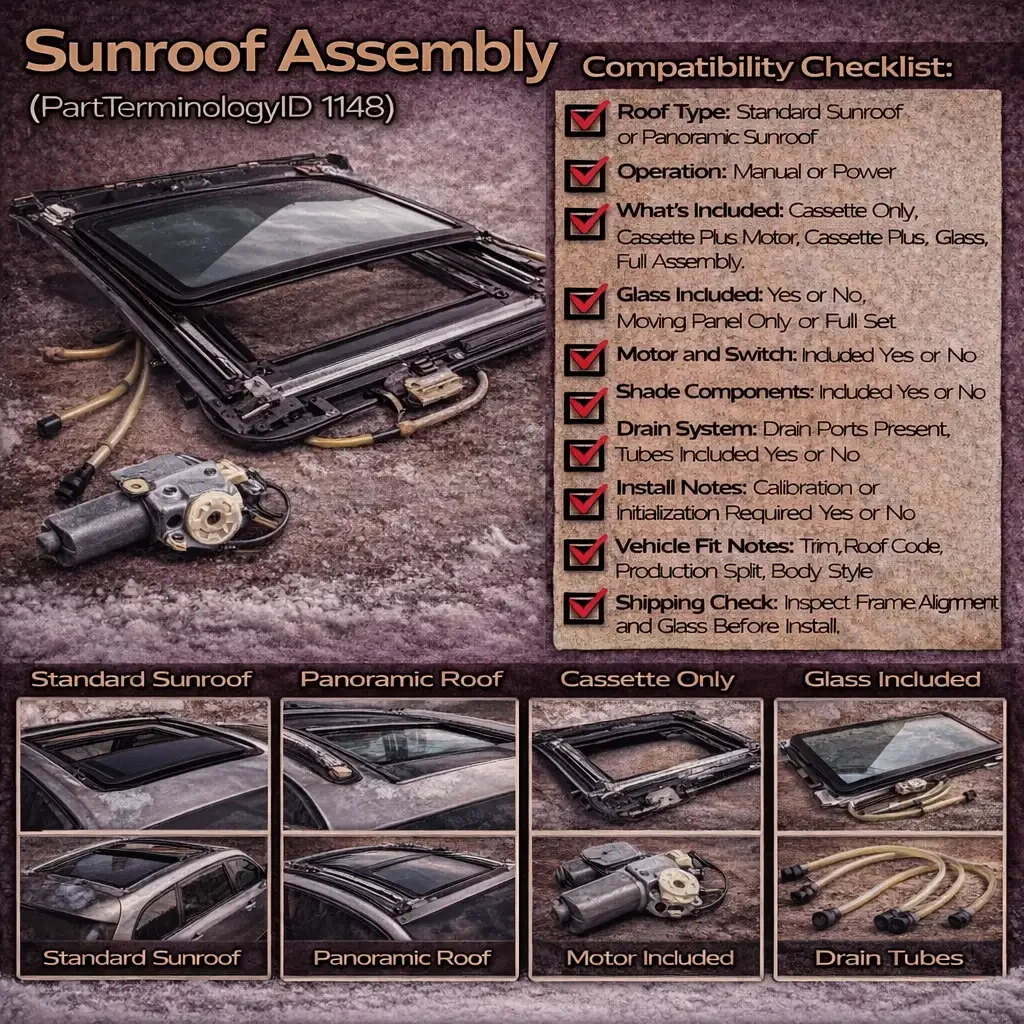
Sunroof Assembly is one of those part names that sounds clear until you try to list it.
Buyers often search "sunroof" when they actually need one specific piece:
glass only
motor
track
switch
shade
seal
full cassette assembly
That is why this category creates expensive returns. It is not just a shipping issue. It is a naming issue.
A correct Sunroof Assembly listing has to define:
what is included
which roof type it fits
manual or power operation
standard or panoramic configuration
drainage and calibration requirements
If those are missing, the buyer receives something that looks close but does not solve the real problem.
This is the PartsAdvisory field guide for PCdb PartTerminologyID 1148: Sunroof Assembly.
Status in New Databases
PartTerminologyID: 1148
Terminology Name: Sunroof Assembly
Current: PIES 7.2 + PCdb
Future: PIES 8.0 + PCdb 2.0
Status: No change
What people call this part
Customers use a lot of overlapping names in this category.
Common names:
sunroof assembly
moonroof assembly
sunroof module
sunroof cassette
roof module
sunroof unit
sliding roof assembly
panoramic roof assembly
sunroof mechanism
sunroof frame assembly
Commonly confused with:
sunroof glass only
sunroof motor
sunroof switch
sunroof shade
headliner
weatherstrip or seal
roof panel skin
drain tubes
Quick rule for listings:
If it is the full mechanical unit with frame and tracks, call it assembly or cassette clearly in the first line.
What a Sunroof Assembly actually is
A Sunroof Assembly is usually the complete roof opening module that manages movement, sealing, and drainage.
Depending on vehicle design, an assembly may include:
frame or cassette structure
tracks and guides
lift arms
sliding mechanism
motor (sometimes)
rails and brackets
drain channels and drain outlets
sometimes glass panel
sometimes shade components
sometimes none of the trim pieces
This is the main problem in the category:
One seller says "assembly" and means frame plus tracks only.
Another says "assembly" and means frame plus motor plus glass.
You have to define contents clearly.
The Sunroof Assembly family tree
1) Standard sunroof assembly
Smaller roof opening, usually one movable glass panel.
Typical buyer intent:
Repair leaks, stuck operation, or broken tracks.
Return trigger:
Buyer expects glass included when only the mechanism is sold.
2) Panoramic sunroof assembly
Larger system, often two glass panels with one moving panel and one fixed panel, plus a larger shade system.
Typical buyer intent:
Major repair after track failure or water leak.
Return triggers:
buyer expects full panoramic glass set
buyer expects shade included
buyer underestimates installation complexity
Panoramic systems are a big category and should be treated like a different product family in the listing.
3) Manual sunroof assembly
Less common on newer vehicles, but still important in older models and some markets.
Return trigger:
Buyer expects electric operation or motor mounts.
4) Power sunroof assembly
Motorized system with switch control and often anti pinch logic.
Return trigger:
Buyer assumes motor and switch are included.
5) Cassette only vs complete assembly with glass
This is the biggest mismatch point in the whole category.
Cassette only usually means frame, tracks, mechanism
Complete assembly may include cassette plus glass plus motor
Some listings say "complete" and still exclude shade or switch
If you do not spell this out, returns are almost guaranteed.
Why sunroof assemblies fail
This section helps buyers and also improves trust because it sounds like real repair experience.
Common failure points:
broken track guides
bent lift arms
stripped cables
failed motor
jammed slide mechanism
drain clogging and water intrusion
cassette frame distortion
seal shrinkage or damage
shade track issues on panoramic roofs
Important buyer education:
A leak is not always bad glass or bad seal. Very often it is a blocked drain or misaligned assembly.
Water leaks and drain tubes, the part buyers overlook
This is a major reason Sunroof Assembly needs a stronger post.
Sunroof systems are designed to handle some water. They manage it through drains.
Typical drain system:
front left drain
front right drain
rear left drain
rear right drain (varies by design)
What causes leaks:
clogged drains
disconnected drain tube
cracked drain outlet
cassette misalignment
damaged seal or frame
prior body repair issues
Catalog point:
Even if you sell the assembly, your listing should remind buyers to inspect drain routing and connections during install.
Motor, switch, and electronics, what must be stated
For power assemblies, buyers need exact content details.
List clearly:
motor included yes or no
motor part number or cross reference if known
switch included yes or no
control module included yes or no
anti pinch support or calibration requirements (if applicable)
Common return story:
Buyer receives a perfect cassette and then realizes the old motor was the actual failure. Or the opposite.
Clear "what is included" language prevents this.
Standard sunroof vs panoramic, a huge difference in buyer expectations
A panoramic roof is not just a larger sunroof. It is a more complex system with:
more rails
more moving components
longer drainage paths
larger shades
more trim interactions
higher shipping damage risk
This affects listing quality:
standard sunroof content should focus on cassette, motor, glass
panoramic content should also address shade compatibility, front and rear panel configuration, and shipping inspection steps
If the part is panoramic, say Panoramic Sunroof Assembly in the title.
Fitment reality, roof systems are trim sensitive
Sunroof assemblies are one of the most trim-sensitive categories in body and roof parts.
Fitment can change by:
body style
roof type
trim level
production date
panoramic vs standard
switch and module configuration
rain sensor and related roof harness packaging on some vehicles
This is why make, model, and year alone is often not enough.
Compatibility Checklist
This is the right-side panel language for the infographic and the blog format.
Every Sunroof Assembly listing should answer:
Roof Type: Standard sunroof or panoramic sunroof
Operation: Manual or power
What’s Included: Cassette only, cassette plus motor, cassette plus glass, full assembly
Glass Included: Yes or no, moving panel only or full set
Motor and Switch: Included yes or no
Shade Components: Included yes or no
Drain System: Drain ports present, tubes included yes or no
Install Notes: Calibration or initialization required yes or no
Vehicle Fit Notes: Trim, roof code, production split, body style
Shipping Check: Inspect frame alignment and glass before install
That checklist is the difference between a successful roof repair and an expensive return.
Catalog checklist for PartTerminologyID 1148
If you want this category to behave in feeds and marketplaces, capture these fields:
PartTerminologyID 1148
Roof type: standard / panoramic
Operation type: manual / power
Assembly scope: cassette only / assembly with motor / assembly with glass / full kit
Glass included: yes or no
Moving panel only or multi panel
Motor included: yes or no
Switch included: yes or no
Control module included: yes or no
Shade included: yes or no
Drain ports present: yes or no
Drain tubes included: yes or no
Calibration required: yes or no
Notes: production date split, trim level, body style
This is a category where "complete" is not a real attribute. Structured contents are.
Common buyer scenarios and the right recommendation
Scenario 1: Sunroof opens crooked or binds
Most likely need:
cassette or track mechanism inspection
guide and rail components
possible full assembly if tracks are damaged
Why:
Motor replacement alone will not fix broken rails.
Scenario 2: Water leak into headliner
Most likely need:
drain inspection first
drain tube reconnection or cleaning
cassette alignment check
seal inspection
Why:
Many leaks are drainage issues, not glass failure.
Scenario 3: Panoramic roof stopped moving
Most likely need:
motor and module diagnosis
track inspection
shade mechanism check
exact panoramic assembly identification
Why:
Panoramic systems fail in multiple places and buyers often order the wrong major part first.
Scenario 4: Collision roof damage repair
Most likely need:
full assembly verification
frame alignment check
glass panel inspection
drain routing and seal integrity review
Why:
Even slight roof distortion can affect sunroof operation and leaks.
FAQ
Is a sunroof assembly the same as sunroof glass?
No. The assembly is usually the full mechanism and frame. Glass may or may not be included.
What is a sunroof cassette?
It is the structural frame and track mechanism that mounts into the roof opening. Some cassettes include motor or glass, some do not.
Can a clogged drain cause a leak even if the sunroof closes fully?
Yes. That is one of the most common causes of sunroof leaks.
Do panoramic and standard sunroof assemblies interchange?
No. They are different systems and should be treated as separate categories.
Will a used or salvage assembly work?
Sometimes, but frame alignment, track wear, and drain condition are critical. This is a high-risk category for hidden damage.