
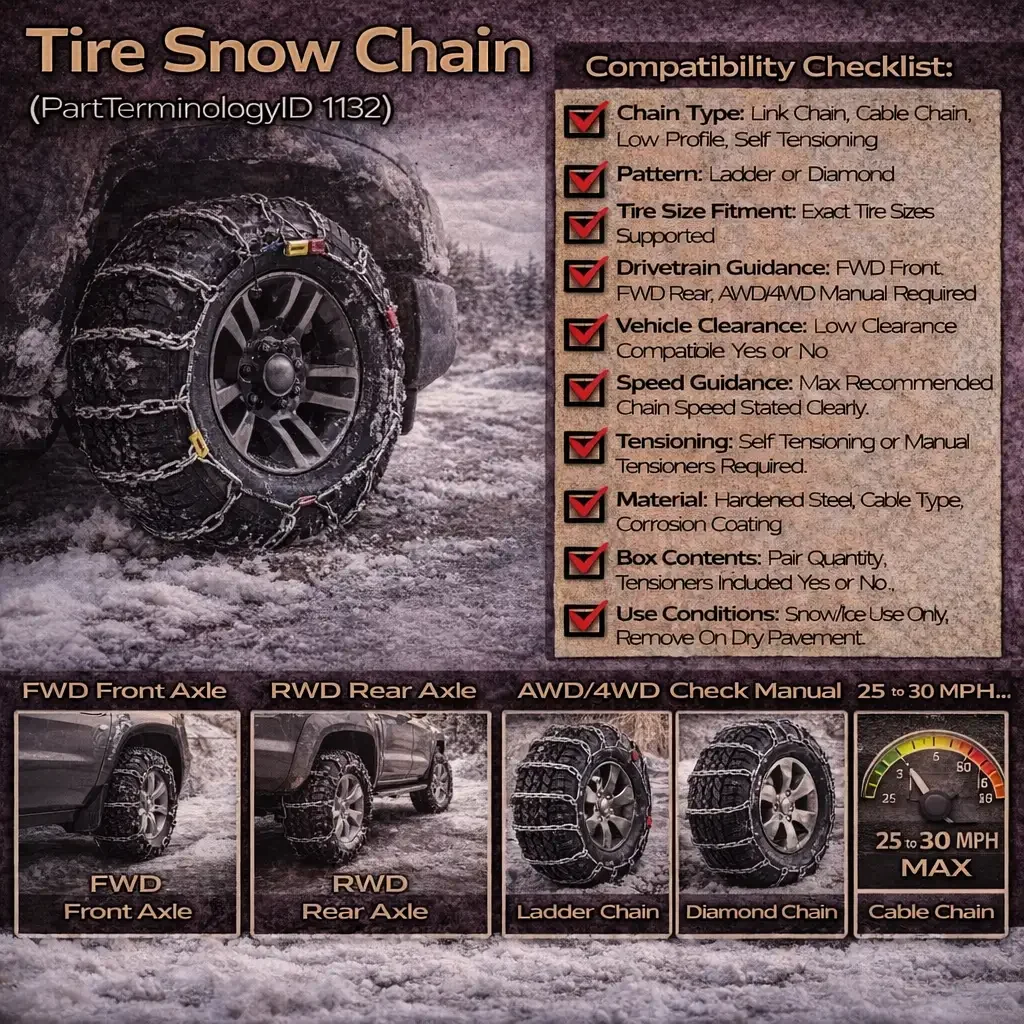
Tire Snow Chain is one of the most important winter categories because a bad choice is not just a return.
It can become:
a broken chain
body damage inside the wheel well
brake line damage
ABS sensor wire damage
loss of traction when the buyer thought they were getting more traction
This category looks simple from a distance. It is not.
A snow chain purchase is really a combination of:
tire size fitment
drivetrain layout
vehicle clearance
chain style
road conditions
safe speed limits
If any one of those is wrong, the product can be "correct" on paper and still fail in the real world.
This is the PartsAdvisory field guide for PCdb PartTerminologyID 1132: Tire Snow Chain, built for the exact problem you mentioned, especially 2WD vs 4WD and how fast you can actually drive with chains.
Status in New Databases
PartTerminologyID: 1132
Terminology Name: Tire Snow Chain
Current: PIES 7.2 + PCdb
Future: PIES 8.0 + PCdb 2.0
Status: No change
What buyers call this part
Customers search a lot of different names for the same category.
Common names:
snow chains
tire chains
winter tire chains
ice chains
link chains
cable chains
traction chains
emergency chains
truck snow chains
SUV tire chains
Commonly confused with:
tire cables
snow socks (textile traction devices)
studded tires
winter tires
traction boards
Important catalog point:
Tire chains and tire cables are often grouped together by shoppers, but they behave differently in ride quality, durability, and clearance. If your listing does not separate them, you create expectation problems.
The first question, 2WD or 4WD/AWD
This is the section every listing and every blog in this category should force up front.
A buyer cannot safely choose chains until they know:
Which wheels drive the vehicle
Which axle has clearance
What the owner manual allows
For FWD (front wheel drive)
Most common rule:
Put chains on the front tires.
Why:
Front wheels provide both drive and steering.
Chaining the front gives the biggest improvement in control for most FWD vehicles.
Risk if done wrong:
Chaining rear only on FWD can improve some stability, but it does not solve forward traction or steering the way front chains do.
For RWD (rear wheel drive)
Most common rule:
Put chains on the rear tires.
Why:
Rear wheels are the drive axle.
This is where you need traction to move and climb.
Risk if done wrong:
Chaining front only on RWD can improve some steering feel, but it does not fix drive traction.
For AWD and 4WD
This is where people get overconfident.
A lot of buyers think AWD means no chains. Then they meet mountain chain control and find out the opposite.
General rule:
Follow the owner manual first.
Many AWD and 4WD systems recommend chains on a specific axle.
Some allow chains on all four tires.
Some vehicles have such tight clearance that they require low profile chains or prohibit certain chain types.
Important truth for your blog:
AWD helps you go. It does not eliminate the need for chains in chain control zones, and it does not help you stop like chains do on ice.
How fast can you drive with snow chains
This is one of the most important buyer education points in the category.
Typical safe chain speed
Most chain manufacturers and vehicle guidelines keep snow chain speeds in the low speed range, commonly around:
25 mph
30 mph max
Some products may specify different limits, but the theme is the same:
Chains are for controlled traction, not normal speed driving.
Why speed matters so much
Driving too fast on chains can cause:
chain breakage
chain slap against fenders
damage to brake components
damage to wheel speed sensor wiring
loss of chain tension
tire damage
The rule buyers need in plain language
If chains are on, slow down.
If the road is clear and dry, remove them as soon as it is safe.
That one sentence prevents a lot of expensive damage.
The Tire Snow Chain family tree
This category has more variation than most buyers realize.
1) Link chains (traditional metal chains)
This is what most people picture first.
Common styles:
ladder pattern
diamond pattern
Ladder pattern
Cross chains run straight across the tire
Often strong and common for trucks and utility use
Can ride rougher
Diamond pattern
More continuous contact across the tread
Usually smoother and better for steering feel
Popular for passenger vehicles and SUVs
Buyer confusion:
Many shoppers only compare price, not pattern. Pattern changes ride quality and traction feel.
2) Cable chains (tire cables)
Lower profile option, often used when clearance is tight.
Pros:
easier clearance on modern cars
lighter
easier to store
Cons:
typically less aggressive traction than true chains
often less durable in hard use
not ideal for deep snow and repeated abuse
Buyer confusion:
Customers buy cables expecting heavy duty truck chain performance.
3) Self tensioning chains
These include a mechanism that helps maintain proper tension.
Pros:
easier installation
less chance of loose chain damage
good for occasional users
Cons:
more expensive
moving parts can wear
Buyer confusion:
Some people assume "self tensioning" means zero setup. It still needs correct fitment and inspection.
4) Manual tension chains
Require separate tensioners or careful manual tightening.
Pros:
lower cost
common in work and fleet use
Cons:
more user error
loose chains can destroy wheel well parts
5) Low profile chains (Class S style fitment use case)
For vehicles with tight clearance, especially passenger cars.
Important:
This is a fitment and clearance issue, not just a marketing phrase. A buyer can have the correct tire size and still buy the wrong chain if the chain profile is too bulky.
Chain placement, what to chain on AWD and 4WD
This needs special attention because people argue about it every winter.
"Do I need chains on all four tires?"
Sometimes yes, sometimes no.
What decides it:
owner manual
chain law or road control requirements
transfer case or AWD system sensitivity
physical clearance
Why manual guidance matters
Some AWD vehicles are very tight around:
struts
brake lines
inner fender liners
wheel speed sensors
Some manuals specify:
front only
rear only
all four
no chains, use cables only
no chains on certain wheel sizes
If your post teaches one thing, teach this:
Tire size fit alone is not enough. Vehicle clearance and manual restrictions matter just as much.
Tire size fitment is necessary, but not enough
Most chain returns happen because the buyer matched the tire size but ignored everything else.
What "fits your tire size" actually means
It means the chain circumference matches the tire dimensions.
It does not automatically mean:
it clears the suspension
it clears the brake hose
it clears the wheel well liner
it clears aftermarket wheels and offsets
it is approved by the vehicle manufacturer
Aftermarket wheel and tire changes make this worse
Lift kits, wider tires, different offsets, and larger wheel packages can change clearance dramatically.
A chain that fit a stock setup can become dangerous on a modified setup.
Materials, durability, and corrosion
Snow chains live in the worst environment possible:
water
salt
slush
road grit
freezing and thawing cycles
Common construction differences:
hardened steel links
case hardened links
zinc coated components
rubber tensioners
steel cable cores (for cable chains)
Buyer education point:
Even good chains rust if stored wet. That is not always product failure. It is often storage failure.
Best practice advice for your blog:
Rinse, dry, and store after use.
Real world install mistakes that cause damage
This section is gold for a PartsAdvisory post because it saves buyers from expensive mistakes.
Mistake 1: Installing chains loosely
Loose chains can whip and slap the wheel well.
Damage can include:
torn liners
cut sensor wires
bent brackets
damaged brake hoses
Mistake 2: Not rechecking tension after first movement
Buyers install, drive 100 feet, and assume it is fine.
Better practice:
Drive slowly a short distance, then stop and recheck tension.
Mistake 3: Driving on dry pavement too long
Chains are for snow and ice traction. Dry pavement creates:
rapid wear
heat
vibration
breakage risk
Mistake 4: Buying aggressive chains for a low clearance vehicle
Even if the tire size matches, sidewall and inner clearance may not.
Mistake 5: Installing on the wrong axle
2WD placement errors are common and make the vehicle feel unstable or ineffective.
Speed, handling, and braking expectations
Buyers often think chains make the vehicle "normal" again. They do not.
Chains improve traction, but they also change:
steering feel
braking distance on mixed surfaces
ride quality
vehicle vibration
noise level
What to teach clearly
Chain speed is low speed only
Smooth inputs matter
No hard acceleration
No sudden braking
No high speed lane changes
This is especially important for truck owners who feel confident in 4WD and accidentally overdrive conditions.
Compatibility Checklist
For your new image style and post format, this should be the right side section header for 1132.
Every Tire Snow Chain listing should answer:
Chain Type: Link chain, cable chain, low profile, self tensioning
Pattern: Ladder or diamond
Tire Size Fitment: Exact tire sizes supported
Drivetrain Guidance: FWD front, RWD rear, AWD/4WD manual required
Vehicle Clearance: Low clearance compatible yes or no
Speed Guidance: Max recommended chain speed stated clearly
Tensioning: Self tensioning or manual tensioners required
Material: Hardened steel, cable type, corrosion coating
Box Contents: Pair quantity, tensioners included yes or no, storage bag included yes or no
Use Conditions: Snow/ice use only, remove on dry pavement
That checklist is the difference between a winter safety product and a winter return product.
Catalog checklist for PartTerminologyID 1132
If you are building structured data for feeds and marketplaces, capture these fields:
PartTerminologyID 1132
Product type: chain or cable
Pattern type: ladder or diamond
Tire sizes supported (full list)
Clearance class / low profile suitability
Drivetrain placement guidance
AWD/4WD note: follow vehicle manual
Max recommended speed
Tensioner included yes or no
Self tensioning yes or no
Pair quantity
Material / coating
Install notes and re-tension reminder
This category absolutely needs stronger attributes than a normal accessory listing.
Common buyer scenarios and the right recommendation
Scenario 1: FWD sedan going to the mountains once a year
Best fit:
low profile chain or cable if vehicle clearance is tight
easy install or self tensioning preferred
Why:
Occasional users need simplicity and clearance safety more than heavy duty performance.
Scenario 2: RWD truck in snow country
Best fit:
true link chains, often heavier duty
clear rear axle fitment guidance
strong tensioning system
Why:
Truck owners often need repeat use and more aggressive traction.
Scenario 3: AWD SUV with mountain travel
Best fit:
chain option approved by owner manual
low profile if required
exact speed guidance and install instructions
Why:
AWD buyers are often surprised by chain requirements and clearance limits.
Scenario 4: Commercial or fleet use
Best fit:
durable link chains
easy replacement parts
consistent sizing and clear labeling
training on installation and retension
Why:
Fleet damage from one loose chain costs more than buying better chains.
FAQ
Do I put chains on all four tires on a 4WD or AWD vehicle?
Sometimes, but not always. Follow the owner manual first. Some vehicles require a specific axle or low profile chains only.
What is the safe speed with snow chains?
Keep speeds low. Many chain products are around 25 to 30 mph max. Follow the chain manufacturer guidance and local road restrictions.
Can I drive on dry pavement with chains?
Only as little as necessary. Dry pavement increases wear and breakage risk quickly.
Are cable chains the same as regular chains?
No. Cables are usually lower profile and smoother, but often less aggressive and less durable than true link chains.
Why did my chain break?
Common causes are loose installation, too much speed, dry pavement use, or wrong clearance for the vehicle.