
Running Board (PartTerminologyID 1108): The Complete Map of Styles, Mount Types, and Fitment Reality
Written by Arthur Simitian | PartsAdvisory
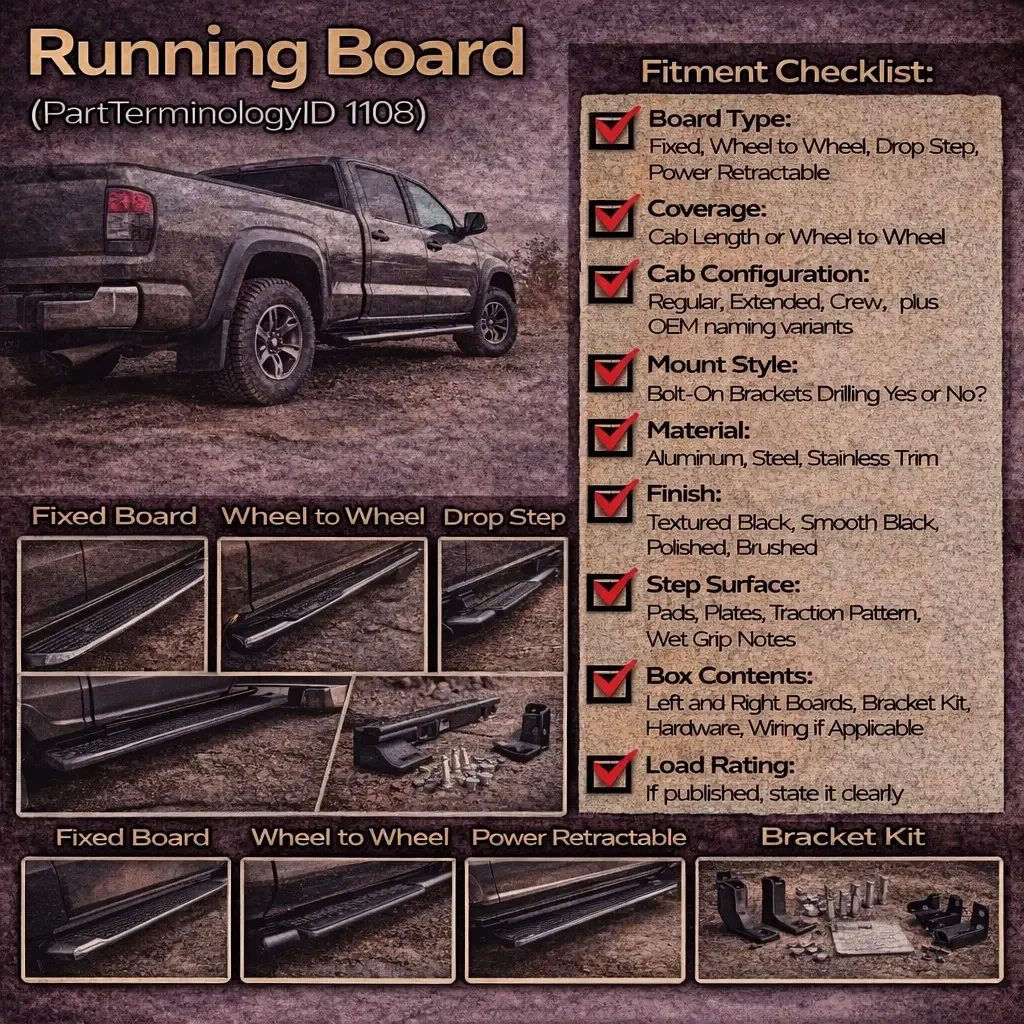
PartTerminologyID 1108, Running Board, is the side-entry step assembly mounted along the rocker panel or frame rail of a truck, SUV, or van to provide an intermediate step surface that reduces the entry and exit height for occupants and improves cargo-loading access to the bed or cargo area. That definition covers the function correctly and leaves unresolved every question that determines whether the replacement or upgrade running board fits the vehicle's frame rail or rocker mount points, aligns with the door openings of the specific cab configuration, clears the fender flares, mud flaps, and rocker trim of the specific trim level, reaches the step positions required for front and rear door access on extended and crew cab configurations, is bracketed for the specific frame geometry or body mounting points of the model year variant, provides adequate ground clearance for the vehicle's intended use, carries the required load for the occupants who will use it, and in the case of power retractable running boards, is electrically compatible with the door-open trigger circuit of the specific vehicle and control system. It does not specify the board style, whether the board is a wide flat fixed step, a wheel-to-wheel extension board, a drop-step board for lifted vehicles, or a power retractable motorized step assembly, the board length and whether it spans the cab length only or extends wheel to wheel, the mount style, whether it uses bolt-on frame rail brackets, rocker-panel clamp brackets, existing factory holes, or requires drilling, the cab configuration compatibility, whether the board is designed for a regular cab, an extended cab with rear access doors, or a full crew cab with four full-size doors, the material, the finish, the step surface traction type, the load rating, the bracket configuration, what hardware and wiring are included, whether left and right boards are sold as a pair or individually, or any of the compatibility notes that prevent interference with fender flares, mud flaps, jacking points, or rocker panel trim. A listing under PartTerminologyID 1108 that provides vehicle year, make, and model without the cab configuration, the board style, the mount style, the material, the finish, and the selling unit cannot be evaluated by any buyer who is comparing two boards for the same vehicle and needs to confirm which one aligns with the door openings, clears the existing trim, and comes with the brackets.
For sellers, PartTerminologyID 1108 is one of the highest-volume truck and SUV accessory categories on every major marketplace, and one of the highest-return categories precisely because the volume creates pressure to simplify listings to vehicle fitment and a single style descriptor. That simplification fails the moment the buyer with a crew cab orders a board listed only by model year and discovers the step pads align with the front doors only because the board was designed for a regular cab, or the buyer with factory fender flares discovers the board sticks out past the flare line because the listing did not state the board's outboard projection. Both returns are generated by listings that have adequate vehicle fitment data and inadequate product specification data.
The additional complexity specific to PartTerminologyID 1108 compared to most other truck accessory PartTerminologyIDs is the cab configuration argument. Running board compatibility is not determined by vehicle year, make, and model alone. It is determined by the intersection of the vehicle's cab configuration and the board's step pad placement along its length. A board designed for a regular cab places its step surface directly below the single door opening on each side. The same board mounted on a crew cab with four full-size doors will have its step surface under the front doors but no step surface under the rear doors, leaving the rear passengers with no usable step point. The cab configuration is not a secondary refinement attribute: it is the primary fitment attribute for this PartTerminologyID, as important as the vehicle year and model.
For sellers, the listing under this PartTerminologyID is only useful if it specifies the board style, the cab configuration compatibility, the mount style, the board length or coverage designation, the material and finish, the step surface type, the load rating, the bracket inclusion, and the selling unit. Without those nine attributes, the listing cannot prevent the cab-length mismatch, the fender flare interference, or the power board wiring incompatibility that generate the highest-volume returns in this category.
What the Running Board Does
Providing a stable intermediate step for vehicle entry and exit
Modern trucks and SUVs have raised significantly in rocker panel height over successive generations, driven by increased ride height, larger wheel and tire combinations, and frame-mounted body designs that sit higher than unibody equivalents. A full-size crew cab truck with a factory suspension lift or an aftermarket level kit may have a rocker panel sill height of 500 to 600mm above the ground, requiring a substantial step up for shorter occupants, children, and anyone carrying cargo. The running board reduces this effective step height by providing a stable platform at approximately 350 to 450mm from the ground, creating a two-step entry sequence from the ground to the board to the cab floor.
The board's step surface must be positioned both horizontally and vertically relative to the door opening to function correctly. The horizontal outboard extension of the board surface determines how far the occupant's foot travels outboard before stepping up into the cab. A board that extends too far outboard from the rocker panel requires the occupant to step further out before stepping up, increasing the effective reach. A board that sits too close to the rocker panel does not provide adequate clearance for the occupant's foot during the step-up motion.
The vertical height of the board surface above the ground must be low enough to provide a meaningful reduction in step height compared to stepping directly into the cab, but high enough to clear road obstacles, curbs, and off-road terrain without grounding during normal operation. Fixed boards typically sit at a height determined by the bracket geometry and cannot be adjusted after installation. Adjustable bracket designs allow the board height to be set within a range during installation, which is particularly relevant for lifted vehicles where the factory bracket geometry positions the board too low relative to the raised rocker panel.
The cab configuration and step pad placement argument
The most common mismatch in PartTerminologyID 1108 is a board designed for one cab configuration installed on a different cab configuration. The three primary cab configurations on domestic trucks are the regular cab with a single row of seating and two front doors, the extended cab with a front row and a smaller rear row accessed through rear-hinged half doors or smaller rear-opening doors, and the crew cab with two full rows of seating and four full-size doors of approximately equal width.
A board sized for a regular cab is typically 1,200 to 1,500mm long, with its step pad or step surface centered below the single door opening. On a crew cab, the distance from the front door leading edge to the rear door trailing edge is typically 1,600 to 1,900mm depending on the vehicle model. A regular-cab-length board mounted on a crew cab provides a step surface under the front door opening but leaves the rear door area without any step, placing the rear passengers at the full unassisted rocker height.
A board sized for a crew cab carries step pads at two positions along its length: one below the front door opening and one below the rear door opening. The distance between these pad positions is specific to the vehicle model's door opening geometry. A crew cab board from one vehicle manufacturer may have pad spacing that does not align with the door openings of a different manufacturer's crew cab, even when the board's overall length appears similar. The listing must state the cab configuration the board was designed for and the pad spacing or coverage length for that configuration.
Extended cab configurations add complexity because the extended cab designation covers multiple door arrangements across different manufacturers. Some extended cab trucks have conventional front doors and smaller rear-hinged access doors. Others have four doors of which the rear pair are smaller than the front pair. The door opening geometry and the resulting required step pad placement differ between these arrangements. A board listed for an extended cab without specifying the exact door arrangement may fit one extended cab variant and miss the rear door opening on another.
The board style and its consequences for fitment and function
Fixed standard running boards are the highest-volume board style and the simplest to specify. They are a single rigid extrusion or stamped panel in aluminum or steel with a flat or slightly crowned step surface, mounted on brackets that attach to the frame rail or rocker panel mounting points. The board length is matched to the cab configuration, the step surface is fixed at the installed height, and no moving parts or electrical connections are required. The buyer's primary specification questions are cab configuration compatibility, bracket inclusion, finish, step surface traction type, and load rating.
Wheel-to-wheel boards extend the step surface beyond the cab doors toward the truck bed, providing a continuous step from the front wheel opening to the rear wheel opening. The extended length covers the entire rocker panel area including the portion behind the rear door, which provides bed access and cargo loading assistance in addition to cab entry. Wheel-to-wheel boards are common on work-use trucks where the buyer loads materials into the bed from the side rather than from the tailgate. The fitment complexity for wheel-to-wheel boards is greater than for cab-length boards because the board must clear the rear wheel well, avoid interference with the mud flap mounting position, and accommodate any bed side trim or step pad installed at the rear of the rocker panel area.
Drop-step boards incorporate a lowered step section at one or more positions along the board's length, providing additional step height reduction for lifted trucks where the standard board height is too high relative to the elevated rocker panel. The drop section is typically 50 to 100mm lower than the board's main surface, achieved through a deeper bracket arm at that position or through a molded step element integrated into the board profile. Drop boards are specifically targeted at lifted truck applications and are not appropriate for stock-height vehicles where the standard board height already provides adequate step assistance. A stock-height buyer who orders a drop board will have the drop section closer to the ground than the standard section, creating a trip hazard where the step level changes along the board's length.
Power retractable running boards deploy from a retracted position flush with the rocker panel when the door-open signal is triggered and retract when the door closes, keeping the board out of the ground clearance envelope when not in use. The deploy trigger is typically a door-ajar signal from the door control module or a dedicated output from the body control module. Power boards require a wiring harness connection to the vehicle's electrical system and in many cases a vehicle-specific plug-and-play harness or a hardwire connection to the door-open circuit. The motor drive unit mounts to the vehicle's frame or rocker structure and requires specific mounting points that may or may not be present on the target vehicle without drilling or fabrication.
Power board fitment is a two-part specification: the physical dimensions and bracket configuration for the mechanical installation, and the wiring configuration for the electrical integration. A power board that fits the mechanical mounting points but requires hardwiring to a door circuit that is not accessible at the mounting location, or that uses a controller that requires a CAN-bus communication signal the vehicle does not provide, will complete the mechanical installation and fail at the electrical stage. The listing must specify the wiring method, the trigger source, and whether the harness is plug-and-play for the specific vehicle or requires custom wiring.
Mount style and bracket configuration
Running boards mount to the vehicle through brackets that connect the board to either the frame rail, the rocker panel, or both. The bracket design is specific to the board's intended load rating, the vehicle's structural geometry, and whether the mounting points use existing holes or require drilling.
Frame rail brackets attach to the outboard face of the frame rail using existing factory holes or through-bolted connections. They provide the highest load-bearing capacity because the frame rail is the vehicle's primary structural member, and they position the board at a height determined by the frame rail's outboard and downward geometry relative to the rocker panel. Frame rail brackets on pickup trucks and body-on-frame SUVs are the most common bracket type for standard fixed boards.
Rocker panel brackets clamp to or bolt through the rocker panel's lower flanges. They are more common on unibody SUVs and crossovers where the frame rail is integrated into the body structure and the rocker panel flange is the most accessible mounting point. Rocker panel brackets typically have lower load ratings than frame rail brackets because the rocker panel sheet metal is thinner than the frame rail.
No-drill bracket systems use existing factory holes, typically the same holes used by the factory step or rocker panel cover attachment points, to mount the board without cutting new holes in the vehicle's body or frame. No-drill brackets are preferred by buyers who are concerned about corrosion at new penetrations or who anticipate removing the boards in the future without leaving visible holes. Not all vehicles have usable existing holes at the correct positions for a given board design, so no-drill compatibility must be verified for the specific vehicle and board combination rather than assumed from the general description.
Why This Part Generates Returns
Buyers order the wrong running board because the cab configuration is not stated and a regular-cab board is installed on a crew cab leaving the rear doors without a step, the board length is stated as a nominal measurement rather than matched to the specific cab configuration producing a board that is either too short or too long for the door opening alignment, the finish is described as black without specifying whether it is textured, smooth, matte, or gloss producing a finish appearance that does not match the buyer's expectation, the board is a pair listing but the buyer interprets it as a single and orders two listings expecting four boards, the brackets are not included and the buyer does not discover this until the boards arrive without mounting hardware, the board's outboard projection conflicts with the vehicle's factory fender flares causing the board edge to sit outside the flare line, the power board wiring requires a vehicle-specific harness that is not included and is not available from the listing's seller, the drop step board is ordered for a stock-height vehicle and the drop section sits so close to the ground it contacts curbs and parking stops, and the board load rating is not stated and is insufficient for the buyer's actual use with heavy work boots and tool belt.
Status in New Databases
PIES/PCdb: PartTerminologyID 1108, Running Board
PIES 8.0 / PCdb 2.0: No change
Top Return Scenarios
Scenario 1: "Regular cab board on crew cab, rear doors have no step surface, returned as wrong part"
The listing specified a running board for the vehicle year, make, and model without stating the cab configuration. The vehicle is a crew cab with four full-size doors. The board is sized for a regular cab with step pads aligned for a single door opening on each side. After installation, the rear passengers had no usable step surface. The rear door opening aligned with an unpaddled section of the board midway along its length. The boards were returned as the wrong part for the vehicle.
Prevention language: "Cab configuration: [regular cab / extended cab / crew cab]. This running board is designed for [crew cab] applications with step pad positions at [X]mm and [X]mm from the front of the board, corresponding to the front and rear door openings of the crew cab door geometry. Verify your cab configuration before ordering. A board designed for a regular cab will not provide a step surface at the rear door opening of a crew cab. Cab configuration is the primary fitment attribute for running boards and must be confirmed independently of the vehicle year, make, and model."
Scenario 2: "Factory fender flares, board outboard projection extends past flare line, visible gap between flare and board edge"
The vehicle has factory-installed fender flares that extend 50mm outboard from the factory body line. The replacement running board has an outboard projection that positions the board edge at the factory body line rather than at the flare line. After installation, the board edge is 50mm inboard of the fender flare edge, creating a visible gap between the board and the flare that the original OE board did not have. The buyer returned the board as incompatible with the flare package.
Prevention language: "Fender flare compatibility: this board is designed for [standard body / flare package] applications. The board's outboard edge projection is [X]mm from the rocker panel centerline. If your vehicle has factory or aftermarket fender flares, verify the board's outboard projection aligns with the flare's inboard edge before ordering. Boards designed for standard-body vehicles will sit inboard of the flare edge on flare-equipped vehicles, creating a gap that the original OE board was designed to close."
Scenario 3: "Power board ordered for specific model, wiring harness requires OBD interface not included, installation incomplete"
The power retractable running board listing stated plug-and-play installation for the vehicle year, make, and model. The plug-and-play harness connects to the OBD-II port for the door-trigger signal rather than to the door-ajar circuit directly. The vehicle's OBD-II port is in a location that makes the harness routing to the board motor units impractical without additional extension cables. The listing did not state the wiring method or the harness routing path. The buyer completed the mechanical installation but could not complete the wiring without additional components not included with the boards.
Prevention language: "Wiring method: [plug-and-play harness connecting to OBD-II port / plug-and-play harness connecting to door-ajar circuit at the A-pillar / hardwire connection to door-open output at body control module / custom wiring required]. Verify the wiring method is suitable for your vehicle's OBD-II port location and your preferred routing path before ordering. The included harness is [X]mm long from the OBD-II connector to the motor unit. If your vehicle's port-to-motor routing distance exceeds this length, an extension harness is required separately."
Scenario 4: "Drop step board on stock-height truck, drop section contacts curb edges and parking stops"
The listing described the board as a drop-step design without specifying that it is intended for lifted truck applications. The buyer ordered it for a stock-height truck based on the vehicle fitment. After installation, the drop sections on the board were approximately 80mm lower than the main board surface, positioning the drop section at approximately 250mm from the ground. The board contacted the raised lips of parking stops and steep driveway aprons during normal daily driving. The buyer returned the board as defective.
Prevention language: "Board style: drop step. Intended application: lifted trucks with [X] to [X] inches of suspension lift. The drop sections on this board are [X]mm lower than the main board surface. For stock-height applications, the drop sections will be at approximately [X]mm from the ground, which may contact parking stops, curbs, and steep driveway transitions. This board is not recommended for stock-height or lightly modified vehicles."
Scenario 5: "Finish described as black, buyer expected smooth gloss, received textured matte, returned as incorrect finish"
The listing stated the board finish as black powder coat. The board has a textured matte black powder coat finish. The buyer expected smooth gloss black to match the existing smooth black body trim on the vehicle. The finish appearance did not match the buyer's expectation and the boards were returned.
Prevention language: "Finish: textured matte black powder coat. The step surface and board face have a textured grain pattern that provides grip and conceals minor scuffs. This is not a smooth or gloss finish. If your vehicle has smooth gloss black body trim and you require a finish match, verify the texture level against the existing trim before ordering. Photos are available showing the finish in natural and direct lighting."
Scenario 6: "Brackets not included, buyer assumed hardware was in the box, installation halted at bracket stage"
The listing covered the running boards only. The buyer assumed the brackets and hardware were included based on the photos, which showed the boards installed on a vehicle. The boards arrived without brackets or mounting hardware. The installation could not proceed without the brackets, which required a separate order with a two-week lead time.
Prevention language: "Box contents: [left and right running boards only / left and right boards with bracket kit / left and right boards with bracket kit and all installation hardware]. Brackets and hardware are [included / not included]. If ordering boards only, source the compatible bracket kit separately before beginning installation. Verify the bracket kit is available and in stock before ordering the boards."
Scenario 7: "No-drill installation claimed, vehicle does not have the required factory holes at the bracket positions, drilling required"
The listing claimed no-drill installation using factory holes. The vehicle is a model year variant that does not have factory holes at the rocker panel positions used by the no-drill bracket system. The factory holes are present on the standard trim level but were not included on the base trim level that omits the factory step option. The buyer drilled four holes in the rocker panel to complete the installation and returned the boards citing false no-drill advertising.
Prevention language: "Installation: no-drill for [trim levels that include the factory rocker step provision]. The no-drill bracket system uses the factory rocker panel holes provided on [specific trim levels]. Verify your vehicle's trim level includes the factory step hole provision before ordering. Base trim levels and certain regional market variants may not have these holes. If your vehicle does not have the factory step provision holes, drilling is required to install these brackets."
Scenario 8: "Wheel-to-wheel board, rear bracket conflicts with mud flap mounting position, mud flap removal required"
The wheel-to-wheel running board's rear bracket mounts at the same position on the frame rail used by the factory mud flap bracket. After installation, the mud flap cannot be remounted over the running board bracket. The listing did not mention the mud flap interference. The buyer had to choose between the running board and the mud flap, returned the board, and sourced a cab-length board that does not reach the mud flap position.
Prevention language: "Mud flap compatibility: the rear bracket on this wheel-to-wheel board mounts at the [X]mm position from the rear of the cab. Verify the rear bracket position does not conflict with your vehicle's factory or aftermarket mud flap mounting bracket before ordering. On some applications, the factory mud flap must be removed or replaced with a shorter mud flap designed for wheel-to-wheel board compatibility. A compatible mud flap option is [available / not currently available] from this seller."
What to Include in the Listing
Core essentials
PartTerminologyID: 1108
component: Running Board
board style: fixed standard, wheel-to-wheel, drop step, or power retractable (mandatory, in title)
cab configuration: regular cab, extended cab, crew cab, or specific door count (mandatory, in title)
board coverage: cab length with dimension in mm, or wheel to wheel (mandatory)
step pad count and pad spacing in mm (mandatory)
mount style: frame rail bracket, rocker panel bracket, or no-drill (mandatory)
drilling required: yes or no (mandatory)
brackets included: yes, no, or optional kit (mandatory)
hardware included: yes or no (mandatory)
material: aluminum, steel, or stainless trim insert (mandatory)
finish: textured matte black, smooth gloss black, polished aluminum, brushed stainless, or other with explicit texture description (mandatory)
step surface type: rubberized pad, molded traction plate, punched surface, or textured powder coat (mandatory)
load rating per board in kg or lbs where available (mandatory)
outboard projection in mm from rocker panel for flare compatibility assessment (mandatory)
board thickness and height profile in mm (mandatory)
fender flare compatibility note: standard body or flare package (mandatory)
mud flap compatibility note for wheel-to-wheel boards (mandatory)
ground clearance at lowest point in mm (mandatory)
selling unit: pair left and right, single left, or single right (mandatory)
power board additional fields: deploy trigger source, wiring method, harness length, manual override, winter operation note (mandatory for power boards)
weight per board in kg (mandatory)
warranty duration (mandatory)
quantity: pair or single with side designation
Fitment essentials
year/make/model/submodel
cab configuration as primary fitment attribute above bed length and trim level
trim level where factory fender flare or rocker trim package changes board compatibility
suspension lift height range where drop-step boards are appropriate
bed length where applicable to wheel-to-wheel board coverage designation
Dimensional essentials
board overall length in mm
board width top surface in mm
step pad dimensions in mm
step pad spacing from board front in mm for each pad
bracket arm drop dimension in mm
bracket arm outboard dimension in mm
board lowest point height from ground on stock-height vehicle in mm
Image essentials
pair of boards shown installed on the target cab configuration with all four doors visible in the frame
board shown from the end profile showing bracket arm drop and board height above ground
step surface shown in closeup in both dry and wet conditions for traction verification
finish shown in natural light and direct sunlight to accurately represent texture and sheen level
bracket hardware shown separated and labeled with component identification
box contents shown completely including boards, brackets, hardware, and wiring if applicable
mud flap and fender flare clearance shown from the front and rear of the vehicle for compatibility context
power board shown in deployed and retracted positions with clearance dimensions labeled
Catalog Checklist for ACES/PIES Teams
PartTerminologyID = 1108
require cab configuration as primary fitment attribute in the title (mandatory)
require board style in the title: fixed, wheel-to-wheel, drop step, or power retractable (mandatory)
require board coverage: cab length with dimension or wheel to wheel (mandatory)
require step pad count and spacing (mandatory)
require mount style and drilling required designation (mandatory)
require brackets included designation (mandatory)
require material and finish with explicit texture description (mandatory)
require step surface type (mandatory)
require outboard projection for fender flare compatibility assessment (mandatory)
require fender flare compatibility note (mandatory)
require mud flap compatibility note for wheel-to-wheel boards (mandatory)
require selling unit: pair or single with side (mandatory)
require ground clearance at lowest point (mandatory)
require load rating where available (mandatory)
for power retractable boards, require deploy trigger source, wiring method, harness length, manual override designation, and winter operation note (mandatory)
differentiate from nerf bar (PartTerminologyID varies): nerf bars are tube-style steps with individual step pads at discrete positions; running boards are wide flat continuous step surfaces; buyers use both terms interchangeably but the products have different profiles, different cab coverage, and different aesthetic presentations; they must not share a PartTerminologyID
differentiate from step bar: step bars are round or oval tube designs with a wider step pad area than nerf bars but narrower than running boards; the step surface is padded at discrete positions rather than continuous; distinguish from running boards in the title
differentiate from running board mounting bracket: the bracket is the hardware that connects the board to the frame or rocker; it is a separate component listed under its own PartTerminologyID; always state bracket inclusion status in the running board listing
flag cab configuration as the most consequential return driver: a board with correct vehicle year, make, and model fitment but wrong cab configuration will have step pads in the wrong positions for the buyer's door openings; this is the highest-volume mismatch scenario and is entirely preventable by one attribute in the title
flag finish texture description as mandatory: black powder coat running boards returned for finish appearance mismatch represent a significant fraction of appearance-related returns; the texture level must be stated explicitly in the first lines of the listing description, not discovered from photos
flag bracket inclusion as mandatory: a buyer who installs mounting brackets to complete a previous installation before ordering new boards will receive the correct boards and be unable to mount them if the new boards require a different bracket configuration that is not included
FAQ (Buyer Language)
Are running boards and nerf bars the same thing?
No. Running boards are wide, flat continuous step surfaces that run the length of the cab. The step surface is typically 100 to 150mm wide and spans from the front door to the rear door on the applicable cab configuration. Nerf bars are tube-style steps with individual rubber or aluminum pads at the front and rear door positions. The step surface is narrower and the tube design is a more aggressive styling choice. Both serve the same entry assistance function but have different appearances, different step surface areas, and different bracket configurations. Search for the specific style you want rather than using the terms interchangeably.
How do I confirm the correct cab configuration for my truck?
Count the full-size doors. Two full-size doors is a regular cab. Two full-size front doors and two smaller rear doors that open in the reverse direction or have a smaller window is an extended cab. Four doors of approximately equal size is a crew cab. Confirm by checking the vehicle title, the door jamb sticker, or the manufacturer's website with the VIN. Aftermarket running boards list cab configurations by their common names, which may differ slightly from the manufacturer's proprietary cab name: what Ford calls a SuperCrew is a crew cab, and what Ram calls a Crew Cab is the same configuration.
Do I need to remove my mud flaps to install running boards?
For standard cab-length boards, usually not. The rear bracket on a cab-length board typically mounts forward of the rear mud flap position. For wheel-to-wheel boards, the rear bracket may conflict with the factory mud flap mounting position depending on the board design. Verify the rear bracket position against your mud flap mounting location before ordering a wheel-to-wheel board. Some wheel-to-wheel board manufacturers offer a compatible replacement mud flap designed to work alongside the rear bracket.
Will running boards fit my truck if it has a lift kit?
It depends on the lift height and the board type. A standard fixed board on a truck with 2 inches of lift will have a slightly lower effective step height than on a stock truck, which is generally desirable. A truck with 4 or more inches of lift may benefit from a drop-step board that positions the step surface lower relative to the raised rocker panel. For very high lifts above 6 inches, the factory bracket geometry may position any standard board too low to provide useful step assistance, and a custom bracket length may be required. Verify the installed board height above the ground for your specific lift height before ordering.
How much weight can running boards hold?
Load ratings vary by board and are not always published by the manufacturer. When published, most aluminum fixed boards have static load ratings of 200 to 300 lbs per board. Steel boards typically have higher load ratings. Dynamic load ratings, which account for the shock load from a person stepping onto the board from a jump, are lower than static ratings. If you will be using the boards to climb into a lifted truck with heavy work gear, specify a board with a published load rating rather than ordering one without the rating and assuming it is adequate.
Do power running boards work reliably in winter conditions?
Power retractable boards are designed to work in winter conditions, but ice accumulation between the board and the rocker panel in the retracted position can impede deployment. Most power board designs include a motor with sufficient torque to break light ice accumulation at deployment. Heavy ice from overnight freezing rain or deep snow packing into the retracted mechanism requires manual clearing before the board will deploy normally. Most power boards include a manual override that allows the board to be deployed by hand if the motor cannot break the ice accumulation. Verify the manual override capability before ordering if your climate regularly produces overnight ice accumulation on vehicle body panels.
What is the difference between a cab-length and a wheel-to-wheel board?
A cab-length board spans from the front wheel well to the rear of the rear door, covering the cab area only. A wheel-to-wheel board extends from the front wheel well to the rear wheel well, covering the full rocker panel area including the space behind the rear door. The wheel-to-wheel extension provides a step surface for bed access and rear-of-cab cargo loading in addition to cab entry assistance. Wheel-to-wheel boards are longer and heavier than cab-length boards, have a rear bracket that mounts further back along the frame rail, and may conflict with rear mud flap positions. If you load cargo into the truck bed from the side rather than strictly from the tailgate, a wheel-to-wheel board is the more functional choice.
Cross-Sell Logic
Running Board Mounting Bracket (if the listing covers boards only without brackets, the bracket kit is the immediate cross-sell; state the compatible bracket kit part number in the board listing)
Nerf Bar (buyers who research running boards frequently compare nerf bars as an alternative style; a clean cross-reference between the two styles helps buyers who want a more aggressive tube-step appearance rather than a wide flat board)
Mud Flap (for wheel-to-wheel boards that require mud flap removal or replacement, cross-reference a compatible mud flap designed for wheel-to-wheel board applications)
Fender Flare (buyers adding running boards to a flare-equipped vehicle may be building out a full exterior package; the fender flare listing is a logical companion to the running board for the same vehicle)
Bed Step (buyers concerned about bed access who consider a wheel-to-wheel board may alternatively prefer a dedicated tailgate step or bed step that provides bed access without the full running board installation)
Power Running Board Controller (for power retractable board installations, the replacement controller is the highest-value service part and should be cross-referenced in the power board listing)
Frame as "the running board is the step between the ground and the cab. The bracket holds the board at the correct height and angle. The step surface keeps the occupant's foot from slipping. The cab configuration determines where the step pads need to be. Everything in the installation is in service of one moment: the step from the ground to the seat."
Final Take for PartTerminologyID 1108
Running Board (PartTerminologyID 1108) is the truck and SUV accessory PartTerminologyID where the cab configuration in the title is the single attribute that prevents the highest-volume return category in the entire accessory catalog: a board with correct vehicle fitment and wrong step pad placement for the buyer's cab configuration. A crew cab buyer who receives a regular cab board has four correctly manufactured, correctly finished, correctly installed boards with step pads in the wrong positions for half of their passengers. The board is not defective. The listing failed to state the cab configuration in the title, and the buyer selected the listing based on vehicle fitment alone.
State the board style in the title. State the cab configuration in the title. State the board coverage. State the step pad count and spacing. State the mount style and whether drilling is required. State the bracket inclusion. State the material and the finish with the explicit texture description. State the step surface type. State the outboard projection for fender flare compatibility. State the selling unit. State the ground clearance. State the load rating. For power boards, state the deploy trigger source, the wiring method, the harness length, the manual override, and the winter operation note. That is the same listing strategy as every other PartTerminologyID in this series: specific attributes at every level to become a listing buyers can act on without guessing. For PartTerminologyID 1108, the cab configuration and the finish texture description are the two attributes that generate the most returns when omitted, and they cost nothing to add.