
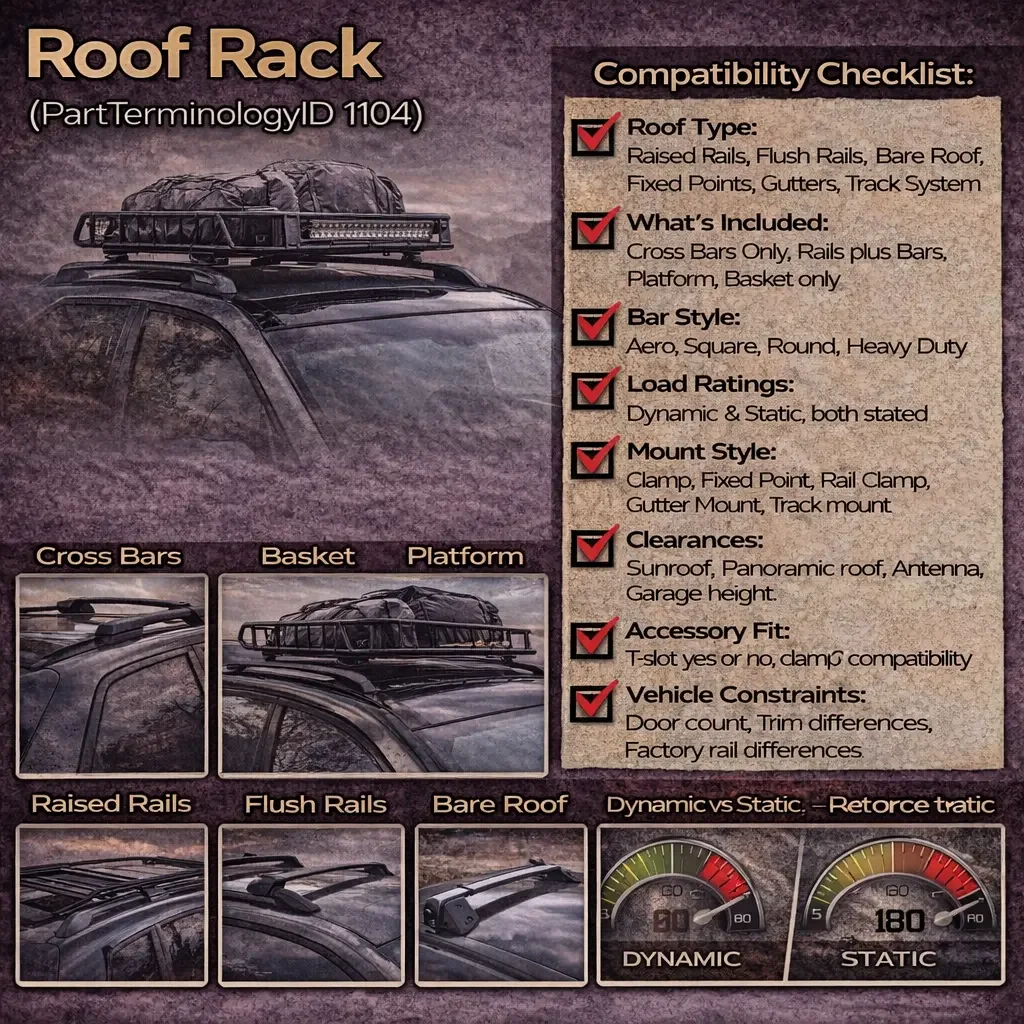
Roof racks look simple in photos. Two bars, some feet, maybe a basket. Easy.
In real life, roof racks are one of the most return-prone accessory categories because the product is not “a rack.” The product is a rack plus a roof type plus a mounting interface plus a load rating plus clearance rules.
Buyers do not think in those layers. They think: “I need to carry stuff.”
So the job of a Roof Rack post on PartsAdvisory is not to explain what a roof rack is. The job is to stop mismatches before they ship.
This guide is the map for PCdb PartTerminologyID 1104: Roof Rack.
Status in New Databases
PartTerminologyID: 1104
Terminology Name: Roof Rack
Current: PIES 7.2 + PCdb
Future: PIES 8.0 + PCdb 2.0
Status: No change
What people mean when they say “Roof Rack”
“Roof rack” is a bucket term. Buyers use it for all of these:
Cross bars (the most common)
Full roof rack systems (side rails plus bars)
Roof baskets
Roof platforms
Cargo trays
Roof boxes (often confused, box is not the rack)
Tracks and rail kits
Gutter mount racks (older vehicles)
Roof tent supporting systems
If your catalog and your listing do not separate these, you get the classic failure:
Customer expects a full rack, receives cross bars only.
The roof types that decide everything
This is the first question you must force in your content. Roof type is fitment.
1) Raised side rails
Rails sit above the roof with a visible gap under them.
Common outcome:
Cross bars clamp to the rails, usually easier installs, wide compatibility.
Top failure:
Rails look raised in photos but are actually flush rails on some trims.
2) Flush rails
Rails sit tight to the roof, usually no finger gap.
Common outcome:
You need a specific foot kit or fixed points designed for that rail profile.
Top failure:
Buyer orders a “clamp on” system meant for raised rails, it will not clamp.
3) Bare roof, no rails
No side rails. The roof may have hidden mounting points, or it may need clamp style feet that grab the door frame.
Top failure:
Buyer assumes “universal,” clamp pads do not match door frame geometry.
4) Fixed points
Factory threaded points under small covers.
Common outcome:
Clean look, strong mounts, vehicle specific.
Top failure:
Buyer does not know they have fixed points and buys clamp style.
5) Rain gutters
Older vehicles, classic trucks, some vans.
Common outcome:
Gutter feet, extremely secure if correct.
Top failure:
Buyer buys modern clamp feet, does not work at all.
6) Factory track systems
Some roofs have tracks that accept sliding mounts.
Top failure:
Buyer buys a rack that blocks the track, or does not engage the track correctly.
This is why Roof Rack is not one category. It is six.
The Roof Rack family tree
Once you break it into these subtypes, the entire category becomes manageable.
A) Cross bars only
Usually two bars plus four feet.
Variants:
Aerodynamic bars
Round bars
Square bars
Heavy duty bars
Telescoping bars
Integrated bars for specific rails
What buyers mess up:
They assume cross bars include the side rails. They rarely do.
B) Complete roof rack system
Includes side rails and cross bars, or a platform structure.
What buyers mess up:
They assume it is bolt-on for every trim. Some trims lack mounting points.
C) Roof basket
Open metal basket that mounts to cross bars.
What buyers mess up:
They assume basket is the rack. It still needs cross bars.
D) Roof platform
Flat platform, slats, modular mounts, often for overlanding setups.
What buyers mess up:
They assume universal width and mounting points. Platforms have fit constraints.
E) Roof cargo tray
Lower profile than a basket, still requires cross bars.
Dynamic vs static load rating, the most misunderstood spec
This is where serious money lives because rooftop tents and heavy cargo depend on it.
Dynamic load
What the rack can carry while driving, braking, cornering, crosswind.
This is the rating that matters for:
highway use
hauling gear
fuel economy impact
safety
Static load
What the rack can hold when parked.
This is the rating that matters for:
rooftop tents
people sleeping in a tent
parked weight distribution
Top confusion:
Buyers see a huge static number and assume it applies to driving. It does not.
Your post should say it in plain language:
Dynamic is driving. Static is parked.
Materials and why wind noise is not “a minor complaint”
Roof rack buyers complain about three things more than anything:
wind noise
missing hardware or wrong fit kit
“it doesn’t fit” because the roof type was wrong
Material and bar shape affect wind noise:
Aero bars usually quieter
Round and square bars whistle more
Cheap fairings can help, but they are not magic
Load position matters, front bar placement matters
If you teach buyers how to reduce noise, they trust you and keep the product.
Clearances that cause surprise returns
Sunroof and panoramic roof clearance
Some racks block sunroof operation or cause contact under flex.
If the vehicle has a panoramic roof, you should explicitly tell readers:
Do not assume clearance, verify it.
Shark fin antennas and roof masts
Modern antennas are taller and placed in awkward zones. Some baskets and platforms interfere.
Garage clearance
Roof racks turn “fits in my garage” into “scrapes every time.”
Tell readers to measure:
Vehicle height plus rack height plus cargo height.
Door frame clamp pressure
Clamp style racks can mark paint or pinch weather stripping if installed wrong.
This is not just cosmetic, it can create wind noise and leaks.
Accessories and compatibility, where the money is
Most buyers are not buying a roof rack for fun. They are buying a rack for an accessory.
Common accessory use cases:
bike carriers
ski and snowboard carriers
kayaks and canoes
roof boxes
rooftop tents
awnings
recovery boards
jerry can mounts
work ladders and pipes
Your content should always include the compatibility truth:
Accessory mounting depends on bar type, bar width, T-slot availability, and weight rating.
Compatibility Checklist
This is the right-side checklist concept, but without the “listing traps” language.
If you want Roof Rack returns to drop, every product page and every listing should answer these:
Roof Type: Raised rails, flush rails, bare roof, fixed points, gutters, track system
What’s Included: Cross bars only, rails plus bars, platform, basket only
Bar Style: Aero, square, round, heavy duty
Load Ratings: Dynamic and static, both stated
Mount Style: Clamp, fixed point, rail clamp, gutter mount, track mount
Clearances: Sunroof, panoramic roof, antenna, garage height
Accessory Fit: T-slot yes or no, bar width, clamp compatibility
Vehicle Constraints: Door count, trim differences, factory rail differences
Hardware and Fit Kit: Included yes or no, vehicle specific yes or no
That checklist is the whole game.
The most common confusion scenarios, and how to stop them
Scenario 1: Customer buys a basket, expects it to mount to the roof
Fix the wording:
Basket mounts to cross bars. Cross bars required.
Scenario 2: Customer has flush rails, buys a raised rail clamp kit
Fix the fitment gate:
Ask for roof type first, not just make and model.
Scenario 3: Customer buys based on static rating for driving
Fix the education:
Dynamic rating is the driving rating. Always.
Scenario 4: Customer wants a rooftop tent, buys a rack with no published static rating
Fix the product positioning:
If static rating is unknown, do not position for tents.
Scenario 5: Customer has a panoramic roof, assumes all racks work
Fix the warning:
Some racks reduce or block sunroof function. Verify clearance.
Simple buyer guidance, what to buy based on intent
If the goal is a roof box or skis
Aero cross bars, published dynamic rating, and a clean clamp system.
Noise matters here because highway use is constant.
If the goal is overlanding and modular mounts
Platform system with published dynamic and static ratings.
You want modular slots, accessory mounts, and a strong interface.
If the goal is occasional hauling
Cross bars plus a tray or small basket.
Focus on fit and hardware quality, not extreme specs.
If the goal is a rooftop tent
Static rating is mandatory, and the roof interface must be robust.
Avoid vague “universal” systems.
FAQ
Do I need cross bars if I buy a basket?
Usually yes. Many baskets mount to cross bars.
Why does my rack whistle?
Bar shape, bar placement, and accessory turbulence. Aero bars are usually quieter.
What matters more, dynamic or static?
Dynamic for driving, static for parked loads like tents.
Will it fit my roof type?
Roof type is the first filter. Raised rail and flush rail systems are not interchangeable.
Can a rack block my sunroof?
Yes. Always verify clearance for sunroof and panoramic roof vehicles.