
Roll Bar (PartTerminologyID 1096): The Complete Map of Names, Mount Types, and Listing Traps
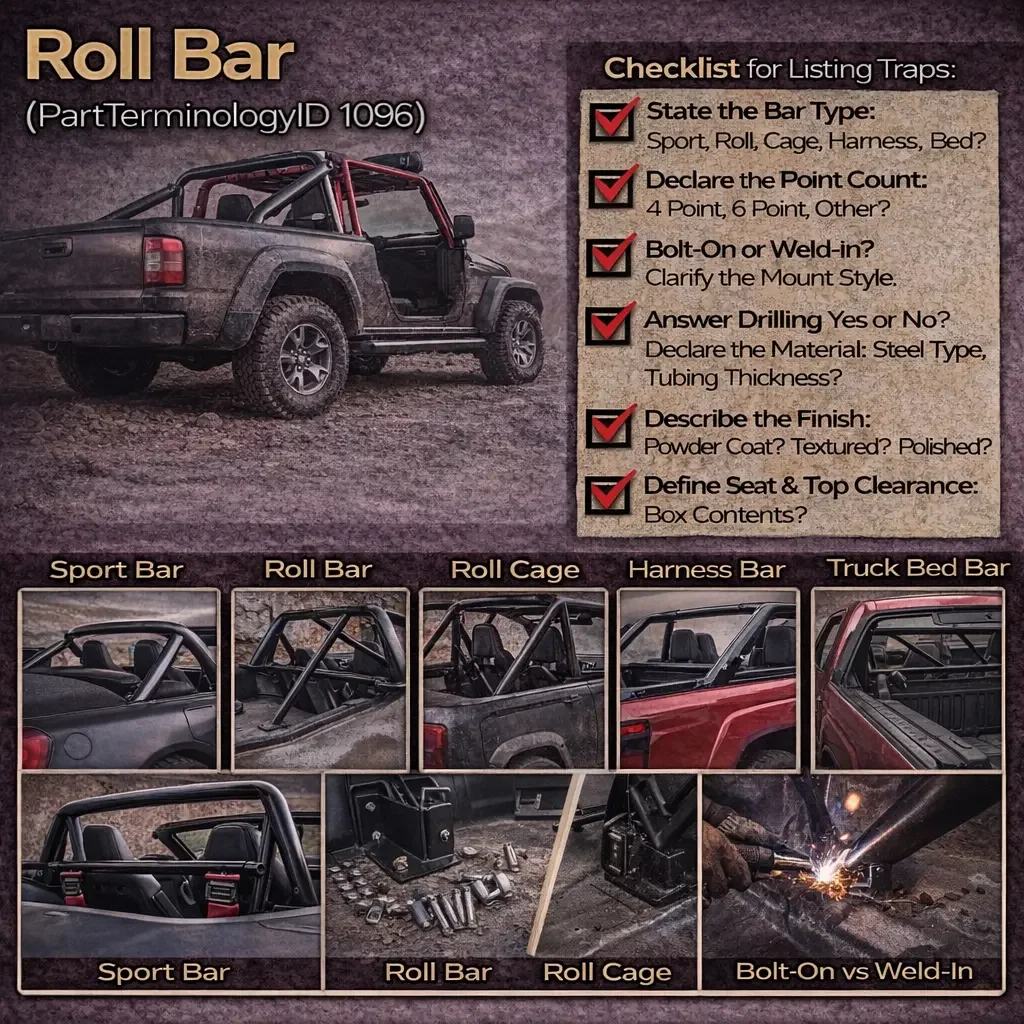
Roll Bar is one of those terms that sounds precise, but behaves like a keyword blender on marketplaces.
Some buyers mean real occupant protection.
Some buyers mean a styling bar for a convertible.
Some buyers mean a truck bed bar for lights.
Some buyers mean a full roll cage, and they will be furious when a single hoop shows up.
That mismatch is why “Roll Bar” can be a return magnet even when the product is perfectly fine. The listing failed, not the metal.
This is the PartsAdvisory field guide for Roll Bar in PCdb PartTerminologyID 1096, written to help you sell it clean and keep your return rate from turning into a monthly subscription.
Status in New Databases
Feature: Current (PIES 7.2 / PCdb) -> Future (PIES 8.0 / PCdb 2.0)
PartTerminologyID: 1096 -> 1096 (No change)
Terminology Name: Roll Bar -> Roll Bar
What customers call this part
Buyers use “roll bar” as a catch all. Your job is to separate what they mean before the box ships.
Common names buyers use:
Roll bar
Sport bar
Roll hoop
Styling bar
Show bar
Harness bar
Chase bar
Light bar (often confused)
Truck bed bar
Bed sport bar
UTV roll bar
Jeep roll bar (people use this for cages and factory hoops)
Common parts confused with roll bars:
headache rack (truck cab protector)
ladder rack
roof rack
cargo bar
light mount crossbar
interior grab bars
If your listing does not say what it is not, you are relying on luck.
The real Roll Bar family tree
This is the key section. Once you teach these categories, most confusion disappears.
1) Sport bar, also called styling bar
Common on convertibles, roadsters, and some trucks.
What it is:
Usually a bolt-on bar designed for appearance, sometimes with accessory mounts.
What it is not:
A guaranteed safety device, unless it is explicitly certified and designed for that purpose.
Return trigger:
Customer thinks it is a real protective roll bar for track use.
How to list it:
Call it sport bar or styling bar if that is what it is.
If it is not safety rated, do not imply it is.
2) Roll bar, single hoop or multi point
This is closer to safety intent, but still varies wildly by brand and application.
Common layouts:
4 point roll bar (main hoop plus rear stays)
6 point roll bar (adds additional mounting points)
with harness bar cross tube
with diagonal brace
Return triggers:
Buyer expects a full cage
Buyer expects padding and harness hardware included
Buyer expects no drilling
How to list it:
State point count, what tubes are included, and whether it includes a harness bar.
3) Roll cage, full interior structure
This is a different product category in buyer minds, even when sellers use “roll bar” in the title.
What it is:
Multi tube structure around occupants, often weld-in or bolt-in.
Return triggers:
Buyer orders “roll bar” and expects only a hoop, receives a cage kit
Buyer orders “roll bar” and expects a cage, receives only a hoop
How to list it:
If it is a cage, say cage in the first line.
4) Harness bar, seat belt and harness mounting crossbar
Many buyers search roll bar when they really want a harness bar.
What it is:
A crossbar that provides harness mounting points, sometimes integrated into a bar, sometimes standalone.
Return triggers:
Buyer expects a roll bar hoop included
Buyer expects harnesses included
How to list it:
Use “harness bar” prominently and state what is included.
5) Truck bed bar, sport bar, chase bar
This is huge in trucks. Buyers call these roll bars constantly.
What it is:
A bar mounted in the bed, often used for lights, looks, and accessories.
What it is not:
A rollover protection device for the cab area.
Return triggers:
Buyer expects it to protect occupants
Buyer expects it to fit with a tonneau cover, toolbox, or bed rails
How to list it:
Call it bed bar or chase bar.
List bed length compatibility, rail system conflicts, and light mounting options.
6) UTV and off-road roll bars
UTV buyers often mean actual rollover structure, but there are still styling variants.
Return triggers:
Cage fitment differences across model years
Roof and windshield conflicts
How to list it:
Be extremely specific about model, year, cage geometry, and accessory compatibility.
Materials and why buyers care
Roll bars are not like trim. Material is not a minor detail. It affects strength, weight, corrosion resistance, and weld behavior.
Common materials:
Mild steel, common and affordable
DOM steel tubing, higher quality tubing used in performance applications
Chromoly, strong and lightweight, typically higher cost and more specialized
Stainless steel, often used for styling bars and corrosion resistance, not always the first choice for track requirements
Aluminum, often used for appearance bars, not typically marketed as true roll protection
Listing trap:
Sellers use “heavy duty” without stating tubing diameter, wall thickness, or material. Buyers compare “heavy duty” across products that are not comparable.
Better approach:
List tube diameter and wall thickness if known
List material type
List finish type
Finishes and corrosion reality
Finish is a major satisfaction driver, especially on trucks and convertibles.
Common finishes:
black powder coat
textured black
polished stainless
raw steel, paint required
primer only, paint required
Return triggers:
buyer expects gloss, receives textured
scratches out of the box
hardware rusts quickly
If hardware is included, call out whether it is stainless or coated. Buyers notice the bolts first.
Mounting types and install reality
This is the second biggest return driver after “what is it.”
Mount types you will see:
Bolt-on, uses factory points
Bolt-on, drilling required
Weld-in, permanent install
Bed mount plates and braces for truck bars
Floor mount plates for interior bars
Frame tie-in systems, more advanced
Listing traps:
“No drill” implied, but drilling is required
Buyer expects all brackets included, but some are optional
Buyer expects it fits with rear seats, but it blocks seat function
Buyer expects it fits with soft top or hard top, but it conflicts
You do not need to write an installation manual in a product listing, but you must declare the big truths:
drilling yes or no
permanent or removable
interior clearance impact
compatibility with tops, seats, tonneau covers, toolboxes
Safety expectations and the words you must use carefully
There is a difference between:
“roll bar style”
“sport bar”
“decorative”
“intended for off-road use”
“meets racing or sanctioning body requirements”
If a product is not explicitly engineered and marketed for occupant protection in motorsports, do not imply that it is. Buyers take that personally.
Good seller language:
“Designed for style and accessory mounting”
“For appearance and auxiliary lighting”
“Check your track or sanctioning body rules if you need certified protection”
That keeps you honest and keeps your customer alive. Both matter.
Compatibility traps you should always call out
Convertibles and roadsters
soft top clearance
hard top clearance
seat travel and recline interference
rear speaker and trim panel conflicts
Trucks
bed length compatibility
tonneau cover interference
toolbox interference
bed rail cap interference
stake pocket use
third brake light visibility issues if lights are added
SUVs and Jeeps
hard top fitment
rear cargo clearance
rear seat fold functionality
If you list none of these, the buyer will discover them after unboxing.
Box contents, what customers assume
People assume a roll bar kit includes everything needed. Often it does not.
Common box contents:
main hoop or main structure
side supports or rear stays
mounting plates
hardware pack
sometimes harness bar tube
sometimes light tabs
sometimes padding
Common missing expectations:
harnesses
wiring
lights
padding
paint or touch up
drilling templates
Your listing should explicitly say what is included, and what is not included.
The listing traps that cause the most returns
Roll bar vs sport bar confusion
Fix: name the type, and use “style” language when appropriate.Roll bar vs roll cage confusion
Fix: if it is a cage, say cage. If it is a hoop, say hoop or bar.Truck bed bar listed like occupant protection
Fix: call it bed bar or chase bar, and state intended use.Drilling not disclosed
Fix: drilling required yes or no, in the first bullets.Rear seat and interior clearance ignored
Fix: add notes on seat travel and seatback clearance.Finish mismatch
Fix: textured vs gloss vs polished, clearly.Hardware quality surprises
Fix: state hardware type and corrosion expectation.Light mounts assumed
Fix: if light tabs are not included, say so.
Catalog checklist for PartTerminologyID 1096
If you want fewer returns, your data needs to separate what “roll bar” means for this SKU.
Bar type: sport bar, roll bar, roll cage, harness bar, bed bar
Point count: 4 point, 6 point, other
Includes harness bar: yes or no
Includes diagonal brace: yes or no
Mount location: interior floor, frame tie in, truck bed, other
Installation: bolt-on, weld-in, drilling required yes or no
Material: steel type, tubing diameter, wall thickness if known
Finish: powder coat, textured, polished, raw
Hardware included: yes or no, hardware type
Compatibility notes: top clearance, seat clearance, tonneau and toolbox conflicts
If you capture those fields, the title writes itself and the buyer knows what they are buying.
Quick FAQ
Is a sport bar the same as a roll bar?
In buyer language, they blur. In reality, sport bars are often styling and accessory mounts. True roll bars are built with protection intent. Your listing should not mix the two.
Will a roll bar fit my convertible top?
Sometimes. Fitment depends on bar geometry and top design. Always check top clearance notes.
Do I need drilling?
Many kits require drilling. Some use factory points. Never assume. The listing must state it.
Can I mount lights on it?
Some bars include tabs, some do not. If it matters, list it.
Does it include harnesses or padding?
Usually not. If included, it should be stated explicitly.