
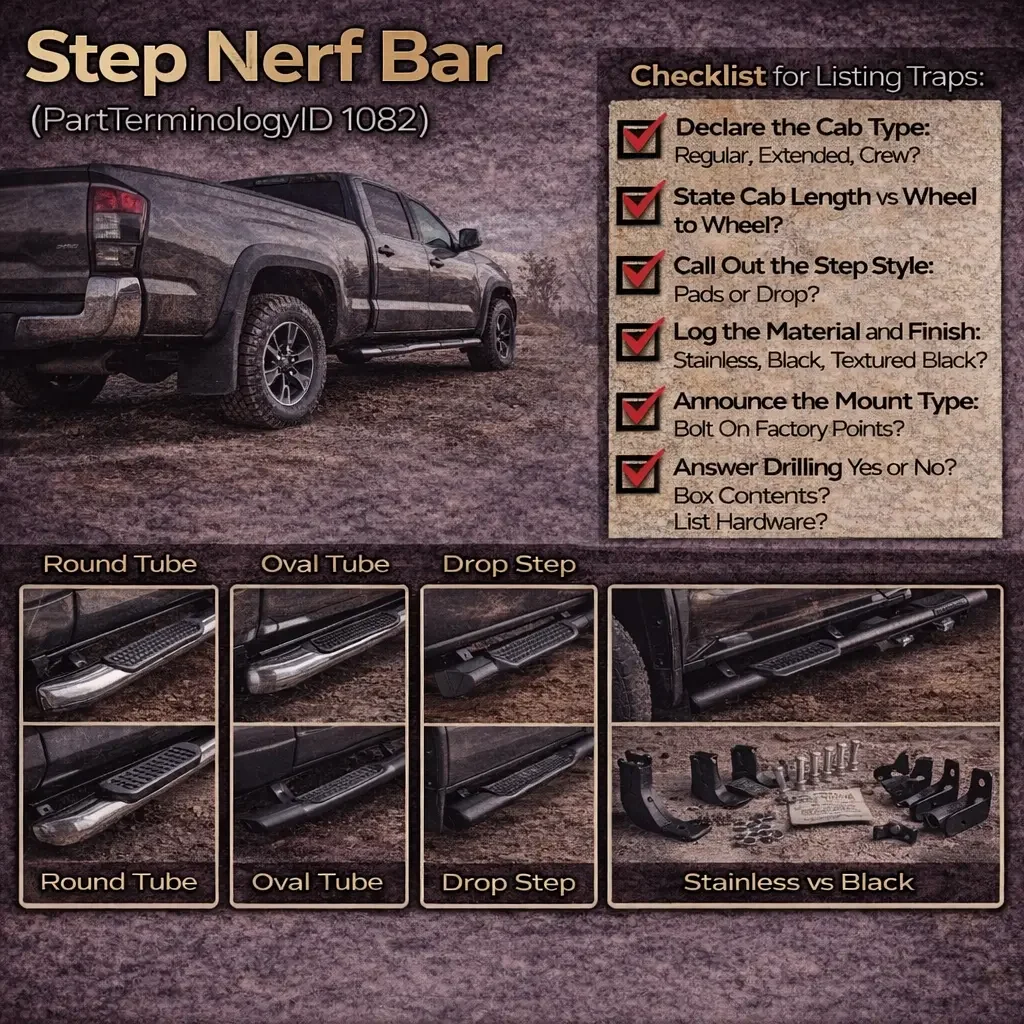
If you sell truck accessories, Step Nerf Bars are not a niche. This is one of the core money parts.
It is also one of the most misunderstood parts on marketplaces because it sits right on the line between “universal looking” and “vehicle specific reality.” Customers see a photo of a shiny bar under a truck and assume it fits every truck. Then the box arrives, brackets do not line up, cab length is wrong, or the step pad lands in the wrong spot. Return.
A Step Nerf Bar is also a trap because the name is not stable. People use “nerf bar,” “side steps,” and “running boards” like they mean the same thing. In catalog terms they can be different products, different coverage lengths, different step designs, and very different installs.
This guide is the PartsAdvisory map for Step Nerf Bar in PCdb PartTerminologyID 1082.
You can use it two ways:
as a buyer education post that reduces returns
as a catalog and listing checklist so your titles, item specifics, photos, and fitment notes actually match what ships
Status in New Databases (ID 1082)
Feature: Current (PIES 7.2 / PCdb) -> Future (PIES 8.0 / PCdb 2.0)
PartTerminologyID: 1082 -> 1082 (No change)
Terminology Name: Step Nerf Bar -> Step Nerf Bar
What people call this part
If you only optimize for “Step Nerf Bar,” you miss a lot of search behavior. Real buyers search by vibe, not by standard.
Common names:
Nerf bars
Step bars
Side steps
Tube steps
Oval step bars
Round step bars
Cab length steps
Wheel to wheel steps
Truck step rails
Side rails with steps
Hoop steps (the drop step style)
Truck running boards (often a different style, but customers mix it)
Important nuance:
“Running board” usually implies a wider, flatter step surface.
“Nerf bar” usually implies a tube style bar, round or oval, with step pads.
“Step nerf bar” is the overlap zone: a tube bar designed specifically for stepping, not just rocker protection.
This naming confusion creates a simple marketplace problem: customers buy running boards, receive tube steps, and label it as not as described.
Your content and your data need to separate them clearly.
What a Step Nerf Bar actually does
Step nerf bars exist for three reasons:
Access
They lower the step height on trucks and SUVs, especially lifted setups, tall factory ride heights, and vehicles with aggressive tires.Protection
They can provide minor rocker protection from parking lot door dings and some debris, depending on how far they stick out and how strong the brackets are.Style
A lot of buyers want the look. Black powder coat, polished stainless, wide oval tubes, drop steps. It is part of the truck identity.
Everything else is secondary.
If you sell this category, the job is not to convince people they need steps. They already know. The job is to get them the correct bar, correct length, correct mount, correct finish, with the correct bracket kit, the first time.
The Step Nerf Bar family tree
This is the section that reduces returns when buyers actually read it. Step nerf bars fall into predictable variants.
1) Tube shape: round vs oval vs flat oval
Round tube is classic. It looks clean, it is common, it is easy to photograph.
Oval tube looks more modern and often provides a little more contact surface.
Flat oval tends to look more premium and can feel more stable underfoot.
Listing trap: customers assume oval means wider stepping area. Sometimes it does, sometimes the step pad is still small. Always show a closeup of the step pad.
2) Coverage length: cab length vs wheel to wheel
Cab length covers the door area only.
Wheel to wheel extends under the bed area on trucks so you can step up to reach the bed.
This is a top return driver. Customers with a short bed often still want wheel to wheel. Customers with a long bed sometimes do not. If your title and specifics do not clearly state cab length vs wheel to wheel, you are gambling.
3) Step style: pads vs drop steps vs continuous step
Step pads are the common rubber or textured pads mounted on the tube.
Drop steps are the hoop steps that hang lower than the tube, designed for lifted trucks and shorter passengers.
Continuous step styles blur into running boards, but some tube systems offer a longer step surface.
Drop steps are loved and hated. Loved for access. Hated because they reduce ground clearance.
If you sell drop steps, you must talk about clearance.
4) Mount position: bolt on brackets vs rocker mount
Most step nerf bars mount to existing frame or body mounting points, often using vehicle specific brackets.
Bolt on bracket kits are the standard. Usually no drilling, but it depends on the vehicle and brand.
Some systems claim “no drill” but still require minor drilling on certain trims or year ranges.
Never promise no drill unless it is truly supported for that fitment.
5) Finish: stainless vs black vs painted vs coated
Finish is not cosmetic, it is ownership reality.
Polished stainless steel stays shiny longer and resists rust better.
Black powder coat looks great but can chip. Chips plus road salt equals rust if the substrate is steel.
E coated and powder coated systems usually last longer than basic paint.
Textured black hides scratches better than gloss.
Listing trap: customers expect a deep glossy black when the product is textured matte, or the reverse. Show the finish clearly, and name it correctly.
6) Integrated features: lights and sensors
Some step bars have:
integrated LED step lights
lighted logos
reflective inserts
in rare cases, integrated rock lights
These features raise expectation. They also raise return risk if the wiring, harness, or install instructions are unclear.
If it has lighting, list:
lights included yes or no
wiring included yes or no
trigger style (door pin, courtesy circuit, switch)
Do not let the buyer discover it after unboxing.
Pros and cons, the honest version
Pros
Easier entry and exit
For families, older drivers, kids, and anyone in work boots, step bars are a quality of life upgrade.
Bed access for trucks
Wheel to wheel setups turn the side of the truck into a ladder.
Improved looks
A good set of step bars changes the truck profile immediately.
Moderate rocker protection
Not the same as real rock sliders, but they can protect from light hits and debris.
Resale friendliness
Trucks with steps sell easier because buyers can picture daily use.
Cons
Fitment complexity
Cab configuration, bed length, trim differences, and bracket variations create confusion.
Ground clearance loss
Especially on drop steps, and on lower vehicles.
Rust and corrosion
Cheap steel plus bad coating equals rust within a season in salt climates.
Noise and vibration if poorly installed
Loose brackets can creak. Poorly aligned bars can flex.
Interference with other accessories
Mud flaps, fender flares, wheel well liners, and running boards can conflict.
If you acknowledge these cons upfront, you reduce the “this is defective” style returns that are really expectation failures.
The cab and body configurations that decide fitment
This is the #1 trap.
Customers think they own a “crew cab” because it has four doors. But the OEM naming matters:
Regular cab
Extended cab
Double cab
Crew cab
Mega cab
SuperCrew, SuperCab (Ford)
Quad cab (Ram)
Then you add:
short bed
standard bed
long bed
A step nerf bar bracket kit is not just a tube. It is geometry.
The bar length must match the door spacing. The step pads must land under the doors, not between them. The bracket mounting points must match the frame or body holes.
If you do not clearly call out cab configuration in fitment notes and item specifics, you will ship a correct product that the buyer cannot install. That still becomes your return.
Vehicle features that create hidden conflicts
This is where “it fits” on paper fails in a driveway.
Fender flares
Factory flares and aftermarket flares change how far the body extends. Some step bars stick out too far, some not far enough. Some look tucked, some look awkward. Buyers care about look.
If your listing has photos on a truck with flares, mention it.
Mud flaps
Mud flaps can block bracket access or interfere with step placement, especially on rear mounts for wheel to wheel systems.
Running boards or factory steps
Some trucks have factory steps or rocker trim that must be removed. Customers hate discovering that mid install.
Make removal requirements obvious.
Pinch welds and rocker molding
Some installs use pinch weld areas. Some vehicles have plastic rocker molding that hides or blocks those points. Again, not every trim is the same.
Side curtain airbag labels and wiring
Some modern vehicles have wiring routed in rocker zones. Low risk if you use factory points, higher risk if drilling is involved.
Lift kits, leveling kits, and tire size changes
Lift kits change the user expectation. They often need drop steps for access. But lift kits also change clearance and approach angles, so the wrong step design can hit on trails or steep driveways.
Your post should teach this: lifted trucks need access steps, but access steps reduce clearance. Choose your tradeoff.
Materials, what actually lasts
A step bar is a coating story.
Stainless steel
resists corrosion better
holds polish, can still pit over time in harsh salt environments
tends to cost more
scratches show, but do not usually lead to rust in the same way
Mild steel
common, affordable
depends heavily on coating quality
if coating chips, rust starts at the chip
Aluminum
lighter
corrosion behavior differs, it does not rust like steel
can still oxidize and look dull
often used in running boards more than tube steps, but it exists
Step pads
Step pads are usually:
rubber
textured plastic
composite inserts
Watch for:
pads that peel
pads that get slippery when wet
pads that fade fast in UV
Good sellers show the step pad texture in photos. Great sellers mention wet traction and texture type.
Finish and coating, what buyers actually complain about
Most complaints are predictable:
“black is not black” (gloss vs matte vs textured confusion)
“scratched out of the box” (packaging issue)
“rust after winter” (coating issue)
“hardware rusted” (hardware quality, not the bar)
If you want to reduce complaints, specify:
finish type (polished, black powder coat, textured black)
whether brackets match the bar finish
hardware material (stainless hardware included, or not)
Hardware is a sneaky return driver. Buyers see rusted bolts and assume the whole kit is junk.
Mount types and the truth about “no drill”
Most premium brands aim for no drill installs. But reality is messy across year ranges.
Common mount designs:
Body mount brackets that use factory body mount bolts or points
Frame mount brackets that bolt to existing threaded holes
Combination mounts using multiple points for stability
What customers want to hear:
bolt on install
no drilling required
uses factory mounting points
all hardware included
installation time estimate
What you should say:
bolt on for most applications
drilling may be required on certain trims or year ranges (if true)
verify fitment notes
check for factory holes and bracket alignment before tightening
Do not oversell no drill. The cost of being wrong is returns and damage.
How to mount a Step Nerf Bar correctly
This matters because poor installs create “defective product” claims.
A clean install process usually looks like this:
Inventory the kit
Confirm you have the correct left and right bar, correct brackets, and correct hardware.Dry fit brackets first
Before lifting the bar into place, loosely attach brackets to the frame or body points. Confirm holes line up.Hang the bar loosely
Attach the bar to brackets with bolts but do not tighten.Align step pad positions
Open doors. Check that step pads land where feet actually step. Check that the bar is level and symmetrical.Check clearance
Turn front wheels left and right. Check clearance to tires, mud flaps, and wheel well liners.Tighten in sequence
Tighten bracket to frame, then bar to bracket. Use torque specs if provided.Recheck after a week
Vibration settles hardware. A quick retorque prevents rattles.
If you include this in your blog, you become the seller the buyer trusts. That trust reduces returns.
Box contents, what should be explicitly stated
A step nerf bar is not one part. It is a system.
Typical box contents:
left and right bar
vehicle specific brackets (2 to 6 brackets depending on cab length)
hardware pack (bolts, washers, spacers)
sometimes backing plates
sometimes wiring kit if lights are included
installation instructions
Common failure:
listing shows bracket kit, box arrives with only bars, brackets sold separately
If brackets are separate, say it in the first lines. Do not hide it in fine print.
The listing traps that cause the most returns
This is the section you want every seller to read.
Trap 1: Cab length not specified
Fix: state cab type clearly, and keep it consistent across title, fitment, and bullets.
Trap 2: Wheel to wheel vs cab length not specified
Fix: state coverage length in the first line.
Trap 3: Photos imply a full set but you ship a pair for front only
Fix: explicitly say front pair, rear pair, or full set. For step bars, usually left and right, but some packages vary.
Trap 4: Finish mismatch
Fix: name the finish, show closeups, and do not color grade photos until the product looks like something else.
Trap 5: Brackets and hardware unclear
Fix: list brackets included yes or no, hardware included yes or no.
Trap 6: Drop step clearance not disclosed
Fix: mention that drop steps hang lower and may reduce ground clearance.
Trap 7: Vehicle has factory rocker trim that must be removed
Fix: include removal notes if applicable.
Trap 8: Lights included but wiring not explained
Fix: list wiring included, trigger method, and install complexity.
These are not rare problems. They are daily problems. Fixing them is how you win the category.
Catalog checklist for PartTerminologyID 1082
If you are structuring data for marketplaces, feeds, and fitment, capture these fields.
Core definition
Tube shape (round, oval, flat oval)
Finish (polished stainless, black powder coat, textured black)
Step style (pads, drop steps, continuous step)
Step pad material and texture type
Coverage and positioning
Coverage length (cab length, wheel to wheel)
Number of step pads and positions
Left and right included yes or no
Installation and mounting
Mount type (bolt on brackets, body mount, frame mount)
Drilling required (yes or no)
Brackets included (yes or no)
Hardware included (yes or no)
Estimated install time if known
Compatibility notes
Cab configuration (regular, extended, crew, plus OEM naming variants)
Bed length relevance for wheel to wheel
Factory flares compatibility note if known
Mud flap and rocker trim notes if known
Materials and durability
Bar material (stainless, steel, aluminum)
Bracket material and coating
Hardware material (stainless, zinc, coated)
If you only capture half of these, your listing becomes a gamble. If you capture all of them, Step Nerf Bars become predictable.
Buyer education section: how to choose the right Step Nerf Bar
This is where you convert.
If the truck is stock height
Choose cab length tube steps with good pads. Drop steps are usually unnecessary unless you have kids or shorter drivers.
If the truck is leveled or lifted
Drop steps become valuable. But choose them with awareness:
they hang lower
they can catch on curbs and off-road obstacles
If the buyer uses the truck for work
Wheel to wheel is often the right move. It makes bed access easier and reduces “climb the tire” behavior.
If the buyer cares about clean look
Oval or flat oval bars can look more integrated than round. Textured black hides wear.
If the buyer lives in a salt state
Stainless is often worth it. If you go black steel, insist on quality coating and hardware.
This advice reduces returns because it prevents the wrong buyer from buying the wrong style.
FAQ
Are step nerf bars the same as running boards?
Not always. Running boards are usually wider and flatter. Step nerf bars are usually tube style with pads or drop steps.
Do they require drilling?
Many kits are bolt on using factory mounting points. Some vehicles or trims may require drilling. The listing should state this clearly.
Will they rust?
Steel bars can rust if the coating chips and the truck sees salt. Stainless resists corrosion better. Hardware quality also matters.
Cab length vs wheel to wheel, which should I buy?
Cab length is for door access. Wheel to wheel adds access to the bed area, especially helpful for work.
Do drop steps reduce clearance?
Yes. That is the tradeoff for easier access on lifted trucks.
Are they compatible with mud flaps and flares?
Sometimes. It depends on how the bar and brackets sit relative to the wheel well and rocker trim. Fitment notes matter.
Closing
Step Nerf Bars are a top category because the value is obvious. People feel it every time they get in and out.
The reason this category returns is not mystery. It is usually one of five failures:
cab type, coverage length, bracket reality, finish expectations, or clearance.
If you teach the variant map and you lock down the catalog fields, Step Nerf Bars become one of the easiest accessory categories to sell with confidence.