
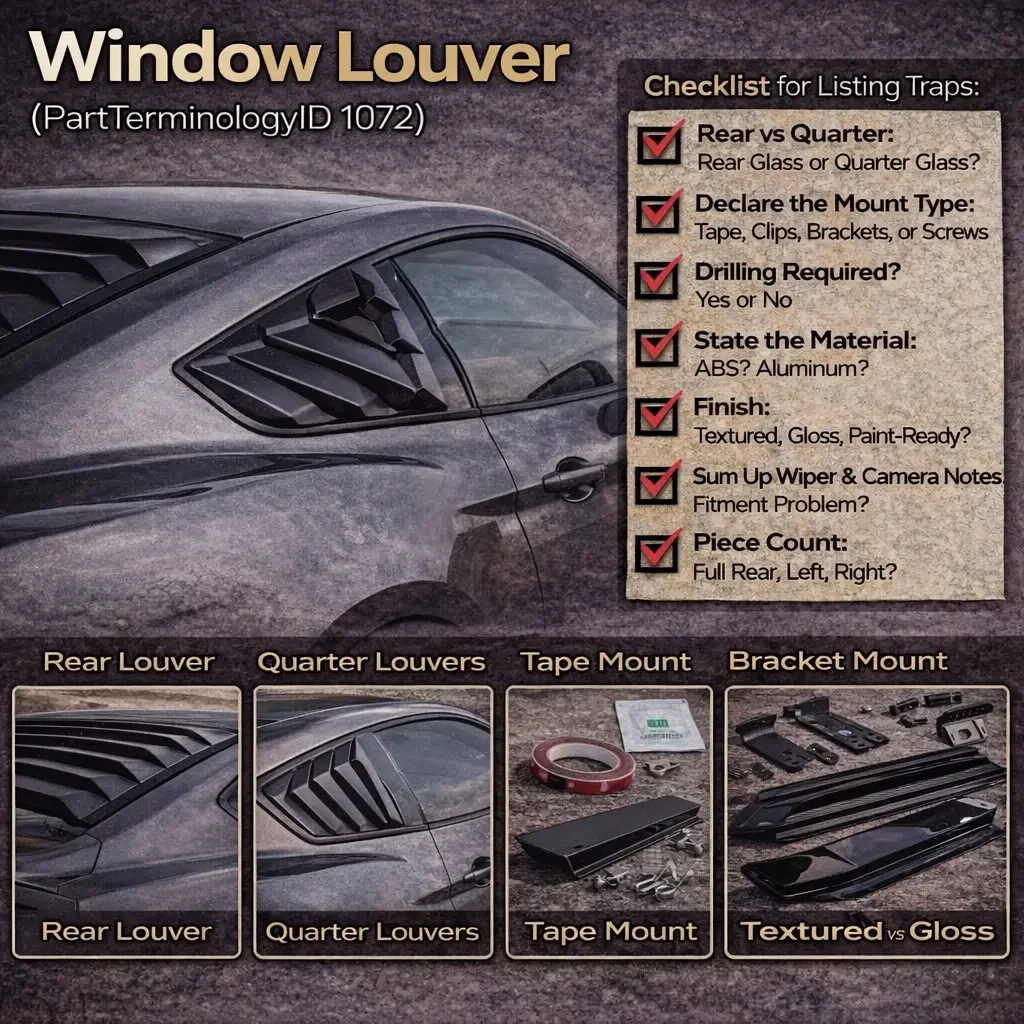
Window louvers are a classic style part that never fully died. They just moved from the 80s muscle car look into modern “retro sport” builds and overland themed builds.
The problem is that buyers use the word “louver” for multiple items, and sellers list them like they are interchangeable. They are not.
Returns usually happen for one of these reasons:
the listing never said which window it fits
the buyer expected a full rear louver and receives quarter window pieces
the mounting method is tape only and the buyer expected clips or brackets
the louver blocks the rear wiper, defroster lines, or a backup camera
the finish looks cheap or does not match the rest of the trim
This is the PartsAdvisory guide for Window Louver in PCdb PartTerminologyID 1072.
Status in New Databases
Feature: Current (PIES 7.2 / PCdb) -> Future (PIES 8.0 / PCdb 2.0)
PartTerminologyID: 1072 -> 1072 (No change)
Terminology Name: Window Louver -> Window Louver
All the names customers use
If you only optimize for “window louver,” you miss a lot of search intent. Buyers commonly type:
Rear window louver
Back window louver
Quarter window louver
Side window louver
Hatch louver
Rear glass louver
Louvers kit
Slat kit
Venetian louvers
Retro louvers
Window shade louvers
Also, buyers sometimes confuse these with:
window visors
sunshades
rear window spoiler extensions
pillar trim kits
A good listing makes it obvious what it is and what it is not.
The main louver types
1) Rear window louvers
The big one. Covers the rear glass on coupes, sedans, and hatchbacks.
What buyers expect:
a strong visual transformation
a one-piece or multi-piece assembly that fits the rear glass shape
Common conflicts:
rear wiper on hatchbacks and SUVs
high-mount brake light placement
rear defroster lines and cleaning access
trunk opening clearance on some designs
2) Quarter window louvers
Small louvers that cover the rear side windows, usually behind the doors.
What buyers expect:
easier install
less risk to visibility compared to rear glass louvers
Common conflicts:
trim package differences that change window shape
mounting surface not flat due to factory molding
3) Side window louvers
Less common on modern cars but still exists for certain platforms.
Common conflicts:
can interfere with window operation if poorly designed
can peel or whistle at speed if the mount surface is wrong
4) Hatch and liftgate louvers
Often called rear louvers, but the mounting and clearance can be very different.
Common conflicts:
rear spoiler clearance
rear wiper
camera position, usually near the license plate or handle
Your catalog and listing should always state the window location clearly: rear glass, quarter glass, side glass, hatch glass.
Materials and finish options
This is a style part. Buyers care about how it looks up close.
ABS plastic
Most common.
stable, light, and affordable
usually offered in textured black or gloss black
paintable if specified, but prep matters
Aluminum
Less common now, but used for certain classic platforms.
durable and rigid
can be powder coated
can look premium, but costs more
Composite or carbon fiber look
Often ABS with a hydro dip or overlay film.
looks great in photos
can disappoint if the finish pattern is low quality
Finish types buyers expect
textured black to match factory trim
gloss black to match modern black-out packages
matte black
primer or paint-ready, less common
Listing trap: “paintable” does not mean “paint matched.” If it ships unpainted, say that clearly.
Mounting methods and install reality
Most louvers install one of three ways.
1) Automotive-grade tape
The most common method today.
Pros:
no drilling
fast install
Cons:
surface prep is everything
cold installs fail
removal can leave adhesive residue
cheap tape is the fastest route to returns
Best listing details:
tape included yes or no
surface prep required, alcohol wipes included yes or no
cure time guidance if the brand provides it
2) Clip-in or bracket mounting
More common on platform-specific kits, especially where the louver needs spacing.
Pros:
more secure
easier removal and cleaning behind the louver
Cons:
more parts
higher chance of missing hardware complaints
Best listing details:
brackets included yes or no
hardware included yes or no
any trimming required
3) Screw-in or rivet mounting
Rare for modern kits, more common on older classics or heavy-duty setups.
Pros:
very secure
Cons:
permanent feel, many buyers hate drilling
return risk if not disclosed
Best listing details:
drilling required yes or no
template included yes or no
Visibility, safety, and feature conflicts
This is where expectations need to be managed.
Rear visibility
Rear louvers reduce visibility, especially at night or in rain.
A good listing uses simple language:
“Rear visibility will be reduced compared to stock.”
Backup cameras
Some designs can partially block the camera view, depending on camera placement and louver depth.
If the brand notes compatibility, include it.
If unknown, do not promise it.
Defroster lines and cleaning
Louvers can make rear glass cleaning harder. Buyers complain when they cannot reach the glass easily.
If the kit is removable, say how it detaches.
Rear wiper
On many hatchbacks and SUVs, a rear louver may interfere with the wiper sweep or motor cover.
This should be an explicit fitment note.
High mount brake light
Some vehicles have the brake light inside the rear glass, others on the spoiler.
A louver can visually block it from certain angles if designed poorly.
You do not need to scare buyers, but you do need to prevent “I had no idea” returns.
Vehicle-specific vs universal
Louvers can be marketed as universal, but they rarely look right that way.
Vehicle-specific louvers match the glass curvature and window perimeter.
Universal louvers usually need trimming or sit awkwardly.
If a product is universal, the listing should say universal in the first lines and show a realistic installed photo.
Box contents and what customers assume
Louvers are a “kit” product, which means box contents must be explicit.
Possible contents:
louver panel or multiple panels
side supports or spacers
tape strips or full pre-applied tape
brackets and screws
alcohol wipe and adhesion promoter
instructions
High return trigger:
listing shows brackets, box arrives with tape only
If tape is the only mount method, say it plainly.
Catalog checklist for PartTerminologyID 1072
If you want fewer returns, capture these attributes:
Window location: rear, quarter, side, hatch
Coverage: full rear glass, partial, left only, right only, pair
Material: ABS, aluminum, composite
Finish: textured black, gloss black, matte, paint-ready
Mount method: tape, clips, brackets, screw-in
Drilling required: yes or no
Hardware included: yes or no
Tape included: yes or no
Rear wiper compatibility: yes, no, not applicable
Backup camera compatibility note, if applicable
Removable for cleaning: yes or no, if applicable
The most common listing traps
rear louver vs quarter louver not specified
coupe vs sedan glass shape mismatch
tape-only mount not disclosed
wiper interference discovered after install
buyers assume a pair, listing is single side
finish looks different than photos, gloss vs textured confusion