
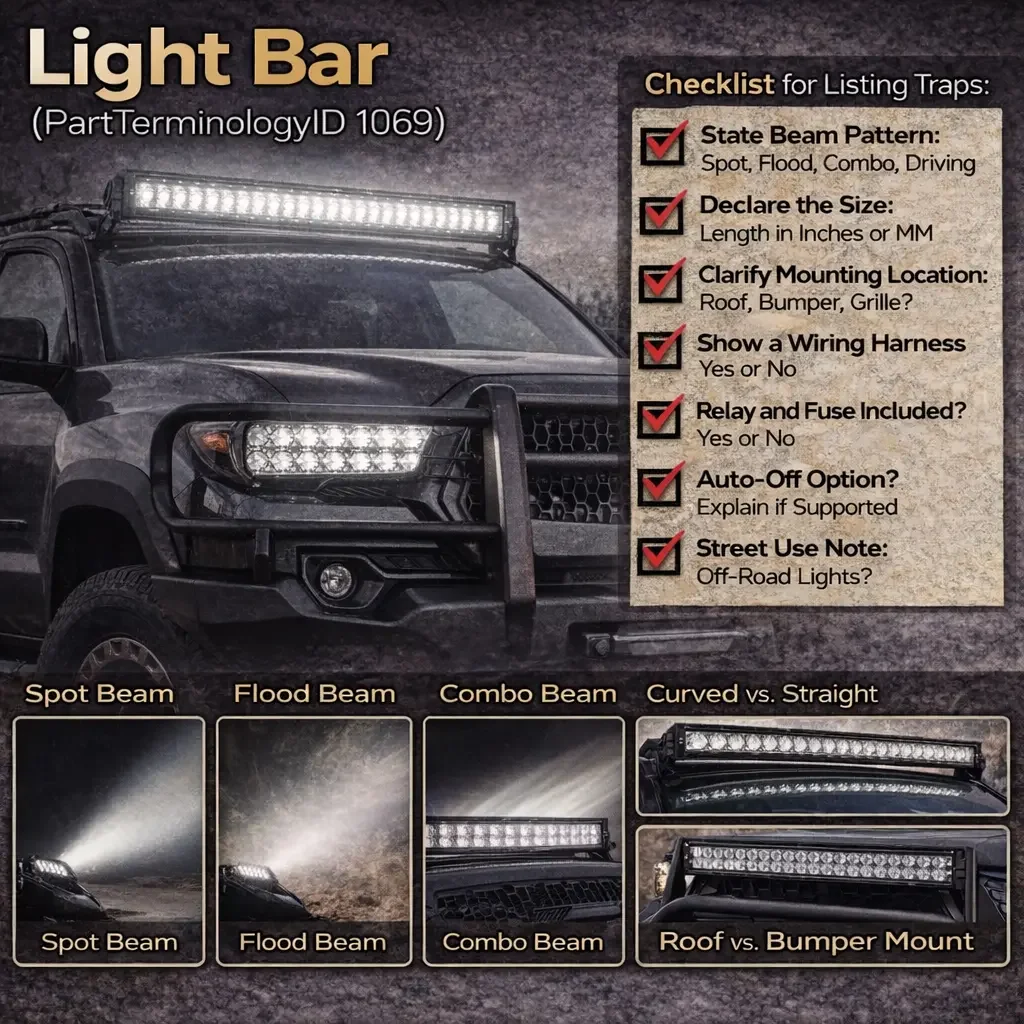
Light bars are one of the highest “wow” upgrades in automotive lighting. They also create some of the highest return rates in lighting because customers buy the photo, not the reality.
A light bar touches everything: electrical load, mounting geometry, water sealing, wind noise, beam pattern, legality, and even driver behavior. If you are building clean catalog data or marketplace listings, this is the category where vague specs become expensive.
This is the PartsAdvisory field guide for Light Bar in PCdb PartTerminologyID 1069.
Status in New Databases (ID 1069)
Feature: Current (PIES 7.2 / PCdb) -> Future (PIES 8.0 / PCdb 2.0)
PartTerminologyID: 1069 -> 1069 (No change)
Terminology Name: Light Bar -> Light Bar
What counts as a “Light Bar”
“Light bar” gets used for multiple products:
Single-row LED light bars
Dual-row LED light bars
Curved light bars
Roof light bars, bumper light bars, grille light bars
Rear chase light bars for dust and visibility
Work light bars (flood pattern)
Emergency style bars (often a different category, but buyers confuse them)
For PartTerminologyID 1069, the common expectation is an auxiliary linear lighting unit designed for forward illumination, typically LED.
Why people buy light bars
Light bars are purchased for real use cases, not only looks:
Off-road trail visibility
Desert driving and high speed night runs
Rural road wildlife spotting
Work and utility lighting (construction, farms, towing)
Snow and dust visibility for convoys (rear-facing chase bars)
Cosmetic “overland” build style
If you understand the buyer intent, you can predict what they will complain about.
Pros and cons (the honest version)
Pros
Huge light output for the price
A quality LED bar can throw a wide wall of light or a tight long-distance beam with less current draw than older halogen setups.
Durable and low maintenance
LEDs do not have filaments. That means better vibration resistance on rough terrain.
Fast install compared to complex multi-light setups
One housing, one mount position, one wiring harness.
Versatile mounting locations
Roof, bumper, grille, A-pillar, bed rack, rear, even inside the windshield on some builds.
Great for work zones
Flood patterns are excellent for loading, backing, and job site lighting.
Cons
Street legality is complicated
Many bars are sold “for off-road use.” On-road use can violate local regulations if used improperly. Even if the bar itself is legal, using it in traffic is not.
Wind noise and aerodynamic drag
Roof bars create noise. Some whistle badly without a fairing.
Glare and reflection problems
Poor mounting angle can blind you via hood reflection, dust, rain, or fog scatter.
Overstated specs
Lumens, wattage, and “range” are often marketed aggressively. Buyers compare the box number to real-world brightness and feel misled.
Moisture intrusion and fogging
Lower quality sealing or venting causes condensation. Returns follow.
Electrical issues if installed wrong
No relay, undersized wire, poor ground, or no fuse can lead to failure or vehicle electrical issues.
Types of light bars
Single row vs dual row
Single row: slimmer, less wind noise, easier to mount in tight spaces
Dual row: more output, thicker housing, can block airflow in some locations
Straight vs curved
Straight: standard beam projection, easier fitment
Curved: better side spread when mounted on the roof, but not always ideal for long-distance throw
Beam patterns
This is the most important spec for the buyer experience.
Spot: long-distance, narrow beam
Flood: wide, short-to-mid range, great for work and trails
Combo: spot in the center, flood on the sides, common “best of both worlds”
Driving pattern: designed to complement headlights, can reduce glare compared to pure flood
If your listing does not state beam pattern, you are asking for a return.
Materials and build quality
Housing
Cast aluminum is common and preferred for heat dissipation
Cheap thin housings can overheat, dim, or fail early
Lens
Polycarbonate is the standard for impact resistance
Scratch resistance varies; coatings matter
Brackets
Stainless steel brackets resist corrosion
Painted mild steel brackets rust faster, especially in salt states
Seals and venting
Quality bars usually have:
strong perimeter gasket
proper venting or breather membrane to prevent condensation
decent IP rating claims (you will see IP67 or IP68)
Important note for listings: “waterproof” is vague. If a brand provides an ingress rating, list it.
Power, current draw, and what the numbers mean
The internet is full of bad light bar math.
Watts
Wattage is how much power the bar consumes, not brightness.
Also, many bars are advertised with “theoretical” wattage rather than real measured draw.
Lumens
Lumens are frequently exaggerated. Real usable light depends on optics, beam pattern, and thermal management, not only the lumen claim.
Voltage range
Most automotive bars are 12V, but many are designed for 9-32V for trucks and fleets. This matters.
Practical listing fields:
input voltage range
current draw at 12V
rated wattage
beam pattern
color temperature if specified (many are 6000K-ish cool white)
Auto-off and control options
This is where “nice upgrade” turns into “professional install.”
Basic switch (manual)
simplest
always on when switched
easiest for most customers
Ignition-controlled auto-off
The bar only gets power when ignition is on. This prevents battery drain.
Common ways to achieve this:
relay triggered by an ignition source
add-a-fuse tapping an ignition-only circuit
using an auxiliary switch system
High beam integration
Some setups trigger the light bar with high beams.
This is common on driving-focused installs, but it must be done carefully to avoid electrical conflicts.
Wireless remotes and Bluetooth controllers
Convenient, but can be unreliable in harsh environments. Also adds pairing confusion and returns.
CAN bus integration (newer vehicles)
Modern vehicles can require CAN-compatible trigger solutions. If your buyer base includes newer German cars, mention this as a potential complexity.
Key catalog note: “Auto-off” is not a feature of the light bar alone. It is usually a function of the harness and trigger wiring.
How to connect a light bar (the clean, safe method)
Most light bars should be installed with:
fused power line from battery positive
relay (so the switch does not carry full current)
switch inside cabin
good ground point
properly sized wire gauge
weatherproof connectors if exposed
The simplest correct wiring setup
Battery positive to an inline fuse (close to the battery)
Fuse to relay power input
Relay output to light bar positive
Light bar negative to chassis ground
Switch controls the relay trigger circuit
Optional trigger source for auto-off or high-beam sync
If a listing includes a harness, buyers want to know:
does it include relay and fuse
length of harness
switch type (rocker, toggle, OEM style)
connector type (DT, Deutsch, waterproof)
single light output or multiple outputs
How to mount a light bar
Mounting is where fitment becomes real. A light bar is only as good as the bracket and placement.
Roof mounting
Pros:
best forward visibility, less shadow from hood
great for off-road
Cons:
wind noise
glare off hood in dust or rain
legal visibility issues if mounted high
more complex wiring run
Bumper mounting
Pros:
cleaner look
easier wiring and less wind noise
good for on-road auxiliary use when aimed correctly
Cons:
more shadow close to vehicle
may block airflow or interfere with sensors
Grille mounting
Pros:
stealthy
protected from branches
minimal wind noise
Cons:
airflow restriction risk
may interfere with adaptive cruise radar behind grille emblem on some vehicles
fitment is trim-sensitive
Behind grille or hidden mount
Pros:
OEM-like appearance
reduced theft risk
Cons:
reduced light output due to grille obstruction
heat management concerns
more install time
Bed rack and rear-facing “chase” bars
Pros:
dust visibility, work lighting
useful for towing or off-road convoys
Cons:
must be carefully controlled so you do not blind drivers behind you
Mounting hardware considerations
brackets included or not
drilling required or no-drill
vibration isolation
anti-theft hardware
The fastest way to get returns is to show a roof-mounted photo and ship universal brackets that require drilling with no warning.
Where listings fail (and why returns happen)
1) Beam pattern not specified
Customer expected long throw, gets flood.
2) Size is unclear
A 20 inch bar looks like a 40 inch bar in photos.
Always state:
length in inches or mm
height and depth if tight fitment
straight or curved
3) Wiring harness not included or unclear
Customer thinks it is plug and play.
4) Legal and street-use confusion
Customer uses it on-road, gets flashed, complains, returns.
5) Condensation complaints
If the bar fogs internally, buyers assume defect.
6) Sensor and camera conflicts
Newer vehicles with radar or front cameras get hit hardest.
Catalog checklist for PartTerminologyID 1069
If you are cleaning catalog data or building item specifics, capture these fields:
Core product
length (inches or mm)
row count: single or dual
shape: straight or curved
beam pattern: spot, flood, combo, driving
color temperature if provided
voltage range
current draw
claimed ingress rating
Mount and install
mount location intent: roof, bumper, grille, universal
brackets included yes or no
drilling required yes or no
wiring harness included yes or no
relay and fuse included yes or no
switch type
Use and control
ignition auto-off supported via harness yes or no
high-beam trigger compatible yes or no
wireless controller included yes or no
Constraints
sensor compatibility notes if applicable
airflow restriction note if grille mount
street use note if off-road only
Quick FAQ
Are light bars legal on the street?
In many places, you cannot use high-output auxiliary lights on public roads in traffic. Some bars must be covered when on-road. The safe move is to position them as off-road use unless your brand documentation says otherwise.
Do I need a relay?
For most bars, yes. It protects the switch and improves reliability.
Will it drain my battery?
It can if wired direct-to-battery without ignition control and left on. Auto-off wiring prevents this.
What beam pattern should I choose?
Flood for work and trails. Spot for distance. Combo for general off-road driving.
Why do some light bars fog up?
Condensation happens when venting is poor or seals fail. Better bars use breathable membranes to equalize pressure.