
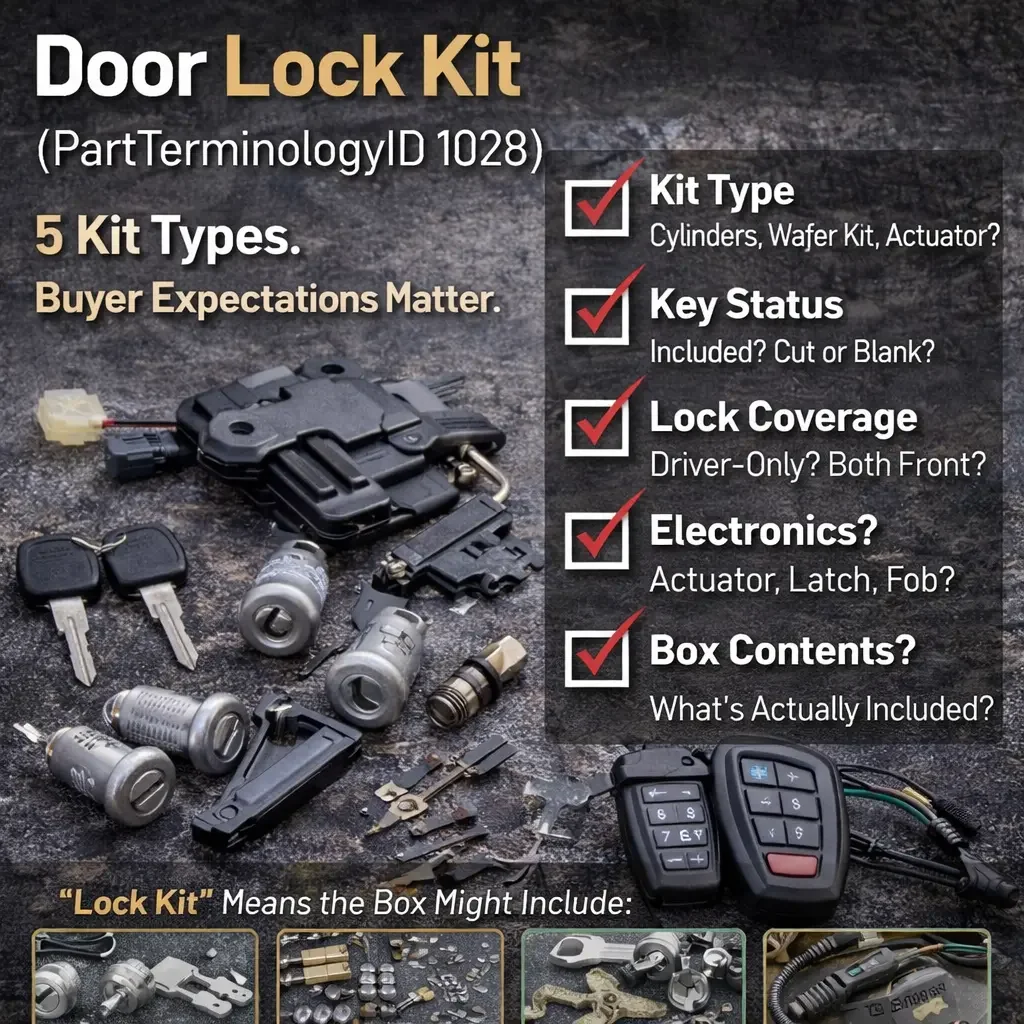
Door lock kits are a category built on assumptions.
Customers buy the phrase “lock kit” and picture a full restore: new locks, matching keys, and everything needed to get back to one key that works everywhere.
Sellers often mean something narrower: a pair of cylinders, a set of tumblers, a single door lock, or a re-key set. On modern vehicles, “lock” can also mean the actuator, the latch, the smart key fob, or the proximity module.
When the noun is ambiguous, buyers fill in the gaps. Returns follow.
This post maps the real-world variants of Door Lock Kit for PCdb PartTerminologyID 1028.
Status in New Databases (ID 1028)
Feature: Current (PIES 7.2 / PCdb) -> Future (PIES 8.0 / PCdb 2.0)
PartTerminologyID: 1028 -> 1028 (No change)
Terminology Name: Door Lock Kit -> Door Lock Kit
First: what does “Door Lock Kit” mean
In the market, “Door Lock Kit” can mean at least five different kit families:
1) Lock cylinder kits (mechanical)
This is the classic meaning.
driver door lock cylinder
passenger door lock cylinder (less common)
tailgate / trunk cylinder
glove box cylinder (older vehicles)
sometimes ignition cylinder included, sometimes not
2) Keyed-alike lock sets
The customer wants one key for multiple locks.
multiple cylinders keyed to match
keys included
sometimes includes clips, retainers, and gaskets
3) Re-key kits (tumbler/pin kits)
These are “service kits,” not “replacement cylinders.”
wafers/tumblers/pins
springs
sometimes tools
often requires a locksmith skill level
4) Actuator or latch-related “lock kits” (modern vehicles)
Customers say lock, but the failure is electric.
door lock actuators
latch assemblies with integrated actuator
cables and rods
sometimes “repair kits” for latch internals
5) Smart key / keyless entry related kits (rare but seen)
This gets messy fast.
fobs
transponder keys
proximity sensors
programming requirements
Most sellers should not call these “Door Lock Kit” without hard clarity, because customers assume keys and cylinders.
The biggest expectation trap: keys and “complete kit” language
When a customer sees “door lock kit,” they assume:
cylinders
matching keys
everything in the box
no extra steps
But reality varies:
keys may be included, blank, cut, or not included
cylinders may be pre-keyed, random keyed, or re-key required
programming may be required for modern keys
clips and retainers may be missing
If you do not state this clearly, you will get returns that look like quality problems but are actually expectation problems.
All the options and variants you should explicitly support
Below is the option universe that actually matters for door lock kits.
Mechanical configuration
with keys
without keys
keys included and pre-cut
keys included but blank
keyed alike (multiple cylinders match one key)
random key (each cylinder different)
re-key to existing key possible (with wafer kit)
includes ignition cylinder or not included
Vehicle coverage
driver door only
both front doors
doors plus trunk/tailgate
full set including glove box (older platforms)
single cylinder replacement only
Hardware and install pieces
clip included vs not included
gasket/seal included vs not included
tailgate cam included vs not included
linkages included vs not included
Electronics and programming (only when relevant)
actuator included vs not included
latch assembly included vs not included
requires programming (yes/no)
immobilizer chip present (yes/no)
remote functions included (lock/unlock/panic)
Compatibility traps
power locks vs manual locks
keyless entry trim vs base trim
valet key systems on some models
different key profiles within the same year range
mid-year cylinder design changes
The catalog fields that matter most for PartTerminologyID 1028
If you want a field set that reduces returns, treat this like a “kit-definition part,” not a single component.
Kit identity
Kit type: cylinder kit, keyed-alike set, re-key kit, actuator kit, latch kit
Components included: list them
Quantity of cylinders
Quantity of keys
Key and coding state
keyed alike: yes/no
keys included: yes/no
keys cut: yes/no
keys blank: yes/no
re-key required: yes/no
reuse original key supported: yes/no
Vehicle and position
location coverage: driver door, passenger door, trunk, tailgate
side and door position logic
Electronics (only if applicable)
actuator included: yes/no
latch included: yes/no
programming required: yes/no
immobilizer chip: yes/no
If you can’t express these fields, you can’t sell this category cleanly.
Catalog checklist for PartTerminologyID 1028
Define the kit type in the first line
Cylinder kit, keyed-alike set, re-key kit, actuator kit, or latch kit.List box contents like a bill of materials
Cylinders, keys, clips, seals, cams, hardware. No ambiguity.Make key status unavoidable
Keys included or not. Cut or blank. Keyed alike or random.Separate mechanical from electronic
Do not let actuators or latch kits hide under “lock kit” without calling that out.Handle trim and keyless package splits
Keyless entry packages can change lock architecture and expectations.Call out programming requirements clearly
If programming is required, say it early. This is a buyer filter.Avoid “complete kit” unless it is truly complete
This phrase drives the worst kind of returns.
The most common listing mistakes
Mistake 1: Not stating whether keys are included
Customer assumes they are. They are not. Return.
Mistake 2: Not stating keyed alike vs random keyed
Customer expected one key for everything.
Mistake 3: Calling a re-key wafer kit a lock kit without warning
Customer expected cylinders, not tiny pins and springs.
Mistake 4: Mixing actuator kits into the same template
The customer needed a mechanical lock, not an electric actuator.
Mistake 5: Not stating programming requirements
Customer finds out after it arrives.
Marketplace-ready “must say” lines
Kit type: Cylinder set, Keyed-alike set, Re-key kit, Actuator kit, Latch kit
Keys included: Yes/No
Keys: Cut or blank
Keyed alike: Yes/No
Locations included: Driver door, passenger door, trunk/tailgate
Hardware included: clips/seals/cams Yes/No
Programming required: Yes/No (only if applicable)
Quick FAQ
Does a door lock kit come with keys?
Sometimes. Many do, many do not. Your listing should state key inclusion and whether the keys are cut or blank.
Are the locks keyed alike?
Some sets are. Many are random keyed. If it matters to the buyer, it must be explicit.
Is this the same as a door lock actuator?
No. Actuators are electric components. Cylinders are mechanical. Many customers confuse the two, so your listing must prevent it.
Will I need programming?
Only for modern keyless or immobilizer-related products. Mechanical cylinder kits do not require programming.
Close
Door lock kits aren’t difficult products. They are difficult nouns.
If you do not define kit type, key status, keyed-alike behavior, and what locations are included, you’ll sell to guessing customers. Guessing customers return parts.
If you paste 3 to 5 example SKUs you carry, I’ll turn this into a marketplace item specifics template for eBay, Amazon, and Walmart for 1028.