
Exterior Door Handle (PartTerminologyID 1024): The Complete Map of Options, Pieces, and Listing Traps
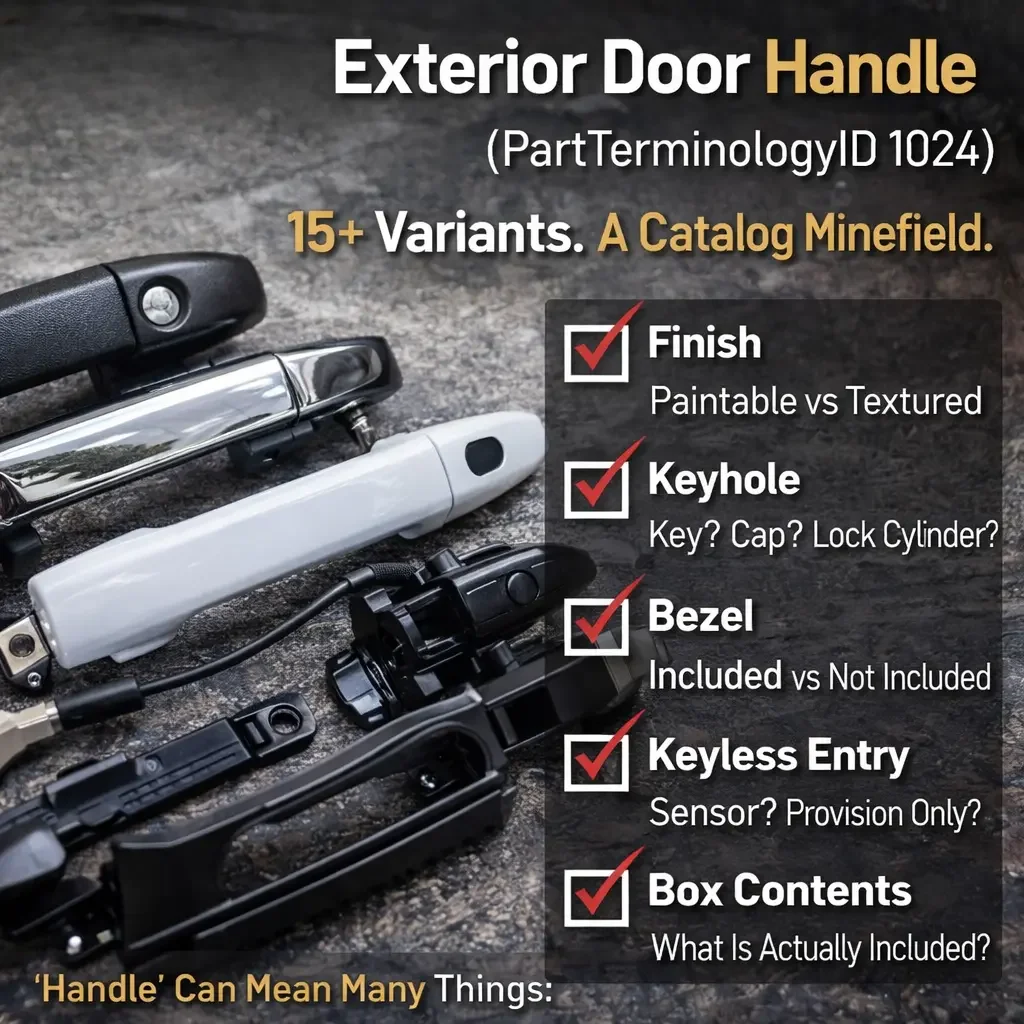
Exterior door handles are one of the highest-volume, highest-return categories in the entire aftermarket. That is not an accident. It is the predictable result of a part category that fails in more ways than almost anything else on a vehicle, combined with catalog practices that treat it like a commodity item with a color and a side.
Handles fail cosmetically. Paint chips, chrome peels, the finish oxidizes. They fail mechanically. The plastic cracks, the linkage tab snaps, the internal spring loses tension. They fail electronically. Keyless sensors stop responding, proximity circuits corrode, wiring pigtails degrade. And they fail at the point of sale, every single day, because buyers assume the word 'handle' means the complete unit, open the box, and find one piece of a system that requires three more parts they did not know they needed to order.
This is not a simple replacement part. It is a system that intersects paint code, door trim, lock configuration, keyless entry electronics, linkage geometry, and sometimes vehicle-specific clip designs that are one-time-use. If your catalog data treats PartTerminologyID 1024 like a single generic entry with a color field and a left/right split, you will convert sales. You will also generate returns at a rate that erodes every dollar of margin in the category.
This guide is the practical, operational reference for everyone who catalogs, sells, or sources exterior door handles in the aftermarket. It covers every variant that causes returns, every catalog field that matters, every listing mistake that costs money, and the exact language buyers need to see before they click purchase.
PCdb Status for PartTerminologyID 1024
Before getting into variants and catalog logic, a quick orientation on where this part lives in the standards ecosystem.
PartTerminologyID
◦ 1024 in both current PIES 7.2 / PCdb and future PIES 8.0 / PCdb 2.0. No change on migration.
Terminology Name
◦ Exterior Door Handle. No rename in PIES 8.0.
Category
◦ Body
SubCategory
◦ Doors
Status
◦ Active in both schema versions.
The terminology is stable. PIES 8.0 does not rename or re-number this part. If you are migrating to the new schema, 1024 maps directly. The challenge in this category has never been the standard. It has been the gap between the standard and the actual product diversity in the market.
What Buyers Mean When They Say Door Handle
The first failure in this category happens before the catalog is even built. It happens when someone assumes that the words 'door handle' have a shared meaning between the supplier, the cataloger, the seller, and the buyer. They do not.
Here are the eight distinct things a customer might mean when they search for an exterior door handle:
• Handle shell only. The piece you grab, with no mechanism, no carrier, no cylinder, and no hardware.
• Handle with trim surround. The handle plus the bezel, escutcheon, or handle cup that frames it on the door skin.
• Handle with keyhole. The handle has a visible key cylinder opening, a key cylinder included, or both.
• Handle without keyhole. For keyless-equipped vehicles or rear doors that never had a cylinder.
• Handle with lock cylinder. The physical cylinder ships in the box with the handle.
• Handle with carrier or bracket. Common on European designs and some modern platforms. The carrier is the structure that mounts to the door. The handle shell is only the exterior touch surface.
• Handle with linkage. Rods, clips, Bowden cables, or small retainers that connect the handle to the latch are included.
• Handle with electronics. A keyless touch sensor, proximity sensor, illumination element, or small switch module is built in.
Most returns trace directly back to this list. The listing said handle. The customer needed one of the eight things above. The listing was technically not wrong. The customer felt misled. The return went through anyway.
The fix is not to carry all eight variants for every application. The fix is to be explicit, in the title, in the item specifics, and in the description, about exactly which of these eight things is in the box. Every word of ambiguity in a door handle listing is a return waiting to happen.
KEY INSIGHT
Returns do not always happen because the wrong part shipped. They happen because the customer received what was described, but not what they expected. Expectation management in the listing is the only lever you control at the catalog level.
The Complete Option Universe for Exterior Door Handles
Exterior door handles have more selectable attributes than almost any other body part in the aftermarket. Each attribute is a return driver when it is missing from the listing. The sections below cover every dimension of variance that matters.
1. Finish, Paint Compatibility, and Color Matching
Finish is the single biggest cosmetic return driver in this category. A customer judges a part in the first three seconds after opening the box. If the texture, sheen, or color is wrong for their vehicle, the part goes back, even if the fitment is correct, even if the mechanism works, even if everything else is right.
The finish options that exist in the market:
• Paintable, primed. The surface is prepared for painting. Typically comes in gray primer or a neutral base coat. The customer is expected to paint this to body color. This is the correct option for customers who want a color match and are willing to paint or have the part painted.
• Paintable, smooth black. The surface is smooth and can accept paint, but it ships as black. Some customers mistake smooth black for textured black and return when they cannot get a clean paint adhesion. Be explicit that the surface is paintable.
• Textured black. A molded-in texture that is not intended to be painted or cannot achieve a clean paint match. Often used for base-trim vehicles where the handle is meant to be a contrasting trim element rather than body-color matched. Do not call this paintable.
• Chrome plated. A plated finish that cannot be painted and is not compatible with body-color matching. Often found on premium trims and trucks. Must be clearly identified to prevent returns from customers expecting a painted match.
• Satin or matte chrome. Similar to chrome but with reduced reflectivity. Customers who ordered gloss chrome will return a satin finish. Label the gloss level.
• Pre-painted, body color matched. Rare in standard aftermarket but common in OE-style replacement programs. If you offer pre-painted handles, you must tie the listing to specific paint codes, not just color names.
RETURN TRAP: Finish Mismatch
The most common finish return: a customer with a silver vehicle receives a smooth black paintable handle and assumes it is the wrong part. The listing said black but never said paintable. The customer returned it before reading the description. Put paintable, intended for body color painting in the title or the first bullet. Not the description. The title.
2. Keyhole, Lock Cylinder, and Cap Configuration
This is the most structurally complex attribute cluster in the category, and it is responsible for a high percentage of does-not-fit returns, even when the handle itself bolts up correctly. The key and lock configuration must match the vehicle's door exactly, not just the year, make, and model.
Keyhole Presence
• With keyhole opening. There is a physical opening in the handle for a key cylinder. Required for any vehicle without keyless entry, or for the driver door on vehicles that have a key backup even with keyless entry.
• Without keyhole opening. A smooth handle face with no cylinder opening. Used for rear doors that never had a cylinder, and for any vehicle where the trim level deleted the key cylinder entirely.
The keyhole question is not just a yes/no. Many modern vehicles have a keyhole on the driver door only. The passenger and rear doors use handles without keyhole openings, even on vehicles that are not keyless-equipped. Your application data must reflect door position, not just trim level.
Lock Cylinder Content
• Lock cylinder included. The physical cylinder ships in the box. This is the minority case in aftermarket, but it must be explicit when true.
• Lock cylinder not included, reuse original. The correct instruction for most replacement handles. Customers will need to transfer their existing cylinder. This must be stated.
• Lock cylinder cap included. Some vehicles conceal the keyhole behind a tethered or snap-in cap. If the cap is part of the handle assembly and included, say so.
• Requires re-key. Some cylinders that ship with the handle are not pre-keyed to match the vehicle. The customer will need to take the handle to a locksmith or dealer.
• Keyed alike option. Pre-keyed cylinders that match a specific key code pattern. Rarely offered in aftermarket replacement but worth noting when present.
COMMON MISTAKE: Keyhole Without Cylinder
Listing a handle with keyhole when the keyhole opening is present but the cylinder is not included. Customers see with keyhole and assume a complete lock unit. They receive a handle with a hole and no cylinder. The return reason: missing parts. Be explicit. Write: Keyhole opening present. Lock cylinder not included. Transfer cylinder from original handle.
3. Bezel and Trim Surround
The bezel, also called the handle cup, escutcheon, or handle surround, is the trim panel that frames the handle and covers the mounting hardware in the door skin. It is a separate part on many vehicles, and it is one of the most underreported missing components in door handle listings.
• With bezel included. The handle and the trim surround ship together. Customer installs both as a unit. Clear.
• Without bezel. Handle only. If the vehicle has a bezel and it is not included, the customer must reuse the original or order separately. This must be stated clearly.
• Bezel not required. Some handle designs mount flush to the door skin without a trim surround. Noting this prevents customers from searching for a bezel that does not exist for their application.
Many customers do not know the word bezel. They just see that their installed handle has a chrome or body-color trim ring and the replacement does not include it. They open the return form and write wrong part or missing piece. The fix is plain language: Does not include handle surround. Reuse original trim panel if equipped. Zero ambiguity. Zero missing piece returns.
4. Keyless Entry Electronics and Sensor Integration
This is the fastest-growing source of returns in the category and it is not slowing down. The percentage of vehicles on the road with some form of passive entry, proximity keyless, or touch-to-lock functionality increases every model year. The handles that serve these vehicles look virtually identical to standard mechanical handles from a distance of ten feet. The difference is internal, and it is absolute. An electronic handle and a non-electronic handle are not interchangeable.
• Passive entry touch sensor. A capacitive pad integrated into the handle that detects the driver's touch to lock or unlock. If the vehicle has this feature and the replacement handle does not include the sensor, the door will not respond to touch commands.
• Proximity sensor. Part of the smart key system that detects the key fob in the driver's pocket. Some designs embed this in the handle itself. Replacing with a non-proximity handle disables hands-free entry.
• Illuminated handle. An LED element built into the handle for puddle lighting or decorative illumination. Requires a wiring connection inside the door.
• Sensor provision only. The handle has a cavity or hole machined for a sensor, but the sensor module is not included. Used for vehicles where the sensor is transferred from the original handle during replacement.
• Wiring pigtail included or not included. Electronic handles require a wiring harness connector. Some aftermarket handles include the pigtail, some do not. This must be specified.
• No electronics. A standard mechanical handle with no sensor provision, no wiring, no electronic function. This must also be stated, to prevent customers from assuming electronics are present.
HIGH RETURN ZONE: Sensor Mismatch
A customer with a passive entry system orders a non-sensor handle because both handles look identical in the listing photos. They install the handle. The door works mechanically but touch-lock stops functioning. They open a return: Part does not work. It does work. It is just not the right variant for their vehicle. Label sensor presence on every listing without exception. Both sides of the statement matter: sensor included, and no sensor, not compatible with passive entry systems.
5. Multi-Piece and Carrier-Based Designs
This is the source of confusion that generates the highest-dollar returns in the category, particularly on European vehicles and many modern Asian platforms. The assumption built into most buyers' mental model of a door handle is that handle means a single piece that replaces the entire exterior mechanism. That assumption is often wrong.
Many door handle systems consist of multiple distinct components:
• Outer handle shell. The piece you touch. On carrier-based designs, this is all that is replaced. No mechanism, no mounting structure, just the exterior grip surface.
• Carrier or base frame. The structural bracket that bolts to the door. The outer shell clips or snaps into the carrier. On vehicles where only the shell breaks, only the shell needs replacement. The carrier stays in the door.
• Lock cylinder housing. A separate housing that holds the cylinder independent of the handle shell on some designs.
• Cap piece. A decorative or functional cap that covers part of the assembly, sometimes covering the cylinder opening, sometimes just finishing the aesthetic.
• Linkage hardware. Rods, Bowden cables, clips, and retainers that connect the handle mechanism to the latch inside the door. On some platforms these are part of the handle unit. On others they are sold separately.
The best-known examples of this multi-piece design pattern are BMW and Mercedes-Benz handles, which have used carrier-based architecture for decades. Volkswagen Group vehicles, many Volvo applications, and a growing number of domestic vehicles with premium trim packages use similar designs. Selling the outer shell under a title that implies a complete assembly is the fastest way to generate expensive, frustrated returns from customers who expected a full replacement unit.
If you are selling a shell, say outer handle shell only in the first line of the description and the title where space permits. If you are selling the complete assembly including carrier, say complete assembly including carrier. If you are selling individual components, list each one explicitly.
6. Door Position and Side
This seems obvious. It is still a top-five source of incorrect orders, because sellers underestimate how granular position data needs to be in this category.
• Front left, driver side front. The most commonly replaced handle on most vehicles. Key cylinder present on most applications.
• Front right, passenger side front. Often shares the handle design with the driver side but typically does not have a key cylinder.
• Rear left. May or may not share design with the front. Typically no key cylinder. Some vehicles use a different handle design on rear doors.
• Rear right. Same logic as rear left.
• Sliding door. Vans and some SUVs. Completely different handle geometry. Must be categorized separately and never grouped with hinged door applications.
Never list a handle as left without specifying front or rear. On vehicles with different front and rear handle designs, which is common, a customer who orders the wrong position gets a part that will not fit the mounting points in the door, even though the handle is for the correct side of the vehicle. Use driver front, passenger front, driver rear, and passenger rear as your positional language. Add the side designations in the specifics.
7. Trim Level and Package Dependencies
Year, make, and model is not sufficient fitment data for exterior door handles on any vehicle built after approximately 2005. Trim level and option packages drive meaningful structural and electronic differences in the handle design. Some of the most common splits:
• Base trim uses a mechanical key cylinder handle. Premium trim uses a keyless proximity handle. The part number is different. The catalog must split the application.
• Chrome handle on one trim. Textured black on the base. Body-color paintable on the top trim. Three different parts for one year-make-model.
• Rear doors with no keyhole on all trims, but the part design itself changes based on whether the vehicle has rear door power windows, because the internal mechanism differs.
• Some vehicles change handle designs mid-production year. The catalog note must reflect production date or VIN range, not just model year.
The vehicles where trim dependency causes the most frequent misfits are full-size domestic trucks and SUVs, German luxury vehicles across all segments, and any vehicle where the trim structure creates five or more configurations within a single model year. For these vehicles, fitment notes in the application data are not optional. They are the catalog.
The Biggest Return Driver: The Assembly Expectation Gap
There is one cognitive model that causes more door handle returns than any technical mismatch, any finish error, or any fitment data error. It is the assumption that exterior door handle means the complete, ready-to-install assembly that replaces everything that touches the exterior of the door mechanism.
When a customer's door handle breaks, they look at the broken piece. They see the chrome grip, the surround trim, maybe the lock cylinder, and the linkage going into the door. In their mental model, all of that is the handle. When they order a replacement, they expect all of it. When the box contains only the outer grip shell, they feel deceived, even if the listing was technically accurate.
This expectation gap is widest in three scenarios:
1. First-time buyers who have never replaced a door handle before and have no reference point for what handle only means in practice.
2. Buyers on European vehicles who do not know their car uses a carrier-based design where the outer shell is a separate replaceable component.
3. Buyers whose original handle came off as a complete unit when they removed it, which happens on many domestic vehicles, who then assume the replacement should also be a complete unit.
The catalog solution is to write box contents like a bill of materials. Not a marketing bullet. Not a features list. A bill of materials stating what is in the box in plain language, in the first line of the description and repeated in the item specifics. Here is the exact language format that works:
BOX CONTENTS FORMAT: SHELL ONLY
Includes: Outer handle shell only. Does not include: bezel/trim surround, lock cylinder, key cylinder cap, carrier bracket, linkage rods, or hardware clips. Lock cylinder transfer from original handle required if vehicle is key-cylinder equipped.
BOX CONTENTS FORMAT: COMPLETE ASSEMBLY
Includes: Handle shell, carrier bracket, and bezel. Does not include: lock cylinder, linkage rods, or hardware clips. Lock cylinder must be transferred from original handle. Carrier replaces existing carrier in door. See installation instructions.
Two sentences. Zero ambiguity. The customer who reads this knows exactly what they are ordering. The customer who does not read it has no legitimate basis for a return claim when they receive what was described.
Catalog Fields That Actually Reduce Returns
The following field set is the operational standard for PartTerminologyID 1024. These are not aspirational data points. They are the minimum required to prevent the return patterns described in this guide.
Fitment and Position Fields
Side
◦ Left (Driver) or Right (Passenger). Never list left alone without position context.
Door Location
◦ Front or Rear. Add Sliding for van and SUV applications.
Position Note
◦ When front and rear designs differ, note this in fitment notes rather than grouping them.
Trim or Package Note
◦ When handle design varies by trim level, split the application. Do not group trim variants under a single fitment row.
Production Date
◦ Use when design changed mid-year. Never rely on model year alone for mid-cycle updates.
Appearance and Finish Fields
Color Name
◦ Be specific. Black is not enough. Use Textured Black or Smooth Black.
Finish Type
◦ Textured, Smooth, Chrome, Satin Chrome, Primed
Paintable Flag
◦ Yes or No. If Yes, state it explicitly: Paintable, intended for body color match.
Pre-Painted Flag
◦ Yes or No. If Yes, include paint code or OEM color name.
Surface Texture
◦ Note heavy texture vs smooth surface for paint adhesion context.
Key and Lock Configuration Fields
Keyhole Present
◦ Yes or No. If Yes, specify whether the listing includes the opening only or the cylinder as well.
Lock Cylinder Included
◦ Yes, No, or Not Applicable for keyless-only applications.
Lock Cylinder Action Required
◦ Transfer from original, Re-key required, or None.
Cap Included
◦ Yes or No. Note if tethered or separate.
Key Cylinder Cap
◦ Included or Not Included. This is a separate field from the main cylinder note.
Electronics and Sensor Fields
Keyless Sensor
◦ Included, Not Included, or Provision Only, meaning the hole is present but the sensor is not.
Sensor Type
◦ Touch (capacitive), Proximity, or None.
Illumination
◦ Yes or No. LED type if applicable.
Wiring Pigtail
◦ Included, Not Included, or Not Applicable.
Electronics Note
◦ Plain-language note. If standard mechanical, write: No electronic components included.
Assembly and Box Content Fields
Assembly Type
◦ Shell Only, Shell and Bezel, Shell and Carrier, or Complete Assembly.
Bezel Included
◦ Yes or No. If No, write: Reuse original if equipped.
Carrier Included
◦ Yes or No. Especially important for European and carrier-based applications.
Hardware Included
◦ Yes or No. List clips, bolts, or retainers if included.
Linkage Included
◦ Yes or No. Rods, cables, or clips.
Box Contents Statement
◦ Full bill-of-materials sentence required on every listing. Include one does-not-include line for every component a buyer might expect.
The Six Most Common Listing Mistakes in This Category
These are not edge cases. These are the recurring patterns that show up in return data, seller feedback reports, and marketplace seller metrics. Each one is preventable with a single catalog field or one sentence added to the listing.
Mistake 1: Paintable vs. Textured Not Stated
A customer with a silver vehicle orders a black handle. The listing says black. The customer receives a textured black handle that cannot be painted to body color. They return it. The return reason: wrong part. The actual problem: the listing never said the finish was textured and not paintable.
The fix: Put Textured Black, not intended for painting or Smooth Black, paintable, intended for body color match in the title. Not the description. The title.
Mistake 2: Keyhole Configuration Not Matched
A customer needs a driver front handle with a keyhole. They order a handle listed with keyhole in the title. They receive a handle with a keyhole opening but no lock cylinder. They cannot complete the installation without transferring the cylinder from their broken handle, which they have already discarded. The return goes through: missing lock cylinder.
The fix: Write this every time: With keyhole opening. Lock cylinder not included. Transfer from original handle required.
Mistake 3: Bezel Not Included, Not Disclosed
A customer replaces a driver door handle on a vehicle where the handle bezel is a visible chrome trim ring. They order the handle. The replacement does not include the bezel. They install it. The customer reports the part looks unfinished. The return reason: missing trim piece.
The fix: Does not include handle surround/bezel. Reuse original trim panel from vehicle. One sentence. Prevents the return.
Mistake 4: Keyless Sensor Mismatch
A customer with passive keyless entry replaces a cracked handle. Both handles look the same in the photos. The listing has no mention of sensor compatibility. The customer installs a non-sensor handle. Touch-lock stops working. They open a return: part is defective. The part is not defective. It is the wrong variant for their vehicle.
The fix: Every handle listing must state either Includes passive entry sensor or No sensor, not compatible with passive/keyless entry systems. Both sides of the statement matter. Ambiguity is the enemy.
Mistake 5: Selling a Shell as a Complete Assembly
A customer with a BMW 3 Series orders a driver door handle. The listing title says Front Left Exterior Door Handle. The listing photo shows an outer shell. The customer expects a complete replacement unit including the carrier. They receive the shell. They do not understand that the carrier stays in the door. They cannot figure out how the new handle connects. The return reason: does not fit.
The fix: Outer handle shell only. Carrier bracket remains in door. Shell clips into existing carrier. Carrier not included. Write it like the customer has never seen the inside of a door, because many of them have not.
Mistake 6: Side Listed Without Door Position
A customer orders a rear driver door handle. The listing says Left. It ships the front left handle. The mounting geometry is different. The handle does not fit. The return reason: wrong part. The catalog had left but never specified front or rear because the data was never split by door position.
The fix: Never use left or right without the door position qualifier. Driver Front Left. Passenger Rear Right. Always both dimensions, always.
Marketplace-Ready Listing Standards for PartTerminologyID 1024
The following language framework is designed for marketplace listings where space is limited and the first few visible lines determine whether the buyer converts or bounces. Every one of these elements should appear on every exterior door handle listing.
Required Title Elements
A compliant title for this category should contain, in order: Part type, which is Exterior Door Handle. Then position, using Driver or Passenger and Front or Rear. Then finish and color. Then one key differentiator such as With Keyhole, No Keyhole, With Sensor, or Without Sensor.
Example title for a paintable driver front handle with keyhole opening but no cylinder included:
Exterior Door Handle, Driver Front Left, Paintable Smooth Black, With Keyhole Opening, Lock Cylinder Not Included
Example title for a textured rear passenger handle without keyhole:
Exterior Door Handle, Passenger Rear Right, Textured Black, No Keyhole
Example title for a chrome driver front handle with passive entry sensor:
Exterior Door Handle, Driver Front Left, Chrome, With Passive Entry Sensor
Required Bullet Points
These seven bullets should appear on every exterior door handle listing:
• POSITION: Driver/Passenger, Front/Rear. For example: Driver Front Left.
• FINISH: Textured Black, Smooth Paintable Black, Chrome, Satin Chrome, or Primed for Paint.
• KEYHOLE: With Keyhole Opening or Without Keyhole. Followed by: Cylinder Included or Cylinder Not Included, Reuse Original.
• BEZEL/SURROUND: Included or Not Included, Reuse Original If Equipped.
• KEYLESS/SENSOR: Passive Entry Sensor Included or No Electronic Components, Not Compatible With Keyless Entry.
• ASSEMBLY TYPE: Shell Only, Shell and Bezel, or Complete Assembly With Carrier.
• BOX CONTENTS: Exact list of what ships in the box.
Box Contents Statement Templates
This is the most important single sentence on the listing. Use one of these templates or write a custom version that is equally specific.
TEMPLATE A: SHELL ONLY
Box contains: Outer handle shell only. Does not include bezel, lock cylinder, key cylinder cap, carrier bracket, linkage rods, clips, or mounting hardware. Lock cylinder transfer from original required if vehicle is key-cylinder equipped.
TEMPLATE B: SHELL WITH BEZEL
Box contains: Outer handle shell and trim bezel/surround. Does not include lock cylinder, key cylinder cap, carrier bracket, linkage rods, or hardware clips. Lock cylinder transfer from original required if vehicle is key-cylinder equipped.
TEMPLATE C: COMPLETE ASSEMBLY
Box contains: Handle shell, carrier bracket, and trim bezel. Does not include lock cylinder or linkage rods. Lock cylinder must be transferred from original handle. Carrier replaces existing carrier in door. See installation instructions.
Application Data Strategy for High-Return Applications
Some vehicle applications generate disproportionate return rates because the application data is structurally difficult to represent accurately. These are the platforms where extra effort in catalog construction pays the highest dividend.
Full-Size Domestic Trucks
Full-size trucks including F-150, Silverado, and RAM have more door handle trim variants than almost any other platform in the market. A single model year on an F-150 can have five or six distinct handle configurations across bed access, cab style, trim level, and keyless entry option. The application data must split by trim level, not just by year. The XL base trim and the Platinum trim have different handles that are not interchangeable. The listing must reflect this.
Additional complexity: the bed access handle and the cab door handle are different parts. The rear cab door on an extended cab may use a different geometry than the front. Sliding rear window packages sometimes affect handle sensor wiring routing. All of these variations must be documented in the application notes.
German Luxury Vehicles
BMW, Mercedes-Benz, and Audi/VW Group applications require extra attention because the carrier-based handle design means buyers are almost always ordering the wrong thing on the first attempt if the listing does not explain the design. BMW and Mercedes applications in particular generate high-value returns because the vehicles are expensive, the buyers are attentive, and the difference between outer shell and complete assembly is a $40 to $200 swing depending on the application.
For these platforms, the listing must explain the carrier concept in plain language, not just in technical spec fields. A note like this eliminates returns before they happen: Note: Your vehicle uses a two-piece door handle system. The carrier bracket remains installed in the door. This listing is for the outer handle shell only, which clips into the existing carrier. This is normal for your vehicle. You do not need to replace the carrier unless it is also physically damaged.
Vehicles With Mid-Year Design Changes
Any vehicle where the handle design changed mid-production year, which is more common than catalog systems typically account for, must have production date range in the fitment notes, not just model year. The catalog note Verify production date before ordering is not sufficient. The note must state the specific production date cutoff: Fits vehicles produced before a specific month and year. For vehicles produced after that date, order the alternate part number or description.
Electric and Hybrid Vehicles With Flush Handles
Some modern vehicles, particularly EVs, use retractable or flush-mount exterior door handles that are an entirely different product category from a functional standpoint. These handles are typically combined with sensor and actuator assemblies and cannot be compared to standard mechanical handles. If you carry these, they should be cataloged as their own distinct product type even if they technically fall under PartTerminologyID 1024. The application notes must explain that this is a powered or retractable design and list the electronic components included or required.
Extended FAQ for Exterior Door Handle (PartTerminologyID 1024)
Why does my paintable handle arrive black instead of body color?
A paintable handle is designed to be painted. It is not pre-painted. Most come primed or in a smooth black base coat to provide a paint-ready surface. The description paintable means the surface is compatible with automotive paint adhesion, not that it has already been painted to match your vehicle. Textured black handles are different. Those are not intended for painting and will not achieve a quality paint match. If you need a body-color match, you will need to either order a pre-painted handle if available for your application, or have the paintable handle painted by a body shop before installation.
Does my vehicle need a handle with a keyhole?
It depends entirely on your specific door and trim configuration. Driver front doors on most non-keyless vehicles have a key cylinder and therefore need a handle with a keyhole opening. Passenger and rear doors often do not have a key cylinder and require handles without keyhole openings. Vehicles equipped with full keyless entry from the factory may have no key cylinders on any door, or may retain a driver-side backup cylinder. Check your original handle. If it has a visible keyhole or a cap covering a keyhole, you need a handle with keyhole provision.
My handle came off as one piece. Why is the replacement only the outer shell?
Some vehicles use a two-piece handle design where the carrier bracket is meant to remain installed in the door during replacement. When your original handle was removed during a repair or body work, it may have come out as a complete assembly, but that does not mean the replacement requires the complete assembly. On carrier-based designs, the outer shell is the wear item that most often cracks or breaks. If your carrier is undamaged, you only need the shell. If the listing does not make this clear, contact the seller to confirm what is included before installing.
Why does my keyless entry not work after replacing the handle?
The most common cause is that the original handle contained a passive entry sensor or proximity module that was not present in the replacement. These sensor components are integrated into the handle structure and are not always visible from the exterior. The replacement handle may be mechanically correct but electronically incomplete for your vehicle's keyless entry system. Check the replacement handle against the specifications for your trim level's keyless entry option. If the original had a sensor and the replacement does not, you will need a handle listed as compatible with passive or keyless entry systems.
What is a handle carrier or bracket?
On vehicles with carrier-based door handle designs, most commonly German luxury vehicles and some modern Asian platforms, the door handle system has two primary components. The carrier bracket mounts to the door structure and houses the linkage mechanism. The outer handle shell is the piece you touch. The carrier remains installed in the door and is typically not replaced unless it is physically damaged. The outer shell is the component that breaks when a handle fails due to UV degradation, impact, or repeated stress. Aftermarket listings that say handle shell only or outer handle only are referring to this outer component only.
How do I know if my vehicle has a passive entry handle?
Look at your original handle carefully. If there is a small capacitive pad, a subtle logo, a proximity sensor window, or any wiring connector attached to the back of the handle, your vehicle uses an electronic handle. You can also check your vehicle's window sticker or order sheet for passive entry, hands-free entry, or keyless access options. Finally, test the function: if touching the handle rather than pressing a button locks or unlocks the door, you have a passive entry handle that requires an electronic replacement.
Can I use a driver side handle on the passenger side?
Sometimes, but not always. Some vehicles use symmetric handle designs that work on either side. Others use handles with keyhole provisions that are physically present only on the driver side, making the driver handle incompatible with passenger side mounting. Additionally, handle cup geometry and mounting tab positions sometimes differ between driver and passenger sides even when the handles look identical from the exterior. Always verify that the handle is specifically listed for the door position you are replacing rather than assuming left-right symmetry.
Catalog Quality Checklist for PartTerminologyID 1024
Use this checklist as the final quality check before any exterior door handle listing goes live. Every item should have a clear, documented answer. If any item cannot be answered, the listing has a gap that will generate returns.
8-Point Verification Before Publishing
4. Identify exactly what is in the box. Handle shell only, assembly with bezel, assembly with carrier, or complete assembly. Write it as a bill of materials before writing the listing title.
5. Document finish and paint behavior. Is it paintable or textured? If paintable, say so explicitly. If textured and not paintable, say that. Put it in the title.
6. Validate keyhole logic by door position and trim level. Does this specific door on this specific trim have a key cylinder? Does the replacement match that configuration?
7. State bezel inclusion status. If the bezel is separate, write: Bezel not included. Reuse original if equipped. If included, list it in box contents.
8. Separate electronic from non-electronic variants. Does this handle have any sensor provision? Passive entry sensor? Proximity module? Wiring pigtail? State it explicitly for both the presence and the absence.
9. Make position unavoidable in the title and specifics. Driver Front Left is not the same as Driver Rear Left. Never allow the position to be inferred from the application data alone.
10. Address multi-piece design if applicable. If the vehicle uses a carrier-based design, explain it in plain language. Do not let handle only do the work without context.
11. Write box contents as a complete sentence. Include one does-not-include statement for every component a customer might expect but will not receive.
Final Thoughts
Exterior door handles are a volume category. Volume is where bad catalog data scales. Every vague listing, every missing finish note, every undisclosed shell-only situation multiplies across thousands of transactions. The damage is not just the return. It is the feedback, the seller metrics, the customer who never comes back, the review that says wrong part when the correct part was actually shipped.
The competitive advantage in this category does not come from price. It comes from trust. A buyer who has a clear listing, who knows exactly what is in the box, what finish to expect, whether the keyhole matches their vehicle, whether the sensor is included, and whether the assembly is complete, buys with confidence. Confident buyers do not return.
The catalog fields described in this guide are not enhancements. They are the floor. They represent the minimum data that a customer needs to make an informed purchase decision on an exterior door handle. Sellers who build their catalog to this standard consistently see lower return rates, higher feedback scores, and better repeat purchase rates in the category.
The part is simple. The system it belongs to is not. Catalog it accordingly.