
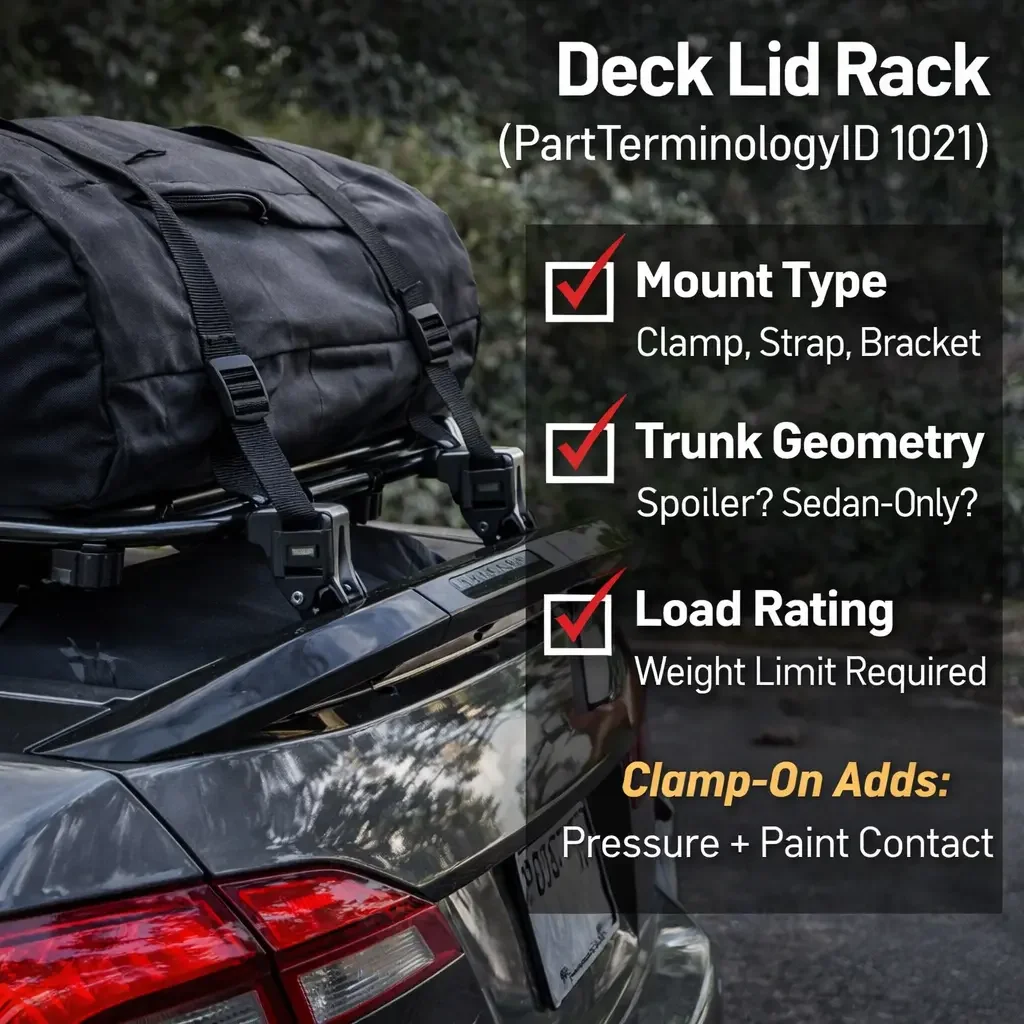
Deck lid racks sell because they look simple.
A buyer sees a clean trunk, imagines a weekend trip, and clicks buy. Then the product arrives and all the stuff that matters shows up at once: clamp geometry, trunk curvature, paint protection, and whether the deck lid can even handle the load.
This category is not just “a rack.” It is a contact system that clamps to painted metal.
If your listing hides that reality, you will sell it. You will also eat the return.
This post is the practical guide for Deck Lid Rack in PCdb PartTerminologyID 1021.
Status in New Databases (ID 1021)
Feature: Current (PIES 7.2 / PCdb) -> Future (PIES 8.0 / PCdb 2.0)
PartTerminologyID: 1021 -> 1021 (No change)
Terminology Name: Deck Lid Rack -> Deck Lid Rack
What a deck lid rack actually is
A deck lid rack is an external cargo rack that mounts to the trunk lid using:
clamp arms that hook under the lid edge, or
strap systems that tension against trunk seams, or
a vehicle-specific bracket kit (less common)
Most are designed for light cargo. Some are marketed for luggage. Some are marketed for bikes. That difference matters.
A deck lid rack is also an interface with paint and weather seals. That is why install method should be obvious in your product data.
The fitment trap: trunk shape and edge geometry
“Fits sedan” is not fitment.
Deck lid racks fail because:
trunk lid edge thickness varies
trunk curvature changes contact points
spoiler presence blocks clamp locations
trunk seam weatherstrips get pinched
rear cameras and sensors get blocked
license plate lights and trunk release access gets compromised
some deck lids are aluminum or composite and flex differently
Even within the same model, trims can change spoilers and lid geometry.
If you list this as universal without constraints, you invite returns.
The buyer reality: load rating is not optional
Deck lid racks get purchased to carry something. That means load limit is the product.
You need to capture and display:
maximum load rating (lbs or kg)
intended cargo type (luggage, light gear, bike support if explicitly rated)
strap or clamp tension design
whether it requires additional tie-down straps
warning language about paint protection and contact pads
If the manufacturer does not provide a load rating, that should be a red flag for how you market it.
The attributes that should be mandatory
If you want fewer returns and fewer “will this fit my car?” messages, capture these:
Mount type: clamp-on, strap-on, vehicle-specific bracket
Selling unit: rack only, rack plus straps, full kit
Load rating: max capacity
Contact protection: rubber pads, foam pads, paint-safe pads
Spoiler compatibility: yes, no, or limited
Trunk access impact: can trunk open with rack installed, yes or no
Material: steel, aluminum, composite
Finish: powder coated, anodized, painted
Dimensions: platform width and depth
Straps included: yes or no
Tie-down points: number and type
Fit notes: “sedan only,” “not for hatchback,” “not for lip spoilers,” etc.
If it touches paint, list the contact material. Buyers care.
Catalog checklist for PartTerminologyID 1021
Define mount type clearly
Clamp-on and strap-on are not the same buyer experience.Do not oversell universality
If it only works on sedans with a clean trunk edge and no spoiler, say that.Surface load rating prominently
Capacity is the product. If it is hidden, customers assume the wrong number.Call out spoiler and body style exclusions
Spoilers, hatchbacks, liftgates, and fastbacks are common mismatch points.Describe contact protection honestly
Rubber pads help, but dirt under pads scratches. Include a “clean surface first” note.Clarify trunk access behavior
Some racks block opening, or you must remove cargo first. Say it.List what’s included
Straps, hooks, pads, hardware. If it is not in the box, do not imply it is.
The three most common listing mistakes
Mistake 1: Treating it like a universal accessory
Trunk geometry and spoilers exist.
Mistake 2: Missing load rating and intended use
Customers assume it can carry more than it can.
Mistake 3: No warning about paint contact
Buyers install on dusty paint and blame the rack for scratches.
Quick FAQ
Will this fit a car with a spoiler?
Sometimes no. Many racks cannot clamp properly with a spoiler in the way. If the listing does not specify, assume limited compatibility.
Can I carry a bike on a deck lid rack?
Only if the product is explicitly rated and designed for that use. Many deck lid racks are luggage platforms, not bike racks.
Will it scratch my paint?
Any product that clamps to paint can scratch if installed on a dirty surface or overtightened. Proper pads, clean surfaces, and correct tension matter.
Close
Deck lid racks are not complicated products. They are complicated outcomes.
If you treat PartTerminologyID 1021 like a universal add-on and skip mount type, spoiler exclusions, load rating, and paint-contact disclosure, you will convert the wrong buyers and pay for it in returns.
If you paste a few example SKUs, I can build a marketplace-ready item specifics template for 1021 that forces clarity across eBay, Amazon, and Walmart.