
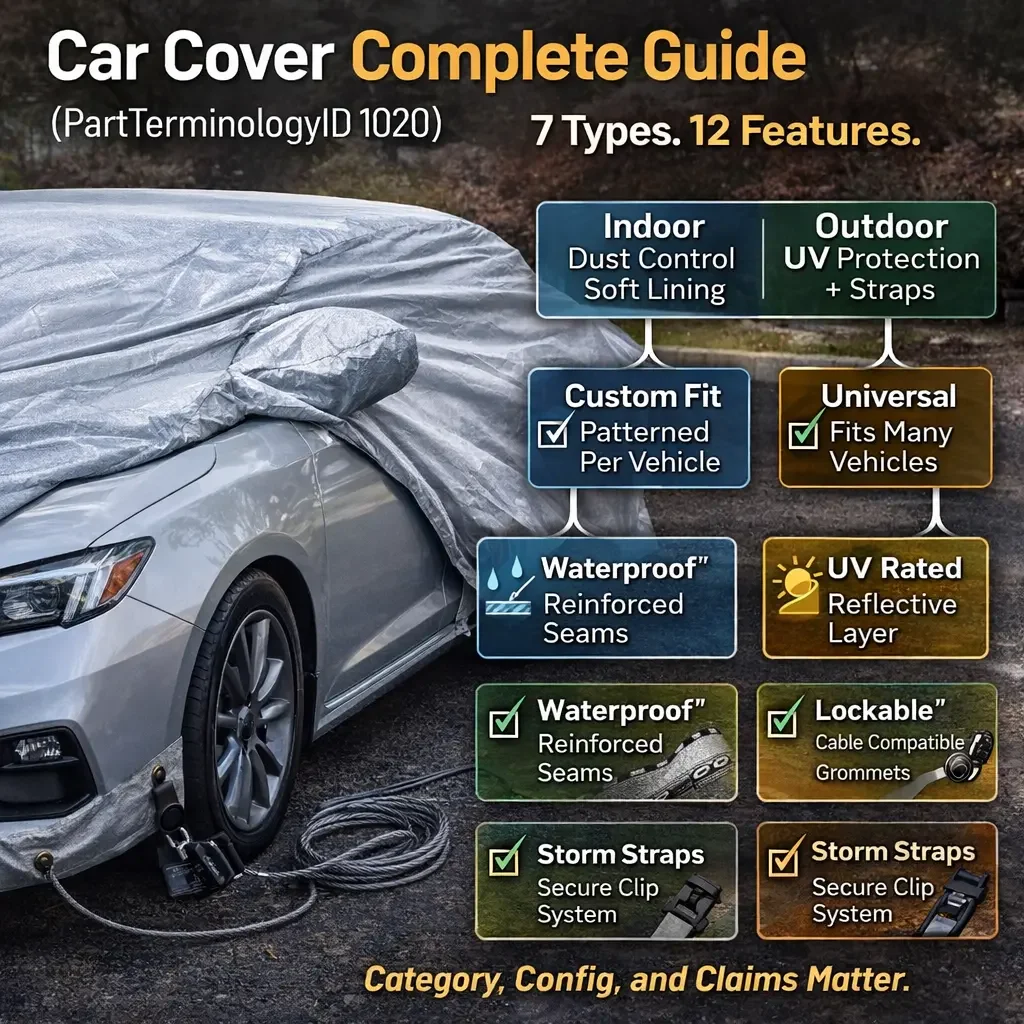
Why this category is messy
Car covers are one of those categories that look simple until you have to sell them at scale. The shopper thinks they are buying protection. The seller thinks they are selling a single SKU type called "Car Cover". Neither side is wrong, but that shortcut is exactly where returns are born.
The word cover hides too much. A dust sheet and a hail blanket are not the same product. A soft indoor stretch cover and a "waterproof" outdoor cover do not behave the same. A universal baggy cover and a pattern cut custom cover do not set buyer expectations the same. When you blur these into one bucket, you get the classic marketplace outcome: a short burst of sales, followed by a steady drip of fit complaints, "not as described" returns, and negative reviews that sit on your listing forever.
This post is a map and a playbook. It is written for catalog teams, marketplace teams, and anyone who has to choose what to list and how to describe it. The goal is not to make every listing longer. The goal is to make every listing clearer. Clarity beats word count. Clarity reduces returns. Clarity earns repeat buyers.
If you want one sentence that summarizes the whole category, it is this: a car cover is a system. The system has five parts. Fit, material, construction, retention, and claims. You do not need every feature to sell. You do need enough data to make your claims true.
Status in New Databases (ID 1020)
This is the standard comparison block used across the PartTerminologyID series so the catalog team knows whether to expect a naming or ID change when moving to newer standards.
· Feature: Current (PIES 7.2 / PCdb) -> Future (PIES 8.0 / PCdb 2.0)
· PartTerminologyID: 1020 -> 1020 (No change)
· Terminology Name: Car Cover -> Car Cover
The real taxonomy: what kind of cover is it
Start with taxonomy. Not marketing taxonomy. Real world taxonomy. What kind of cover is it, and what threat is it designed to fight. If you get this wrong, every other attribute becomes noise.
I like to teach this category as five buckets. Indoor, outdoor, all-weather (which is usually just a marketing label), specialty protection, and partial covers. You can add bubble storage systems as a sixth bucket because buyers mix it into the same mental category, even though the product behaves more like a storage enclosure than a cover.
Below, each bucket includes what the buyer expects, what tends to go wrong, and what your listing must state to avoid misunderstandings.
1) Indoor covers
Indoor covers are garage products. Their job is dust control and paint friendly contact. If you sell indoor covers, you are selling softness and breathability, not storm survival.
Common indoor subtypes include dust covers, soft stretch covers (often spandex blends), fleece lined covers, anti static covers, and breathable cotton blend covers. The specific fabric matters less than the promise. The promise is "I will not scratch your finish and I will keep dust off."
Where indoor covers fail is predictable. Customers use them outside. They get wet. They flap in wind. They trap moisture because they were never designed for rain performance. Then they leave a review that says the cover is bad, when the reality is the use case was wrong.
Catalog guidance: always label indoor covers as indoor. Put it in the first line. Put it in the bullet list. Put it in the attributes. Add an explicit warning that outdoor exposure will reduce performance, especially for rain, wind, and UV.
2) Outdoor covers
Outdoor covers are weather products. Their job is UV, precipitation, and wind management. This is where most sellers overpromise, because the temptation to call everything waterproof and all-weather is strong.
A good outdoor cover does three things at the same time. It blocks UV. It sheds water. It manages moisture trapped between the cover and the vehicle. That last point is the one people forget. If you trap moisture, you are creating a microclimate that can haze paint, accelerate corrosion on exposed hardware, and leave the buyer with a musty smell they blame on your product.
Outdoor subtypes include UV resistant covers, water resistant covers, multi layer heavy duty covers, and breathable outdoor covers with vents. The right listing does not just throw these words in. It explains the tradeoffs. More waterproofing often means less breathability. More breathability often means less resistance to standing water. The "best" cover depends on climate.
Where outdoor covers fail is wind. Buyers do not realize how much wind loads a large fabric surface. If you sell outdoor covers, retention is part of the story. Elastic hems help. Straps help more. Reinforced grommets help. A cable lock helps for security but it is not a wind solution.
3) All-weather covers (why the label drives returns)
All-weather is a dangerous label. It is not a technical standard. It is a promise. If you cannot prove the promise with construction details, do not use the label.
If you insist on using all-weather, back it with specifics. What is the layer construction. Are seams sealed. Are there vents. What climate is it intended for. Desert sun is not the same as coastal humidity. Snow load is not the same as summer rain.
A simple rule that keeps you honest: if you cannot name the actual protections, you do not have a real all-weather cover. Call it outdoor, then list the protections you can support.
4) Specialty protection covers
Specialty protection covers exist for a specific threat. They are not interchangeable. If you catalog them like a general cover, buyers will buy them wrong.
Hail covers are the easiest example. They are either padded or inflatable. If they are padded, buyers need to know thickness and impact zones. If they are inflatable, buyers need to know how inflation works and what parts are protected. If you skip those details, you get instant "not what I thought" returns.
Other specialty covers include snow and ice covers (often windshield first systems), reflective sun and heat covers, storm and high wind covers with reinforced strap systems, wildfire ash and fine dust covers intended for storage, and covers positioned for tree sap and bird dropping resistance.
Catalog guidance: specialty covers should expose the threat in the product name and bullets. Do not hide it under generic outdoor language. If it is a hail cover, say hail. If it is an ash barrier storage cover, say ash and say storage.
5) Partial covers and capsule storage systems
Partial covers are not full car covers. Buyers buy them fast because they are solving a focused problem. They also return less because the fit expectations are simpler.
Common partial categories include windshield covers, front end bra style covers, and half covers that protect roof and glass. They are often sold in colder climates for frost and snow, or in sun heavy areas for dashboard and interior heat management.
Then there are bubble storage systems, sometimes called capsules. These are enclosed storage products. They do not behave like fabric covers. They behave like a storage environment, sometimes with airflow management. Buyers will still compare them to covers because the need is the same: protect the vehicle during storage. If you sell capsules, treat them as their own category and explain setup, footprint, power requirements (if any), and storage intent.
Fit type is the return lever: custom-fit vs semi-custom vs universal
Fit type is the return lever. Two covers can be made from the same fabric, and the one with the wrong fit will get blamed as low quality. Buyers rarely separate fit from material in their review. They say "cheap" when they mean baggy.
There are three fit types that matter. Custom fit, semi custom, and universal. The words are simple, but sellers use them loosely, and that is what creates angry buyers.
Custom-fit covers
Custom fit covers are pattern cut for a specific vehicle profile. They fit tighter, they look better, and they flap less in wind. Mirror pockets are typically included. The buyer expectation is high because the buyer is paying for precision.
Failure mode: wrong body style, wrong generation, wrong trim. If the listing says "fits Camry" but the pattern is for a different generation or the cover assumes no spoiler and the vehicle has a wing, the buyer will feel misled even if the cover physically stretches over the car.
Catalog guidance: custom fit needs real fitment logic. At minimum, year range, make, model, and body style. Better is year range plus body code, roof type, and spoiler notes. If you are going to claim custom fit, your fitment qualifiers must be strict.
Semi-custom covers
Semi custom covers are grouped by body type and approximate length. You will see categories like sedan small, sedan large, coupe, hatchback, SUV small, SUV large, and sometimes pickup short bed and long bed. The cut is generic but not totally random.
Failure mode: buyers read semi custom as custom. The product arrives, mirror pockets do not line up, the fabric is loose on the hood, and wind flaps start. The buyer blames quality. This is really expectation management.
Catalog guidance: do not call semi custom "custom fit". Say semi custom. Provide a length range in inches. Provide a simple fit disclaimer that the cover is designed around body class and length, not exact contours.
Universal covers
Universal covers are one cover fits many. They are the easiest to list and the highest return risk. That does not mean they should not exist. It means you need to sell them honestly.
Failure mode: the buyer expects a tailored look. They get a loose fabric bag. If the listing used the word custom, the return is guaranteed. If the listing used clear language like "universal" and "loose fit", the buyer self selects and returns drop.
Catalog guidance: universal should always include the word universal. It should include the vehicle class and a length range. If you have enough data, add height notes for lifted trucks and widebody vehicles.
Sizing that works: length, width, height, and what buyers really mean by "fit"
Most marketplaces want a size. Buyers want the cover to fit. The problem is that "size" is not one thing. It can mean vehicle length, or it can mean cover dimensions, or it can mean a marketing size like "SUV Large". If you do not control this language, you will create confusion.
The clean approach is to publish two numbers. A supported vehicle length range in inches and the cover's own length in inches. If you can only publish one, publish the supported vehicle length range.
For custom fit, the length range can be implied by fitment. Still, including it builds trust and reduces "is this too small" questions.
If you sell semi custom or universal, the length range is not optional. It is the primary buyer decision field.
The feature map: everything a car cover can include, organized for real decisions
Car covers can include a long list of features, and that list is not the enemy. The enemy is unstructured feature language. Buyers cannot parse it. Marketplaces cannot filter it. Your own support team cannot answer questions consistently.
The trick is to group features the way buyers think. Weather and water, UV and heat, wind security, theft deterrence, paint safety, debris protection, climate intent, and usability.
Below is an expanded feature map with what each feature really implies from a materials and construction perspective. If you cannot support the implication, do not claim the feature.
Weather and water protection
Water language is where this category gets toxic. Buyers hear "waterproof" and imagine a sealed tent. Many covers are not built like that. A fabric can be water resistant and still allow seepage through seams. A cover can repel water for a short period and still saturate after a long storm.
If you want to talk about water honestly, you need four fields. Outer fabric behavior, membrane behavior (if any), seam behavior, and venting behavior.
Outer fabric behavior is about coatings and weave. Membrane behavior is about whether there is a barrier layer. Seam behavior is about whether seams are taped or sealed. Venting behavior is about how trapped moisture is handled.
When a listing says waterproof without seam sealing, that is marketing, not performance. Buyers will discover that in the first rain.
· Water-resistant fabric (repels light rain, not a sealed system)
· Waterproof fabric or membrane layer (barrier layer exists)
· Seam sealing, taped seams, or seam sealed construction (the real difference maker)
· Double-stitched seams (durability, not waterproofing)
· Storm flaps or drip-edge designs (helps channel water)
· Hydrophobic outer coating and quick-dry claims (surface behavior)
· Moisture-wicking inner layer and vent panels (condensation control)
· Mold and mildew resistance claim (only credible with breathability and care guidance)
UV and sun protection
UV is the quiet killer. Sun exposure breaks down paint, plastics, and interior materials. Buyers understand UV protection, but they do not understand the difference between reflective heat control and UV barrier claims.
A cover can be UV resistant because of the outer fabric treatment, or it can be reflective because of a silver or aluminized outer layer. Those are related but not identical.
If you sell in hot climates, the reflective layer is a conversion driver. Buyers want a cooler cabin. They also want to prevent dashboard cracking.
Catalog guidance: if you claim UV protection, state what part of the cover is doing it. Treated outer fabric, reflective outer layer, or both. If you have a warranty term that covers sun damage, show it.
· UV-resistant outer layer and UV inhibitor treated fabric
· Reflective silver exterior or aluminized heat-reflective film
· Fade-resistant dye and heat reduction positioning
· Paint oxidation defense positioning (good when phrased as UV protection)
Wind security and retention
Wind is where outdoor covers fail most. A cover can be made from great material and still get shredded because it flapped itself to death on the highway side of a driveway.
Elastic hems are the baseline. They help hold the cover under the bumper line. They do not solve gusts. Straps solve gusts. Reinforcement solves long term wear.
The key is to describe retention hardware like you would describe a cargo strap. Buyers understand straps. They understand buckles. They understand where the strap goes. If you just say "windproof", you are wasting words.
· Elastic hem, reinforced elastic hem
· Buckle strap system, front and rear straps
· Center belly strap, cross straps, wheel tie straps
· Grommet tie-down points and reinforced grommets
· Adjustable tension straps and anti-flap shaping seams
· Weighted hems or edge reinforcement
Security and theft deterrence
Security features sell because buyers want a simple deterrent. But this category is full of misinterpretation. "Lockable" rarely means theft proof. It usually means the cover has grommets that allow a cable to pass through.
A cable lock helps in two ways. It discourages casual removal, and it can reduce wind lift when routed correctly. It does not stop a determined thief with a knife.
Catalog guidance: if you say lockable, specify "lock cable compatible" and call out whether a cable is included.
· Lockable grommets or lock cable compatible grommets
· Cable lock included or cable lock compatible
· Reinforced lock ports and anti-theft strap systems
· Privacy cover positioning (hides vehicle shape and contents)
Paint and finish protection
Paint protection is the reason indoor covers exist, and it is also a big selling point for outdoor covers. The trap is the phrase "scratch-proof". The cover is not the scratch. The dust is the scratch.
Any cover can become abrasive if the vehicle is dirty when covered. That is not a product defect. That is physics. Dust turns into sandpaper when fabric moves.
If you want to reduce returns and negative reviews, bake in the right guidance. Use claims like soft-lined, paint-safe lining, and non-abrasive contact. Then add the key instruction: clean the vehicle before covering.
Catalog guidance: separate inner liner type from outer material. Buyers care about both. They also care about whether the lining sheds lint or leaves residue.
· Soft inner liner, fleece-lined interior, brushed cotton inner layer
· Anti-static fabric and dust-resistant weave
· Indoor show-car cover positioning and swirl-mark reduction positioning
· Paint-safe non-abrasive lining (with guidance to cover only clean paint)
Environment and debris protection
Debris protection is where marketing gets creative. Pollen barrier, tree sap resistance, bird dropping resistance, ash barrier, sand protection. Buyers want a simple answer: will this keep the mess off my car and will it be easy to clean.
The right way to sell debris protection is to talk about outer surface behavior and cleaning behavior. Does sap wipe off. Does the outer surface resist staining. Can the cover be rinsed. Can it be machine washed. What are the care limits.
Catalog guidance: if you claim an ash barrier or fine dust protection, be honest about storage intent. A breathable outdoor cover can still allow fine dust through at seams and vents. A storage oriented barrier cover can trap moisture if used in humid rain. The threat tradeoff matters.
· Dust and pollen barrier positioning
· Tree sap and bird droppings resistance positioning
· Acid rain and salt air positioning
· Wildfire ash and wind-blown sand protection positioning
Temperature and climate intent
Climate intent is the missing field in most catalogs. A cover that works in Arizona can be a nightmare in Florida. A cover that blocks rain in Seattle can trap moisture in a humid garage.
If you can only capture one climate attribute, capture intended use plus breathability priority. If you can capture more, tag covers as desert sun, coastal humidity, snowy climate, and high wind.
Even if the cover is not engineered for a specific climate, describing where it performs best reduces returns because buyers self select.
· Desert heat intent and reflective heat control
· Humid climate intent with breathability priority
· Snow and frost positioning (often paired with windshield systems)
· Thermal insulation claims (rare, mainly padded products)
Convenience and usability
Usability features look like small details until you watch customer support tickets. Mirror pockets prevent one of the most common complaints. An antenna patch prevents tearing. A labeled front and rear edge prevents wrong installs that lead to strap confusion.
Zipper access doors are niche but useful for daily drivers that get covered at night. EV charging port access is starting to matter. Storage bags matter more than you think because buyers hate wrestling a cover back into a tiny sack.
Catalog guidance: treat usability features as conversion tools for the right buyer segments. Do not clutter every listing with every feature. Expose the ones that matter for your target use case.
· Mirror pockets and reinforced mirror pockets
· Antenna patch, antenna pocket, and shark-fin antenna accommodation
· Spoiler accommodation and roof rack compatibility (rare, usually loose fit)
· Zipper access door and EV charging port access
· Color-coded straps, quick-fit labels, and built-in storage bag options
· Machine washable claim and easy clean coatings (must include care instructions)
Construction and material language buyers see
Material language is where buyers get lost. Sellers say "5 layer" and buyers assume quality. Sometimes 5 layers is better. Sometimes it is just thicker and worse for breathability.
Most covers are variations of woven polyester, non-woven polypropylene blends, stretch knit fabrics, and layered assemblies with membranes. Terms like micro-porous breathable membrane and TPU waterproof layer show up often.
You do not need to educate every buyer on polymer science. You do need to standardize what your catalog captures. Outer material. Inner liner. Layer count. Presence of a membrane. Presence of seam sealing. Tear resistance features like ripstop. Reinforced panels in hood and roof zones.
If you sell specialty covers like hail, add padding thickness and impact zone description. Buyers will pay for real protection when you describe it with numbers.
· Single layer vs multi-layer construction and stated layer count
· Outer material type (woven polyester, non-woven, stretch knit)
· Inner liner type (fleece, cotton, soft-touch)
· Membrane type (micro-porous breathable membrane, TPU barrier layer)
· Reinforced panels, reinforced corners, ripstop tear resistance
Special vehicle categories and why shape matters
Special vehicle categories are not just marketing. They are shape problems. A cover that fits a coupe can fail on a convertible because the roofline and rear deck geometry is different. A cover that fits a stock truck can fight a lifted truck because height and mirror position changes.
If you catalog by vehicle category, be specific. Convertible, sports car low profile, lifted truck, dually, widebody. These words should be backed by sizing and fit intent.
If you cannot back them, do not use them. They will increase conversion and increase returns in the same week.
· Convertible covers
· Classic car covers and storage intent covers
· Sports car low-profile covers
· Lifted truck covers, dually covers, widebody covers
· Van covers and near-RV size confusion
The claims that cause the most returns
The highest return words in this category are not mistakes in fabric. They are mistakes in language. Buyers read a claim as a guarantee. If you use a claim as a vibe, the buyer will punish you for it.
Here are the four claims that cause the most returns, and what you must have in your data if you want to use them.
Claim to proof matrix
Think of claims as contracts. Each claim needs proof fields. If you cannot supply the proof fields, remove the claim and replace it with a narrower statement that you can support.
1) "Waterproof"
Waterproof means the buyer expects rain performance that does not soak through. In a cover, that expectation depends on seams and design. You can have a waterproof fabric and still leak through seams. You can have a water-resistant fabric that performs well in light rain and fails in a storm.
If you use waterproof, you should also answer these questions: Are seams sealed or taped. Are there vents and where. Does the cover have a drip edge design. What is the care guidance for drying and storage.
If you cannot answer those, say water-resistant. It is better to sell less with honesty than to sell more and eat returns plus reputation damage.
2) "All-weather"
All-weather reads like everything-proof. It is not. Buyers interpret it as hurricane proof, snow proof, heat proof, and theft proof all at once. That is why it drives returns.
If you must use all-weather, define the actual protections. UV, rain, dust, snow, wind. Pick the set. Then show construction details that support the set.
In most catalogs, it is safer to avoid the label and instead list the protection set as attributes and bullets.
3) "Custom fit"
Custom fit is a precision claim. If the cover is not patterned for the exact vehicle profile, do not use the phrase. Buyers will compare photos of other covers and decide you lied.
Semi custom can be a good product. Universal can be a good product. They are not custom fit. Sell them as what they are and you will keep the buyers who actually want them.
If you have a custom fit cover, prove it with strict fitment mapping and with photos that show mirror pockets and contour fit.
4) "Scratch-proof"
Scratch-proof is the classic claim that creates long term brand damage. The cover can be soft. The cover can be paint safe. The cover cannot defeat dirt.
If you want to sell paint safety, use soft-lined, non-abrasive liner, and paint-safe contact language. Then tell the truth: cover a clean vehicle.
This framing reduces returns because you set the buyer up for success instead of setting them up to blame you for physics.
How to present car cover selection without confusion
You can reduce buyer confusion by ordering information the way the buyer decides. Most listings do the opposite. They start with marketing claims and end with fit details. That is how you get returns.
The buyer decision order that works is simple. Use case first. Fit second. Size third. Compatibility details fourth. Protection set fifth. Included items sixth. Care and storage seventh.
When you build product pages around this order, you can run the same structure across all brands and you will get fewer questions, fewer cancellations, and fewer returns.
· 1. Intended use: indoor or outdoor (or specialty threat)
· 2. Fit type: custom, semi-custom, universal
· 3. Size: supported vehicle length range in inches
· 4. Compatibility: mirror pockets, antenna, spoiler, roof rack
· 5. Protection set: UV, water behavior, breathability, wind retention
· 6. What's included: straps, lock cable, storage bag, patch kit
· 7. Care and storage: cleaning method, dry before storage, warranty
The catalog fields that matter most for PartTerminologyID 1020
Car covers are feature rich, so it is easy to drown your catalog in noise. The goal is to capture the fields that drive buyer decisions and protect you from claim based returns.
If you only capture ten fields, capture these. If you can capture more, the next section includes a full template you can use for internal product onboarding and marketplace item specifics.
· Intended use: indoor, outdoor, specialty threat (hail, snow, ash)
· Fit type: custom-fit, semi-custom, universal
· Vehicle class: sedan, coupe, hatchback, SUV, truck, van
· Supported vehicle length range in inches (and cover length if available)
· Mirror pockets: yes or no, and pocket style if known
· Antenna accommodation: patch, pocket, none
· Outer material and inner liner material (separate fields)
· Water behavior: water-resistant vs waterproof, seam sealed yes or no
· UV protection: yes, and any warranty term or rating language
· Wind retention: straps included yes or no, strap style
Car Cover attribute template (practical and publish-ready)
Below is a full attribute template that is practical. It is not meant to be perfect for every brand. It is meant to be consistent across your organization. If you use it, your listing team can write accurate copy without guessing, and your support team can answer questions without improvising.
Use this as a worksheet. Treat anything marked Required as required for publish. Treat the rest as best effort. In this category, best effort is still a competitive advantage because most sellers publish with almost no data.
Marketplace mapping: eBay, Amazon, Walmart, and your own site
Once your internal template is clean, the next question is how it maps to marketplaces. Marketplaces reward the sellers who provide structured item specifics. The reward is not just conversion. The reward is fewer returns because filters help the buyer pick the right product.
The mistake is to treat marketplaces like a copy paste job. eBay cares about item specifics and buyer filters. Amazon cares about structured bullets and trust in claims. Walmart behaves more like a hybrid. Your content can be the same, but the structure cannot.
Below are practical recommendations for each platform. The exact field names differ, but the underlying data is the same.
eBay: item specifics are the product
eBay is item specifics first. If you skip item specifics, you force the buyer to guess. Guessing is a return.
For car covers, buyers filter on fit type, vehicle type, and intended use. If you do not offer those fields, your listing floats into the wrong searches and gets the wrong buyers.
A practical eBay item specifics strategy: include Intended Use (Indoor or Outdoor), Fit Type (Custom-fit, Semi-custom, Universal), and Supported Vehicle Length Range in inches. Then add Material, Color, and Features like Mirror Pockets and Straps.
In description and bullets, avoid claiming waterproof unless you can prove seam sealing. This is where eBay returns get ugly because buyers can file "item not as described".
Amazon: bullets and images beat adjectives
Amazon is trust and clarity. Many buyers will not read long descriptions. They read the title, the images, and the first few bullets.
If you sell on Amazon, build a bullet structure that follows buyer decision order. Intended use, fit type, size, compatibility, protection set, and care.
Amazon also punishes vague claim language with reviews. A single one star review that says "not waterproof" can tank conversion. If you cannot guarantee waterproof performance, do not use the word.
Use images to prove features. Show vents. Show straps. Show seam taping if it exists. Amazon buyers believe photos more than words.
Walmart: clarity for utility shoppers
Walmart is a mix. You still need item specifics, but buyer behavior resembles both Amazon and a traditional retail site. Clear categorization and clear attribute selection matters.
Walmart customers often buy covers as a utility purchase. They want to know if it fits and if it protects against basic weather. That means you should lead with size and intended use.
If you sell semi custom and universal covers, Walmart is where your size clarity pays off. Many Walmart returns are simply wrong size, not defect.
Your own site: teach and cross sell without friction
On your own site, you have one advantage: you can teach. Education reduces returns and increases AOV because you can cross sell the right accessories without looking spammy.
A good own site flow includes a short decision wizard. Indoor or outdoor. Custom or universal. Vehicle length. Threat priority (sun, rain, wind, hail). Then show three options with honest tradeoffs.
If you cannot build a wizard, at least structure the PDP in the buyer decision order and add a simple comparison table across your cover lineup.
Four buyer scenarios and what they actually need
To make this practical, here are four buyer scenarios that show how the same word, car cover, can mean totally different products. Use these scenarios when you train your team or when you build category landing pages.
Scenario 1: Garage stored classic car
Scenario 1: The garage stored classic. The owner washes the car, drives it on weekends, and stores it indoors. The threat is dust and accidental contact. The buyer cares about softness, breathability, and a clean look. A fleece lined indoor cover or a soft stretch cover is the right answer. The wrong answer is a heavy outdoor cover that traps moisture and leaves a smell in the garage.
Catalog triggers: label Indoor. Highlight soft liner. Highlight breathability. Add the instruction to cover only a clean vehicle.
Scenario 2: Outdoor daily driver in heavy sun
Scenario 2: The outdoor daily driver in a sunny climate. The owner parks outside. They want UV protection and they want the car to feel cooler when they get in. The threat is sun and interior heat. Water may be secondary. A reflective outdoor cover with UV protection and vents is the right answer. A thick non-breathable cover can trap moisture from night condensation even in dry climates.
Catalog triggers: label Outdoor. Highlight UV protection and reflective layer. Mention venting. Add retention hardware for wind if the area is gusty.
Scenario 3: Coastal humidity and salt air
Scenario 3: Coastal humidity and salt air. The owner is trying to protect paint and trim, but moisture is constant. The threat is corrosion and mold, not just rain. A breathable outdoor cover with good venting and a water resistant outer layer is often better than a fully waterproof non-breathable cover. The buyer needs honesty about tradeoffs. The cover must be dried regularly.
Catalog triggers: label Outdoor. Highlight breathability and moisture control. Avoid overpromising rust prevention. Provide care guidance.
Scenario 4: Hail and high-wind storm regions
Scenario 4: Hail and storm threat. The buyer wants impact protection. A standard outdoor cover is not enough. They need a padded hail cover or an engineered storm system with reinforced straps. If you sell a basic cover with the word "all-weather" into this scenario, the buyer will feel betrayed when the first hail storm dents the hood.
Catalog triggers: label Specialty. Name the threat. Provide padding thickness and zones. Provide strap system details. Provide setup guidance.
Operational reality: how this category creates duplicate SKUs and what to do about it
Car covers are a variant factory. One base pattern can spawn dozens of SKUs: indoor vs outdoor material, color options, security options, strap kits, and then fit variants across body styles. If you do not manage this intentionally, you create duplicate SKUs that confuse buyers and your own team.
The right way to manage variants is to define your product families. Family by fit type and pattern. Then variant by material package and retention package. Then accessories as separate SKUs that can be bundled.
Do not create fake differentiation. A cover with a storage bag and a cover with the same bag should not be separate SKUs unless you must. Buyers do not want eight near identical options. They want three clear options with real differences.
Cross sell that serves the buyer: reduce failure modes, not just increase AOV
Cross sell is not a gimmick in this category. It is often the difference between a buyer who is happy and a buyer who complains. Wind strap kits, cable locks, antenna patches, repair kits, and storage upgrades actually solve problems.
If you sell outdoor covers, a strap kit should be part of the conversation. If you sell lock cable compatible covers, offer the cable. If you sell covers with no mirror pockets, say it clearly so the buyer does not assume.
A simple rule: cross sell the items that reduce failure modes. Do not cross sell random accessories. Cross sell solutions.
· Wind strap kit (if not included)
· Cable lock (if lock cable compatible grommets exist)
· Storage bag upgrade or compression bag
· Repair patch kit
· Antenna patch kit or antenna pocket accessory (brand dependent)
· Desiccant packs for long storage (when storage intent is real)
Photography checklist: the images that reduce returns
Photography is your silent catalog. A single good photo can replace 200 words of claims.
In this category, the most valuable photos are not lifestyle shots. They are proof shots. Show the cover installed. Show the mirror pockets. Show strap routing. Show seam taping if it exists. Show vents. Show the inside liner texture. Show grommets and reinforcement. Show the storage bag and how the cover folds.
If you sell semi custom or universal, show what loose fit looks like. That sounds counterintuitive, but it reduces returns because it sets the right expectation. Buyers who want a tailored look will leave before buying, and that is a win.
If you sell a hail cover, show padding thickness with a ruler. Give the buyer a number in an image. It builds trust immediately.
Install and care guidance that prevents fake defects
Installation and care is where most "defects" are born. Buyers put the cover on a dirty car, trap grit, then complain about scratches. Buyers store the cover wet, then complain about mildew. Buyers install a cover backwards, then complain straps do not line up.
You can prevent this with a short care block in every listing. Keep it simple. Clean the vehicle. Install with the correct orientation. Use straps in wind. Dry before storage. Do not store wet. Inspect grommets and straps after storms.
This is not fluff. It is the difference between a one star review and a repeat buyer.
FAQ you can reuse in listings
The fastest way to improve conversion without increasing returns is to answer the questions buyers already have. Here is a practical FAQ you can reuse across your own site and marketplace descriptions.
Close: the operator summary
If you do not want to read the whole post, here is the operator summary.
Car covers are not a single product. They are a set of systems that fight different threats. Your job is to label the threat, label the use case, and then prove your claims with data. Fit type and sizing are the return levers. Seam sealing and breathability are the truth behind water claims. Straps are the truth behind wind claims. Soft liners are the truth behind paint claims.
If you catalog this category well, you earn a buyer who is unusually loyal. If you catalog it poorly, you earn a buyer who writes reviews that hurt you for years.
If you want, I can turn this into two reusable assets: a Car Cover Attribute Template spreadsheet for marketplace item specifics, and a decision chart graphic for indoor vs outdoor, custom vs universal, and water-resistant vs waterproof.
Attribute template groups (copy into your onboarding sheet)
Core identity (Required)
· PartTerminologyID: 1020
· Product type: Car Cover
· Brand
· Manufacturer part number
· UPC or GTIN if available
· Fit type: Custom-fit, Semi-custom, Universal
· Intended use: Indoor, Outdoor, Specialty (specify threat)
Sizing and fit (Required for Semi-custom and Universal)
· Supported vehicle length range (inches)
· Cover dimensions if provided: length, width, height (inches)
· Vehicle class: sedan, coupe, hatch, SUV, truck, van
· Body style notes: convertible, wagon, etc
· Mirror pockets: Yes or No
· Mirror pocket style: sewn pocket, stretch pocket, none
· Spoiler accommodation: Yes or No
· Antenna accommodation: patch, pocket, none
· Roof rack compatibility: Yes or No (rare)
· EV charging port access: Yes or No (if applicable)
Materials and construction (Highly recommended)
· Outer material type (standardized list)
· Inner liner type (standardized list)
· Layer count as stated by manufacturer
· Membrane present: Yes or No
· Seam sealing: taped, sealed, none specified
· Vent panels present: Yes or No and location
· Reinforced panels: hood, roof, trunk, none
· Ripstop or tear resistance: Yes or No
· Grommets: count and reinforcement type
Protection claims (Required if you claim it)
· UV protection: Yes or No
· Water behavior: water-resistant or waterproof
· Wind retention hardware included: Yes or No
· Security features: lock cable compatible, cable included
· Debris positioning: dust, pollen, ash, sap (only if supported)
· Hail protection: padding thickness and impact zones (if applicable)
Included items and usability (Recommended)
· Straps included: Yes or No
· Strap style: front and rear buckles, center belly strap, cross straps, wheel ties
· Storage bag included: Yes or No and bag type
· Repair patch kit included: Yes or No
· Installation labels: front and rear labels, color-coded straps
· Zipper access door: Yes or No
Care, storage, warranty (Recommended but powerful)
· Cleaning method: wipe clean, rinse, machine wash allowed
· Dry before storage: Yes
· Storage warning: avoid storing wet cover to prevent mildew
· Warranty term and what it covers
· Care disclaimer for paint: cover a clean vehicle
FAQ (formatted for listing reuse)
Q: Is this cover waterproof?
A: If a cover is truly waterproof, it needs a barrier layer and it needs sealed seams. Many covers are water-resistant, which is great for light rain but not a sealed tent. Look for seam sealed or taped seam construction if you need heavy rain performance. If the listing does not state seam sealing, assume it is water-resistant, not fully waterproof.
Q: Will this scratch my paint?
A: A soft-lined cover is designed to be paint safe, but any cover can scratch if the vehicle is dirty when covered. Clean the vehicle before installing the cover. Dirt trapped under fabric becomes abrasive when the cover moves in wind.
Q: Do I need straps?
A: If the cover is used outdoors, straps are strongly recommended. Wind is the main cause of cover damage and paint abrasion. Elastic hems help but do not replace straps in gusty areas.
Q: What size do I buy if I am between sizes?
A: Choose based on supported vehicle length range first. If you are on the upper edge, go up a size unless the cover is custom fit. For semi custom and universal, a cover that is too small will tear or pull off. A cover that is slightly large can be managed with straps.
Q: Do mirror pockets matter?
A: They matter for custom appearance and wind stability. If the cover is universal or semi custom, mirror pockets may not align. If you care about tight fit and low flap, choose a cover with mirror pockets designed for your vehicle profile.
Q: Can I use an indoor cover outside for a day?
A: Short outdoor exposure is possible, but indoor covers are not designed for UV, rain, or wind. If the cover gets wet, dry it fully before storage. For routine outdoor use, choose an outdoor rated cover.