
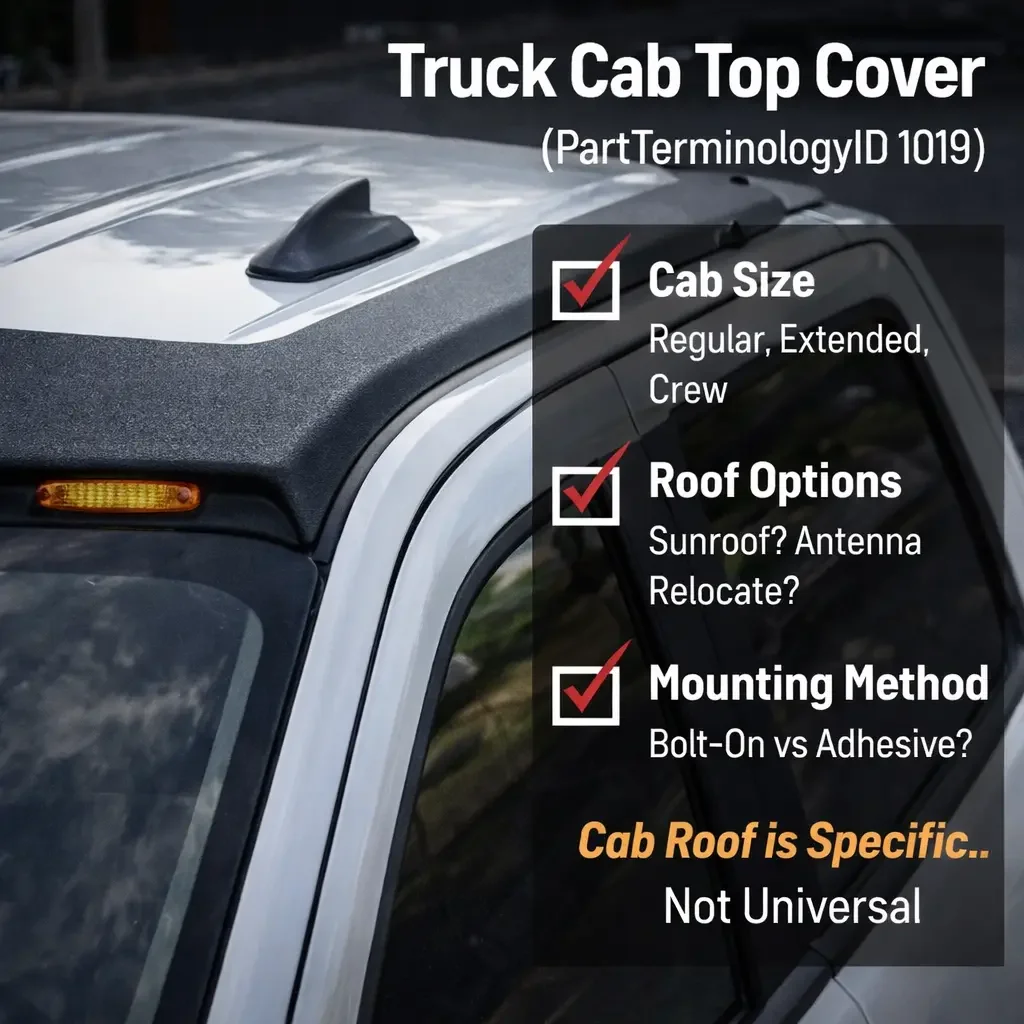
Cab top covers occupy a strange space in the automotive aftermarket. Ask ten shoppers what they call this part and you will get ten different answers: roof cover, top cap, cab visor, sun shield, weather cap, or simply "that thing on top of the cab." Ask ten sellers how they list it and you will see just as much variation. Some treat it like a cosmetic upgrade. Some lump it with visors. Some skip fitment notes entirely.
The result is predictable. The part ships. The customer discovers the cover does not match their roof. The return follows. Sometimes a negative review follows that.
This guide is a complete breakdown of Truck Cab Top Cover under PCdb PartTerminologyID 1019: what it is, why fitment is more complex than it looks, what attributes you must capture to reduce returns, and how to build a catalog entry that actually protects both the seller and the buyer.
What Is a Truck Cab Top Cover, Exactly?
A truck cab top cover is an exterior component designed to sit on or over the top section of the cab. That sounds simple. In practice, the function and form can vary considerably depending on the product and the application.
Depending on the specific product, a cab top cover may serve one or more of the following purposes:
• Protective surface cover: Shields the factory roof panel from UV exposure, minor abrasion, and weathering over time.
• Cosmetic top cap: Changes the visual appearance of the cab roof, often used for a blacked-out or custom appearance on pickup trucks.
• Weather deflector cover: Reduces wind-driven water intrusion at roof seams and edges, particularly on older cab designs where seam sealing may have degraded.
• Sun and wind shield cover: Sometimes overlaps with visor-style products. These are frequently confused with traditional cab visors, which mount at or above the windshield header rather than covering the full roof.
The defining characteristic of this part category is that its fitment is governed entirely by the cab roof it must sit on. That means the part does not merely "fit a truck." It must fit that specific truck's cab configuration, roof geometry, and installed options. Failing to understand this is the root cause of most returns in this category.
PCdb Status: PartTerminologyID 1019
In the current PCdb and PIES 7.2 standards, PartTerminologyID 1019 is assigned specifically to Truck Cab Top Cover. There are no changes anticipated in PIES 8.0 or the next PCdb revision. The ID and terminology name remain stable. This stability is useful for catalog teams: existing mappings do not need to be reclassified during a system migration.
However, stability in the ID does not mean that catalog entries built years ago are still accurate. As truck model lines have evolved, roof geometries have changed with each generation and facelift. An application that was correct for a 2015 model year may be completely wrong for a 2019 model year of the same nameplate if a body style refresh changed the roof stamping, even subtly.
Catalog teams should treat PartTerminologyID 1019 as a stable anchor for terminology and classification, but treat the underlying application data as something that requires active maintenance any time a new model generation is released.
The Fitment Trap: Why Year, Make, and Model Is Not Enough
Most parts in the automotive aftermarket can be filtered down to a reliable application using year, make, model, and submodel. Cab top covers are different. Fitment breaks at several additional decision points that standard ACES attributes do not automatically surface for shoppers.
Cab Configuration
Regular cab, extended cab, and crew cab trucks have different roof lengths and, in many cases, different roof contours and stamping profiles. A cover designed for a regular cab will not work on a crew cab of the same model year. This is the single most common fitment error in this category. Always lock down cab configuration in the application and surface it prominently in the listing.
Generation and Facelift Breaks
Truck manufacturers frequently update roof geometry during mid-cycle refreshes, not just full-generation changes. These updates can be subtle: a slightly different crown radius, repositioned seam lines, or a changed drip rail profile. Even minor differences are enough to make a cover from one model year clip incorrectly or sit unevenly on the next model year. The safest approach is to split application ranges aggressively rather than bridging fitment across a known facelift year.
Roof Option Conflicts
Sunroofs, panoramic glass roofs, and factory clearance lights are all roof-mounted features that can physically block or conflict with a cab top cover. A cover that works perfectly on a standard roof may require cutouts, voids, or entirely different geometry to accommodate a sunroof. Many covers are simply not compatible with panoramic roofs at all. If the listing does not explicitly address roof options, shoppers with sunroofs or clearance lights will assume compatibility and discover otherwise after installation.
Antenna and Rail Conflicts
Factory roof-mounted antennas and roof racks or rails can prevent some covers from sitting flush or attaching correctly. Depending on the mounting method, antenna conflicts may require relocation during installation. Again, this information needs to be in the listing, not buried in fine print.
Mounting Method Variation
Some covers attach via adhesive tape only. Some use clips. Some bolt on and may require drilling. The mounting method changes the buyer's purchase decision, installation complexity, and reversibility. Adhesive-only covers require specific surface preparation and cure time to bond correctly. Bolt-on covers may require holes in the cab. These are not minor details. They are qualification filters for many buyers.
Material and Finish: What Buyers Actually Care About
Beyond fitment, material and finish are the two specification areas that generate the most post-purchase dissatisfaction when listings are vague. Buyers in this category are often making visual and durability decisions as much as fitment decisions.
Materials in Common Use
• ABS plastic: The most common material for production cab top covers. Lightweight, paintable, and resistant to moderate impacts. Quality can vary significantly between manufacturers, and thickness affects how well the cover follows the roof contour at the edges.
• Fiberglass: Used in premium and custom applications. Heavier than ABS but can be molded with greater precision and tends to hold paint better over time. Common in commercial and heavy-duty truck aftermarket.
• Composite materials: Blended constructions that aim to combine the weight advantage of ABS with improved rigidity. Less standardized across the category.
Finish Options
Finish is one of the most frequent sources of buyer disappointment when listings are vague. The three common states are:
• Primed: Ready for paint but not finished. Buyers who expect a painted or textured product and receive a primed cover will be immediately dissatisfied, even if the fitment is perfect.
• Textured black: A factory-look finish that matches many OEM-style truck trims. Popular with buyers who want a clean appearance without paying for color matching.
• Paint-to-match or color-matched: Requires a paint code or color selection at the time of order. The logistics of this process, whether the manufacturer does the painting or the buyer does, and what the turnaround time is, must be clearly disclosed.
If your listing leaves any ambiguity about whether the cover arrives ready to install or requires paint work, expect returns from buyers who assumed the wrong thing.
The Attributes That Should Be Mandatory for Every Listing
If you want to reduce returns and support tickets in this category, the following attributes need to be captured as structured data and surfaced in item specifics and listing bullets, not buried in a description paragraph. The goal is to ensure a shopper can self-qualify before adding to cart.
• Location: Cab roof / cab top.
• Cab Configuration: Regular, extended, or crew. Specify each supported configuration explicitly.
• Roof Type Compatibility: State whether the product works with a standard roof, a sunroof, or a panoramic glass roof. List any restrictions.
• Marker Light Compatibility: Note whether the product fits trucks with or without factory clearance lights.
• Antenna Compatibility: State whether the antenna is compatible as-is, requires relocation, or is not compatible.
• Mounting Method: Adhesive, clip-on, bolt-on, or a combination. Do not leave this unstated.
• Included Components: List every item in the box: cover, hardware, adhesive, prep pads, templates, instruction sheets.
• Material: ABS, fiberglass, or composite. Specify clearly.
• Finish: Primed, textured black, or paint-to-match. Do not let buyers assume.
• Color (if painted): Specify paint code requirements and who is responsible for painting.
• Dimensions: Length and width of the coverage area.
• Installation Notes: Drilling required, cure time, surface prep requirements. State all of these upfront.
Each of these attributes represents a question a buyer will have, either before or after purchase. If the listing answers it before purchase, you close the sale. If the listing forces them to find out after purchase, you generate a return.
Catalog Checklist for PartTerminologyID 1019
Use this checklist when building or auditing a catalog entry for any truck cab top cover product.
1. Define what it is and what it is not. Cab top cover sits on or covers the cab roof. It is not a bed cap, not a windshield visor, not a roof rack, and not an aerodynamic spoiler. Misclassification in the first line of the description sets up every downstream problem.
2. Lock down cab configuration. Regular, extended, crew. Do not let this float as an implied or assumed value. If the product only fits regular cab, say regular cab only.
3. Capture roof options explicitly. State whether the product is compatible with or excludes sunroofs, panoramic roofs, clearance lights, and antenna configurations. Do not leave this unstated.
4. Make the mounting method unavoidable. Adhesive-only and bolt-on are completely different installation experiences. Buyers need to know this before purchase, not during.
5. List what is included like a bill of materials. Hardware, adhesive tape, prep pads, templates, instruction sheets. If an item is not included, say so. Do not let the buyer assume.
6. Control finish expectations. Primed, textured, or paint-to-match must be stated plainly. If paint-to-match, explain the ordering and turnaround process.
7. Split facelift years aggressively. If the roof stamping changed between two model years, split the application. Never average fitment across a known body style change.
8. Test against your three most common conflicting roof options. Before publishing, verify that the application correctly excludes sunroof configurations it does not fit.
The Three Most Common Listing Mistakes and Why They Keep Happening
Mistake 1: Treating It Like a Universal Cosmetic Accessory
Cab top covers look like cosmetic parts. They sit on top of the vehicle and change its appearance. This visual simplicity leads catalog teams to treat them like accessories: something that either fits loosely or can be made to fit with a little adjustment. The reality is that roof geometry is a hard fitment gate. A cover that does not match the cab contour will not sit flush, will create wind noise at highway speeds, will leave visible gaps at the edges, and may leak if the product is also serving a weather-sealing function. There is no "close enough" in this category.
Mistake 2: Not Calling Out Roof Options
Sunroof and panoramic roof conflicts are the single largest driver of "doesn't fit" returns in this category. Shoppers with factory sunroofs frequently purchase cab top covers without noticing that the product is designed for a standard roof only. If the listing does not explicitly address sunroof compatibility, not buried in a paragraph but prominently stated in the item specifics, this return happens every single time. The same applies to factory clearance lights, which raise the profile of the roof at the front edge and can prevent some covers from mounting flush.
Mistake 3: Hiding Installation Requirements
Installation complexity is a purchase qualifier for many buyers. A customer who discovers drilling is required after the product arrives, or who applies an adhesive-mounted cover incorrectly because cure time and surface prep requirements were not stated, has a bad experience regardless of whether the cover technically fit the vehicle. Listing the installation requirements prominently is not a liability; it is a filter that ensures the buyer is prepared for the actual installation process.
Frequently Asked Questions
Will one cab top cover size fit all cab configurations for the same truck model?
Almost never. Regular cab, extended cab, and crew cab variants of the same truck model have different roof lengths and often different contours. A product that fits a regular cab will not fit a crew cab of the same model year without significant modification, if at all. Always verify cab configuration before purchasing.
Can I install a cab top cover if my truck has a sunroof?
Only if the specific product is designed for sunroof-equipped trucks. Most standard cab top covers are designed for trucks without sunroofs and cannot accommodate the glass opening. If the product listing does not explicitly state sunroof compatibility, assume it is not compatible until confirmed with the manufacturer.
Is adhesive mounting as reliable as bolt-on mounting?
Adhesive mounting can be highly reliable when surface preparation is done correctly and cure time is respected. Most adhesive-mounted cab top covers use automotive-grade double-sided tape designed for exterior applications. The key variables are a clean, degreased surface, correct application temperature, and adequate cure time before driving. Bolt-on mounting tends to be more permanent and more tolerant of installation variability, but requires drilling, which is irreversible.
Do cab top covers affect fuel economy?
The aerodynamic impact of a cab top cover depends heavily on its design. A smooth, well-fitted cover that follows the roofline may have a neutral or marginally positive effect on aerodynamics. A poorly fitted cover that creates gaps or turbulence at the edges will have a slightly negative effect. The impact in either direction is generally minor for everyday driving.
What is the difference between a cab top cover and a cab visor?
A cab visor mounts specifically above the windshield, at or near the windshield header, and is designed to shade the front glass and deflect wind. A cab top cover sits over the entire top section of the cab roof. Some products blur this line by extending from the front of the roof and acting partially as a visor, but they are distinct part types with different installation profiles and fitment requirements.
The Bottom Line
Truck cab top covers are not a difficult category to sell successfully. The product is well-established in the aftermarket, demand is consistent, and buyers understand what they want. The difficulty is in the catalog work that separates a confident purchase from a guess.
Buyers in this category assume "roof is roof." They expect that if a listing shows compatibility with their truck, the cover will fit their truck's roof, regardless of whether they have a sunroof, clearance lights, or a crew cab that received a different roof stamping than the regular cab model they happen to be looking at. When the listing does not correct that assumption, the guess-sale follows. Guess-sales return.
The solution is not complicated. Capture cab configuration, roof option compatibility, and mounting method as mandatory structured attributes. Split facelift years when the roof geometry changed. Surface installation requirements before the cart, not after the box opens. List what is in the box like a bill of materials.
Do that consistently across every SKU in PartTerminologyID 1019 and the return rate drops. The customer review improves. The support tickets thin out. And the listing does the qualification work that previously fell on the returns department.