
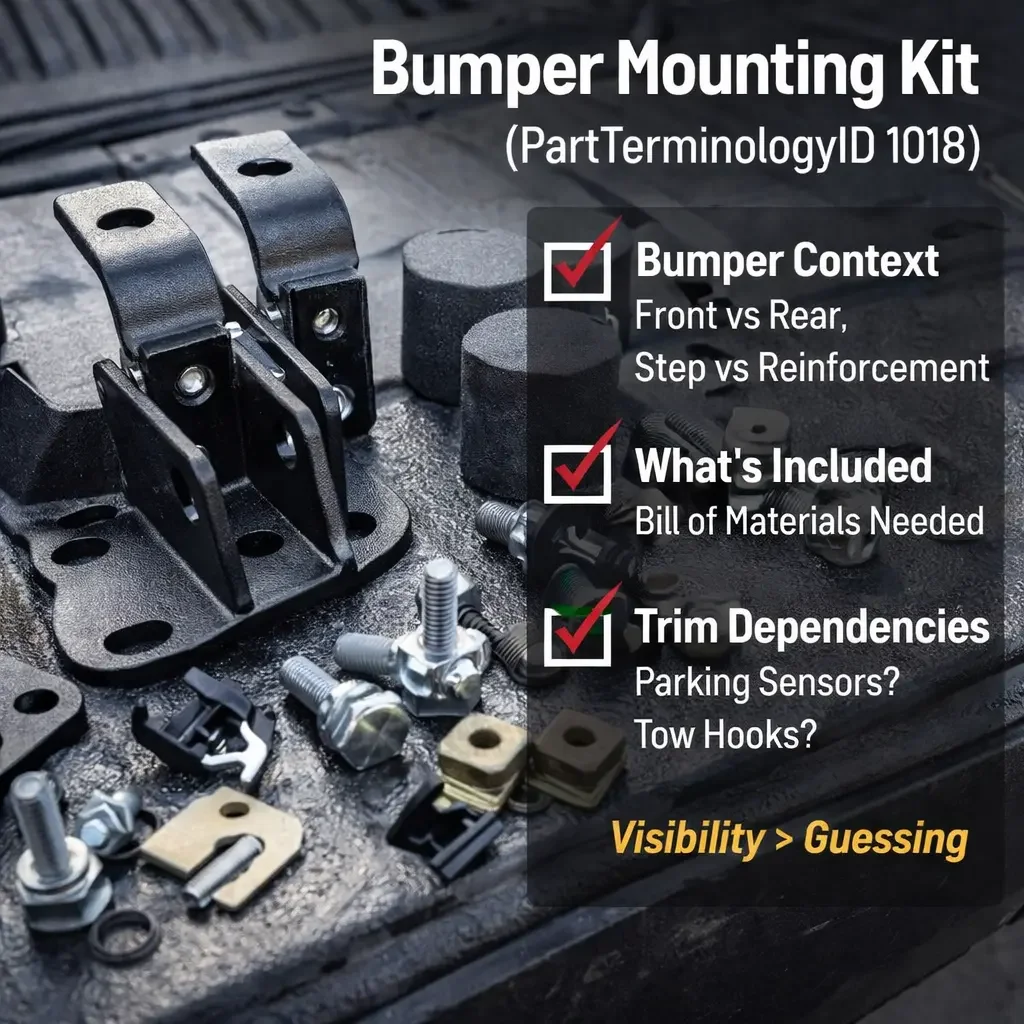
Introduction: Where Good Products Go to Die
Mounting kits are where good products go to die. Not because the metal is bad. Not because the engineering is flawed. Not because the supplier cut corners. They fail in the market because the listing is vague, the catalog data is incomplete, and the buyer is left guessing about what they are actually buying.
A bumper mounting kit, as cataloged under PCdb PartTerminologyID 1018, is one of the most misunderstood product categories in the aftermarket parts ecosystem. The terminology sounds straightforward. The product category seems simple. But the reality of how bumper mounting kits vary by vehicle, trim level, bumper style, and feature configuration makes this one of the highest-risk SKUs from a return-rate perspective in the entire body and bumper segment.
This guide is the practical, operations-level reference for anyone who sources, catalogs, lists, or sells bumper mounting kits. It covers what the product actually is, why buyers return it, how to catalog it correctly, and what attributes must appear in your item specifics to avoid preventable returns and marketplace penalties.
Whether you are managing catalog data for a warehouse distributor, building listings for eBay, Amazon, or Walmart, or consulting on fitment accuracy for a mid-size aftermarket brand, this document provides the framework you need to get PartTerminologyID 1018 right.
PCdb and PIES Status for PartTerminologyID 1018
Before discussing the product itself, it is worth establishing where PartTerminologyID 1018 sits in the current and evolving data standards landscape. The Auto Care Association maintains the Product Information Exchange Standard (PIES) and the Product Classification Database (PCdb), which together define the canonical terminology, attributes, and structure for aftermarket parts data.
Status in New Databases (ID 1018)
Feature: Current (PIES 7.2 / PCdb) -> Future (PIES 8.0 / PCdb 2.0)
PartTerminologyID: 1018 -> 1018 (No change)
Terminology Name: Bumper Mounting Kit -> Bumper Mounting Kit
The stability of this PartTerminologyID across PIES versions means your catalog investments today are protected. There is no migration required when PIES 8.0 rolls out. The terminology is settled. What is not settled - and what causes the vast majority of marketplace failures - is how sellers populate the attributes and item specifics that live underneath that terminology.
What a Bumper Mounting Kit Actually Is
The definition of a bumper mounting kit is not the word 'kit.' The definition is the contents. This distinction matters because 'kit' implies completeness, but completeness means different things to different buyers, different vehicles, and different bumper configurations.
A bumper mounting kit is a collection of components used to install, align, or secure a bumper assembly to a vehicle's frame or body structure. Depending on the application and the specific vehicle, a kit may include any combination of the following:
• Mounting brackets - left side, right side, and center brackets that connect the bumper assembly to the frame rails or body structure
• Reinforcement brackets or support arms - secondary structural pieces that add rigidity and distribute impact load
• Fastener hardware - bolts, nuts, clips, washers, and push fasteners specific to the application
• Absorber components - foam energy management pads or plastic absorbers that sit between the bumper cover and the reinforcement bar
• Impact bar mounting pieces - adapters or brackets for securing the bumper reinforcement bar
• Trim retainers - clips and retainers that secure bumper cover edges, which some brands bundle into a kit
• Alignment hardware - spacers, shims, or adjustable brackets used to achieve proper panel fit
The challenge is that not every kit includes all of these components. A bracket-only kit is technically a bumper mounting kit. A hardware-and-clips kit is also technically a bumper mounting kit. A full install bundle with brackets, hardware, absorbers, and retainers is also a bumper mounting kit.
If the listing does not specify what is in the box, the buyer will assume it includes everything they need. That assumption creates returns.
The rule is simple: define the contents before the customer has to ask. List them explicitly. Include quantities where you can. If the kit is brackets only, say brackets only. If the kit includes absorbers, name the absorbers. If hardware is included, state the hardware count. This single practice eliminates the largest source of returns in this product category.
Why Bumper Mounting Kits Have High Return Rates
Bumper mounting kits do not fail because they are poor-quality products. They generate returns because of data failures at the catalog and listing level. Understanding the specific mechanisms behind these returns allows you to address them systematically rather than reactively.
Mechanism 1: The Ambiguous Kit Scope
A customer searching for a bumper mounting kit to replace a damaged front bumper on their truck expects to receive everything they need for installation. If the listing title says 'Bumper Mounting Kit' and the kit contains only two side brackets, the customer receives something they did not expect. They return it. They leave a negative review. The return is coded as 'item not as described' and the listing accumulates defects.
This is entirely preventable. Specifying 'Front Bumper Side Bracket Set - Brackets Only, Hardware Not Included' eliminates the ambiguity. The customer who wants a complete kit keeps looking. The customer who specifically needs side brackets buys with confidence.
Mechanism 2: Front and Rear Confusion
This is the single most common return driver in the category. Front and rear bumper mounting kits share the same PartTerminologyID but are completely different products. They mount to different frame structures, use different bracket geometries, and are not interchangeable in any way.
A listing that does not specify front or rear in the title, attributes, or item description forces the buyer to make an assumption. Half the time, that assumption is wrong. Adding a single word - front or rear - to the title and the item specifics prevents this category of return entirely.
Mechanism 3: Trim Level and Feature Dependency
Modern vehicles, particularly trucks and SUVs from model year 2010 onward, offer significant variation in bumper configuration across trim levels. The base trim may have a simple painted bumper cover with no sensors and no camera provisions. The mid-level trim may add parking sensor cutouts. The top trim may add a radar module housing, a backup camera provision, and a tow hook receiver.
Each of these configurations may require different bracket geometry, different mounting hardware, or different absorber shapes. A mounting kit that fits the base trim will fail on the sensor-equipped trim. A kit designed for the tow hook configuration will not mount correctly without the tow receiver reinforcement.
Sellers who do not specify sensor compatibility, camera compatibility, or tow hook configuration in their listings are actively setting up a subset of their buyers to receive incorrect parts. The incompatibility is not in the product - it is in the data.
Mechanism 4: Facelift and Mid-Cycle Refresh Splits
Manufacturers regularly refresh vehicle exterior styling mid-generation. These changes often look minor from the outside - revised grille opening, redesigned lower valance, different fog lamp position - but they require completely different mounting bracket geometry underneath.
A seller who lists a mounting kit as fitting 'Model Year 2019-2023' without splitting pre-facelift from post-facelift applications will generate consistent returns from every customer whose vehicle falls on the wrong side of the refresh boundary. The fitment data is technically incomplete, and the returns are the result.
The correct approach is to identify the production break and split the application. If the facelift happened partway through 2021, the listing should reflect 2019-2021 pre-facelift and 2021-2023 post-facelift as separate applications with a clear note about how to identify which variant a customer has.
Mechanism 5: Steel Versus Painted Cover Variants on Trucks
Heavy-duty trucks and commercial vehicles often offer both a traditional painted bumper cover and a painted steel step bumper as separate build options. These are not variations of the same bumper - they are distinct assemblies with different mounting systems, different bracket geometries, and in many cases different frame attachment points.
A mounting kit for a steel step bumper is not compatible with a painted cover bumper installation, and vice versa. Listings that fail to specify which bumper style they support will capture buyers with the wrong vehicle configuration in a significant percentage of transactions.
The Fitment Trap: Why 'Fits the Vehicle' Is Not Specific Enough
The foundational error in bumper mounting kit catalog data is believing that vehicle fitment - confirming the year, make, model, and submodel - is sufficient to establish that a part will work for a customer.
It is not. Vehicle fitment is necessary but not sufficient. Bumpers are an ecosystem, not a single component. Within the same year, make, model, and even submodel, the following variables can produce incompatible mounting requirements:
• Front versus rear application - affects everything from bracket shape to bolt pattern
• Bumper cover versus bumper reinforcement versus step bumper - different structural systems entirely
• Parking sensor configuration - cutouts and brackets differ between sensor and no-sensor variants
• Backup camera provision - affects lower bumper bracket and valance attachment points
• Radar module housing - front bumper specifically, affects center bracket and absorber profile
• Tow hook receiver integration - affects frame attachment hardware and reinforcement requirements
• Trailer hitch provisions - affects rear bumper bracket geometry and clearance
• Sport versus base trims - fascia shapes differ, bracket geometry follows fascia
• Off-road package bumpers - entirely different mounting structure, often includes skid plate integration
• Aftermarket bumper conversions - may require conversion brackets not included in OE-replacement kits
Every one of these variables is a potential return if it is not disclosed in the listing. The customer who calls to ask about sensor compatibility before ordering is the rare buyer. The customer who orders, receives the wrong kit, and returns it without calling is the typical buyer.
Your listing needs to do the qualification work that the customer will not do for themselves. That means specifying every relevant variable in structured attributes - not buried in a paragraph in the description - where it can be indexed, filtered, and verified.
The Attributes That Must Be Structured Fields
These are not optional fields. They are not 'nice to have' data points. They are the attributes that determine whether your listing sells without returns or sells with a 15% to 25% return rate. Each one should be a structured item specific that can be indexed, filtered, and verified against vehicle build data.
Location: Front or Rear
This is mandatory. It belongs in the title and in the attributes. There is no circumstance where omitting this is acceptable. Front and rear mounting kits are different products. The attribute should be a controlled vocabulary field: Front, Rear, Front and Rear (only for universal hardware kits where this is genuinely true).
Bumper Type Supported
The type of bumper the kit is designed to mount matters as much as the location. Controlled values: Bumper Cover, Bumper Reinforcement, Step Bumper, Off-Road Bumper, OE Replacement, Conversion Kit. If the kit works with multiple bumper types, list each explicitly.
Kit Contents with Quantities
This is where most catalog data fails. The contents field should read like a bill of materials, not a marketing phrase. Example of good contents data: '2x Side Mounting Brackets (Left and Right), 1x Center Support Bracket, 12x Mounting Bolts M8x1.25 35mm, 8x Push Clip Fasteners, 2x Foam Absorber Pads.' Example of unacceptable contents data: 'Complete hardware set for professional installation.'
The first example qualifies the buyer. The second example creates expectations the product may not meet.
Left/Right Logic
Bracket-only kits frequently contain directional components. Side brackets are left-specific and right-specific. A kit that contains both should be labeled as a pair or complete set. A kit that contains only the driver-side bracket should be labeled as left only. Never force left/right designation on hardware that is truly universal - bolts do not have a side. But never omit it on components that are physically directional.
Feature Compatibility Flags
This attribute needs to be a checklist, not a paragraph. Structured values should include: Parking Sensors (Yes/No/Compatible/Not Compatible), Backup Camera (Yes/No/Compatible/Not Compatible), Radar Module (Yes/No/Compatible/Not Compatible), Tow Hook (Yes/No/Compatible/Not Compatible), Trailer Hitch (Yes/No/Compatible/Not Compatible). If the kit was not designed for sensor-equipped variants, that flag needs to be visible before the customer adds to cart.
Material and Finish
Material: Steel, Aluminum, Composite, Mixed. Finish: Galvanized, Powder Coated, E-Coated, Raw/Unfinished. Both matter for corrosion resistance expectations and for compatibility with specific OE mounting configurations.
Installation Notes
Structured notes that belong in item specifics, not buried in descriptions: Does Not Include Fasteners, Drilling Required, Reuse OEM Hardware Required, Professional Installation Recommended, Requires Removal of OEM Bumper Reinforcement. These notes set installation expectations before the customer buys, not after they have the part on their workbench.
OE Reference Numbers
If you have OE part number cross-references, include them. OE references allow buyers and technicians to verify fitment against dealer data. They also improve search indexing on marketplaces that match against OEM numbers.
The Complete Catalog Checklist for PartTerminologyID 1018
This checklist should be applied to every SKU classified under PartTerminologyID 1018 before the listing goes live on any marketplace channel.
Step 1: Define the Bumper Context
Start by locking in the fundamentals. Is this kit for the front bumper, rear bumper, or both? What type of bumper is it designed to mount - cover, reinforcement, step bumper, or off-road bumper? These two data points belong in the title and must be confirmed before any other work begins. If you cannot answer both questions, the catalog data is incomplete and the listing should not go live.
Step 2: Build the Contents List Like a Bill of Materials
Document every component in the kit with quantities. Do not use qualitative phrases like 'all necessary hardware' or 'complete installation kit.' Instead, list every discrete item: brackets by name and quantity, fasteners by specification and quantity, clips by type and quantity, absorbers by description and quantity. If the kit contains 14 pieces, list all 14. This list becomes the primary defense against 'item not as described' return claims.
Step 3: Audit Left/Right Logic
Review each component in the kit for directionality. Brackets are almost always side-specific. Fasteners and clips are usually universal. Absorbers may be specific to left or right or may be universal. Once you have categorized each component, apply the appropriate designation to the overall kit: Left Only, Right Only, Pair (Left and Right), or Complete Set. Never default to universal if any component is directional.
Step 4: Map Feature Dependencies Explicitly
Pull the vehicle's available build configurations. Identify every variant where the bumper mounting structure differs. For each variant, determine whether your kit is compatible, not compatible, or requires modification. Document this in structured fields, not in a paragraph. If your kit does not work with parking sensors, that must be surfaced in item specifics so it can be filtered by buyers and flagged by marketplace fitment systems.
Step 5: Identify and Split Facelift Applications
Research the vehicle's production history. Identify any mid-cycle exterior refreshes within your listed year range. If a refresh occurred, determine whether the mounting kit fitment carries across the refresh break or is specific to pre-refresh or post-refresh production. If the fitment is split, create separate fitment records or add a build date qualifier. Do not average the years and hope for the best.
Step 6: Eliminate Vague Language from Title and Description
Review the listing title and description for any phrase that a buyer could interpret multiple ways. 'Fits most models' must be replaced with the exact vehicles it fits. 'Complete kit' must be followed immediately by the actual contents list. 'Easy installation' should be replaced with factual installation notes. Vague language is not a neutral choice - it actively creates false expectations.
Step 7: Separate Related Parts Cleanly in the Catalog
A bumper mounting kit is not a bumper. A clip retainer kit is not a mounting bracket set. A bumper reinforcement is not a bumper cover. Catalog relationships between these parts are important, but the boundaries between them must be clear. If you have separate SKUs for the mounting kit and the bumper itself, ensure the item specifics make the scope of each product unambiguous. Cross-sell relationships should never create the impression that buying one product means receiving the other.
The Three Most Damaging Listing Mistakes in This Category
Mistake 1: Calling a Bracket Set a Mounting Kit Without Disclosing It Is Brackets Only
This is the highest-volume return driver in the PartTerminologyID 1018 category. A customer who buys a bumper mounting kit expects something they can use to mount a bumper. If the kit contains only two brackets and the customer also needs absorbers, clips, and fasteners, they have bought an incomplete solution without knowing it.
The fix is straightforward: be specific about what is in the box. If it is brackets only, say brackets only in the title and in the first line of the description. This will reduce conversions slightly for buyers who need a complete kit, and it will increase satisfaction dramatically among buyers who specifically need replacement brackets. The net result is fewer returns, higher seller ratings, and better long-term listing health.
Mistake 2: Omitting Front or Rear From the Title
This generates returns from approximately half the buyers who receive a kit for the wrong location. The customer who needed a front bumper mounting kit and received a rear kit cannot use what they received. The return is coded as an error in the fitment data, and over time, listings with this pattern accumulate fitment complaints and marketplace suppression.
Adding 'Front' or 'Rear' to the listing title costs nothing. It takes three seconds. It saves every return from buyers who guessed wrong. There is no argument for omitting it.
Mistake 3: Ignoring Sensor, Camera, and Driver Assist Trim Variations
This mistake disproportionately affects listings for vehicles from 2015 onward, where parking sensor and driver assistance hardware became common across trim levels. A bumper mounting kit that fits the base trim configuration of a popular truck or SUV may be completely incompatible with the same vehicle equipped with sensors, because the sensor cutouts require different bracket geometry, different clip configurations, or different absorber profiles.
Sellers who do not test or research their kits against sensor-equipped variants, and who do not disclose compatibility in item specifics, will generate consistent returns from buyers in that trim configuration. The buyer has no way to know before ordering. The listing gave them no warning. The return is the predictable outcome.
How Poor Catalog Data Affects Marketplace Performance
Return rates and negative feedback are the obvious consequences of the catalog data failures described above. But the downstream effects on marketplace performance are more significant and longer-lasting than many sellers appreciate.
On Amazon, sustained return rates above category benchmarks trigger automated listing suppression and can trigger ASIN removal. The catalog data that caused the returns is not the only thing that suffers - the entire account health is affected. Reinstating a suppressed ASIN requires not just fixing the listing but demonstrating root cause correction to Amazon's catalog and compliance teams.
On eBay, high rates of 'item not as described' returns directly impact seller performance metrics, which determine search ranking and Buy Box visibility. A listing that generates returns from catalog ambiguity is actively damaging its own organic visibility, which means the sales data that would otherwise justify catalog investment never materializes.
On Walmart Marketplace, fitment accuracy is increasingly enforced through automated ACES (Aftermarket Catalog Exchange Standard) data validation. Listings that do not pass ACES validation thresholds are suppressed from fitment-filtered search results, which for auto parts is the primary discovery pathway.
The investment in catalog data quality is not a compliance cost. It is a performance investment. Every return prevented translates directly to marketplace ranking protection, review score protection, and conversion rate stability.
Frequently Asked Questions
Do I need a bumper mounting kit if I am only replacing the bumper cover?
Not always, but often. Many bumper cover replacements can reuse the OEM mounting brackets and hardware if they were not damaged in the incident that required the cover replacement. However, plastic clips and push fasteners are commonly broken during bumper removal and are inexpensive to replace proactively. Checking OEM clip condition before reassembly is recommended. If the mounting brackets were bent or cracked, they must be replaced, and a kit is the most efficient way to source the required hardware.
Will a bumper mounting kit work with a bumper that has parking sensors or radar?
Only if the kit was specifically designed or validated for that bumper configuration. The sensor and radar variants of a bumper cover have different internal geometry that may require different bracket placement, different clip types, or different absorber shapes. If the listing does not explicitly state compatibility with sensor or radar-equipped bumpers, assume it was designed for the base configuration and verify before ordering.
Is a bumper hardware kit the same as a bumper mounting kit?
Not always. A hardware kit typically contains only fasteners - bolts, nuts, clips, and push pins. A mounting kit usually includes structural components such as brackets and supports in addition to or instead of fasteners. Both can be listed under PartTerminologyID 1018, but a hardware-only kit and a bracket kit are not interchangeable for the buyer who needs one but not the other. This is why the contents declaration is mandatory.
How do I handle a vehicle that had a mid-year production change?
First, research the exact build date of the change. Manufacturers publish technical service bulletins and production change notices that document when body structure changes take effect. Your fitment record should reflect the production date split, not just the model year. Many catalog systems support build date qualifiers in ACES fitment data. Use them. A listing that spans a production change without disclosing it will reliably generate returns from buyers on the wrong side of that change.
Should I list one kit that covers multiple bumper types or separate kits?
Separate kits with specific fitment data will consistently outperform a single vague listing across multiple metrics: return rate, conversion rate, customer satisfaction, and search visibility. The temptation to consolidate SKUs to simplify catalog management is understandable, but it transfers the disambiguation cost to the buyer, who is poorly equipped to handle it. Specific listings serve buyers who know exactly what they need, and specific data is what marketplace algorithms reward.
Closing: Bumper Mounting Kits Are Not Complicated Products - They Are Complicated Data
The metal in a bumper mounting kit is not what causes returns. The design is not the failure point. The failure point is the absence of clear, specific, structured data at the listing level.
Bumper mounting kits under PartTerminologyID 1018 require a small number of critical data fields to be populated correctly: location, bumper type, kit contents, left/right logic, feature compatibility, and application splits for facelifts and production changes. When these fields are complete and accurate, the product sells to buyers who can actually use it. Returns drop. Reviews improve. Listing health improves. Channel revenue is protected.
When these fields are missing or vague, the product sells to buyers who are guessing. Some guesses are right. Many are wrong. Wrong guesses become returns. Returns become metrics problems. Metrics problems become revenue problems.
The catalog data investment for this product category is not large. It requires knowing what is in the kit, where it goes, and what vehicle configurations it is compatible with. That knowledge exists somewhere in your supply chain - in the product specification sheet, in the OE fitment data, in the engineering notes from the manufacturer. The work of good catalog management is surfacing that knowledge into structured fields where it protects every transaction.
If you are evaluating your current PartTerminologyID 1018 listings and want to build a reusable item specifics template for eBay, Amazon, and Walmart, the checklist in this document provides the framework. Apply it to your existing SKUs, audit the gaps, and close them before the returns close them for you.