
Written by Arthur Simitian | PartsAdvisory
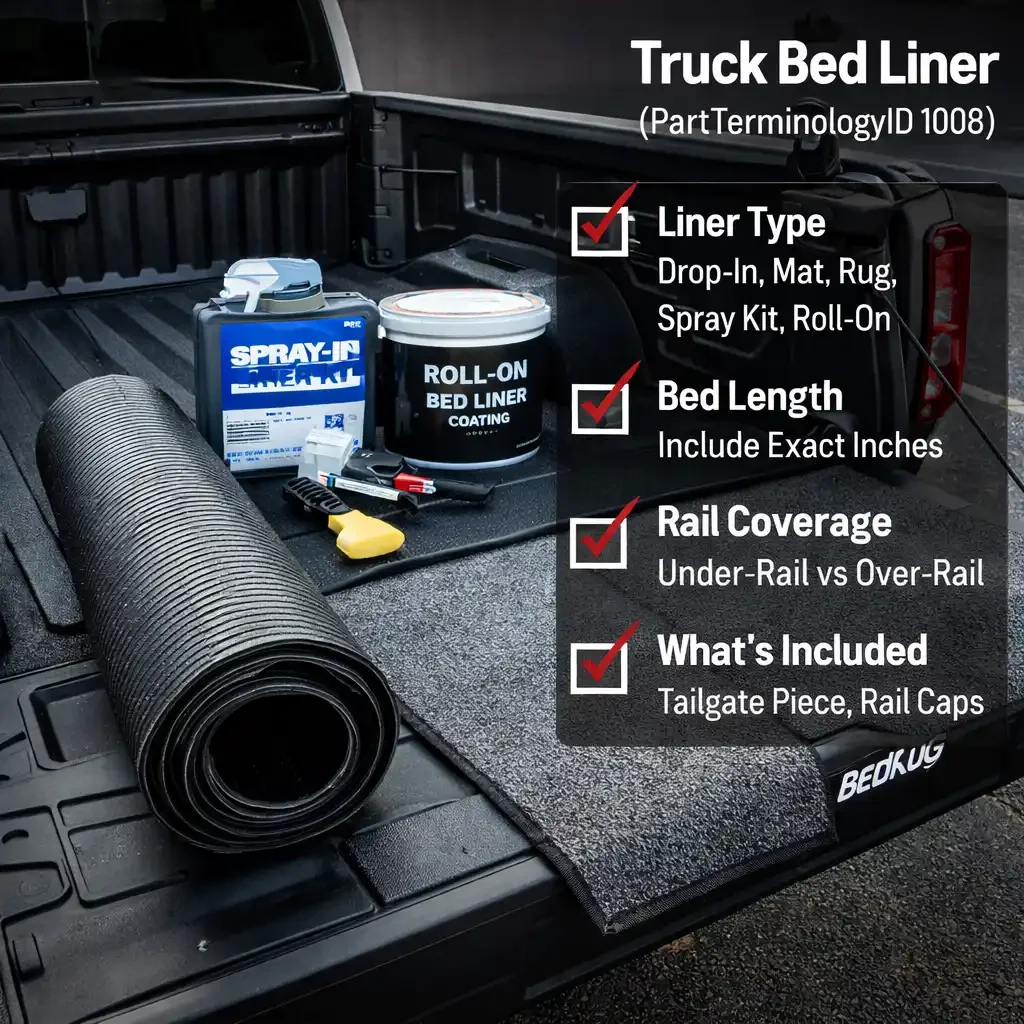
PartTerminologyID 1008, Truck Bed Liner, is a protective covering installed in the cargo bed of a pickup truck to shield the bed floor, walls, and tailgate from scratches, dents, corrosion, and cargo damage. That definition covers the function correctly and leaves unresolved every question that determines whether the replacement the buyer orders actually fits their specific truck. It does not specify the liner type, whether the product is a molded drop-in plastic shell, a flat rubber mat, a carpet-backed fabric liner, a spray-in coating kit, a roll-on DIY coating, or a modular bed protection system. It does not specify the bed length in inches, the cab configuration, the wheelbase, the bed style, whether the liner covers the rails under or over, whether the tailgate piece is included, whether bed rail caps are included, what the liner material is, what the surface texture is, what the color is, what the installation method is, whether drilling is required, what hardware is included, whether the product is compatible with factory bed rail systems, tie-down tracks, or tonneau covers, or whether the product is a complete kit or a single floor piece that requires separate purchase of wall sections and a tailgate piece. A listing under PartTerminologyID 1008 that provides vehicle year, make, and model without the liner type, the bed length in inches, the cab configuration, the bed style, and the rail coverage method cannot be evaluated by any buyer who has already measured their bed, checked their cab configuration, and is trying to confirm the replacement covers their specific truck before placing the order.
For sellers, PartTerminologyID 1008 is a high-margin, high-return-rate category where the return economics are particularly punishing because the product is large, heavy, and expensive to ship in both directions. A drop-in bed liner that does not fit because the listing said 2019-2024 F-150 without specifying short bed versus long bed costs the seller the inbound freight, the return freight, the restocking labor, and the potential for a damaged return that cannot be resold as new. The buyer who ordered the wrong liner typically did not know their bed length before ordering because bed length is not a piece of information most truck owners carry in their heads. They knew their year, make, and model. The listing's job was to tell them which bed length the product covers and to make the bed length confirmation unavoidable before the order was placed.
The return rate for truck bed liners is consistently above the category average for large exterior accessories because the fitment complexity is high and the fitment data in most listings is incomplete. Bed length alone is not sufficient because the same bed length exists across different cab configurations and wheelbase variants, and the bed geometry at the cab wall, the wheel well positions, and the rail contour can differ between configurations that share a nominal bed length. Rail coverage method alone is not sufficient because over-rail and under-rail liners have different installation requirements and different compatibility with other bed accessories. Liner type alone is not sufficient because a buyer who expects a molded drop-in and receives a flat mat will return the product regardless of whether the mat fits the bed dimensions.
For sellers, the listing under this PartTerminologyID is only useful if it specifies the liner type, the bed length in exact inches, the cab configuration, the bed style, the rail coverage method, the tailgate piece inclusion, the kit contents, and the installation method. Without those eight attributes as the foundation of every listing, the category will generate returns at a rate that erodes the margin advantage that bed liners offer at full price.
What Truck Bed Liner Covers and Why the Category Is Wider Than It Looks
The five product types under PartTerminologyID 1008
The term truck bed liner describes five fundamentally different product types that share a protective function but differ in form factor, fitment complexity, installation method, return profile, and buyer expectation. A catalog that treats all five as the same product type under a single listing format will produce returns on each type from buyers expecting one of the other four.
A drop-in liner is a molded plastic shell, typically high-density polyethylene, that is shaped to the specific contours of a particular truck bed. It sits in the bed with the floor piece resting on the bed floor and the wall sections contacting the bed sidewalls. It does not attach permanently to the bed and can be removed for cleaning or for access to bed features beneath it. The fit is vehicle-specific to the model year, the cab configuration, the bed length, and the bed style. A drop-in liner for a 2022 F-150 SuperCrew with a 5.5-foot bed will not fit a 2022 F-150 SuperCrew with a 6.5-foot bed, and it will not fit a 2022 F-150 Regular Cab with a 6.5-foot bed even though the bed length is the same, because the cab wall geometry at the front of the bed differs between cab configurations.
A bed mat is a flat rubber or thermoplastic mat that covers the bed floor without wall coverage. It does not require a vehicle-specific fit because it does not need to conform to the wheel well humps or the bed sidewalls. It is a universal or near-universal product that fits by trimming or by selecting a mat size that is close to the bed floor dimensions. A buyer who orders a bed mat expecting a drop-in liner will return it regardless of how well the mat fits the floor, because the mat does not provide the wall protection and the snug contoured fit that the buyer expected from a liner.
A bed rug or carpet liner is a fabric-backed carpet product that covers the floor and walls of the bed with a softer material than polyethylene or rubber. It is typically vehicle-specific for the wall coverage sections and is used in applications where scratch protection and noise reduction are the priority over heavy-duty impact resistance. It is not a drop-in liner and should not be listed as one.
A spray-in liner is a professionally applied polyurethane or polyurea coating that is sprayed directly onto the cleaned and prepared bed surface by a technician at an authorized installation center. It is not a part: it is a service. A DIY spray-in kit, however, is a product that a buyer can purchase and apply themselves using aerosol cans or a spray gun with a single-component coating. The DIY kit is a part under PartTerminologyID 1008, but it has entirely different attributes from a drop-in liner and must be listed separately with its own attribute framework.
A roll-on DIY coating kit is a liquid coating applied with a roller or brush rather than a spray gun. It produces a similar textured finish to a spray-in coating but with different application equipment and different coverage area per kit. Like the spray-in kit, the roll-on kit is vehicle-specific in the sense that the buyer needs to cover a specific area, but it is not vehicle-specific in the way that a drop-in liner is: the coverage quantity is determined by the bed area, not by the contour fit.
Why the type must be the first attribute in every listing
The five product types described above attract different buyers with different expectations. A buyer searching for a drop-in liner who clicks on a mat listing and does not notice the distinction until the flat mat arrives in the bed will return the product and leave a complaint. A buyer searching for a roll-on kit who clicks on a drop-in liner listing and does not notice the distinction will attempt to install the rigid shell and contact support when it does not perform like a coating. The type distinction is not a fine-print specification: it is the first attribute the buyer needs to confirm before any dimension or compatibility question is relevant.
The listing title must state the liner type. Truck Bed Drop-In Liner, Truck Bed Mat, Truck Bed Rug, DIY Spray-In Liner Kit, and DIY Roll-On Liner Kit are five different title constructions that prevent the type confusion that a generic Truck Bed Liner title invites.
The Fitment Problem Is Configuration, Not Just Bed Length
Why bed length alone is not sufficient
Bed length is the attribute most sellers add first because it is the most obviously critical dimension for a drop-in liner fit. It is necessary but not sufficient. The same nominal bed length exists on different cab configurations, and the cab wall geometry at the front of the bed differs between those configurations in ways that affect how a drop-in liner seats at the cab end.
A 6.5-foot bed on a Regular Cab F-150 has a different cab wall profile at the front of the bed than a 6.5-foot bed on a SuperCab F-150. The front section of the drop-in liner that presses against the cab wall must conform to the cab wall contour for the liner to sit flat and snug at the front. A liner molded for the Regular Cab cab wall profile will have a gap or a pressure point at the front section when installed in a SuperCab with the same bed length, because the cab wall contours are different.
This means bed length and cab configuration are co-primary fitment attributes. Neither can replace the other. A listing that states the bed length without the cab configuration and a listing that states the cab configuration without the bed length are both incomplete fitment specifications.
Wheelbase as a fitment variable on specific platforms
On some truck platforms, particularly full-size domestic trucks through certain model year ranges, the wheelbase affects the bed geometry independently of the cab configuration and bed length combination. Two trucks with the same cab configuration and the same nominal bed length but different wheelbase options can have different wheel well positions within the bed, which affects how a drop-in liner seats around the wheel humps on the floor section.
Most modern truck platforms have standardized the relationship between cab configuration, bed length, and wheelbase sufficiently that wheelbase is not a separate required fitment attribute. However, on platforms where wheelbase is an independent variable that affects bed geometry, the listing must include the wheelbase as a separate fitment attribute alongside cab configuration and bed length.
Bed style: fleetside versus stepside versus dually
Fleetside is the standard smooth-sided bed with flush exterior panels. It is the bed style on the overwhelming majority of modern pickup trucks and is the assumed bed style in most bed liner listings that do not specify otherwise.
Stepside, also called flareside or sportside depending on the manufacturer, is a narrow-bed style with external rear fenders that create a step on the outside of the bed and a narrower bed floor between the wheel humps. A drop-in liner for a fleetside bed will not fit a stepside bed because the wheel hump positions and the bed width are fundamentally different.
A dually bed is the bed on a dual rear wheel truck, which has a wider rear axle and different wheel well geometry inside the bed to accommodate the dual rear wheels. The wheel humps on a dually bed are larger and positioned differently than on a single rear wheel bed of the same length. A single-rear-wheel bed liner will not fit a dually bed.
Bed style must be stated in the listing for every drop-in liner SKU. On most modern platforms fleetside is the only available option and the distinction from stepside or dually is less relevant, but on platforms where stepside or dually variants exist, the omission of the bed style attribute will generate returns from stepside and dually owners who ordered a standard liner and discovered the fit problem at installation.
Under-rail versus over-rail coverage
Rail coverage is the attribute that determines how the liner interacts with the top of the bed sidewalls and whether it is compatible with other bed accessories including tonneau covers, bed rail caps, and bed extenders.
An under-rail liner fits inside the bed with the top edge of the liner wall sections sitting below the top of the bed rails. The bed rails remain exposed above the liner top edge. An under-rail liner is compatible with most factory bed rail systems and does not conflict with most tonneau covers because it does not add thickness to the rail top surface. Its installation profile is lower and less visible from outside the vehicle.
An over-rail liner has wall sections that extend over the top of the bed rails and hang down on the outside of the bed. The over-rail sections protect the top of the rail and the outer face of the rail from cargo impact and from dings caused by items being loaded over the side. An over-rail liner adds thickness to the rail area and commonly conflicts with soft tonneau covers that clip to the top of the rail, tri-fold hard covers that hinge on the rail, and snap-on bed rail caps.
The buyer who has a tonneau cover and orders an over-rail liner will face a compatibility conflict at installation that the listing had the opportunity to disclose and did not. The buyer who wants over-rail coverage for rail protection and orders an under-rail liner will be disappointed that the rails are exposed above the liner edge. Both are returns caused by a missing attribute that costs nothing to add to the listing.
Tailgate piece: included or not
The tailgate piece is the section of the drop-in liner that covers the inside face of the tailgate. On some liner products, the tailgate piece is included in the kit as a separate molded component. On others, the tailgate is not covered and the buyer must source a tailgate mat or pad separately. On some listings, a tailgate liner is sold as a separate SKU and can be optionally added to the bed liner order.
Whether the tailgate piece is included or not included must be stated in the listing. A buyer who expects full bed coverage including the tailgate and receives a liner without a tailgate piece will either return the liner as incomplete or contact support to source the missing piece, which generates customer service cost even if it does not generate a physical return.
Bed rail caps: included or not
Some drop-in liner kits include bed rail caps, which are plastic covers that snap over the top of the bed rails. Bed rail caps protect the painted metal rail surface from chips and scratches caused by items being loaded over the side. They are a common addition to drop-in liner kits on domestic trucks and are a source of returns and complaints when the buyer assumes they are included and they are not, or when the buyer does not need them and receives them in a kit they expected to contain only the liner.
Whether bed rail caps are included must be stated explicitly. Their inclusion affects the perceived value of the kit and the compatibility with existing bed accessories: a buyer who already has factory rail caps will receive redundant components if the liner kit includes its own caps.
The Attributes That Drive Conversion and Prevent Returns
Material and surface texture
Drop-in liners are most commonly manufactured from high-density polyethylene, which is impact-resistant, chemically resistant to most cargo fluids, and dimensionally stable across a wide temperature range. Some premium drop-in liners use a different polyethylene formulation with UV stabilizers that prevent the material from fading and chalking under prolonged sun exposure.
Bed mats are most commonly rubber or thermoplastic rubber, which provides high friction to prevent cargo movement and is resistant to oils, fuels, and other cargo fluids. Carpet liners use a polypropylene or polyester carpet face with a rubber or polyethylene backing that provides moisture resistance beneath the carpet layer.
Surface texture determines how cargo behaves on the liner surface and is a secondary purchase decision attribute for buyers who are choosing between products with the same footprint. A ribbed surface channels liquids to the drain holes and provides a degree of cargo resistance through the contact patterns of the ribs. A smooth surface is easier to clean but provides less cargo friction. A textured or studded surface provides high cargo friction and is preferred for heavy-use work truck applications where cargo must not shift during transit.
Color
Black is the dominant color for drop-in liners and bed mats and is the assumed color when color is not specified. However, some platforms and some accessory categories offer liner products in gray, dark gray, tan, or custom colors that match specific interior color schemes. A listing that does not specify color will be interpreted as black by the majority of buyers. A listing for a non-black liner that does not specify color will generate returns from buyers who assumed black and received another color.
State the color in the listing attributes and in the title for any non-black product. For black products, stating black in the attributes is best practice because it prevents the ambiguity that produces complaints.
Installation method
Drop-in liners are installed without permanent attachment to the bed on most designs: the liner sits in the bed by gravity and friction with no fasteners or adhesive required. Some drop-in liners include anti-rattle clips or hook-and-loop patches that prevent the liner from shifting and rattling during vehicle operation. Some drop-in liners require drilling through the liner into the bed for permanent anchor fasteners.
The installation method must be stated as no-drill or drill-required. A buyer who does not want to drill into their truck bed for a temporary protection solution will return a drill-required liner. A buyer who wants a permanently anchored liner for heavy work use and receives a no-drill design that shifts under cargo load will be unsatisfied with the product regardless of the fit.
Tonneau cover compatibility
Over-rail liners are the primary compatibility concern with tonneau covers, as established in the rail coverage section above. However, the compatibility question extends to under-rail liners on some platforms because the floor thickness of the liner raises the effective bed floor height, which can affect the closure geometry of roll-up tonneau covers that reference the bed floor in their tensioning system.
The listing should state compatibility with the most common tonneau cover types for the specific truck platform: soft roll-up, tri-fold hard, retractable, hinged one-piece, and snap-on. If the liner manufacturer has published compatibility data for specific tonneau cover brands and models, that data should be included in the listing or linked from it.
Factory bed rail system and tie-down track compatibility
Many modern trucks are equipped from the factory with integrated bed rail systems such as the Ram Box cargo management system, the Ford BoxLink system, the Chevrolet CornerStep system, or the Toyota Deck Rail system. These systems use brackets, channels, and anchor points that are part of the factory bed structure and that may conflict with an over-rail liner's wall sections or rail caps.
The listing must state whether the liner is compatible with factory bed rail systems for the specific truck platform. A liner that conflicts with a factory rail system the buyer is actively using will be returned immediately, because the buyer will not remove or disable a factory feature to install an aftermarket liner.
Status in New Databases
PIES/PCdb: PartTerminologyID 1008, Truck Bed Liner
PIES 8.0 / PCdb 2.0: No change in PartTerminologyID or terminology label. The transition from PIES 7.2 to PIES 8.0 is a schema evolution. The PartTerminologyID and the label remain stable. Internal systems keyed to 1008 do not require remapping.
Top Return Scenarios
Scenario 1: "Same bed length, different cab configuration, liner does not seat at cab wall"
The listing stated fits 2019-2024 Chevrolet Silverado 1500, 6.5-foot bed. The buyer has a 2021 Silverado 1500 Regular Cab with a 6.5-foot bed. The liner was molded for the Crew Cab cab wall profile, which has a different contour at the front of the bed than the Regular Cab. The front section of the liner does not seat flush against the Regular Cab wall and lifts away from the bed floor at the front corners.
Prevention language: "Bed length: 6.5 feet (78 inches). Compatible cab configurations: [Crew Cab only / Double Cab only / Regular Cab only / all cab configurations]. This liner is molded to the cab wall profile of the [specified] cab configuration. The front section of the liner will not seat correctly against the cab wall of a different cab configuration even if the bed length matches. Verify your cab configuration before ordering."
Scenario 2: "Over-rail liner, existing soft tonneau cover, rail interference, both products unusable simultaneously"
The buyer has a soft roll-up tonneau cover that clips onto the top of the bed rails. They ordered an over-rail liner to protect the rails from cargo damage. The over-rail liner's rail sections add approximately 8mm of thickness to the rail top surface. The tonneau cover's clamp system cannot accommodate the additional rail thickness and does not clip securely. The buyer cannot use both products simultaneously and returned the liner.
Prevention language: "Rail coverage: over-rail. The over-rail sections extend over the top of the bed rails and add thickness to the rail surface. Over-rail liners are not compatible with soft roll-up tonneau covers, snap-on tonneau covers, or any cover system that clips directly to the factory rail top surface. For use with tonneau covers, specify an under-rail liner. Verify tonneau cover compatibility before ordering."
Scenario 3: "Liner type listed as bed liner, buyer expected drop-in, received rubber mat"
The listing used the generic title Truck Bed Liner without specifying the product type. The primary product image showed a rubber mat rolled out flat. The buyer, who had previously owned a drop-in liner on a previous truck, assumed the product was a molded drop-in shell based on the category name. A flat rubber mat arrived. The buyer returned it as the wrong product.
Prevention language: "Product type: bed mat. This is a flat rubber mat that covers the bed floor only. It does not include wall coverage, wheel well coverage, or a tailgate piece. It does not conform to the bed contours and does not sit snugly against the bed walls. For full bed coverage including walls and tailgate, specify a drop-in bed liner. Verify the product type matches your coverage expectation before ordering."
Scenario 4: "Tailgate piece not included, buyer assumed complete kit, tailgate left unprotected"
The listing described a complete bed liner kit with no statement about the tailgate piece. The product shipped without a tailgate liner. The buyer assumed the kit included tailgate coverage based on the word complete in the listing title. The inside face of the tailgate was left unprotected. The buyer contacted support and was told the tailgate piece is sold separately. The buyer returned the liner as incomplete.
Prevention language: "Kit contents: bed liner floor piece, left wall section, right wall section, front bulkhead piece. Tailgate piece: [included / not included, available separately as part number X]. The tailgate piece is sold separately for this application. If full bed coverage including the tailgate is required, add the tailgate piece to your order before checkout."
Scenario 5: "Dually truck, standard fleetside liner ordered, wheel hump positions incompatible"
The buyer has a 2023 Ram 3500 dually. The listing stated fits 2019-2024 Ram 2500/3500 6.4-foot bed without distinguishing between single rear wheel and dual rear wheel configurations. The liner molded for single rear wheel wheel hump positions does not accommodate the larger and differently positioned wheel humps of the dually bed. The floor section of the liner is not flat against the dually bed floor and the wall sections do not seat correctly against the dually bed walls.
Prevention language: "Bed configuration: [single rear wheel only / dual rear wheel (dually) only / both]. Dually trucks have larger and differently positioned wheel humps inside the bed than single rear wheel trucks of the same bed length. A liner molded for a single rear wheel bed will not fit a dually bed. Verify whether your truck is a single rear wheel or dual rear wheel (dually) configuration before ordering."
Scenario 6: "Drill-required installation, buyer did not want to drill, returned after discovering fastener requirement"
The listing did not state the installation method. The buyer assumed no-drill installation based on their experience with previous drop-in liners that required no fasteners. The installation instructions included with the liner specified four anchor bolts requiring drilling through the liner and into the bed floor. The buyer returned the liner to avoid drilling into the factory bed.
Prevention language: "Installation method: [no-drill, sits in bed without fasteners / drill-required, includes anchor hardware for permanent installation / clip-in, includes anti-rattle clips without drilling]. Verify the installation method matches your preference before ordering. A drill-required installation creates permanent holes in the bed floor. If you prefer a no-drill solution, specify a drop-in liner that does not require fasteners."
Scenario 7: "Over-rail liner, factory Ram Box cargo management system, wall sections conflict with factory rail brackets"
The buyer's truck has the factory Ram Box cargo management system with rail-mounted brackets and anchor points. The over-rail liner's wall sections cover the factory rail channels and prevent the Ram Box bracket system from functioning. The buyer cannot access the factory tie-down points through the liner and the Ram Box accessories cannot be mounted with the over-rail liner in place.
Prevention language: "Compatibility note: this over-rail liner is not compatible with factory Ram Box cargo management systems, factory tie-down track systems, or other factory rail-mounted accessories. The over-rail wall sections cover the factory rail channels. For trucks equipped with factory rail systems, specify an under-rail liner that does not interfere with existing rail accessories."
Scenario 8: "Spray-in DIY kit, buyer expected coverage for full-size bed, single kit insufficient"
The listing stated DIY spray-in liner kit for pickup trucks. The buyer ordered one kit for a full-size long bed truck. The kit coverage rating was stated in fine print as suitable for compact truck beds up to 5.5 feet. The full-size 8-foot bed required two kits for complete coverage. The buyer ran out of coating before completing the tailgate and returned both the incomplete coating and the kit as insufficient for the stated use.
Prevention language: "Coverage area: [X] square feet per kit. Recommended for bed sizes up to [X.X] feet in length. For full-size truck beds [X.X] feet and longer, two kits are recommended for complete floor and wall coverage including the tailgate. Verify your bed area against the kit coverage rating before ordering."
What to Include in the Listing
Core essentials
PartTerminologyID: 1008
component: Truck Bed Liner
liner type: drop-in, bed mat, bed rug, spray-in DIY kit, or roll-on DIY kit (mandatory, in title)
vehicle make, model, and model year range (mandatory)
bed length in exact inches and feet (mandatory)
cab configuration: regular, extended, double, super, crew, or all (mandatory)
wheelbase where it affects bed geometry independently of cab and bed length (mandatory where applicable)
bed style: fleetside, stepside, or dually (mandatory)
rail coverage: under-rail or over-rail (mandatory for drop-in liners)
tailgate piece: included or not included with separate SKU cross-reference if sold separately (mandatory)
bed rail caps: included or not included (mandatory)
liner material: high-density polyethylene, rubber, thermoplastic rubber, carpet, or polyurethane coating (mandatory)
surface texture: smooth, ribbed, textured, or studded (mandatory)
color (mandatory)
installation method: no-drill, drill-required, clip-in, or adhesive (mandatory)
hardware included: yes or no with hardware list if yes (mandatory)
kit contents list: enumerate every component by name and quantity (mandatory for kit listings)
tonneau cover compatibility: by cover type and by specific brands where data is available (mandatory)
factory bed rail system compatibility note (mandatory for trucks with factory rail systems)
tie-down track compatibility (mandatory)
coverage area in square feet for DIY coating kits (mandatory)
quantity note for DIY kits: single bed versus large bed coverage guidance (mandatory)
UV resistance rating or stabilizer note for outdoor storage applications (mandatory)
weight in pounds (mandatory for shipping and handling expectation)
Fitment essentials
year/make/model/submodel
bed length in inches (primary fitment attribute alongside cab configuration)
cab configuration (co-primary fitment attribute alongside bed length)
bed style: fleetside, stepside, or dually
wheelbase where applicable
factory bed equipment: Rail Box, BoxLink, CornerStep, Deck Rail, or other factory systems
Dimensional essentials
bed floor length in inches
bed floor width between wheel humps in inches
bed floor width outside wheel humps in inches
bed wall height in inches
liner wall section height in inches
over-rail overhang depth in inches for over-rail designs
liner thickness in inches at floor section
Image essentials
liner in isolation against a neutral background with cab configuration and bed length labeled
liner installed in the correct truck bed showing fit at cab wall, wheel humps, and tailgate
rail coverage detail showing under-rail edge position or over-rail overhang
tailgate piece shown separately if included, with installation sequence visible
bed rail caps shown if included with installation detail
kit contents laid out flat with every component labeled and counted
tonneau cover compatibility shown with liner installed and cover closed for compatible configurations
conflict shown with incompatible cover type if the liner has known conflicts
texture detail close-up for ribbed, textured, or studded surface options
factory bed rail system shown with liner installed for compatibility confirmation listings
Catalog Checklist for ACES/PIES Teams
PartTerminologyID = 1008
require liner type in title and in type attribute field (mandatory)
require bed length in exact inches alongside nominal feet designation (mandatory)
require cab configuration as co-primary fitment attribute with bed length (mandatory)
require bed style: fleetside, stepside, or dually (mandatory)
require rail coverage method: under-rail or over-rail (mandatory for drop-in liners)
require tailgate piece inclusion status with separate SKU cross-reference (mandatory)
require bed rail caps inclusion status (mandatory)
require installation method: no-drill, drill-required, clip-in (mandatory)
require complete kit contents list for any product described as a kit (mandatory)
require tonneau cover compatibility data by cover type (mandatory)
require factory bed rail system compatibility note for platforms with factory rail systems (mandatory)
require coverage area in square feet for DIY coating kits (mandatory)
prevent single year-make-model fitment line without bed length and cab configuration: a fitment line without both attributes is incomplete and will generate wrong-configuration returns
differentiate from tonneau cover (PartTerminologyID varies): tonneau covers close the top of the bed; bed liners protect the inside surfaces; both are bed accessories but cover different surfaces and attract different buyers; cross-reference compatibility between the two in both listings
differentiate from bed mat (PartTerminologyID varies): if your catalog implementation assigns bed mats to a separate PartTerminologyID from drop-in liners, the type distinction must still be in the listing title and attributes under both PartTerminologyIDs to prevent cross-type purchases
differentiate from truck bed side rail anchor (PartTerminologyID 1014): rail anchors are structural tie-down accessories that mount in the bed rails; bed liners are surface protection products; both are bed accessories but serve different functions; note rail system compatibility in both listings
flag over-rail liner and tonneau cover conflict as mandatory disclosure: the most frequent compatibility complaint for bed liners involves over-rail liner conflict with tonneau covers; this conflict is fully preventable by a compatibility statement in the listing
flag dually bed style as mandatory where platform offers dually option: dually wheel hump geometry incompatibility with standard bed liners produces an unfittable return that cannot be trimmed or adjusted
flag cab configuration as co-primary fitment attribute equal to bed length: a listing that captures bed length but not cab configuration has captured half the fitment information and will generate cab wall fit complaints at volume
FAQ (Buyer Language)
How do I find my bed length to confirm the correct liner?
The most accurate method is to measure the inside of the bed from the inside face of the tailgate when closed to the inside face of the bulkhead at the cab wall. Measure along the bed floor from bulkhead to tailgate with the tailgate fully closed and latched. The measurement in inches is your bed length for liner selection purposes. Note that the nominal bed length designation, such as short bed or long bed, is a marketing term that varies by manufacturer: a short bed on a Ram 1500 is 67.4 inches, while a short bed on a Ford F-150 is 65 inches. Measure the actual inside length rather than relying on the short or long designation when ordering a vehicle-specific drop-in liner.
Will a drop-in liner work with my tonneau cover?
It depends on the liner's rail coverage method and the tonneau cover's attachment system. Under-rail liners are compatible with most tonneau covers because the liner sits inside the bed below the rail top surface and does not add thickness to the rail. Over-rail liners conflict with tonneau covers that clip, snap, or clamp to the top of the bed rail because the over-rail sections add material thickness to the rail surface that prevents the cover's attachment mechanism from seating correctly. If you have a tonneau cover or plan to add one, specify an under-rail liner and verify the specific cover brand and model is listed as compatible by the liner manufacturer.
What is the difference between an under-rail and an over-rail liner?
An under-rail liner has wall sections that stop at or below the top of the bed rails. The rails are exposed above the liner top edge and the liner is not visible from outside the vehicle when the tailgate is closed. An over-rail liner has wall sections that extend over the top of the bed rails and hang down on the outside of the bed, covering the rail top surface and the outer face of the rail. Over-rail coverage protects the rails from cargo dings and side-loading damage but conflicts with tonneau covers and snap-on rail caps. Under-rail coverage leaves the rails exposed but does not conflict with bed accessories attached to the rails. Most buyers who want rail protection alongside their drop-in liner choose bed rail caps as a separate accessory over an over-rail liner when they also have a tonneau cover.
I have a Ram 3500 dually. Will a standard Ram 1500 or 2500 liner fit my bed?
No. Dually trucks have larger rear wheel housings that produce different wheel hump positions and dimensions inside the bed compared to single rear wheel trucks of the same bed length. A liner molded for a single rear wheel truck will not accommodate the larger wheel humps of the dually bed and will not sit flat on the floor or contact the walls correctly. You need a liner specifically listed as compatible with the dually configuration of your specific model year and bed length.
My drop-in liner rattles when I drive over rough roads. What is causing this and how do I fix it?
A rattle from a drop-in liner is typically caused by the liner floor or wall sections lifting and contacting the bed surface at specific points during vehicle flex over rough terrain. The most common causes are a liner that is slightly mismatched to the bed geometry, a liner that has warped from thermal cycling, or a liner that was designed as no-drill and has shifted slightly from its correct position. The most effective solution is an anti-rattle kit consisting of self-adhesive hook-and-loop pads applied to the bed floor and the corresponding positions on the liner underside. Some liner manufacturers offer their own anti-rattle kits for their specific liner designs. Permanent anchor kits with drilling are also available for drop-in liners and eliminate the rattle entirely at the cost of permanent bed holes.
Can I use a drop-in liner with a factory spray-in bed coating already applied?
Yes. A factory spray-in bed coating provides a textured surface layer over the bed floor and walls that does not change the bed dimensions significantly enough to prevent a correctly fitted drop-in liner from seating. The liner will sit on top of the spray-in coating without damaging it. Some buyers prefer this combination for maximum protection: the spray-in coating protects the surfaces not covered by the drop-in liner and provides backup protection if the liner is removed.
Do I need to remove my drop-in liner for a spray-in service?
Yes. A spray-in liner service requires access to the bare metal or factory bed surface for adhesion. A drop-in liner must be removed before the spray-in application and can be reinstalled over the cured coating if desired. However, most buyers who commit to a spray-in service do not reinstall the drop-in liner afterward, since the spray-in provides the same surface protection with less bulk and without the rattle potential of a loose drop-in shell.
Cross-Sell Logic
Tonneau Cover (the most frequent concurrent purchase for a truck bed liner; specify under-rail liner for compatibility with all cover types; cross-reference the tonneau cover PartTerminologyID alongside the liner listing)
Bed Rail Caps (PartTerminologyID varies: if the liner kit does not include rail caps and the buyer wants rail top surface protection, bed rail caps are the concurrent purchase; note compatibility with the liner's rail coverage method)
Truck Bed Side Rail Anchor (PartTerminologyID 1014: tie-down anchor accessories that mount in the bed rail system; cross-reference compatibility with over-rail and under-rail liners for the specific truck platform)
Anti-Rattle Kit (hook-and-loop pad sets or anchor hardware kits for buyers who want to secure a no-drill drop-in liner against shifting)
Tailgate Liner or Tailgate Mat (for liner kits that do not include a tailgate piece; sold as a separate SKU by most liner manufacturers for their specific liner families)
Bed Extender (a bed extender mounts in the bed hitch receiver and extends the effective bed length; compatibility with over-rail liners must be verified; under-rail liners are generally compatible with bed extenders)
Cargo Net or Cargo Organizer (for buyers who want to secure cargo on top of the liner surface; compatible with tie-down tracks and bed anchors accessible through or beside the liner)
Frame as "the drop-in liner protects the bed floor and walls from the cargo that the truck was designed to carry. The tailgate liner protects the inside face of the gate the cargo is loaded over. The bed rail caps protect the tops of the rails the cargo slides past. The tonneau cover protects everything inside from weather. All four are in the same buying decision for a buyer who is equipping a new truck."
Final Take for PartTerminologyID 1008
Truck Bed Liner (PartTerminologyID 1008) is the accessory category where configuration complexity is hidden behind a search term that appears simple. Every buyer who searches for a truck bed liner knows their year, make, and model. Most do not know their cab configuration by name, their bed length in inches, whether their liner needs to be under-rail or over-rail, or whether the kit they are about to order includes a tailgate piece. The listing's job is to surface those answers before the order is placed, not after the wrong liner arrives in a box that is three feet too long for the return label.
The liner type in the title resolves the drop-in versus mat versus rug versus coating confusion before the buyer reads a single attribute. The bed length in exact inches alongside the nominal short or long designation resolves the F-150 short bed versus Ram 1500 short bed discrepancy that identical nominal lengths obscure. The cab configuration as a co-primary fitment attribute alongside bed length resolves the cab wall geometry mismatch that produces the largest volume of correctly-configured-bed-length-wrong-fit returns in this category. The rail coverage method resolves the tonneau cover conflict before the buyer closes the purchase and the cover simultaneously. The kit contents list resolves the tailgate piece and rail cap expectation before the unboxing. The installation method resolves the drilling decision before the buyer commits to a product that requires a permanent modification they did not consent to.
State the liner type in the title. State the bed length in inches. State the cab configuration. State the bed style. State the rail coverage method. State the tailgate piece inclusion. State the kit contents. State the installation method. State the tonneau cover compatibility. State the factory rail system compatibility. That is the same listing strategy as every other PartTerminologyID in this series: specific attributes at every level to become a listing buyers can act on without guessing. For PartTerminologyID 1008, the cab configuration paired with the bed length is the attribute combination that no liner manufacturer's part number resolves for a buyer who does not already know their configuration, and the listing that omits it is creating the return before the order is placed.