
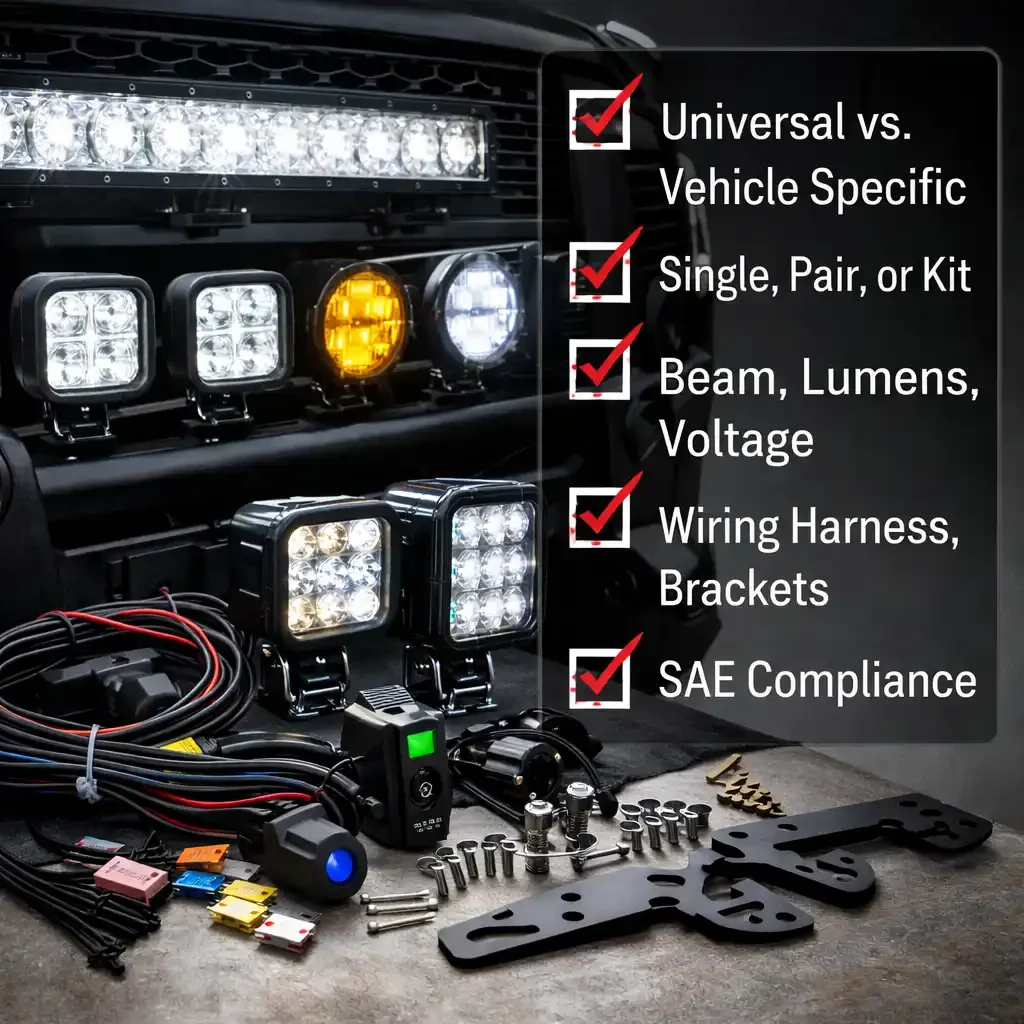
Written by Arthur Simitian | PartsAdvisory
PartTerminologyID 1005, Auxiliary Light, is a supplemental exterior light added to a vehicle to improve visibility beyond the factory lighting system. That definition covers the function in one sentence. It does not specify the intended use case, whether the light is a forward-facing driving light for long-distance illumination, a fog light for low-mounted wide-beam glare control, a ditch light for side-angle road edge coverage, a pod or cube light for compact auxiliary fill, a light bar for wide multi-LED off-road illumination, or a work and scene light for rear or side-facing job site coverage. It does not specify the light source, the beam pattern, the lumen output, the color temperature, the voltage rating, the wattage draw, the mounting configuration, the housing material, the ingress protection rating, whether the light carries SAE or DOT compliance markings or is restricted to off-road use only, whether the product is a single light or a pair, whether a wiring harness is included, whether mounting brackets are included, whether a relay and fuse are included, or whether the product is a universal fit or a vehicle-specific application with a defined mounting position on a specific make and model. A listing under PartTerminologyID 1005 that provides a product name, a photo, and a price without the beam pattern, the compliance status, the selling unit definition, and the kit contents cannot be evaluated by any buyer who has a specific use case, a specific mounting position, and a specific wiring expectation before they click add to cart.
For sellers, PartTerminologyID 1005 is one of the highest-volume and highest-return-rate listings in the Electrical, Lighting and Body category precisely because the terminology is a bucket. Every supplemental exterior light that does not fit a more specific PartTerminologyID lands here. Fog lights land here when they are sold as universal kits rather than vehicle-specific replacements. Driving lights land here. Light bars land here. Pod lights, cube lights, ditch lights, and work lights all land here. The breadth of that coverage means a buyer searching PartTerminologyID 1005 can be any of a dozen different buyers with entirely different product expectations, and a listing that does not specify which type of auxiliary light it is will attract all of them and satisfy only a fraction.
The return economics of an under-described auxiliary light listing are worse than most other categories because the product is bulky, the buyer's expectation mismatch is often discovered at installation rather than at unboxing, and the complaint is almost always framed as a fitment failure or a missing component rather than a buyer error. A buyer who ordered a pod light kit expecting mounting brackets and a wiring harness that were not included does not self-identify as having ordered the wrong product: they identify the seller as having shipped an incomplete kit. The return reason on file is product not as described, the feedback is negative, and the listing has not changed, so the next buyer makes the same assumption and the cycle continues.
For sellers, the listing under this PartTerminologyID is only useful if it specifies the light type, the beam pattern, the lumen output, the compliance status, the selling unit, the complete kit contents, the mounting configuration, the wiring requirements, and the vehicle application scope. Without those nine attributes, the listing cannot prevent the expectation mismatch that drives the return rate for this PartTerminologyID above the category average.
What the Auxiliary Light Category Covers and Why It Matters
The range of products under PartTerminologyID 1005
The term auxiliary light describes the role of the product, not its shape, size, or technology. That role definition is broad enough to include products that are fundamentally different in mounting position, beam geometry, compliance status, and installation complexity. Understanding the full range of products under this PartTerminologyID is the first step in writing a listing that prevents returns.
A driving light is forward-facing, designed for long-distance illumination at highway speed, and typically mounted high on the bumper or grille. Its beam is a narrow pencil or spot pattern that throws light far down the road with minimal lateral spread. A buyer looking for a driving light is not looking for a fog light, and a listing that does not specify driving light as the type will attract fog light buyers who install the product low on the bumper and complain about glare.
A fog light is low-mounted, designed to project a wide flat beam close to the road surface below the fog layer, and is specifically shaped to minimize backscatter into the driver's eyes. Its beam is a wide, flat cut-off pattern that is the opposite of a driving light beam in every geometric dimension. A fog light mounted at bumper height and aimed correctly is not a driving light and should never be described as one.
A ditch light is an angled forward light mounted on the A pillar or upper bumper corners, aimed outward from the vehicle centerline to illuminate the road edges and ditches on either side of the path of travel. It supplements the forward-facing driving lights by covering the lateral blind zones that straight-ahead beams miss on curves and intersections. A ditch light kit is a vehicle-specific product on most platforms because the A pillar bracket must fit the specific A pillar geometry of the make and model.
A pod or cube light is a compact square or round auxiliary light, typically between two and four inches in overall dimension, used as a fill light, a ditch light supplement, or a bumper accent light. Its small form factor makes it versatile but also makes it the most commonly misunderstood product in the auxiliary light category: a buyer who sees a two-inch pod and assumes it produces the same output as a six-inch driving light will be disappointed regardless of how the lumen specification is stated.
A light bar is a wide multi-LED unit ranging from four inches to fifty inches or more in overall length, designed for broad front illumination on off-road vehicles or as a supplemental overhead flood on work trucks. The length is the primary purchase decision attribute for a light bar and must be in the listing title. A buyer who orders a twenty-inch light bar when they needed a forty-inch unit because the listing did not state the length clearly is a return that was created entirely by a title omission.
A work or scene light is rear or side-facing, designed to flood a job site with broad coverage rather than project a beam forward. It is common on service trucks, utility vehicles, emergency vehicles, and agricultural equipment. Its beam is a flood pattern with no focus on distance, and it is almost always powered from the vehicle's electrical system through a relay and fuse rather than from a switched ignition circuit.
Why a single PartTerminologyID covers all of these
PartTerminologyID 1005 covers all of these products because the PCdb taxonomy defines the role rather than the form. From the catalog's perspective, every product that serves as a supplemental exterior light beyond the factory system is an auxiliary light. The seller's job is to use the attributes available in PIES and in the marketplace item specifics frameworks to distinguish the specific product from every other product under the same PartTerminologyID. The PartTerminologyID is the filing cabinet. The attributes are the labels on the folders inside it. A filing cabinet with no labels is not a catalog: it is a pile.
The Fitment Problem Is the Kit, Not the Light
Universal versus vehicle-specific: the first decision in every listing
The most consequential binary decision in an auxiliary light listing is whether the product is universal or vehicle-specific. A universal auxiliary light has no defined mounting position, no vehicle-specific bracket, and no installation instruction that references a specific make or model. It fits any vehicle that has a suitable mounting surface and a buyer willing to fabricate or source their own mounting solution. A vehicle-specific auxiliary light kit includes a bracket designed for a specific mounting position on a specific make and model and is sold on the premise that the buyer can bolt it on without fabrication.
The return rate for universal auxiliary lights sold with copy that implies vehicle-specific fitment is among the highest in the category. Copy that says perfect fit for your truck without specifying the make, model, or mount position creates a vehicle-specific expectation on a universal product. The buyer who cannot mount the light to their specific bumper without drilling returns the product with a fitment complaint. The listing did not fail in its universal specification: the copy failed by implying a specific fitment that the product cannot deliver.
The rule is straightforward. If the product is universal, the listing must say universal, must not imply any specific mounting position without noting that modification may be required, and must not use vehicle-specific language in the title or the description. If the product is vehicle-specific, the ACES application data must be correct, the listing must state the specific makes, models, and years, and the mounting position must be explicitly defined.
The kit contents problem
A large proportion of auxiliary light returns are not caused by fitment problems at all. They are caused by kit content mismatches: the buyer expected a complete installation kit and received only the lights, or the buyer expected only the lights and received a kit with components they did not need and cannot return individually.
A complete auxiliary light kit for a specific vehicle may include the lights themselves, a pair of vehicle-specific mounting brackets, a wiring harness with pre-terminated connectors, a relay, a blade fuse and fuse holder, a dash-mounted rocker switch, mounting hardware including bolts and washers, and installation instructions. A buyer who orders this kit on the assumption that everything needed for installation is included and receives only the two lights and a generic instruction sheet has received a product that is functionally unusable without additional purchases.
The kit contents must be described like a bill of materials. Every component in the box must be named, quantified, and described with enough specificity to allow the buyer to identify what is and is not included before purchasing. The kit contents list is not marketing copy. It is the contract between the listing and the buyer about what arrives in the box.
The selling unit definition
State whether the listing is for one light or two. This is the single most common item specifics error for auxiliary lights across all marketplaces. A buyer who orders one unit expecting a pair because the product image shows two lights and the price seems consistent with a pair price has a legitimate complaint. A product image that shows two lights must either be accompanied by a clearly stated quantity of one, or the listing must be for a pair.
The quantity problem is compounded by marketplace search filters that allow buyers to filter by pair and that default to including single-unit listings in pair searches when the quantity field is not populated. A listing with an unpopulated quantity field in a marketplace that defaults to the pair filter will attract pair-seeking buyers and return single units, generating a return rate that cannot be diagnosed without checking the item specifics.
The Attributes That Drive Conversion and Prevent Returns
Beam pattern
The beam pattern is the single most important technical attribute for an auxiliary light after the light type. Spot, flood, combo, driving, and fog are the five primary beam pattern categories. Within each category, additional specification is possible: a spot beam may be specified by its beam angle in degrees, a flood beam by its horizontal and vertical spread, and a driving beam by its peak intensity in lux at a stated distance.
For a buyer comparing two pod lights of similar lumen output, the beam pattern is the attribute that determines which one is correct for their application. A twenty-degree spot beam from a pair of ditch lights will not provide adequate lateral coverage for a ditch light application. A sixty-degree flood beam from a pair of driving lights will not provide adequate distance throw for a highway driving application. The beam pattern must be stated in degrees where possible, not just in the categorical label.
Lumen output: claimed versus tested
Lumen output is the most abused specification in the auxiliary light category. LED auxiliary lights are routinely marketed with raw lumen claims based on the theoretical output of the LED chips before losses through the lens, the reflector, and the housing optics. The effective lumens delivered to the road surface, which is the specification the buyer actually cares about, is typically 30 to 50 percent lower than the raw lumen claim on budget-tier products and 15 to 25 percent lower on mid-tier products.
A listing that states 10,000 lumens without specifying whether that is raw or effective output is a listing that will generate complaints from buyers who installed the light and found it significantly dimmer than their expectation based on the specification. The correct approach is to state both the raw lumen claim and the effective lumen output if testing data is available, or to state raw lumens with a note that effective output will be lower due to optical losses.
For sellers who have IESNA LM-79 test data from a certified testing laboratory, publishing the tested lumen output rather than the raw chip specification is the highest-credibility approach and the most defensible against marketplace compliance reviews that are increasingly scrutinizing lumen claims.
Color temperature
Color temperature in Kelvin affects how the buyer perceives the light output and whether the light produces the beam character they expect. The common range for LED auxiliary lights is 3,000K for warm amber-white fog and driving lights through 6,500K for cool blue-white off-road lights. The most common specification in the market is 5,000K to 6,000K, which produces a neutral to cool white that appears bright to the human eye without the blue cast of extreme cool-white products.
Amber auxiliary lights, which are popular for fog applications and for off-road driving in dusty or foggy conditions, have a color temperature of approximately 2,000K to 3,000K. Amber is not a color temperature variation of white: it is a different spectral output that requires a separate listing category or a clear amber designation in the listing to prevent a buyer expecting white from receiving amber.
Voltage, wattage, and amperage
Voltage rating, wattage draw, and amperage draw are the three electrical specifications that determine whether the auxiliary light can be safely installed in the buyer's vehicle electrical system. Most passenger vehicles and light trucks operate on a 12-volt nominal system. Commercial vehicles, heavy trucks, and some specialty vehicles operate on a 24-volt system. An auxiliary light rated for 12 volts only that is installed on a 24-volt commercial vehicle will fail immediately from overvoltage.
Wattage and amperage determine the circuit protection required. A 100-watt auxiliary light drawing approximately 8.3 amps on a 12-volt system requires a fuse rated above 8.3 amps and a wire gauge adequate for that current over the run length from the power source to the light. A listing that states wattage and amperage allows the buyer to plan the wiring before installation. A listing that states only lumens leaves the buyer guessing about wiring requirements.
Mounting type and position
The mounting type determines what hardware the buyer needs and whether the product will fit their intended installation location. Common mounting types include stud mount, where a threaded stud on the back of the housing threads into a bracket or surface, bar mount for lights designed to clamp onto a light bar or roll bar, bracket mount for lights that include or require a dedicated bracket, and flush mount for lights intended to be recessed into a bumper or panel surface.
The mounting position describes where on the vehicle the light is designed to be installed: front bumper, rear bumper, A pillar, roof, grille, bed rack, or other. For universal lights, the mounting position is a recommendation rather than a requirement. For vehicle-specific lights, the mounting position must correspond to the bracket included in the kit.
Ingress protection rating
The IP rating describes the light's resistance to solid particle ingress and water ingress. The two-digit IP rating encodes both: the first digit is solid particle protection from 0 to 6, and the second digit is liquid ingress protection from 0 to 9. An IP67 rating means the light is dust-tight and can withstand immersion in up to one meter of water for up to thirty minutes. An IP68 rating means it can withstand continuous immersion beyond one meter at the manufacturer's stated depth.
For off-road auxiliary lights and any light installed in a position exposed to road spray, stream crossings, or power washing, an IP67 or IP68 rating is the minimum acceptable specification. A light with an IP54 rating, which is splash-resistant but not immersion-rated, sold as an off-road auxiliary light will fail from water ingress during the first serious water crossing or heavy rain event at highway speed.
Street legality and compliance marking
The compliance status of an auxiliary light determines where it can legally be used on public roads and must be stated in every listing. SAE-marked auxiliary lights meet the Society of Automotive Engineers performance standards for the applicable beam type and can be used on public roads in most jurisdictions subject to local installation regulations. DOT-marked lights meet Federal Motor Vehicle Safety Standards and are acceptable for highway use on vehicles subject to FMVSS. ECE-marked lights meet the Economic Commission for Europe regulations and are required for road use in most European markets.
A light marked off-road use only has not been tested or certified for any on-road standard and may not be legally operated on public roads regardless of its output quality. Installing an off-road-only auxiliary light and activating it on a public road is a traffic violation in most jurisdictions and, more importantly, is a product liability issue for any seller whose listing does not clearly disclose the off-road restriction.
The compliance status must appear in the listing attributes, in the product description, and where the marketplace allows it, in the product title for off-road-only products. A buyer who installs an off-road-only light on their street-driven vehicle and receives a moving violation or fails a vehicle inspection has a legitimate grievance if the listing did not prominently disclose the restriction.
Status in New Databases
PIES/PCdb: PartTerminologyID 1005, Auxiliary Light
PIES 8.0 / PCdb 2.0: No change in PartTerminologyID or terminology label. The transition from PIES 7.2 to PIES 8.0 is a schema evolution, not a semantic rename. Internal systems keyed to PartTerminologyID 1005 do not require remapping.
Top Return Scenarios
Scenario 1: "Kit listed as complete, wiring harness not included, buyer could not complete installation"
The product listing described an auxiliary light kit without enumerating the kit contents. The product image showed two lights, two brackets, and a wiring harness laid out together. The wiring harness in the image was a generic stock photo and was not included in the shipped product. The buyer received two lights and two brackets without a harness, switch, or relay. The buyer could not complete the installation without purchasing a harness separately and returned the kit as incomplete.
Prevention language: "Kit contents: 2 x LED auxiliary lights, 2 x vehicle-specific mounting brackets, 1 x wiring harness with pre-terminated connectors, 1 x 40A relay, 1 x 30A fuse and holder, 1 x dash-mounted rocker switch, mounting hardware, installation instructions. Wiring harness is [included / not included: sold separately as part number X]. Verify kit contents against your installation requirements before ordering."
Scenario 2: "Universal product, vehicle-specific copy, buyer could not mount without drilling"
The listing described a universal pod light kit with copy that stated fits most trucks and SUVs with front bumpers. The buyer's truck has a plastic front bumper without any factory mounting provisions. The lights could not be mounted without drilling through the bumper face or fabricating a custom bracket. The buyer returned the kit as incompatible with their vehicle.
Prevention language: "Fitment type: universal. No vehicle-specific bracket included. Mounting requires a suitable mounting surface such as a bull bar, bumper channel, or light bar. May require drilling or fabrication for vehicles without factory mounting provisions. If your vehicle has a factory auxiliary light mounting point or a bull bar with pre-drilled holes, verify the mounting hole diameter and spacing matches the stud or bracket dimensions before ordering."
Scenario 3: "Raw lumen claim, effective output significantly lower, buyer compared to claimed specification and found product dim"
The listing stated 8,000 lumens. The buyer compared this to a competitor product rated at 6,000 lumens that they had previously used and found brighter. The 8,000-lumen claim was raw chip output. The competitor's 6,000-lumen claim was effective output after optical losses. The actual effective output of the 8,000-lumen product was approximately 4,800 lumens. The buyer returned the product as not as bright as advertised.
Prevention language: "Lumen output: [X,XXX] lumens raw LED chip output. Effective lumens at road surface: approximately [X,XXX] lumens after optical losses through lens and reflector. Note: raw lumen claims reflect LED chip theoretical output before housing optics losses. Effective output will be lower. Compare effective lumen specifications when evaluating auxiliary lights from different manufacturers."
Scenario 4: "Off-road only light, on-road use implied by copy, buyer received moving violation"
The listing described a light bar as a high-performance driving light without mentioning the off-road restriction. The product was marked off-road use only on the housing but not in the listing. The buyer installed the light bar on the roof of their daily driver and used it on public roads. The buyer received a moving violation for the non-compliant light and returned the product with a complaint that the listing did not disclose the restriction.
Prevention language: "Compliance status: off-road use only. This light is not SAE, DOT, or ECE certified and may not be legally operated on public roads in most jurisdictions. For on-road auxiliary lighting, specify a product with SAE or DOT compliance marking. Installing and operating off-road-only lights on public roads may result in traffic violations and failed vehicle inspections."
Scenario 5: "Single light listed, product image showed pair, buyer expected two lights"
The product image showed two lights side by side. The listing quantity field was blank. The buyer purchased one unit expecting a pair based on the image. One light arrived. The buyer returned it as the wrong quantity.
Prevention language: "Selling unit: 1 light. This listing is for a single auxiliary light. The product image shows two lights for beam pattern and scale reference only. For a complete pair, order quantity 2 or select the pair listing at [link]. Verify the selling unit before adding to cart."
Scenario 6: "24-volt commercial vehicle, 12-volt-only light, immediate failure on first power-up"
The buyer operates a fleet of 24-volt commercial vehicles. The auxiliary light listing stated LED, universal, 12-24V compatible in the title. The body of the listing had a buried specification of 12V only. The buyer ordered ten units for fleet installation. All ten failed on the first power-up at 24 volts. The listing title implied dual voltage compatibility that the actual product did not have.
Prevention language: "Voltage rating: [12V only / 12-24V dual voltage / 24V only]. Verify your vehicle's electrical system voltage before ordering. This light is rated for [12V] operation only. Installation on a 24-volt system will cause immediate component failure. For 24-volt commercial vehicle applications, specify a light with confirmed 24V or 12-24V dual-voltage rating."
Scenario 7: "IP54 rated light, off-road stream crossing, water ingress, immediate failure"
The listing described an IP54-rated auxiliary light as waterproof. The buyer installed the lights on an off-road vehicle used for trail riding including water crossings up to eighteen inches deep. The IP54 rating protects against splashing water but not immersion. The lights failed from water ingress during the first stream crossing.
Prevention language: "Ingress protection rating: IP[XX]. Note: IP54 is splash-resistant only and is not suitable for water crossings or immersion. For off-road applications involving water crossings, stream fording, or high-pressure washing, specify a minimum IP67-rated auxiliary light. IP67 provides dust-tight protection and resistance to immersion in up to one meter of water for thirty minutes."
What to Include in the Listing
Core essentials
PartTerminologyID: 1005
component: Auxiliary Light
light type: driving light, fog light, ditch light, pod or cube, light bar, work light, or scene light (mandatory)
fitment type: universal or vehicle-specific with ACES application data if vehicle-specific (mandatory)
selling unit: single, pair, or kit with complete contents list (mandatory)
beam pattern: spot, flood, combo, driving, fog with beam angle in degrees where available (mandatory)
light source: LED, halogen, or HID (mandatory)
lumen output: raw and effective where both are known (mandatory)
color temperature in Kelvin (mandatory)
voltage rating: 12V, 24V, or dual (mandatory)
wattage and amperage draw (mandatory)
mounting type and mounting position (mandatory)
housing material (mandatory)
lens material (mandatory)
ingress protection rating: IP rating (mandatory)
compliance status: SAE, DOT, ECE, or off-road use only (mandatory)
kit contents list: enumerate every component if selling a kit (mandatory)
wiring harness included: yes or no (mandatory)
relay included: yes or no (mandatory)
switch included: yes or no (mandatory)
mounting brackets included: yes or no with vehicle-specific or universal bracket note (mandatory)
operating temperature range in degrees Celsius (mandatory)
housing dimensions: length, width, height in mm or inches (mandatory for light bars, pods, and cubes)
light bar length in inches for light bar listings (mandatory)
warranty duration (mandatory)
quantity: 1, 2, or kit (mandatory)
Fitment essentials
year/make/model/submodel for vehicle-specific applications
mounting position: front bumper, A pillar, roof, grille, rear bumper, bed rack, or other
bracket type: vehicle-specific or universal with modification note
wiring system: direct wire, plug-and-play harness, or bare wire requiring custom installation
Dimensional essentials
overall housing dimensions in mm or inches
light bar length in inches for bar listings
mounting hole diameter and spacing in mm
stud diameter and thread pitch for stud mount designs
wire lead length in mm or inches
connector type if harness is included
Image essentials
light in isolation with housing dimensions callouts
beam pattern shown on a wall or road surface at a stated distance
kit contents laid out individually for kit listings: every component visible and identifiable
mounting hardware shown with callouts for stud diameter and hole spacing
compliance marking visible on the housing or lens for SAE and DOT listings
vehicle-specific installation shown for vehicle-specific kits
IP rating shown on housing for off-road listings
wiring diagram included for kit listings with harness
Catalog Checklist for ACES/PIES Teams
PartTerminologyID = 1005
require light type: driving, fog, ditch, pod, light bar, work, or scene (mandatory)
require fitment type: universal or vehicle-specific (mandatory)
require selling unit definition: single, pair, or kit (mandatory)
require complete kit contents enumeration for kit listings (mandatory)
require beam pattern with angle in degrees where available (mandatory)
require lumen output: raw and effective (mandatory)
require color temperature in Kelvin (mandatory)
require voltage rating (mandatory)
require wattage and amperage (mandatory)
require IP rating (mandatory)
require compliance status with off-road restriction disclosure (mandatory)
require light bar length in title and specifics for all light bar listings (mandatory)
differentiate from headlamp assembly (PartTerminologyID varies): headlamp assemblies are factory replacement lighting for the primary forward illumination system; auxiliary lights are supplemental additions; headlamp replacements are vehicle-specific OE fitment; auxiliary lights may be universal or vehicle-specific
differentiate from fog light assembly (PartTerminologyID varies): factory replacement fog lights are vehicle-specific OE fitment replacements listed under their own PartTerminologyID; auxiliary fog lights sold as universal kits or aftermarket upgrades fall under 1005
differentiate from work light (PartTerminologyID varies): some catalog implementations have a separate PartTerminologyID for work and scene lights; verify whether your catalog implementation uses a separate PartTerminologyID for rear-facing and side-facing work lights before assigning 1005
flag universal versus vehicle-specific as mandatory: copy that implies vehicle-specific fitment on a universal product is the root cause of the highest volume of fitment complaints for this PartTerminologyID
flag kit contents enumeration as mandatory: missing component complaints are the highest volume return reason for auxiliary light kits and are fully preventable by a complete contents list
flag compliance status as mandatory: off-road restriction not disclosed in the listing is a product liability issue for the seller and a traffic violation risk for the buyer
flag lumen claim type as mandatory: raw versus effective lumen claims are the root cause of the highest volume of brightness complaints for LED auxiliary lights and are the subject of increasing marketplace compliance scrutiny
flag selling unit as mandatory: single versus pair confusion is the most consistently avoidable return reason for this PartTerminologyID
FAQ (Buyer Language)
What is the difference between a driving light and a fog light?
A driving light projects a narrow, long-distance beam straight ahead, designed to supplement high beams at highway speed by throwing light further down the road than the factory high beams can reach. It is typically mounted at or above bumper height and aimed slightly downward along the road centerline. A fog light projects a wide, flat beam close to the road surface, designed to illuminate the ground directly in front of the vehicle in fog, rain, or snow without the backscatter that a high-mounted narrow beam creates in low-visibility conditions. Fog lights are mounted low, aimed with a sharp horizontal cut-off at the top of the beam to keep the light below the fog layer. Installing a driving light in a fog light position produces dangerous glare in low-visibility conditions. Installing a fog light in a driving light position produces inadequate distance coverage at highway speed. The beam pattern and mounting position must match the use case.
Do I need a relay for my auxiliary lights?
For most auxiliary lights drawing more than five amps, yes. A relay allows the auxiliary lights to be powered directly from the battery rather than through the vehicle's factory switch circuits, which are typically rated for lower current loads. Powering a high-output auxiliary light directly through a factory switch without a relay risks overheating the switch and the factory wiring, which can cause a switch failure, a wiring failure, or in severe cases a fire. A relay allows a low-current signal from the factory switch or a dash switch to control a high-current circuit from the battery through a properly fused and rated wire. Most complete auxiliary light kits include a relay for this reason. If your kit does not include a relay, source one rated for the amperage draw of your lights before installation.
What does off-road use only mean and can I use the lights for camping?
Off-road use only means the light has not been tested or certified to SAE, DOT, or ECE standards for on-road use. Activating an off-road-only light while driving on a public road is a traffic violation in most jurisdictions, regardless of whether the light is mounted correctly or aimed correctly. For camping, stationary use, or driving on private property, off-road-only lights are fully legal and perfectly functional. For driving on public roads, specify a product with SAE or DOT compliance marking.
Why does my new auxiliary light seem dimmer than the lumen specification suggested?
The lumen specification on most auxiliary lights is the raw LED chip lumen output, which is measured at the LED junction before the light passes through the lens, the reflector, and the housing optics. By the time the light exits the housing and reaches the road surface, the effective output is typically 30 to 50 percent lower than the raw chip specification on budget-tier products. In addition, a narrow spot beam concentrates the available lumens in a small area and appears brighter in the center spot but covers a smaller total area. A wide flood beam distributes the available lumens over a large area and appears less bright per square foot but provides better overall coverage. Compare effective lumen specifications and beam patterns rather than raw chip lumen claims when evaluating auxiliary lights.
My auxiliary light kit included mounting brackets but they do not fit my bumper. What should I check?
First, confirm whether the kit is universal or vehicle-specific. A universal bracket is not designed for your specific bumper and will require modification or replacement with a vehicle-specific bracket from the same manufacturer or a third-party bracket supplier. A vehicle-specific bracket that does not fit your bumper may indicate an incorrect vehicle application in the listing: verify the make, model, year, and trim level match the listing's stated application exactly, including whether the application specifies a factory bumper or an aftermarket bumper. Some auxiliary light kits specify fitment to a specific aftermarket bumper brand and will not fit the factory bumper.
What IP rating do I need for a light I plan to use in the rain?
For rain and road spray exposure in normal on-road driving, IP65 is the minimum adequate rating. IP65 provides dust-tight protection and resistance to water projected from a nozzle in any direction. For off-road use including water crossings up to eighteen inches, IP67 is the appropriate minimum: dust-tight and immersion-rated to one meter for thirty minutes. For deep water crossings beyond one meter or for lights that may be submerged during recovery operations, IP68 at the manufacturer's stated depth rating is required. Do not rely on terms like waterproof or weatherproof without an IP rating number: these terms have no standardized meaning and cannot be compared between manufacturers.
Cross-Sell Logic
Auxiliary Light Wiring Harness (if the kit does not include a harness, a universal or vehicle-specific harness rated for the auxiliary light amperage draw is a mandatory concurrent purchase for a complete installation)
Relay and Fuse Kit (40A relay, blade fuse, and holder for buyers who are sourcing the lights only and building their own wiring solution)
Dash Mount Switch (rocker switch or toggle switch rated for the relay control circuit; required for any auxiliary light installation without a factory switch provision)
Vehicle-Specific Mounting Brackets (for universal pod and cube lights being installed on a specific bumper or A pillar; the bracket converts the universal light into a vehicle-specific installation)
Light Bar Mounts and Clamps (for roof and hood-mounted light bars requiring adjustable clamps or permanent mounts)
Wiring Conduit and Loom (for clean routing of auxiliary light wiring through the firewall and along the frame)
Anti-Flicker Resistor (for LED auxiliary lights installed on CAN-bus vehicles that produce a flickering or error code from the low-resistance load of the LED circuit)
Frame as "the auxiliary light produces the beam. The wiring harness and relay deliver the power to the light without overloading the factory circuits. The mounting brackets put the light in the correct position for the beam pattern to work as designed. The switch gives the driver control. The IP rating determines whether the light survives the environment it is installed in. All are in the same installation decision."
Final Take for PartTerminologyID 1005
Auxiliary Light (PartTerminologyID 1005) is the PartTerminologyID where the listing's job is to narrow a broad category into a specific product that matches a specific buyer's use case, mounting position, wiring expectation, and compliance requirement before they click buy. The terminology label covers everything from a compact cube pod on a daily driver bumper to a fifty-inch light bar on an off-road race truck. A listing that does not specify which of those it is will attract every buyer in the category and satisfy only the ones who happened to need the exact product that shipped.
The light type and beam pattern resolve the use case. The fitment type resolves the mounting expectation. The kit contents list resolves the installation completeness question. The lumen claim type resolves the brightness expectation. The compliance status resolves the legality question. The IP rating resolves the environment survivability question. The selling unit definition resolves the quantity expectation. Every one of those attributes addresses a specific return scenario that has already happened at scale in this category and will continue to happen at scale on every under-described listing.
State the light type. State the beam pattern with angle. State the lumen output as raw or effective. State the compliance status prominently. State the selling unit clearly. Enumerate every component in a kit listing. State the IP rating. State the voltage. State the wattage. State whether the harness, relay, switch, and brackets are included or not. That is the same listing strategy as every other PartTerminologyID in this series: specific attributes at every level to become a listing buyers can act on without guessing. For PartTerminologyID 1005, the compliance status and the kit contents list are the two attributes that no lumen specification substitutes for, because they are the ones that determine whether the product can be legally installed and whether the installation can be completed with what arrives in the box.