
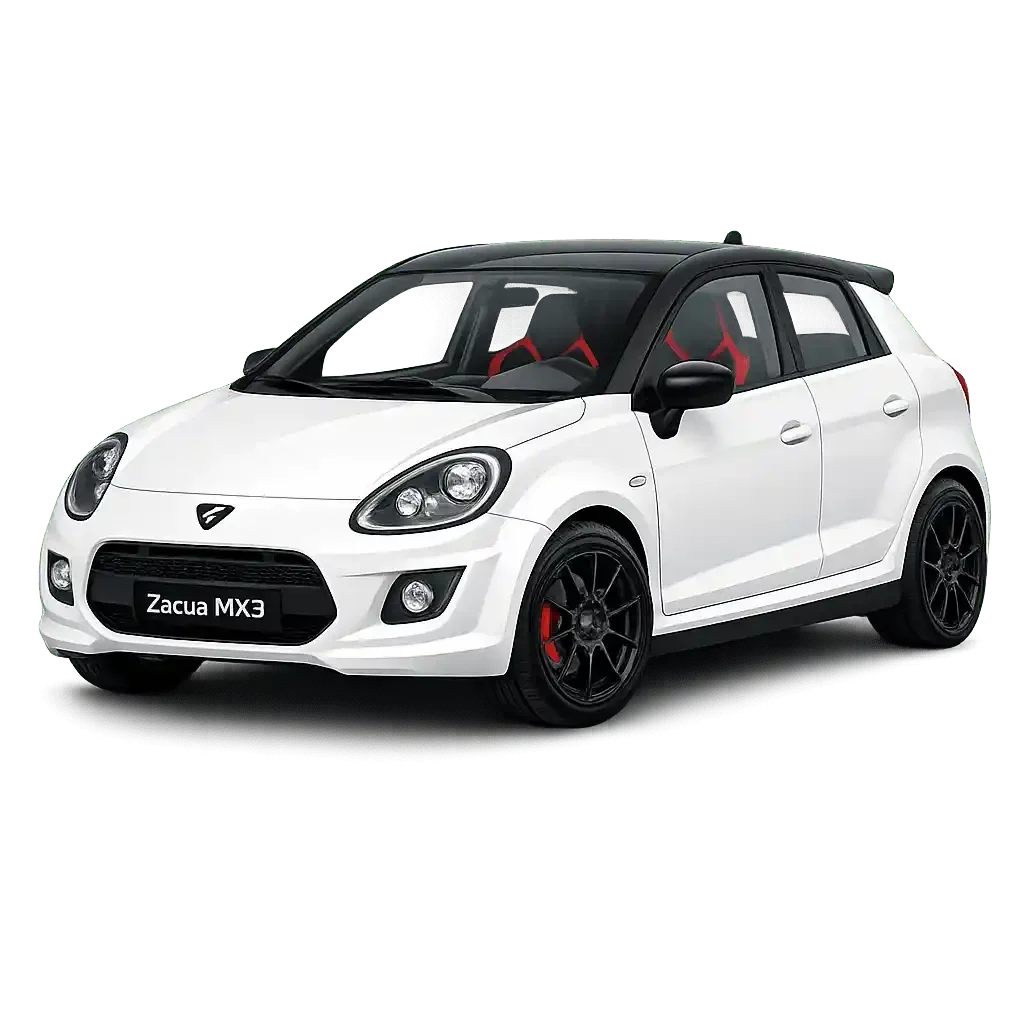
The Zacua MX3 is the vehicle that started it all. It was the first model announced when Zacua debuted in August 2017, and it holds the distinction of being the original Mexican-built electric car. The MX3 is the hatchback variant in the Zacua lineup, identified by its upright rear profile, rear hatch opening, and nearly double the cargo space of its coupe sibling, the MX2.
This is a companion guide to our Zacua MX2 Coupe fitment guide. The MX3 shares every mechanical, electrical, and interior component with the MX2, but the rear body structure is completely different. If you are building catalog entries for both models, the powertrain and chassis parts can cross-reference, but anything behind the B-pillar must be listed separately.
Brand background
Zacua was founded in 2017 in Mexico City by Motores Limpios, S.A.P.I. de C.V., a subsidiary of COPEMSA (Compania Operadora de Estacionamientos Mexicanos), one of Mexico's largest parking facility operators. The brand name comes from the Nahuatl word for a bird species native to the region from Mexico to Panama, the favorite bird of the Aztec emperor Moctezuma II.
The company partnered with French microcar manufacturer Automobiles Chatenet, adapting the CH30 platform with an electric drivetrain developed by Spain's Dynamik Technological Alliance. Batteries are sourced from a Chinese supplier. Vehicle electronics were developed in-house at Zacua's Puebla facility. Every vehicle is hand-assembled at the Puebla 2000 Industrial Park by a production team composed primarily of women.
Zacua sells exclusively by order. There is no dealer inventory or traditional showroom network. Each car is built to the buyer's specifications through a personalized ordering process.
What the MX3 covers
The MX3 is the hatchback body style. It was the first Zacua model conceived, and its design is distinguished by a more upright, classic rear profile compared to the MX2 coupe's sloping roofline. The MX3 features a rear hatch (not a trunk), two-tone exterior paint, plastic body trim, round headlights and taillights, and hidden door handles recessed behind the door edges.
The MX3's defining practical advantage over the MX2 is cargo space: 487.5 square centimeters of trunk capacity, nearly double the MX2 coupe's 247.5 square centimeters. This makes the MX3 the more versatile daily-use option in the two-model lineup.
Important naming note: In 2018, the hatchback was marketed as the Zacua M3. Starting with the 2019 production cycle, the name was updated to MX3. The M3 and MX3 are the same body style concept (two-seat electric hatchback), but the MX naming reflects the refined generation after Zacua settled into its Puebla production process. For catalog purposes, treat the 2018 M3 as a separate fitment group from the 2019-onward MX3 for exterior body components.
Model year marketing note: Zacua does not assign traditional model year designations to the MX3. On its official site, it is simply the "Zacua MX3." When you place an order, the paperwork reflects the actual build year of the unit you receive. Industry databases that show entries for 2019, 2020, 2021, and so on are using production years, not formal model year announcements. For catalog systems that require a model year field, use the build year from the vehicle registration or VIN documentation.
MX3 model history
2018 Zacua M3 (Base): The original hatchback, first production year. Marketed under the M3 name. This was the vehicle that premiered at Zacua's launch event at the Hotel Presidente Intercontinental in Mexico City on July 6, 2017. Production started at the Puebla plant in May 2018, with initial pricing at 550,000 pesos.
2019 Zacua MX3 (Base): The hatchback transitions to the MX3 name. Same core specifications. The production facility was fully established in its Puebla 2000 Industrial Park location.
2020 Zacua MX3 (Base): Continued production.
2021 Zacua MX3 (Base): Continued production.
2022 Zacua MX3 (Base): Continued production. Zacua formally reintroduced the MX3 and MX2 to the public in February 2022 after a period of refining the production process and weathering challenges from the 2017 earthquake and the COVID-19 pandemic.
2023 Zacua MX3 (Base): Continued production.
Current production status: As of early 2025, Zacua continues to offer the MX3 by order at a price of 599,900 Mexican pesos (approximately $30,500 USD). Like the MX2, no formal "2025 MX3" or "2026 MX3" model year has been published. Zacua's CEO has announced plans for five new models including an updated city car, a delivery truck, an electric motorcycle, and a sports vehicle. The company is expanding its Puebla plant and has discussed exporting vehicles to California, all of which suggests continued MX3 production alongside the new lineup.
MX3 specifications
The MX3 shares its complete technical foundation with the MX2 and every other Zacua model. Specifications have remained consistent across all production years:
Motor: Electric PMSM (Permanent Magnet Synchronous Motor), Sevcon Gen4 controller, 34 kW (46 hp) peak power at 3,750 rpm, 87 Nm torque
Battery: Lithium LiFePO4 (lithium iron phosphate), 15.6 kWh total capacity (13.3 kWh usable), life rated at 3,000 full charge cycles (approximately 8 years of daily full charges). At 80% remaining capacity, batteries can be repurposed for energy bank and lighting projects through a recycling partnership with COPEMSA.
Range: Approximately 160 km (100 miles) per full charge. Actual range varies with inclines, speed, and driving habits.
Charging: SAE J1772 (Type 1) connector. Standard charge time 0-100% in approximately 8 hours on household power (220V bi-phase).
Top speed: 85 km/h (53 mph), electronically limited for urban use
Drivetrain: Front-wheel drive
Transmission: Automatic, D/N/R with 1:5.79 ratio
Driving modes: ECO, Standard, and Sprint. When battery drops below 15%, only ECO mode is available.
Brakes: ABS disc brakes with regenerative braking. Front discs 225 mm diameter, rear discs 200 mm diameter. Hydraulic circuit.
Suspension: Front: independent MacPherson struts with lower wishbones and vertical dampers. Rear: trailing arm with auto-deformable axle stabilizer.
Wheels: 15-inch aluminum with black gloss inserts
Dimensions: 3,065 mm long, 1,770 mm wide, 1,442 mm tall
Weight: 685 kg
Seating: 2 passengers. Bucket-style seats with manual recline via lateral levers.
Cargo: 487.5 square centimeters (hatchback opening), nearly double the MX2 coupe's 247.5 square centimeters
Interior features: 7-inch display with Bluetooth connectivity, phone integration, internet navigation, email access, social media, vehicle status monitoring, surround audio system
Exterior colors (MX3): Marfil (Ivory), Negro (Black), Plata (Silver), Rojo (Red), and Blanco (White)
Color note for catalog teams: The MX3 is offered in five exterior colors compared to the MX2's three (Red, Oxford, Marfil). If you are listing painted body panels, bumper covers, or color-matched trim, the MX3 has a wider color palette. Confirm the exact color before ordering painted parts.
Step 1: Confirm hatchback versus coupe
This is the single most important fitment check on any Zacua. The MX3 (hatchback) and MX2 (coupe) share every mechanical, electrical, and interior component, but the rear body structure is different.
Parts unique to the MX3 hatchback (do not cross with MX2 coupe):
Rear hatch panel and hatch frame
Hatch hinges, struts, and latch mechanism
Rear glass and rear glass weatherstrip
Tail lamp housings and tail lamp mounting hardware
Rear bumper cover and bumper mounting brackets
Rear quarter panel sections (different contour from coupe)
Rear interior cargo area trim and carpet
Hatch seal and weatherstripping
Rear wiper and washer system (if equipped)
Parts shared between MX3 hatchback and MX2 coupe:
Complete powertrain (motor, controller, battery pack, wiring harness)
Front body panels, hood, fenders, front bumper
Headlights, front corner lamps, and front lighting
Front and rear suspension (struts, springs, control arms, stabilizer)
Brakes (rotors, calipers, pads, brake lines, master cylinder)
Wheels and tires
CV axles and driveline components
Steering rack, tie rods, and steering column
All interior components forward of the cargo area
Charging port, charging cable, and onboard charger
Battery pack and battery management system
HVAC system
All electrical control modules, fuses, and sensors
Windshield and front door glass
Rule: Never list rear body parts for a Zacua without confirming MX3 (hatchback) or MX2 (coupe). Everything behind the B-pillar is body-style-specific.
Step 2: Confirm M3 (2018) versus MX3 (2019 onward)
The 2018 M3 was the first production year under the original name. The MX3 designation started in 2019 and reflects the refined production generation. While the mechanical platform is the same, exterior body panels, trim pieces, and potentially lighting assemblies may differ between the M3 and MX3 generations.
Rule: For exterior body panels, hatch assemblies, bumpers, grille trim, and lighting, treat 2018 M3 and 2019+ MX3 as separate fitment groups until verified otherwise. For all mechanical, electrical, and powertrain components, the M3 and MX3 are interchangeable.
Step 3: No further splits needed
The MX3 requires no additional fitment splits beyond body style and generation. There is:
One engine across all years
One battery across all years
One transmission across all years
One drivetrain (FWD) across all years
One trim level (Base) across all years
No facelift changes within the MX3 generation
No market variations (Mexico only)
No AWD option
No hybrid option
The biggest fitment and catalog traps on the MX3
1. Hatch hardware listed as trunk hardware
Why this is a problem: The MX3 has a rear hatch. The MX2 has a trunk. These are different opening mechanisms with different hinges, struts, latches, and seals. A catalog entry that lists "Zacua trunk latch" without specifying body style will send the wrong part to an MX3 owner, or vice versa.
How to stop returns: Always specify hatch (MX3) or trunk (MX2) in the part description. Add a buyer prompt: "The MX3 has a rear hatch opening. The MX2 has a trunk. Confirm which body style you have before ordering."
2. Painted parts shipped in the wrong color
Why this is a problem: The MX3 is available in five colors (Marfil, Negro, Plata, Rojo, Blanco) while the MX2 is available in three (Red, Oxford, Marfil). If a buyer orders a painted bumper cover or body panel without specifying color, or if the listing assumes MX2 colors apply to MX3, the part arrives in the wrong finish. Because these cars are built to order with no dealer stock, color-matched parts are especially important.
How to stop returns: Require color confirmation on any painted or color-matched body part. List the available MX3 colors explicitly: Marfil (Ivory), Negro (Black), Plata (Silver), Rojo (Red), Blanco (White).
3. The M3 name causing database confusion
Why this is a problem: The 2018 hatchback was called M3. Anyone searching a catalog for "Zacua M3" will not find results filed under "MX3," and vice versa. Worse, the "M3" designation could create confusion with the BMW M3 in catalog systems that use partial string matching.
How to stop returns: List M3 (2018) and MX3 (2019+) as separate model entries. Add cross-reference notes between them. For parts that are mechanically identical across both, link the listings so a search for either name surfaces the correct results. Be aware of potential BMW M3 cross-contamination in search results and ensure make-level filtering is enforced.
4. Assuming aftermarket body parts exist
Why this is a problem: The Zacua MX3 is a hand-built microcar produced in small volumes for a single market. There is no established aftermarket body panel industry for this vehicle. A buyer searching for a replacement hatch, bumper cover, or fender will likely find nothing in standard aftermarket catalogs. The only source for most body components is Zacua directly.
How to stop confusion: If you are listing Zacua-compatible parts, focus on categories where universal or cross-referenced parts apply: brake pads, brake rotors, wiper blades, bulbs, tires, cabin accessories, and charging adapters. For body panels and Zacua-specific components, direct buyers to the manufacturer.
5. Listing Chatenet CH30 body parts as fitting the MX3
Why this is a problem: The MX3 is built on a platform derived from the French Chatenet CH30 microcar. A resourceful parts researcher may find CH30 hatchback components and assume they fit the MX3. While the underlying structure is related, the Zacua has a unique electric powertrain, different electronics, and the body panels may have been modified for the Mexican production version.
How to stop returns: Do not cross-list Chatenet CH30 body parts as fitting the Zacua MX3 without physical verification on the actual vehicle. Some structural and suspension components may be compatible, but this must be confirmed part by part. Powertrain and electrical components will not cross under any circumstances.
A clean MX3 fitment rules block
Required attributes for Zacua MX3 parts listings:
Make: Zacua
Model: M3 (2018) or MX3 (2019 onward)
Body style: Hatchback (distinguish from MX2 Coupe)
Build year from registration or VIN documentation
For exterior body parts: confirm M3 (2018) or MX3 (2019+) generation
For rear body parts: confirm hatchback, not coupe
For painted parts: confirm exterior color (Marfil, Negro, Plata, Rojo, or Blanco)
Buyer confirmation prompts:
Rear body parts: "Confirm your Zacua is the MX3 hatchback, not the MX2 coupe"
Painted parts: "Confirm your exterior color from the MX3 palette: Marfil, Negro, Plata, Rojo, or Blanco"
Exterior panels: "Confirm build year. 2018 models were sold as M3, 2019 and later as MX3"
Hatch parts: "The MX3 has a rear hatch. The MX2 has a trunk. Confirm you need hatch components"
Quick identification guide for buyers
Tell readers to gather these items before shopping:
Build year from registration
Confirm body style: hatchback (MX3, upright rear with hatch) or coupe (MX2, sloping roofline with trunk)
Photo of the rear, straight on (this is the fastest way to distinguish MX3 from MX2)
Name on the vehicle: M3 or MX3
Exterior color (Marfil, Negro, Plata, Rojo, or Blanco for MX3)
Photo of the part being replaced, showing mounting points
If the buyer cannot confirm hatchback versus coupe from a rear photo, they are not ready to order rear body parts.
Cross-reference with the MX2 coupe guide
For catalog teams building fitment data for the full Zacua lineup, here is how the MX3 and MX2 relate:
Shared part numbers (use same listing, both models): All powertrain components, all suspension components, all brake components, all steering components, all front body panels and lighting, all interior components forward of the cargo area, all electrical modules, battery and charging system, wheels and tires, windshield and front door glass.
Separate part numbers (list each model individually): Rear hatch (MX3) versus trunk lid (MX2), rear bumper cover, tail lamp assemblies, rear glass, rear quarter panel sections, rear weatherstripping and seals, hatch/trunk hinges and struts, hatch/trunk latch mechanism, rear interior trim panels, rear cargo area carpet.
Color-specific parts (confirm model and color): Any painted body panel, bumper cover, or color-matched trim. The MX3 offers five colors; the MX2 offers three. Not all colors overlap.
Bottom line
The Zacua MX3 is the hatchback that launched Mexican electric vehicle manufacturing. It is mechanically identical to the MX2 coupe in every way that matters for powertrain, chassis, and electrical parts. The only splits that matter are body style (hatchback versus coupe), generation (M3 2018 versus MX3 2019 onward), and exterior color for painted components.
Like the MX2, the biggest challenge is not fitment complexity. It is catalog visibility. The MX3 does not appear in most aftermarket databases, and the brand does not use traditional model year marketing. Build your entries now with the correct make, model, body style, generation, and color attributes, and you will own this catalog space before anyone else realizes the opportunity.
Disclaimer: This guide is based on publicly available specifications, Zacua press materials, and independent research. Part interchangeability should always be confirmed via VINand OEM part number lookup. Specifications may change without notice. This document does not constitute official Zacua parts catalog data. Visuals and illustrations in this article were generated using AI for representative purposes and may not reflect exact technical schematics.