
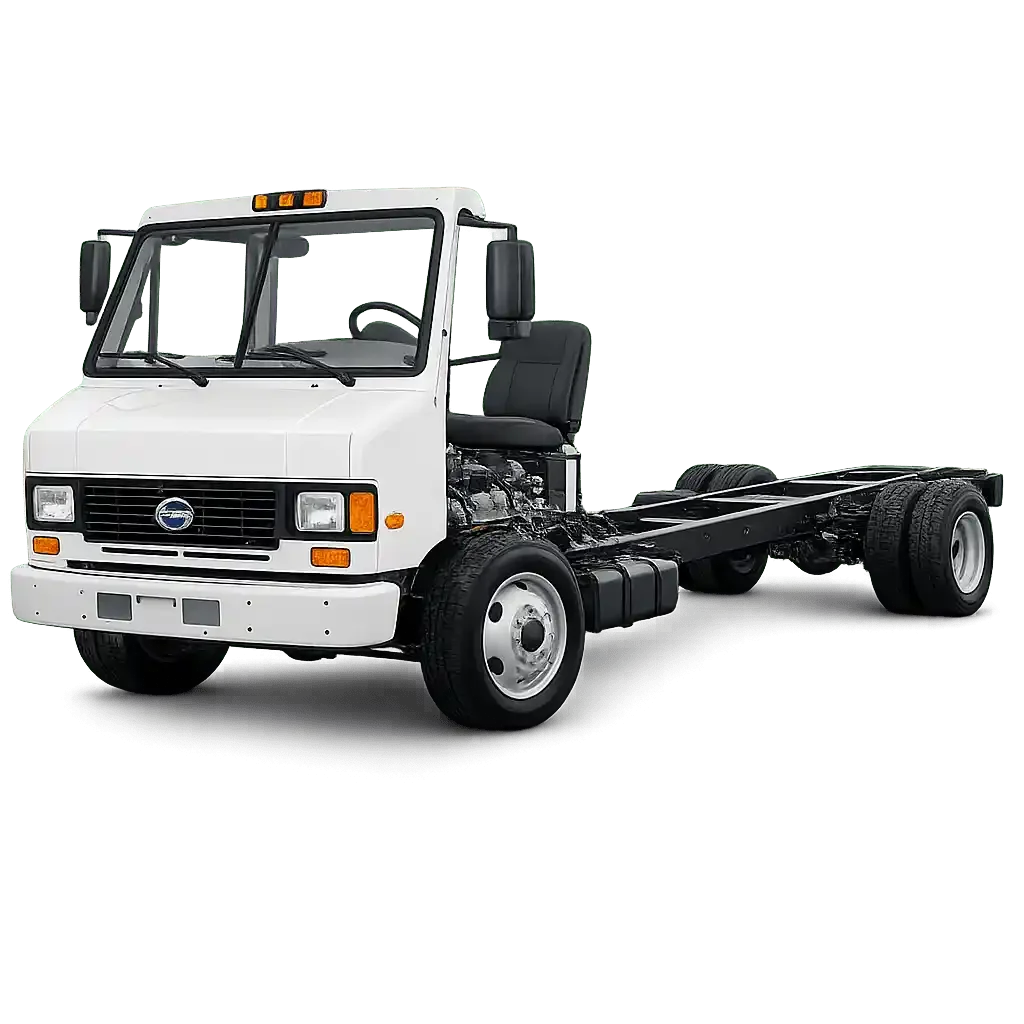
The Workhorse P30 is one of the most confusing entries in the entire North American parts catalog ecosystem. It is not a single vehicle. It is not a truck. It has no body. It is a stripped chassis sold to coach builders who bolt motorhome bodies onto it, and to commercial body manufacturers who build step vans on top of it. The name "P30" is a catch-all that aftermarket databases, DMV offices, and parts counters use to describe a family of chassis that actually includes distinct models with different engines, transmissions, suspension configurations, brake systems, weight ratings, wheelbases, and even different manufacturers depending on the year.
If you sell parts for anything described as a Workhorse P30, a Workhorse P32, a Chevrolet P30, or any coach or step van built on one of these platforms between 2000 and 2005, this guide identifies every fitment split that causes wrong orders and explains what you need to confirm before listing a single part number.
The naming mess: P30, P32, P42, and why it matters
This is the single most important thing to understand about this chassis family: "P30" is not a model. It is a generic term that has been carried forward from the GM era and is now used loosely by parts databases, DMVs, Carfax, and parts counter staff to describe multiple distinct chassis types. Here is what the actual designations mean:
P32: The official model name for the light-duty motorhome stripped chassis, used by Class A gas motorhome builders. This is what Workhorse formally called their motorhome chassis from 1999 through 2005. When someone says "Workhorse P30 motorhome chassis," they almost always mean the P32.
P42: The official model name for the light-duty step van (commercial) stripped chassis, used for delivery trucks, bread vans, FedEx/UPS-type vehicles, and similar commercial bodies. This is a different chassis from the P32 with different engines, different steering components, and different applications.
P30: A generic/legacy term from the GM era that covers both the P32 and P42 (and earlier variants). Many aftermarket databases still list everything under "P30" and do not distinguish between the motorhome chassis and the step van chassis.
Parts that fit a P32 motorhome chassis do not necessarily fit a P42 step van chassis, and vice versa. The steering gear, steering linkage, engine options, and many chassis-specific components differ between the two. If your database lists parts under "Workhorse P30" without distinguishing P32 from P42, you will generate returns.
VIN identification: Workhorse-built chassis VINs begin with "5B4." GM/Chevrolet-built chassis VINs begin with "1GB." The sixth digit of the VIN indicates the chassis type: "3" or "5" indicates a P32, "6" indicates a W20 or W22. The seventh digit of the VIN can further help: a "1" or "2" in the seventh position indicates an older P30 configuration, while later codes indicate Workhorse updates.
Who built what and when
Understanding who manufactured the chassis is critical because parts numbering changed when production transferred:
1999: Workhorse Custom Chassis (headquartered in Union City, Indiana) acquired the P-series chassis line from General Motors/Chevrolet. Early 1999 production chassis are essentially identical to the outgoing Chevrolet P32, with the main visible difference being a Workhorse logo on the steering wheel instead of a Chevy bowtie. Workhorse also continued building P30 commercial vans under Chevy contracts through spring 2000.
2000-2001: Workhorse began making meaningful engineering changes. In 2000 or 2001 (sources vary slightly on exact timing), the wide-track front suspension upgrade was introduced, widening the front tire track by 13.25 inches so the front tires aligned with the outer rear duals instead of the inner rear tires. This is a major fitment split for front suspension, steering, and brake components.
2001: The GM Vortec 8100 (8.1L/496 cubic inch) V8 replaced the Vortec 7400 (7.4L/454 cubic inch) V8 as the engine for the P32 motorhome chassis. This is one of the most important single-year changes in the entire production run.
2003: The GM 4L85-E transmission began replacing the 4L80-E in some P32 chassis depending on GVWR.
2005: Final model year for the P32 chassis. The J72 automatic parking brake system replaced the J71 on 17,000-lb and 18,000-lb GVWR models. After 2005, the P32 was discontinued and replaced by the W16 and W18 chassis.
Engine options: the critical split
This is the primary mechanical fitment divide on the P32 motorhome chassis during 2000-2005:
GM Vortec 7400 (L29) - 7.4L (454 cubic inches) V8
Available on: P32 motorhome chassis, 1999-2000 (carryover from GM era)
Power: approximately 290 hp at 4,000 rpm, 410 lb-ft torque at 3,200 rpm
Fuel system: multi-port fuel injection (MPFI)
Block: cast iron, overhead valve, two valves per cylinder
Firing order: 1-8-4-3-6-5-7-2 (traditional big-block order)
Notes: This is the final evolution of the classic Chevrolet 454 big-block. It shares bore diameter with the later 8.1L but is otherwise a different engine
GM Vortec 8100 (L18) - 8.1L (496 cubic inches) V8
Available on: P32 motorhome chassis, 2001-2005
Power: 340 hp at 4,200 rpm, 455 lb-ft torque at 3,200 rpm
Fuel system: sequential fuel injection (similar to Gen III small-block system)
Block: cast iron, overhead valve, two valves per cylinder, 18-bolt head pattern
Bore and stroke: 107.95 x 111mm (4.25 x 4.37 inches)
Compression ratio: 9.1:1
Firing order: 1-8-7-2-6-5-4-3 (different from the 7.4L)
Oil pan capacity: 6.4 quarts
Assembly: Tonawanda, New York
Notes: Approximately 80 percent of the parts were redesigned compared to the 7.4L. Different head bolt pattern, longer connecting rods, different intake ports, different oil pan rails, metric threads throughout. Workhorse became the exclusive supplier of this engine in the Class A motorhome market
GM L31 - 5.7L (350 cubic inches) V8
Available on: P42 step van (commercial) chassis
Power: approximately 255 hp
Notes: This engine was not used in P32 motorhome chassis during the Workhorse era, but it was the standard engine for the P42 commercial step van chassis. If your database shows a "Workhorse P30" with a 5.7L, it is almost certainly a P42 step van, not a P32 motorhome
GM L57 - 6.5L Diesel V8
Available on: P42 step van (commercial) chassis
Notes: Non-turbo diesel option for the commercial step van. Not used in P32 motorhome chassis
Rule: Never list engine parts for "Workhorse P30" without confirming the exact engine. A 5.7L part does not fit a 7.4L chassis. A 7.4L part does not fit an 8.1L chassis. And the 8.1L has a different firing order, different head bolt pattern, and different fuel injection system from the 7.4L, so even "big-block V8" is not specific enough.
Transmission options
Three GM Hydra-Matic transmissions were used in the P32 motorhome chassis during 2000-2005. No P32 chassis ever received an Allison transmission (the Allison was reserved for the W-series chassis):
GM 4L80-E: 4-speed automatic overdrive. Used in P32 chassis from 1999 through approximately 2002.
GM 4L85-E: 4-speed automatic overdrive. An upgraded, heavier-duty version of the 4L80-E. Used in some P32 chassis starting with the 2003 model year, depending on GVWR. Externally identical to the 4L80-E.
GM 4L80-E vs 4L85-E split: These transmissions look identical from the outside but have internal differences in clutch packs, valve body calibration, and torque capacity. The 4L85-E was used in higher-GVWR P32 chassis. If a customer is ordering internal transmission parts, rebuild kits, or valve body components, you must confirm which transmission they have.
Important: If someone tells you they have a "Workhorse P32 with an Allison transmission," they do not have a P32. They have a W-series chassis (W20, W22, or W24). The Allison 1000 series 5-speed automatic was exclusively paired with the W-series. This is a common misidentification.
GVWR options and what they affect
The P32 chassis was available in four gross vehicle weight ratings during the 2004-2005 era:
14,800 pounds
15,000 pounds
17,000 pounds
18,000 pounds
GVWR affects the following fitment-critical components:
Brake system configuration (see brake section below)
Spring rates (front coil springs, rear leaf springs)
Shock absorber specification
Wheel and tire size (16-inch versus 19.5-inch)
Axle rating and components
Automatic parking brake presence (the J71/J72 automatic apply parking brake is used on chassis with GVWR above 15,000 pounds)
Frame rail gauge and reinforcement in some configurations
Rule: GVWR is a required attribute for suspension, brake, wheel, tire, axle, and parking brake components. A 14,800-lb chassis and an 18,000-lb chassis may share the same engine and transmission but use completely different springs, shocks, brakes, and wheels.
Wheelbase options
The P32 was available in multiple wheelbase lengths ranging from approximately 158.8 inches to 228 inches. The wheelbase was specified by the coach builder who ordered the chassis, so there is no single "standard" wheelbase.
Parts affected by wheelbase:
Frame rails (different lengths, obviously)
Brake lines and fuel lines (routed along the frame, length varies)
Driveshaft/propeller shaft (different lengths for different wheelbases)
Exhaust system (tail pipe extensions differ by wheelbase)
Parking brake cables (length varies)
Chassis wiring harness (length and routing vary)
Fuel tank size and position (75-gallon tank standard on some configurations)
The wheelbase is recorded on the Service Parts Identification Label (SPID), which the coach builder typically installed on an inner body panel to the left of the driver's seat.
Rule: For any part that runs the length of the chassis (brake lines, fuel lines, exhaust, driveshaft, parking brake cables, wiring harness), require the wheelbase measurement before accepting an order. "Workhorse P32" is not enough.
Front suspension: standard track versus wide track
This is one of the most consequential fitment splits on the P32:
Standard track front end: Inherited from the GM/Chevrolet P30 era. Front tires align with the inner rear duals. Used on early Workhorse P32 chassis (1999-2000).
Wide track front end: Introduced by Workhorse around 2000-2001. Front tire track widened by 13.25 inches so front tires align with the outer rear duals. Includes new suspension geometry, different control arms, different steering components, and different Bilstein gas-charged shock absorbers (1.65-inch diameter). Available as standard equipment on the three heavier GVWR ratings (15,000, 17,000, and 18,000 pounds).
Parts affected by the standard track/wide track split:
Upper and lower control arms
Steering knuckles
Tie rod assemblies
Steering gear
Coil springs
Shock absorbers
Front brake components (rotor diameter and caliper mounting may differ)
Wheel bearings and hubs
Sway bar and links
Front crossmember braces
The P32 uses independent front suspension with coil springs and helper air bags on both standard and wide track configurations. This is different from the W-series, which uses a solid front axle with leaf springs.
Rule: Confirm standard track or wide track before listing any front suspension, steering, or front brake component. A "1996-2005 Workhorse/GM P32 front end rebuild kit" must be confirmed against the actual track configuration of the buyer's chassis.
Brake system splits
The P32 used disc brakes on all four wheels, but the configuration varies:
Front brakes: Disc brakes on all P32 models. Rotor size and caliper specification may vary by GVWR and track width.
Rear brakes: Disc brakes on longer/heavier models, drum brakes on some shorter/lighter models.
Critical note on the W-series brake recall: The notorious Bosch disc brake recall (sticking calipers, overheating, rotor damage) applies to the W-series chassis (W20, W22), NOT to the P32. If a customer mentions the brake recall, they likely have a W-series chassis, not a P32. Do not cross-reference W-series brake parts with P32 brake parts.
Rule: Require GVWR and year for all brake components. Confirm rear disc versus rear drum. Do not cross-reference P32 brake parts with W-series brake parts.
The J71 and J72 automatic apply parking brake (AAPB)
This is the single most notorious system on the entire Workhorse P-series chassis, and it is one of the most common reasons owners contact parts suppliers. The automatic apply parking brake is a Workhorse-specific system that does not exist on any other vehicle platform, and its parts are sourced exclusively through Workhorse-specific suppliers.
Which chassis have it: The AAPB is installed on all P-series chassis with GVWR above 15,000 pounds that are equipped with the 4L80-E or 4L85-E transmission. The lower GVWR P32 models (14,800 pounds) with the Hydra-Matic transmission may use a conventional parking brake instead.
How it works: The parking brake is a drum-type brake mounted on the driveshaft directly behind the transmission. It is spring-applied and hydraulic-release. An electric/hydraulic pump provides the pressure to release the brake. When you shift to Park or pull the yellow knob on the dashboard, the system releases hydraulic pressure and the spring applies the brake. When you shift to Drive, the pump builds pressure to release the brake.
J71 system: Used on all P-series chassis with AAPB from the mid-1990s through the 2004 model year. Has three sub-versions (Version I, Version II, Version III) with different actuator designs. The J71 is the "infamous" system that causes the majority of owner complaints about parking brakes not releasing, pumps stalling, fluid leaks, and actuator failures.
J72 system: Used on 2005 P32 chassis with 17,000-lb and 18,000-lb GVWR. An improved design that has proven somewhat more reliable, but not trouble-free. Also used on some W-series chassis.
Parts unique to the AAPB system:
Actuator assembly (driveshaft-mounted brake drum and hydraulic actuator)
Hydraulic pump and motor
Pressure switch ("green switch," prone to stripping out of the aluminum hex adapter bushing)
Solenoid valve (pressure valve solenoid)
Hydraulic lines (pump to actuator)
Parking brake cables (clevis-end, threaded fitting end, lengths vary by wheelbase)
Brake shoes (internal expanding, inside the driveshaft-mounted drum)
Reservoir
Yellow dash knob and associated wiring
Wiring harness and connectors specific to the AAPB system
Brake pedal return spring (shared with service brake)
Rule: If a customer orders "parking brake" parts for a Workhorse P32, you must first confirm whether their chassis has the J71 AAPB, the J72 AAPB, or a conventional parking brake. Then confirm the J71 actuator version (I, II, or III). Then confirm wheelbase for cable length. Getting any of these wrong results in a guaranteed return.
Telling the P32 apart from the W-series
This matters because databases, Carfax, and even owners frequently confuse P32 and W-series chassis. Many parts suppliers have filled W-series orders using P32 part numbers and vice versa, generating returns. Here is how to tell them apart:
P32 identification:
VIN begins with "5B4" (Workhorse) or "1GB" (GM/Chevrolet for pre-1999)
Sixth VIN digit is "3" or "5"
Independent front suspension (coil springs with air bags)
GM 4L80-E or 4L85-E transmission (never Allison)
Engine: 7.4L (1999-2000) or 8.1L (2001-2005) for motorhome, 5.7L or 6.5L diesel for step van
Last model year: 2005
W-series identification (W20, W22, W24):
VIN sixth digit is "6" (W20/W22) or "7" (W24)
Solid front axle with leaf springs on all four corners
Allison 1000 series 5-speed automatic transmission
Engine: 8.1L only
First model year: approximately 2002-2003
Parts that do NOT cross between P32 and W-series:
Entire front suspension (IFS versus solid axle: nothing interchanges)
Transmission and all transmission-related parts (GM 4-speed versus Allison 5-speed)
Brake system (different design, different calipers, different recall history)
Steering components
Frame rails and crossmembers
Chassis wiring harness
Parking brake system (J71/J72 on P32 versus different system on W-series)
Parts that may cross between P32 and W-series:
Engine (8.1L Vortec 8100 is common to both from 2001+)
Some engine accessories (alternator, starter, water pump may share part numbers)
Some cooling system components
Some fuel system components
Rule: If a buyer says "Workhorse chassis," that is not enough information. Confirm P32 or W-series before listing any chassis, suspension, brake, transmission, or steering parts.
Cross-referencing with GM/Chevrolet parts
Because Workhorse never manufactured engines or transmissions (they used GM powertrains), many parts can be cross-referenced to GM part numbers. However, there are important caveats:
Parts that cross-reference well to GM: Engine internals, transmission internals, alternator, starter, ignition components, many engine sensors, engine gaskets, oil filter, air filter, many cooling system components. For engine parts, experienced owners often look up the equivalent GM truck with the same engine (for example, a 2002 Chevrolet 2500HD with the 8.1L for engine-specific parts).
Parts that do NOT cross-reference to any other GM vehicle: Fan clutch (the Workhorse P32 fan clutch is unique and not used on any other GM application), chassis wiring harness, frame rails, parking brake system, some exhaust components, some fuel tank and fuel line configurations, and steering components specific to the motorhome chassis.
Parts numbering confusion: When Workhorse took over from GM, parts that were shared with other GM products retained their AC Delco part numbers. Parts that were exclusive to the P-series chassis were re-numbered as Workhorse part numbers. This means the same chassis may have parts from two different numbering systems. A parts supplier who only searches one system may miss the other.
Database gaps: Many aftermarket databases do not list "Workhorse P32" at all. They may list "Chevrolet P30" going through 1998 only, or they may show the P-series ending when GM stopped production. This forces customers to search under incorrect vehicle descriptions to find parts, which creates fitment risk. Some experienced owners deliberately tell parts counter staff "it is for a 1998 P30 motorhome" even when they have a 2002 Workhorse P32, because that is the only way to get results in the system. This works for shared parts but fails for anything that changed between the GM and Workhorse eras.
The biggest return traps on the Workhorse P30/P32
1. Listing engine parts without confirming 7.4L versus 8.1L
Why they get returned: These are fundamentally different engines. Different displacement, different firing order, different head bolt pattern, different fuel injection system, different oil pan rails, different connecting rods. A 7.4L intake manifold does not fit an 8.1L. A set of 8.1L head bolts does not match a 7.4L head.
How to stop returns: Require engine displacement on every engine, fuel, exhaust, and ignition part. Use the model year as a guide (2000 or earlier is likely 7.4L, 2001 or later is 8.1L on the P32 motorhome chassis), but always confirm because early 2001 chassis may have used remaining 7.4L inventory.
2. Mixing P32 motorhome and P42 step van parts
Why they get returned: The P32 and P42 use different engines (8.1L or 7.4L on the P32 versus 5.7L or 6.5L diesel on the P42), different steering systems, and different chassis configurations. A parts counter person who sees "Workhorse P30" in the database has no way to know which one the buyer actually owns.
How to stop returns: Always require the customer to specify motorhome or step van (commercial). Cross-check the engine: if they have a 5.7L, it is a P42 step van. If they have a 7.4L or 8.1L, it is almost certainly a P32 motorhome. Add a buyer prompt: "Confirm chassis type: P32 motorhome or P42 step van."
3. Front suspension parts crossing standard track and wide track
Why they get returned: Standard track and wide track P32 chassis have completely different front suspension geometry. Control arms, tie rods, steering knuckles, and even shock absorbers differ between the two configurations. A set of control arms for the standard track will not bolt to a wide track chassis.
How to stop returns: Require confirmation of standard track or wide track. Use model year and GVWR as guides (wide track became standard on heavier GVWR ratings from 2001 onward), but always confirm because early 2000-2001 chassis may have either configuration.
4. Parking brake parts listed without confirming J71 version, J72, or conventional
Why they get returned: Three different parking brake systems were used across the P32 production run: J71 (with three sub-versions), J72 (2005 only on higher GVWR), and conventional (lower GVWR models). Cables, actuators, pumps, solenoids, and brake shoes are all version-specific. An actuator for J71 Version I does not fit a J71 Version III chassis.
How to stop returns: Require year, GVWR, and parking brake system type. Add a buyer prompt: "Does your chassis have a yellow Auto Park knob on the dashboard? If yes, confirm J71 or J72 system."
5. Cross-listing P32 and W-series parts
Why they get returned: Completely different suspension architecture (IFS versus solid axle), different transmissions (GM versus Allison), different brake systems. Nothing suspension-related, transmission-related, or brake-related crosses between the two.
How to stop returns: Require chassis model. Add a buyer prompt: "Does your chassis have independent front suspension with coil springs and air bags (P32), or a straight front axle with leaf springs (W-series)?"
6. Transmission parts listed without confirming 4L80-E versus 4L85-E
Why they get returned: Externally identical but internally different. Rebuild kits, clutch packs, and valve body components differ between the two transmissions. The 4L85-E is a heavier-duty version that began appearing on higher-GVWR P32 chassis from approximately 2003.
How to stop returns: Require model year and GVWR. For internal transmission parts, require the specific transmission model from the SPID label or VIN decode.
7. Brake parts crossing P32 and W-series (the recall confusion)
Why they get returned: The Bosch disc brake recall for sticking calipers applies to the W-series (W20, W22), not to the P32. Owners who have heard about the recall may order W-series brake components for their P32, or vice versa. The two chassis use completely different brake systems.
How to stop returns: Confirm chassis model (P32 versus W-series) and year. If the buyer mentions a brake recall, clarify that the recall applies to W-series only.
8. Wheelbase-dependent parts shipped in wrong length
Why they get returned: Driveshafts, brake lines, fuel lines, exhaust extensions, parking brake cables, and wiring harnesses are all specific to the wheelbase length. A driveshaft for a 178-inch wheelbase P32 will not fit a 228-inch wheelbase P32.
How to stop returns: Require wheelbase measurement for all length-dependent parts. Direct buyers to the SPID label on the inner wall left of the driver's seat.
A clean Workhorse P30/P32 fitment rules block
Required attributes for parts listings:
Chassis model: P32 (motorhome) or P42 (step van/commercial)
Model year (2000-2005)
Manufacturer: Workhorse (VIN starts 5B4) or GM/Chevrolet (VIN starts 1GB)
Engine: 5.7L (P42 only), 6.5L diesel (P42 only), 7.4L (P32 1999-2000), or 8.1L (P32 2001-2005)
Transmission: 4L80-E or 4L85-E (P32 only, never Allison)
GVWR: 14,800 / 15,000 / 17,000 / 18,000 pounds
Front suspension: standard track or wide track
Wheelbase (for any length-dependent part)
Wheel size: 16-inch or 19.5-inch
Rear brake type: disc or drum
Parking brake system: J71 (specify version I/II/III), J72, or conventional
Buyer confirmation prompts:
Engine parts: "Confirm engine: 5.7L, 6.5L diesel, 7.4L, or 8.1L"
Transmission parts: "Confirm transmission: 4L80-E or 4L85-E (if unsure, provide year and GVWR)"
Front suspension/steering: "Confirm wide track or standard track front end"
Brake parts: "Confirm GVWR and whether rear brakes are disc or drum"
Parking brake: "Does the dash have a yellow Auto Park knob?"
Length-dependent parts: "Provide wheelbase measurement from the SPID label"
All parts: "Is this a motorhome (P32) or step van/commercial (P42) chassis?"
Quick identification guide for buyers
Tell readers to gather these items before shopping:
VIN number (first three characters tell manufacturer, sixth digit tells chassis type)
SPID label information (inner wall, left of driver's seat: lists VIN, wheelbase, and all production options)
GVWR from the certification label
Engine size from the engine bay or documentation
Transmission type from the SPID label or a VIN decode service
Photo of the front suspension (coil springs with air bags = P32, straight axle with leaf springs = W-series)
Confirmation of standard track or wide track front end
Confirmation of yellow Auto Park knob on dash (present or absent)
Wheelbase measurement
If the buyer cannot provide at least the VIN, engine size, and GVWR, they are not ready to order chassis parts for a Workhorse P30/P32.
Parts sourcing notes
The Workhorse P32 chassis has been out of production since 2005, and Workhorse itself went through bankruptcy during the 2009 economic downturn. Parts availability is a mixed picture:
Engine and transmission parts (GM 7.4L, 8.1L, 4L80-E, 4L85-E) remain widely available through GM dealers, AC Delco, and aftermarket suppliers because these powertrains were used in multiple GM truck applications
Front suspension and steering rebuild kits are available from specialty suppliers (Ultra RV Products / workhorseparts.com is the primary dedicated source)
J71 and J72 parking brake system components are available from Ultra RV Products and select specialty suppliers, but some components require custom fabrication (such as hydraulic hose replacement for steel tubing)
Chassis-specific components (wiring harness, chassis-specific frame parts) are becoming harder to source and may require used/salvage inventory
The fan clutch used on the P32 is unique to this chassis and is not used on any other GM vehicle; confirm the specific part number before ordering
Workhorse published a comprehensive Chassis Guide covering 1995-2006 models that remains the best single reference document for P-series specifications and parts information
Bottom line
The Workhorse P30/P32 is not one vehicle. It is a matrix of chassis types, engine families, transmission variants, GVWR ratings, suspension configurations, brake systems, and parking brake designs that were sold to dozens of different coach builders who each finished the vehicle differently. The "P30" name that appears in most databases hides all of this complexity behind a single entry.
Build your listings around the actual fitment splits: P32 versus P42, engine displacement, transmission model, standard track versus wide track, GVWR, wheelbase, and parking brake system. Require every one of these attributes before accepting an order for any chassis-specific part. The alternative is a returns rate that will make you wish you had never listed the platform at all.
Disclaimer: This guide is based on publicly available specifications, Workhorse press materials, and independent research. Part interchangeability should always be confirmed via VINand OEM part number lookup. Specifications may change without notice. This document does not constitute official Workhorse parts catalog data. Visuals and illustrations in this article were generated using AI for representative purposes and may not reflect exact technical schematics.