
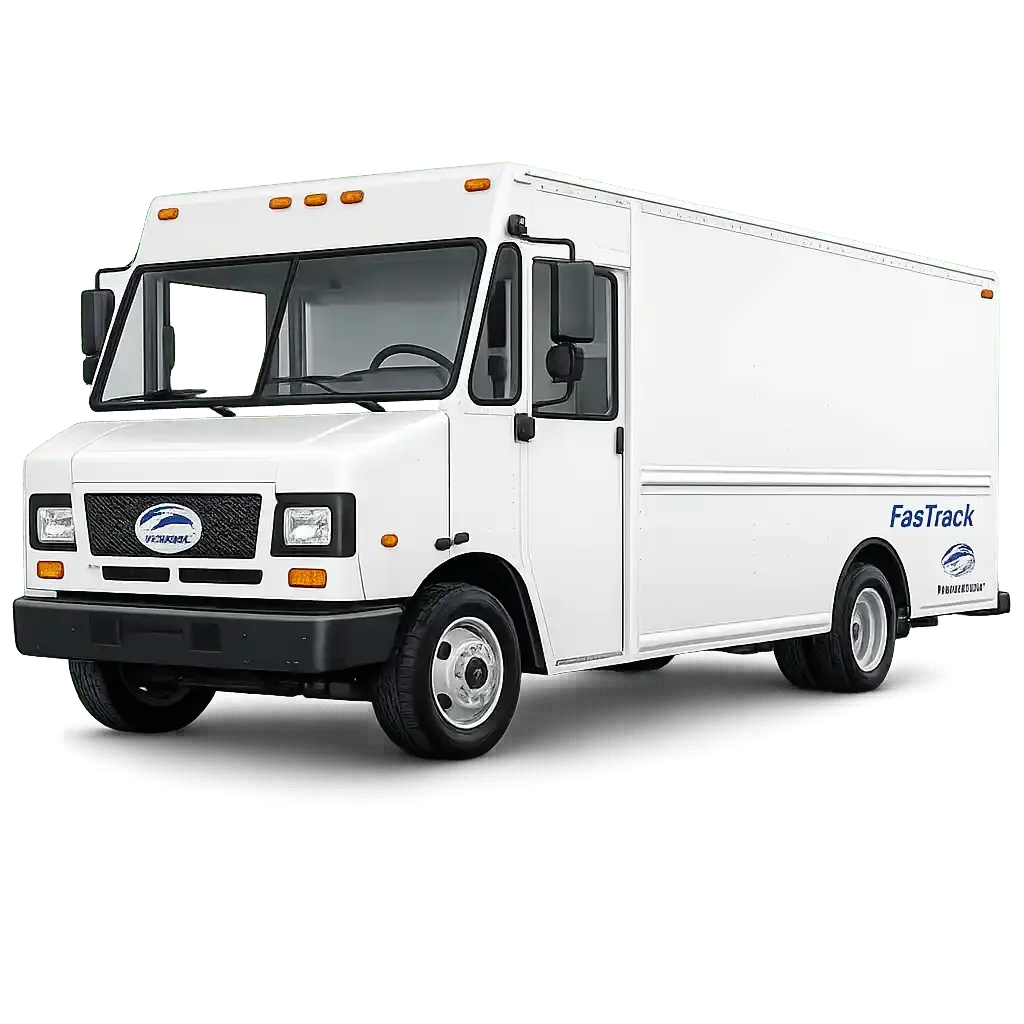
The Workhorse FasTrack is not a single vehicle. It is a lineup of pre-configured commercial walk-in step vans built by Workhorse Custom Chassis in Union City, Indiana, on the P42 stripped chassis platform. Between 2000 and 2005, Workhorse sold the FasTrack in at least twelve model designations: FT931, FT1061, FT1260, FT1261, FT1460, FT1461, FT1600, FT1601, FT1800, FT1801, and FT1802. Every single one of these shares the same basic chassis, the same GM Vortec V8 engine family, and the same automatic transmission. The model numbers encode body length and weight rating, not different platforms.
This matters for parts sellers because aftermarket databases list each of these as a separate vehicle, which makes it look like you need twelve different fitment strategies. You do not. You need one strategy with a handful of splits based on body length, wheelbase, GVWR, model year generation, and front suspension type. This guide explains what every FasTrack model number means, what actually differs between them, and where the real fitment traps hide.
What the FasTrack program was
The FasTrack program was Workhorse's answer to a specific market problem. Fleet buyers who needed commercial walk-in step vans (the kind used by delivery companies, laundry services, mobile tool sales, newspaper delivery, and similar operations) traditionally had to order a stripped chassis from one manufacturer and a cargo body from a separate body builder. This meant two orders, two lead times, two warranties, and a complicated specification process.
Workhorse created FasTrack as a one-stop program: chassis and body together, one order, one warranty, one phone number for service, and popular configurations kept in dealer stock for quick delivery. The idea was to make buying a walk-in truck as simple as buying a cargo van. Each FasTrack model number represented a specific combination of body length, wheelbase, and GVWR that Workhorse had pre-engineered and could build quickly.
The program launched around 2000 on the P42 commercial chassis. In 2007, Workhorse relaunched FasTrack on the newer W42 chassis with Utilimaster bodies, which is a completely different platform. This guide covers only the 2000-2005 P42-based FasTrack models.
Decoding the FasTrack model numbers
Every FasTrack model number follows a pattern: "FT" followed by digits that indicate the approximate cargo body length and a generation/configuration suffix. Once you understand this system, the entire lineup stops being confusing:
FT931: The shortest configuration. 9-foot class body. Available 2002-2003.
FT1061: Single-rear-wheel (SRW) configuration with a 10-foot class body. 125-inch wheelbase. 9,600-pound GVWR. Independent front suspension. This was the lightest model in the lineup, designed to provide walk-in cargo access in something closer to a light truck footprint. Available 2002-2005.
FT1260 and FT1261: 12-foot class body. 133-inch wheelbase. FT1260 is the earlier generation (2000-2001). FT1261 is the updated generation (2002-2005).
FT1460 and FT1461: 14-foot class body. FT1460 is the earlier generation (2000-2002). FT1461 is the updated generation (2002-2005).
FT1600 and FT1601: 16-foot class body. 157-inch wheelbase. FT1600 is the earlier generation (2000-2001). FT1601 is the updated generation (2002-2005).
FT1800, FT1801, and FT1802: 18-foot class body. 178-inch wheelbase. FT1800 is the earlier generation (2000-2001). FT1801 is the updated generation (2002-2005). FT1802 is an additional configuration variant (2002-2003).
The pattern: The first two digits after "FT" tell you the approximate body length in feet (10, 12, 14, 16, 18). A "60" or "00" suffix indicates the first-generation build (2000-2001 production). A "61" or "01" suffix indicates the second-generation build (2002-2005 production). The FT1802 and FT931 are additional configurations that do not fit the pattern as cleanly but follow the same chassis and powertrain architecture.
GVWR range across the lineup: Models ranged from approximately 9,600 pounds (FT1061 SRW) up to 14,000 pounds for the heavier dual-rear-wheel configurations. The lighter-GVWR models (around 10,000 pounds) used independent front suspension with coil springs. The heavier models (around 14,000 pounds) used an I-beam front axle.
What is shared across every FasTrack model
This is the critical information for catalog teams. The following components are the same (or use the same part numbers) across all twelve FasTrack models regardless of body length:
Engine: All 2000-2005 FasTrack models use GM Vortec V8 gasoline engines. The primary engine for the P42-based FasTrack is the GM L31 5.7L (350 cubic inch) V8, producing approximately 255 hp. Some later models (2004-2005) may also have been available with the GM Vortec 4800 (4.8L/LR4) V8. Confirm engine displacement by VIN or engine stamp, but the vast majority of these trucks have the 5.7L.
Transmission: 4-speed automatic (GM 4L80-E family).
Fuel system: Multi-port fuel injection. Throttle body, injectors, fuel rail, fuel pressure regulator, and associated sensors are shared across the lineup for a given engine displacement.
Ignition system: Distributor, ignition coil, spark plugs, plug wires all cross-list across models for a given engine.
Cooling system: Radiator, water pump, thermostat, thermostat housing, heater core, heater hoses, and cooling fans are shared for a given engine.
Electrical system: Alternator, starter motor, battery, ignition switch, and most engine-related sensors cross-list across all FasTrack models.
Steering gear: Power steering pump, steering gear box, and steering column components are shared across models with the same front suspension type (see the front suspension split below).
Rear axle: Differential, axle shafts, bearings, and seals are shared within the same GVWR class and wheel configuration (SRW versus DRW).
Engine accessories: Oil filter, air filter, PCV valve, serpentine belt, belt tensioner, idler pulley, and oil cooler components cross-list.
In practical terms, if a customer needs spark plugs, an alternator, a water pump, an oil filter, a starter, or any internal engine component for any FasTrack model, the part number is the same across the entire lineup for a given engine. This is important because it means you can build one master listing for engine, ignition, fuel, cooling, and electrical parts and apply it to all twelve FasTrack models.
The four real fitment splits
Despite sharing a platform and powertrain, the FasTrack lineup has four meaningful fitment splits that catalog teams must track:
Split 1: Generation (first-generation versus second-generation)
The "60/00" suffix models (FT1260, FT1460, FT1600, FT1800) were built from 2000 to approximately 2001. The "61/01" suffix models (FT1061, FT1261, FT1461, FT1601, FT1801) were built from approximately 2002 to 2005. The FT1802 and FT931 overlap this boundary.
Parts that may differ between generations:
Instrument cluster and dashboard components (minor revisions)
Chassis wiring harness (updated connectors and routing)
Emissions components (updated for compliance year changes)
Some engine accessories if the engine sub-variant changed (for example, updated PCV system; there is a TSB referencing PCV operation and oil consumption risk on the LR4 4.8L engine, TSB PIP4492K)
For most mechanical parts (engine internals, transmission, brakes, suspension), the generation split does not create a fitment difference. For electrical, emissions, and interior components, confirm the model year and model number.
Split 2: Front suspension type
This is the most important chassis-level split in the FasTrack lineup:
Independent front suspension (IFS) with coil springs: Used on lighter-GVWR models (approximately 10,000 pounds and under), including the FT1061.
I-beam front axle: Used on heavier-GVWR models (approximately 14,000 pounds).
Parts affected by the front suspension split:
Front coil springs or leaf springs (completely different)
Front shock absorbers (different mounting, different specification)
Upper and lower control arms (IFS only, do not exist on I-beam)
King pins or ball joints (different between IFS and I-beam)
Steering knuckles
Tie rod assemblies and drag links
Front wheel bearings and hubs
Sway bar and links
Front brake calipers and rotors (may differ in size between GVWR ratings)
Rule: For any front suspension, steering, or front brake component, require the buyer to confirm whether they have independent front suspension or an I-beam front axle. Model number alone is not enough because GVWR options within the same body length can determine which suspension was installed.
Split 3: Wheelbase and body length
The wheelbase determines the length of every component that runs the length of the chassis:
125-inch wheelbase (FT1061)
133-inch wheelbase (FT1260, FT1261)
157-inch wheelbase (FT1600, FT1601)
178-inch wheelbase (FT1800, FT1801, FT1802)
The FT1460 and FT1461 (14-foot body) fall between the 133-inch and 157-inch options depending on configuration.
Parts affected by wheelbase:
Driveshaft/propeller shaft (different length for every wheelbase)
Brake lines (routed along the frame, length varies)
Fuel lines (length varies)
Parking brake cables (length varies)
Exhaust system (tail pipe length and routing vary)
Chassis wiring harness (different lengths)
Frame rails (different lengths)
Rule: For any length-dependent part, require the buyer to confirm body length or wheelbase. A driveshaft for an FT1061 (125-inch wheelbase) will not fit an FT1801 (178-inch wheelbase). This seems obvious, but when a database lists all twelve models as eligible for the same driveshaft, mistakes happen.
Split 4: GVWR and wheel configuration
The GVWR determines brake specification, spring rates, axle ratings, and wheel/tire size:
Lighter models (approximately 9,600-10,000 pounds GVWR): Single rear wheels (SRW) on the FT1061. Standard-duty brakes, lighter spring rates, standard wheel and tire sizes.
Heavier models (approximately 14,000-14,500 pounds GVWR): Dual rear wheels (DRW) on larger body configurations. Heavy-duty brakes, heavier spring rates, larger wheel and tire sizes.
Parts affected by GVWR:
Rear brake drums or rotors (size varies by GVWR)
Rear brake shoes or pads
Rear springs (different rate and number of leaves)
Rear shock absorbers
Wheel studs and lug nuts (SRW versus DRW)
Wheels (single versus dual)
Tires (different load rating)
Axle shaft and bearing specifications
Rule: Require GVWR or confirmation of single rear wheel versus dual rear wheel for any brake, spring, axle, wheel, or tire component.
How to list FasTrack parts efficiently
Because the twelve model numbers share so much, the most efficient catalog strategy is to build three tiers of listings:
Tier 1 (universal across all FasTrack models for a given engine): Engine internals, gaskets, timing components, oil pump, water pump, thermostat, spark plugs, plug wires, ignition coil, distributor, alternator, starter, oil filter, air filter, PCV valve, fuel injectors, fuel pressure regulator, throttle body gasket, exhaust manifold gaskets, transmission filter, transmission pan gasket, and most engine sensors. List all twelve FasTrack models plus the Workhorse P42 and P30 under the same part number.
Tier 2 (split by front suspension type and/or GVWR): Front suspension components, steering components, front brake components, rear brake components, rear springs, rear shocks. Require confirmation of IFS versus I-beam and GVWR/wheel configuration.
Tier 3 (split by wheelbase/body length): Driveshaft, brake lines, fuel lines, exhaust tail pipe, parking brake cables, chassis wiring harness, frame rails. Require specific model number or wheelbase measurement.
The P42 connection
Every FasTrack model from 2000 to 2005 is built on the Workhorse P42 commercial step van chassis. The P42 is the commercial counterpart to the P32 motorhome chassis. In many aftermarket databases, FasTrack models are listed separately from the P42, even though they are the same chassis with a pre-installed cargo body.
This creates a duplication problem: a parts supplier may have one listing for "Workhorse P42" and twelve separate listings for each FasTrack model, all pointing to the same part number. Or worse, the P42 listing may show different year coverage than the FasTrack listings, making it look like they are different vehicles.
For catalog cleanup purposes, you can treat FasTrack FT-series and Workhorse P42 as the same chassis for all powertrain, engine, transmission, and most chassis components. The only place they might differ is in body-specific parts (cargo box panels, cargo doors, cargo lighting, step bumpers, body mounts), which are determined by the body builder rather than the chassis.
Critical cross-reference note: Many parts databases also list these parts under "Workhorse P30," "Chevrolet P30," or even "GMC P3500" because the P42 chassis descends from the GM P-series family. The 5.7L engine used in the FasTrack/P42 is the same GM L31 used in numerous Chevrolet and GMC trucks, vans, and SUVs from the 1990s and 2000s. Engine-specific parts can often be cross-referenced to a Chevrolet truck with the same 5.7L engine for broader parts availability.
The biggest return traps on the FasTrack
1. Ordering the wrong driveshaft because the database shows "fits all FasTrack models"
Why it gets returned: Driveshaft length is determined by wheelbase. The FT1061 has a 125-inch wheelbase. The FT1801 has a 178-inch wheelbase. That is a 53-inch difference. No single driveshaft fits both.
How to stop returns: Require the specific FasTrack model number (which encodes body length and approximate wheelbase) or the wheelbase measurement directly. Add a buyer prompt: "Confirm your FasTrack model number or wheelbase measurement."
2. Front suspension parts crossing between IFS and I-beam models
Why they get returned: The FT1061 at 9,600 pounds GVWR has independent front suspension. A heavier FT1801 at 14,000 pounds GVWR has an I-beam front axle. These are completely different suspension architectures. Control arms do not exist on an I-beam chassis. King pins do not exist on an IFS chassis.
How to stop returns: Require front suspension type confirmation. Add a buyer prompt: "Does your FasTrack have independent front suspension with coil springs, or a straight I-beam front axle?"
3. Mixing FasTrack (P42 commercial) with P32 motorhome parts
Why they get returned: The FasTrack P42 commercial chassis uses the 5.7L V8. The Workhorse P32 motorhome chassis uses the 7.4L or 8.1L V8. These are different engines. A parts counter person who sees "Workhorse" in the database may pull up a P32 part for a FasTrack customer. The exhaust manifold, intake manifold, cylinder heads, fuel system, ignition system, and nearly every engine-specific component will be wrong.
How to stop returns: Confirm engine displacement on every order. If the customer says 5.7L, they have a P42/FasTrack commercial chassis. If they say 7.4L or 8.1L, they have a P32 motorhome chassis. Never list these under the same fitment.
4. Brake parts shipped for the wrong GVWR
Why they get returned: Lighter FasTrack models and heavier FasTrack models use different brake specifications (rotor size, drum size, pad compound, shoe width). A brake rotor for a 10,000-pound FasTrack may not match a 14,000-pound FasTrack even though they share the same chassis family.
How to stop returns: Require GVWR and wheel configuration (SRW or DRW) for all brake component orders. Add a buyer prompt: "Confirm GVWR from the certification label and whether your truck has single rear wheels or dual rear wheels."
5. Confusing the 2000-2005 P42-based FasTrack with the 2007+ W42-based FasTrack
Why it gets returned: In 2007, Workhorse relaunched the FasTrack program on the completely new W42 chassis with Utilimaster bodies. The W42 uses different engines (4.8L or 6.0L GM Vortec), a different frame, different suspension (parabolic leaf springs front and rear), different brakes (Brembo four-wheel disc with Meritor WABCO ABS), and different everything. The two generations of FasTrack share a name but share almost no parts.
How to stop returns: Confirm model year. If 2000-2005, it is a P42-based FasTrack. If 2007 or later, it is a W42-based FasTrack. Never list across this boundary for any part.
6. Engine parts listed without confirming 5.7L versus 4.8L
Why they get returned: While the 5.7L (350) L31 was the primary engine, some later FasTrack models (2004-2005) were available with the 4.8L (LR4) Vortec V8. These are completely different engine families: the 5.7L is an older-generation pushrod V8 with a specific bore and stroke, while the 4.8L is a Gen III architecture engine with different heads, different intake, different exhaust manifolds, different sensors, different oil pan, and different accessories.
How to stop returns: Require engine displacement confirmation on all engine, fuel, exhaust, and ignition parts. Add a buyer prompt: "Confirm engine size: 5.7L or 4.8L."
A clean FasTrack fitment rules block
Required attributes for FasTrack parts listings:
Model year (2000-2005 for P42-based, 2007+ for W42-based)
FasTrack model number (FT931, FT1061, FT1260, FT1261, FT1460, FT1461, FT1600, FT1601, FT1800, FT1801, FT1802)
Engine displacement: 5.7L (L31) or 4.8L (LR4)
Front suspension type: independent (IFS with coil springs) or I-beam
GVWR (from certification label)
Wheel configuration: single rear wheel (SRW) or dual rear wheel (DRW)
Wheelbase (for length-dependent parts): 125, 133, 157, or 178 inches
Buyer confirmation prompts:
Engine parts: "Confirm engine size: 5.7L or 4.8L"
Front suspension/steering/front brakes: "Confirm independent front suspension or I-beam front axle"
Rear brakes/springs/axle: "Confirm GVWR and SRW or DRW"
Driveshaft/brake lines/exhaust/cables: "Confirm FasTrack model number or wheelbase"
All parts: "Confirm model year (2000-2005 P42 chassis or 2007+ W42 chassis)"
Quick identification guide for buyers
Tell readers to gather these items before shopping:
VIN number (Workhorse FasTrack VINs begin with "5B4")
Model year from registration or title
FasTrack model number from the data plate or documentation (FT followed by numbers)
Engine size: look for "5.7L" or "4.8L" on engine cover or in documentation
GVWR from the certification label (typically on the driver's door jamb or frame)
Wheelbase from documentation or direct measurement
Photo of the front suspension (coil springs with A-arms = IFS, straight beam = I-beam)
Confirmation of single rear wheels or dual rear wheels (look at the rear axle)
If the buyer can provide the FasTrack model number and engine size, you can fill in most of the other attributes from the model number decode. If they cannot provide even the model number, direct them to the data plate, which is typically located on the inner wall to the left of the driver's seat.
Parts sourcing notes
The FasTrack's GM powertrain means engine and transmission parts remain widely available:
The 5.7L L31 engine is one of the most common GM V8s ever produced. Parts are available from GM dealers, AC Delco, and every major aftermarket brand. Cross-reference to any 1996-2002 Chevrolet truck with the 5.7L Vortec for the broadest selection.
The 4.8L LR4 (if equipped) is a Gen III architecture engine shared with the Chevrolet Silverado 1500 and GMC Sierra 1500. Parts are equally abundant.
The 4L80-E transmission is a well-supported unit with rebuild kits, torque converters, and individual components available from multiple suppliers.
Chassis-specific parts (frame rails, body mounts, cargo body panels, cargo doors) are harder to source and may require Workhorse specialty suppliers or salvage inventory.
The primary dedicated source for Workhorse-specific chassis parts is Ultra RV Products (workhorseparts.com), which stocks P42 components.
Brake and suspension components can often be cross-referenced through the P42 listing if the specific FasTrack model number does not appear in a given database.
Complete FasTrack model quick reference
FT931: 9-foot class body. 2002-2003. 5.7L V8.
FT1061: 10-foot class body. SRW. 125-inch wheelbase. 9,600-lb GVWR. IFS. 2002-2005. 5.7L V8 (4.8L available 2004-2005).
FT1260: 12-foot class body. 133-inch wheelbase. 2000-2001. 5.7L V8.
FT1261: 12-foot class body. 133-inch wheelbase. 2002-2005. 5.7L V8 (4.8L available 2004-2005).
FT1460: 14-foot class body. 2000-2002. 5.7L V8.
FT1461: 14-foot class body. 2002-2005. 5.7L V8 (4.8L available 2004-2005).
FT1600: 16-foot class body. 157-inch wheelbase. 2000-2001. 5.7L V8.
FT1601: 16-foot class body. 157-inch wheelbase. 2002-2005. 5.7L V8 (4.8L available 2004-2005).
FT1800: 18-foot class body. 178-inch wheelbase. 2000-2001. 5.7L V8.
FT1801: 18-foot class body. 178-inch wheelbase. 2002-2005. 5.7L V8 (4.8L available 2004-2005).
FT1802: 18-foot class body. 178-inch wheelbase. 2002-2003. 5.7L V8. Additional configuration variant.
Bottom line
Twelve model numbers, one platform. The Workhorse FasTrack FT-series is a lineup of pre-configured walk-in step vans that share the same P42 chassis, the same GM V8 engine, and the same automatic transmission. The model number encodes body length and generation, not a different vehicle.
Build your engine, ignition, fuel, cooling, electrical, and transmission listings once and apply them across all twelve models. Split your suspension listings by front suspension type (IFS versus I-beam). Split your brake listings by GVWR. Split your driveshaft, brake lines, and exhaust listings by wheelbase. And never cross the 2005/2007 boundary between the P42-based FasTrack and the W42-based FasTrack relaunch.
Do that, and twelve confusing model numbers become one straightforward catalog strategy.
Disclaimer: This guide is based on publicly available specifications, Workhorse press materials, and independent research. Part interchangeability should always be confirmed via VINand OEM part number lookup. Specifications may change without notice. This document does not constitute official Workhorse parts catalog data. Visuals and illustrations in this article were generated using AI for representative purposes and may not reflect exact technical schematics.