
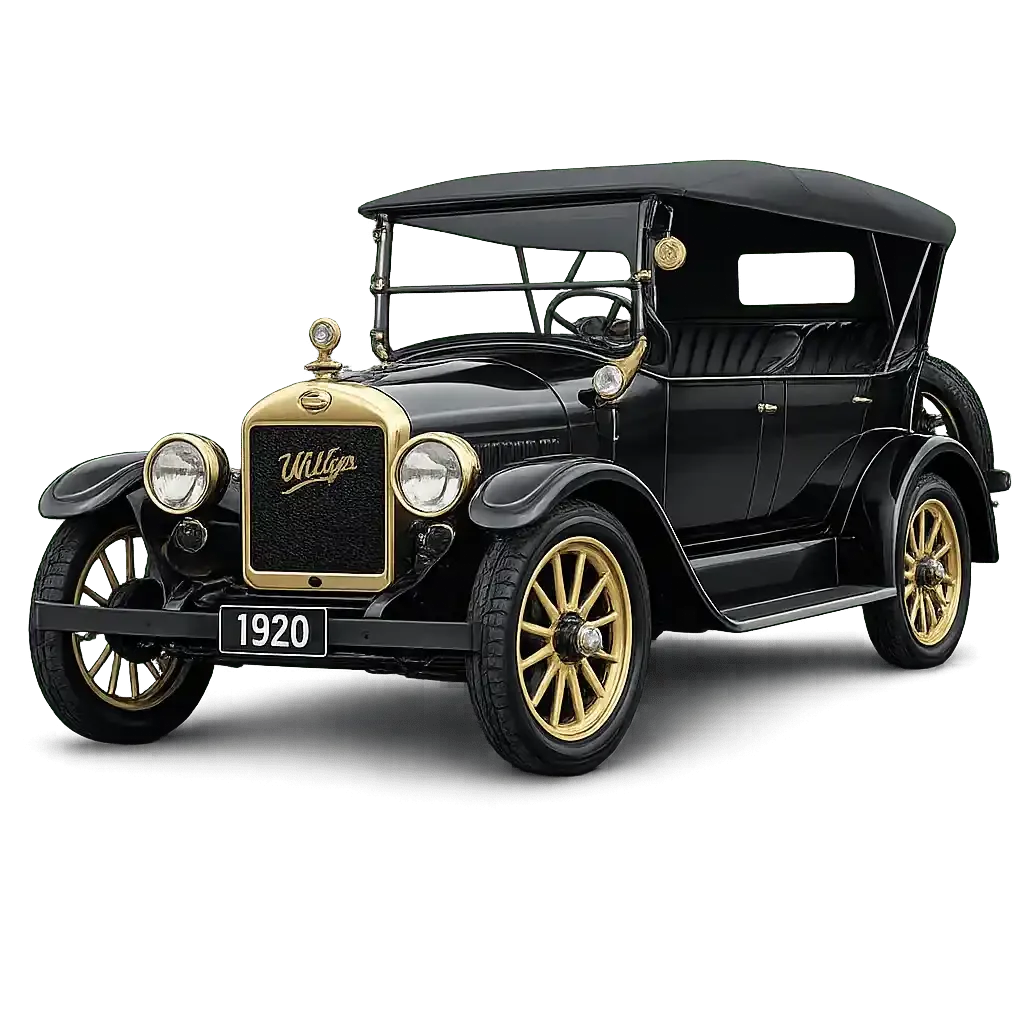
Selling parts for pre-war Willys-Overland vehicles? You need to understand the brand hierarchy, the engine type splits, and the chassis changes that ran across four overlapping nameplates. Get it wrong and you are shipping the wrong gaskets, bearings, or brake components to a restorer who knows his Model 96 from his Model 98. This guide breaks down every major fitment split from 1911 through 1933 so you can list accurately and stop preventable returns.
Brand and Platform Background
Willys-Overland was not one car line. It was an empire of overlapping brands, all built in Toledo, Ohio, under the direction of John North Willys. Between 1911 and 1933, the company operated four distinct passenger car nameplates, plus a companion brand, and each carried its own chassis dimensions, engine architecture, and parts catalog.
Here is what you are actually dealing with:
Overland (1902-1926): The bread-and-butter line. Budget four-cylinder cars on 100-inch wheelbases through the early 1920s, with a six-cylinder Model 93 added in 1925. This is the nameplate that made Willys the second-largest automaker behind Ford from 1912 to 1918.
Willys-Knight (1914-1933): The premium line. Distinguished by its Knight sleeve-valve engine, which used sliding sleeves instead of poppet valves. Built in four-cylinder, six-cylinder, and briefly V8 configurations. Multiple sub-series ran simultaneously at different price points and wheelbases.
Whippet (1926-1931): The Overland replacement. Lighter, more modern, and sold as a distinct brand. Available in both four-cylinder (Model 96 family) and six-cylinder (Model 93A/98 family) versions.
Willys Six and Eight (1930-1933): The Whippet successors that dropped the Whippet name and transitioned toward the Depression-era Willys 77.
Falcon-Knight (1927-1929): A companion brand sharing the Whippet six-cylinder chassis but fitted with a smaller Knight sleeve-valve engine. Shares significant chassis and body parts with the Whippet 93A and Willys-Knight 56.
Every one of these lines had its own model numbering system, and some shared chassis components while others did not. The engine type (poppet valve vs. sleeve valve) is the single most important fitment split across the entire range.
Complete Model, Year, and Chassis Breakdown
Overland Models (1911-1926)
1911-1913 Era: Expanding Lineup
Model 38 (1910-1911): First Toledo-built Overland, 4-cylinder, sliding gear transmission
Model 45 (1911): Torpedo roadster variant
Model 59T (1912): Mid-range touring
Model 61 (1912): Larger touring, multiple body styles
Model 69 (1912-1913): Economy four-cylinder
Model 71 (1913): Torpedo-bodied roadster
1914-1918 Era: Peak Production
Model 79 (1914): Includes the rare 79-S Speedster (estimated fewer than 50 built)
Model 80 (1915): Four-cylinder touring
Model 81 (1915): Four-cylinder, commercial-oriented variant
Model 82 (1915): Six-cylinder model
Model 83 / 83B (1916): Four-cylinder, delivery car variants available
Model 84 (1916): Light car
Model 85-4 / 85-4B (1917-1918): Four-cylinder, 100-inch wheelbase
Model 85-6 (1917-1918): Six-cylinder variant
Model 86 (1916-1917): Six-cylinder
Model 88-4 / 88-6 (1917-1918): Four and six-cylinder options
Model 89-6 (1918): Six-cylinder
Model 90 / 90B (1917-1919): Light Four, 100-inch wheelbase, Triplex cantilever spring system
1920-1926 Era: The Overland Four and Six
Model 4 / 4A (1920-1922): Four-cylinder, 100-inch wheelbase
Model 91 / 91A (1922-1925): Four-cylinder, 100-inch wheelbase
Model 92 "Bird Series" (1923-1925): Four-cylinder, 106-inch wheelbase (Red Bird, Blue Bird, Black Bird variants by body color)
Model 93 "Overland Six" (1925-1926): Six-cylinder, 112.75-inch wheelbase. The last Overland before the Whippet transition.
Combined production of Models 4, 4A, 91, 91A, and 92 from August 1919 through May 1926 reached approximately 642,000 units. All used the Triplex three-point cantilever spring system.
Willys-Knight Models (1914-1933)
All Willys-Knight vehicles use the Knight sleeve-valve engine. This is the defining fitment characteristic. No poppet-valve engine components interchange with these vehicles.
1914-1925: The Four-Cylinder Era
Model K (1914-1915): Original four-cylinder sleeve-valve, 114-inch wheelbase, $2,500 price range
Model 84 (1915): Four-cylinder Knight
Model 88-4 (1916-1917): Four-cylinder Knight
Model 88-8 / V8 (1917-1919): Sleeve-valve V8, 120-inch wheelbase, 286 cubic inches, 65 hp. Built for only three model years. Extremely rare.
Model T (mid-1920s): Four-cylinder continuation
Model 64 (1923): Four-cylinder, 118-inch wheelbase
Model 67 (1923): Four-cylinder
1925-1933: The Six-Cylinder Era
After 1925, the Willys-Knight transitioned primarily to inline sixes. Multiple sub-series ran at the same time, organized by size and price:
Light Six (lower cost, shorter wheelbase):
Model 70 (1926): 113-inch wheelbase, 177.9 cu in, 53 hp sleeve-valve six
Model 70A "Special Six" (1927-1929): 113-inch wheelbase, 53 hp
Model 70B (1929-1930): 113-inch wheelbase, updated Light Six
Model 87 (1930): Light Six continuation, shared parts list with 70B
Model 95 (1931-1932): Final Light Six series
Standard Six (mid-range):
Model 56 (1928-1929): 109.5-inch wheelbase, sleeve-valve six, 45 hp. Shares significant chassis dimensions with the Whippet 98 and Falcon-Knight.
Great Six (premium, longer wheelbase):
Model 66 (1926): 126-inch wheelbase, 237 cu in, 60 hp sleeve-valve six
Model 66A (1927-1929): 126-inch and 135-inch wheelbase options, 70 hp, 255 cu in
Model 66B (1929-1930): 120-inch wheelbase, 87 hp, 255 cu in
Model 66D (1931-1932): Great Six continuation
Model 66E "Streamline Six" (1932-1933): Final Willys-Knight, 121-inch wheelbase, 255 cu in, 87 hp. Last sleeve-valve car produced in the United States. Production ended November 1932.
Whippet Models (1926-1931)
Four-Cylinder (Model 96 Family):
Model 96 (1926-1928): 100.6-inch wheelbase, 134.2 cu in four-cylinder, 30 hp, four-wheel brakes. Production ended December 1928.
Model 96A (1929-1931): 103.5-inch wheelbase (slightly longer than 96), improved engine with 3/8-inch longer stroke, claimed 60+ mph top speed. Second series (September 1930) had restyled hood resembling Willys Six.
Six-Cylinder (Model 93A/98 Family):
Model 93A (1927-1928): 109.25-inch wheelbase (shortened from the Overland 93's 112.75-inch), 40 hp six-cylinder. The lowest-priced six with four-wheel brakes at introduction.
Model 98 (1928-1929): Replaced 93A, same general platform
Model 98A (1929-1930): Updated six-cylinder Whippet
Willys Six and Eight (1930-1933)
These replaced the Whippet name as the Depression set in:
Model 98B "Willys Six" (1930): 110-inch wheelbase, 193 cu in L-head six, 65 hp. Essentially the Whippet evolved into a Willys-branded car.
Model 97 "Willys Six" (1931): 113-inch wheelbase (some sources say 110-inch), 193 cu in L-head six
Model 97A (1931): Sport Coupe variant of the 97
Model 98D "Willys Six" (1931): 121-inch wheelbase, same 193 cu in engine as Model 97
Model 6-90 "Willys Six" / "Silver Streak" (1932): Replaced 98D on the long wheelbase
Model 79 "Willys Six" (1933): Final six-cylinder, then discontinued in favor of the four-cylinder Willys 77.
Willys Eight:
Model 8-80 (1930-1931): 120-inch wheelbase, Continental 14W L-head straight-eight, 245.4 cu in. Introduced April 1930.
Model 8-80D (1931): Updated Eight
Model 8-88A (1932-1933): Final Willys Eight series. Lasted only two seasons total before being dropped.
Falcon-Knight (1927-1929)
Model 10 (1927-1928): 109.25-inch wheelbase, six-cylinder sleeve-valve engine (same as Willys-Knight 56)
Model 12 (1928-1929): Updated Falcon-Knight
The Falcon-Knight chassis matches the Whippet 93A except for the engine (sleeve-valve vs. poppet-valve) and the brake configuration (three-shoe internal brakes all around vs. the Whippet's mixed setup).
Step-by-Step Fitment Splits
Split 1: Engine Type (Poppet Valve vs. Sleeve Valve)
This is the first question you must answer for every part.
Poppet-valve (conventional) engines:
All Overland models (1911-1926)
All Whippet models (1926-1931)
Willys Six models 98B, 97, 98D, 6-90, 79 (1930-1933)
Willys Eight models 8-80, 8-80D, 8-88A (1930-1933)
Knight sleeve-valve engines:
All Willys-Knight models (1914-1933)
All Falcon-Knight models (1927-1929)
Gaskets, valvetrain components, cylinder head parts, manifolds, and internal engine hardware do not cross between these two engine families. Period.
Split 2: Cylinder Count
Within each engine type, you must split by cylinder count:
Four-cylinder poppet-valve: All Overland fours (Models 4, 4A, 91, 91A, 92, 79, 80, 81, 83, 84, 85-4, 88-4, 90), Whippet 96 and 96A
Six-cylinder poppet-valve: Overland Six (Model 93), Whippet 93A/98/98A, Willys Six (98B, 97, 98D, 6-90, 79)
Eight-cylinder poppet-valve: Willys Eight (8-80, 8-80D, 8-88A) using a Continental-supplied L-head straight-eight
Four-cylinder sleeve-valve: Early Willys-Knight (1914-1925), Models K, 64, 67, and T-series
Six-cylinder sleeve-valve: Later Willys-Knight (1925-1933), Models 70/70A/70B/87/95 (Light Six), Model 56 (Standard Six), Models 66/66A/66B/66D/66E (Great Six), plus Falcon-Knight Models 10 and 12
V8 sleeve-valve: Willys-Knight 88-8 (1917-1919) only. 286 cu in, two main bearings, single eccentric shaft. A unique configuration with essentially zero parts crossover to any other Willys engine.
Split 3: Wheelbase Groups
Wheelbase determines frame rails, driveshaft length, brake lines, and body fitment. Group your listings carefully:
~100-inch group: Overland fours (Models 4, 4A, 91, 91A: 100-inch), Whippet 96 (100.6-inch), Whippet 96A (103.5-inch, close but not identical)
~106-109-inch group: Overland Model 92 (106-inch), Whippet 93A (109.25-inch), Whippet 98/98A (109.25-inch), Willys-Knight 56 (109.5-inch), Falcon-Knight (109.25-inch)
~110-113-inch group: Willys Six 98B (110-inch), Willys Six 97 (113-inch), Willys-Knight Light Six 70/70A/70B/87 (113-inch), Overland Six 93 (112.75-inch)
~118-121-inch group: Willys-Knight 64 (118-inch), Willys Six 98D (121-inch), Willys-Knight 66B (120-inch), Willys-Knight 66E (121-inch), Willys Eight 8-80 (120-inch)
~126-135-inch group: Willys-Knight Great Six 66/66A (126-inch standard, 135-inch limousine)
Split 4: Brake System Configuration
Brake hardware is model-specific and year-sensitive:
Pre-1926 Overlands: Rear-wheel brakes only (two-wheel braking)
Whippet 96 (1926-1928): Four-wheel brakes, three-shoe front internal, two-shoe rear external
Whippet 93A: Four-wheel brakes, three-shoe front internal, two-shoe rear external (changed to all internal later in production)
Whippet 96A (1929-1931): Cable-controlled four-wheel brakes, updated configuration
Whippet 98/98A: Different distributor and brake configuration from 93A despite shared platform
Willys-Knight 70/70A/70B: Own brake setup, non-interchangeable adjustment hardware with Whippet despite similar wheelbase
Willys-Knight 66/66A: Bijur chassis lubrication system on Great Six, Bendix brakes on later 66B
Split 5: Electrical System Generation
1911-1914 models: Magneto ignition (Dixie magneto on many models), no electric starter
1915-1919 models: Transition to electric lighting and starting, Auto-Lite systems introduced
1920s models: Auto-Lite ignition standard across the range, but distributor caps and components vary by model. The Whippet 93A uses Auto-Lite IG 1323 distributor cap (also used by Nash 1925-28 and Hupmobile 1926-34). The Whippet 98, 98A, and Willys 98B use a different distributor, and the cap is NOT interchangeable with the 93A.
Late 1920s-1930s: Finger Tip Control system (steering wheel button for horn, lights, and starter) introduced on 1929 models including Whippet 96A and Willys-Knight 70-B. The Electrolock switch system is a separate electrical component requiring its own documentation.
Split 6: Spring System
Overland Models 4, 4A, 91, 91A, 92 (1920-1926): Triplex three-point cantilever spring system with two quarter-elliptic springs at both front and rear. Unique to this generation. Do not confuse with conventional semi-elliptic setups.
Whippet 96: Conventional semi-elliptic springs, front 34.5 inches, rear 51.75 inches
Whippet 93A: Slightly longer springs than 96 (front 34.5 inches, rear 51.75 inches)
Late production 93A units: Tryon spring shackles replaced earlier conventional shackles starting at specific serial numbers
Biggest Return Traps
Trap 1: Mixing Poppet-Valve and Sleeve-Valve Engine Parts
Why they get returned: A buyer searches "1928 Willys six-cylinder head gasket" and the listing does not specify engine type. The Willys-Knight Model 70A (sleeve-valve) and the Whippet 93A (poppet-valve) are both 1928, both six-cylinder, and both made by Willys-Overland. The gaskets are completely different. The cylinder head design is completely different. Nothing interchanges.
How to stop returns: Always list the engine type (poppet-valve or sleeve-valve) as a primary fitment attribute. If you are selling for a Willys-Knight or Falcon-Knight, state "sleeve-valve engine" in the title. If you are selling for an Overland, Whippet, or Willys Six/Eight, state "conventional poppet-valve engine" in the listing. Never list a part as fitting "Willys 6-cylinder" without specifying which engine architecture.
Trap 2: Whippet 93A Distributor Cap Cross-Listed with Whippet 98
Why they get returned: The Whippet 93A and Whippet 98 are both Whippet sixes and look nearly identical externally. Sellers assume the ignition parts interchange. They do not. The 93A uses the Auto-Lite IG 1323 distributor cap. The 98 and 98A use a different distributor entirely. The cap is not interchangeable.
How to stop returns: List the exact Whippet model number (93A, 98, or 98A) for every electrical component. Cross-reference the Auto-Lite part number when available. Note the known cross-application (Nash 1925-28, Hupmobile 1926-34) for the 93A cap to help buyers confirm.
Trap 3: Willys-Knight 56 Parts Listed as "Whippet" or Vice Versa
Why they get returned: The Willys-Knight Model 56, the Whippet 98, and the Falcon-Knight all share the same 109-inch wheelbase and significant chassis components. Sellers list body panels or chassis parts as "Whippet" when they actually came from (or fit) a Willys-Knight 56 or Falcon-Knight. The engine-related parts (manifolds, engine mounts, cooling components) are model-specific because the sleeve-valve engine has different physical dimensions and mounting points than the poppet-valve Whippet six.
How to stop returns: When listing chassis, suspension, or body parts for any of these three models, note the known crossover (WK-56 / Whippet 98 / Falcon-Knight chassis interchange). When listing engine-adjacent parts, list only the specific model. State whether the part is engine-side or chassis-side.
Trap 4: Overland "Bird Series" Model 92 Parts Listed as Model 91
Why they get returned: The Model 91/91A and Model 92 are both Overland Fours from the same era, both use four-cylinder poppet-valve engines, and both use the Triplex cantilever spring system. However, the Model 92 has a 106-inch wheelbase while the 91/91A sits on a 100-inch wheelbase. Frame rails, driveshafts, brake lines, and body panels are different lengths.
How to stop returns: Always include the model number (91, 91A, or 92) and the wheelbase (100-inch or 106-inch). The "Bird Series" name (Red Bird, Blue Bird, Black Bird) only applies to the Model 92. If you see color-specific factory paint references, the part is a Model 92.
Trap 5: Willys-Knight Great Six Wheelbase Confusion Across Years
Why they get returned: The Model 66 Great Six changed wheelbases across its production run. The original Model 66 (1926) sat on a 126-inch wheelbase. The 66A (1927-1929) was available in both 126-inch and 135-inch (limousine) wheelbases. The 66B (1929-1930) dropped to 120 inches. The 66E (1932-1933) used 121 inches. Sellers list a part as fitting "Willys-Knight 66" without specifying which sub-series, and the frame, driveshaft, or body panel does not fit.
How to stop returns: Always list the complete model designation (66, 66A, 66B, 66D, or 66E) along with the wheelbase. Never use just "Model 66" as a catch-all for the entire Great Six line.
Trap 6: Whippet 96 vs. 96A Brake Component Confusion
Why they get returned: The Whippet 96 ended production in December 1928. The 96A started production in October 1928 (for the 1929 model year). During the overlap period, brake system design changed. The 96A used cable-controlled brakes with a different adjustment procedure. A buyer orders brake shoes or adjustment hardware listed generically as "Whippet 4-cylinder" and receives the wrong generation.
How to stop returns: Split all brake listings between Model 96 (1926-1928) and Model 96A (1929-1931). Note the cable-control distinction for the 96A. Reference the specific Bendix brake documentation for each model.
Fitment Rules Block
Required attributes for every Willys-Overland (1911-1933) parts listing:
Brand/nameplate: Overland, Willys-Knight, Whippet, Willys Six, Willys Eight, or Falcon-Knight
Model number: Full designation (e.g., 96A, 70A, 66B, 93A, 98D)
Model year(s)
Engine type: Poppet-valve (conventional) or Knight sleeve-valve
Cylinder count: 4, 6, or 8 (and V8 for 1917-1919 WK 88-8)
Wheelbase: In inches (100, 103.5, 106, 109.25, 110, 113, 118, 120, 121, 126, 135)
Engine displacement (when listing engine-related parts)
Brake system type (when listing brake components): two-wheel rear only, four-wheel mechanical, cable-controlled, Bendix type
Electrical system specifics (when listing ignition/electrical): Magneto or Auto-Lite, distributor model number, Finger Tip Control / Electrolock where applicable
Buyer Confirmation Prompts
Before shipping any part for a 1911-1933 Willys-Overland vehicle, confirm these details with the buyer:
"Which nameplate is your vehicle: Overland, Willys-Knight, Whippet, Willys Six/Eight, or Falcon-Knight?"
"What is the exact model number on your data plate or registration? (Example: 96A, not just 'Whippet')"
"Does your engine use conventional poppet valves or Knight sleeve valves?"
"What is your wheelbase in inches?"
"For brake or electrical parts: What is the chassis serial number range? Mid-production changes on Whippets and Knights were common and tied to specific serial number break points."
"For 1920-1926 Overland Fours: Does your car use the Triplex cantilever spring system or conventional semi-elliptic springs?"
Quick Identification Guide
How to tell what you are looking at:
Overland (1911-1926): Look for "Overland" hub caps and radiator badges. Four-cylinder models predominate. If it has the Triplex cantilever spring system (visible as angled quarter-elliptic springs front and rear), it is a 1920-1926 Model 4/4A/91/91A/92.
Willys-Knight (1914-1933): Look for the Knight sleeve-valve engine. The engine lacks visible valve springs and rocker arms on top. Instead, you will see a smooth cylinder head with no external valvetrain. The "junk head" combustion chamber caps are distinctive. Radiator badges read "Willys-Knight." Premium trim and interior compared to Overland and Whippet.
Whippet (1926-1931): Compact body with European-influenced styling. Early production units (1926-early 1927) may still have Overland hub caps and Overland radiator badges even though they are Whippets. Look for the Whippet radiator badge on later units. Four-cylinder models (96/96A) are more common than six-cylinder (93A/98/98A).
Falcon-Knight (1927-1929): Visually similar to Whippet 93A but with a longer hood and more hood louvres. Sleeve-valve engine (check for absence of valve springs). Three-shoe internal brakes all around (vs. Whippet's mixed setup).
Willys Six/Eight (1930-1933): Transitional styling between Whippet and the later Willys 77. Model 97/97A Sport Coupe had distinctive wire wheels. Look for "Willys" badging without "Knight" or "Overland."
Serial number resources: The Willys Overland Knight Registry (WOKR) maintains the definitive serial number break points for dating production changes within models. Their roster data tracks when specific mid-production engineering changes took effect. For serious identification work, WOKR is the go-to source.
Parts Sourcing Notes
Willys-Overland parts from this era exist in a three-tier supply chain:
NOS (New Old Stock): Still surfaces occasionally, particularly for Whippet 96/96A and Willys-Knight 70-series models, which had the highest combined production volumes. Auto-Lite electrical components (ignition points, distributor caps, condensers) are the most commonly found NOS items. Check part numbers carefully, as Auto-Lite supplied multiple automakers and cross-reference charts from the era can be misleading.
Reproduction: Limited but growing. Gasket sets for the more common four and six-cylinder poppet-valve engines are reproduced. Sleeve-valve engine gaskets are harder to find and may require custom fabrication. Brake linings are available through specialty pre-war suppliers. Rubber parts (seals, grommets, window channels) are made by a handful of vendors specializing in 1920s-1930s American cars.
Used/salvage: The primary source for body panels, trim, and chassis-specific parts. The Willys Overland Knight Registry connects buyers and sellers through their network. Hershey (AACA fall meet) remains the largest swap meet for this era of parts. Be aware that the Whippet 96's four-cylinder engine (134.2 cu in) is the ancestor of the Willys Jeep Go-Devil engine, so some very early internal engine components may cross-reference with Willys 77 and even early Jeep parts catalogs, though the external accessories and mounting hardware changed significantly across those decades.
Cross-manufacturer compatibility to watch for: The Whippet 93A's Auto-Lite IG 1323 distributor cap also fits Nash (1925-1928) and Hupmobile (1926-1934). The Willys Eight used a Continental-supplied straight-eight engine, so some internal engine parts may cross to other Continental-powered cars of the era. The Willys-Knight 56 shares chassis parts with both the Falcon-Knight and the Whippet 98, making the three models a useful parts-hunting triad for restorers.
Disclaimer: This guide is based on publicly available specifications, Willys press materials, and independent research. Part interchangeability should always be confirmed via VINand OEM part number lookup. Specifications may change without notice. This document does not constitute official Willys parts catalog data. Visuals and illustrations in this article were generated using AI for representative purposes and may not reflect exact technical schematics.