
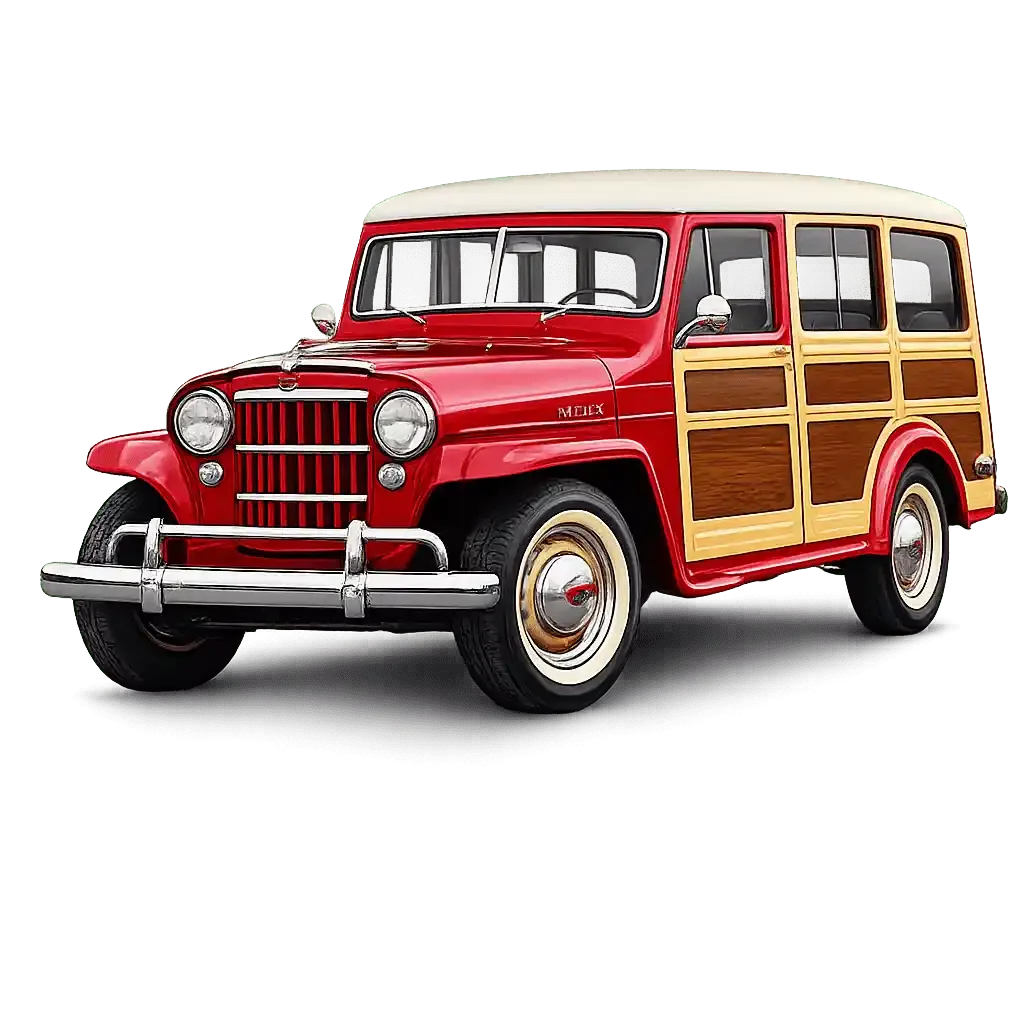
Willys-Overland came out of World War II as a Jeep company. Between 1946 and 1956, it tried to be three companies at once: a Jeep manufacturer (CJ-2A, CJ-3A, CJ-3B, CJ-5), a truck and wagon builder (Station Wagon, Pickup, Jeepster), and a passenger car maker (the Aero line). Each family used different engines, different wheelbases, different frames, and different electrical systems. The engine lineup alone included four distinct powerplants across two architectural families, and the transition from L-head to F-head happened at different times on different models. Add two generations of Korean War military Jeeps (M38 and M38A1) sharing some but not all parts with their civilian counterparts, and you have one of the most return-prone catalogs in the vintage parts market. This guide maps every split.
Brand and Platform Background
Willys-Overland emerged from WWII with massive name recognition courtesy of the Jeep, but limited product range. The company's strategy was to leverage the Jeep brand across multiple vehicle types, expanding from military utility into civilian utility, personal transportation, and eventually back into the passenger car market.
The ownership timeline matters for parts identification:
Willys-Overland Motors (1946-1953): The original company. All vehicles from this period carry Willys-Overland serial number formats and parts numbering.
Willys Motors / Kaiser-Willys (1953-1955): Kaiser-Frazer purchased Willys-Overland in 1953. The "Overland" name was dropped. Kaiser brought its own 226 cu in Super Hurricane engine into the Willys lineup, creating yet another engine option.
After 1955: Kaiser dropped the Aero passenger car line and the Jeepster, focusing exclusively on Jeep products. U.S. Aero production ended, though tooling went to Brazil for continued production starting in 1960.
The database for this guide covers five product families:
Universal CJ Series (civilian Jeeps): CJ-2A (1945-1949), CJ-3A (1949-1953), CJ-3B (1953 onward), CJ-5 (1955 onward). All on 80-inch wheelbase, 4WD, open body. Three different engines across the run.
Military Jeeps: M38 (1950-1952) and M38A1 (1952-1957). Based on their civilian counterparts (CJ-3A and CJ-5 respectively) but with reinforced frames, 24-volt electrical systems, and military-specific hardware.
Station Wagon / Panel Delivery: Introduced 1946 on a 104.5-inch wheelbase. All-steel body (no wood). Available in 2WD and 4WD. Multiple engine options over the years.
Jeep Truck (Pickup): Introduced 1947 on a 118-inch wheelbase. Shared front sheetmetal, engines, and drivetrain components with the Station Wagon, but the longer frame and bed are unique.
Willys Aero (passenger car): 1952-1955. Completely separate unibody platform on a 108-inch wheelbase. Multiple engine options including Willys and Kaiser powerplants. Shares nothing with the Jeep/truck lines except a few engine variants.
Jeepster: 1948-1951. A phaeton (open touring car) sharing the Station Wagon's drivetrain, front suspension, and steering, but with unique body and rear fenders. Rear-wheel drive only.
Engine Family Reference
Understanding the engine lineup is critical before diving into model details. Four major powerplants appear across this period:
L-134 Go-Devil (flathead inline four, 134.2 cu in, 60 hp)
Configuration: L-head (side-valve)
Application: CJ-2A, CJ-3A, M38, Station Wagon 463, Jeep Truck 463, Jeepster VJ-2/VJ-3, early pickups
Years in this range: 1946-1950 (civilian), 1950-1952 (M38 military)
Note: This is the same engine family from the prewar Willys and wartime MB, upgraded to 60 hp by Barney Roos
F-134 Hurricane (F-head inline four, 134.2 cu in, 72 hp)
Configuration: F-head (intake valve overhead, exhaust valve in block). Same block as Go-Devil but with new cylinder head
Application: CJ-3B, CJ-5, M38A1, Station Wagon 473, Jeep Truck 473/475, Aero Lark (export only)
Years: 1950 onward
Note: Taller than the Go-Devil due to the overhead intake valve. This height difference is the reason the CJ-3B has a raised hood compared to the CJ-3A.
L-148 Lightning (flathead inline six, 148.5 cu in, 75 hp) and L-161 Lightning (flathead inline six, 161 cu in, 75 hp)
Configuration: L-head (side-valve)
Application: Station Wagon 663/673, Jeepster VJ3-6/673-VJ, Aero Lark (domestic)
Years: 1948-1951 (L-148), 1950-1951 (L-161)
Note: The L-148 appeared first in 1948. The L-161 was a bored-out version. Both were replaced by F-head versions.
F-161 Hurricane Six (F-head inline six, 161 cu in, 90 hp)
Configuration: F-head
Application: Aero Wing/Ace/Eagle, Station Wagon 685
Years: 1952-1954
L-226 Super Hurricane (flathead inline six, 226.2 cu in, 115 hp)
Configuration: L-head. This engine came from Kaiser, not from Willys' own engine family.
Application: Aero Ace/Eagle (1954), Station Wagon 4WD (1954 onward), Jeep Truck 6-226
Years: 1954 onward
Note: Completely different engine family from all other Willys powerplants. Different block, different mounts, different accessories. This is a Kaiser/Continental Red Seal engine.
Complete Model, Year, and Trim Breakdown
CJ-2A (1945-1949)
Wheelbase: 80 inches
Engine: L-134 Go-Devil, 60 hp
Transmission: T-90 3-speed manual (replaced the MB's T-84)
Transfer case: Dana 18
Axles: Dana 25 front, Dana 41 rear (changed to Dana 44 late in production)
Electrical: 6-volt
Grille: 7-slot (vs. MB's 9-slot)
Windshield: Two-piece, folding, with square upper corners
Key identification features: Larger flush-mounted headlights vs. MB, tailgate, side-mounted spare tire, top bow storage brackets welded to driver's side body
Production: Approximately 214,202 units
Variants: Farm Jeep options (PTO, belt pulley, hydraulic lift)
Mid-production changes: Dana 41 to Dana 44 rear axle; small-window canvas top to large-window top (around serial number 46180, mid-1950); driver's side motor mount orientation changed with introduction of vacuum-boosted fuel pump
CJ-3A (1949-1953)
Wheelbase: 80 inches
Engine: L-134 Go-Devil, 60 hp
Transmission: T-90 3-speed manual
Transfer case: Dana 18
Axles: Dana 25 front, Dana 41 rear (changed to Dana 44 at serial number CJ-3A 62488, late 1950)
Electrical: 6-volt
Grille: 7-slot
Windshield: One-piece, folding, with rounded upper corners (key visual difference from CJ-2A)
Key differences from CJ-2A: Shorter rear wheelwell (32 inches vs. CJ-2A's 34 inches), driver's seat moved rearward for more legroom, no top bow storage brackets, tool box lid with water gutter and drain, vacuum-boosted fuel pump for better wiper operation, different engine front plate and driver's side motor mount (mount ear faces forward vs. both facing rearward on CJ-2A)
Production: 131,843 units
Variants: Farm Jeep (1951 onward), Jeep Tractor (bare-bones field-use variant with PTO)
Serial number format change: Pre-1951 used "CJ-3A" prefix with continuous numbering. Starting 1951, format changed to indicate model year (e.g., 451-GB1 for 1951).
CJ-3B (1953-1968, but 1953-1956 for this guide)
Wheelbase: 80 inches
Engine: F-134 Hurricane, 72 hp
Transmission: T-90 3-speed manual (4-speed optional from 1963)
Transfer case: Dana 18
Axles: Dana 25 front, Dana 44 rear
Electrical: 6-volt (changed to 12-volt mid-1950s)
Grille: 7-slot
Key difference from CJ-3A: Raised hood and higher grille to clear the taller F-head Hurricane engine. This is the single easiest way to identify a CJ-3B from a distance.
Production (U.S.): 155,494 total through 1968; approximately 196,000 worldwide including licensed production
CJ-5 (1955 onward)
Wheelbase: 81 inches (one inch longer than CJ-2A/3A/3B)
Engine: F-134 Hurricane, 72 hp (initial)
Body: Completely new "round-fender" design derived from the M38A1 military Jeep
Key differences from CJ-3B: Rounded hood and fenders (vs. flat fenders on all previous CJs), one-inch-longer wheelbase, wider track, restyled body
Note: The CJ-5 ran for 29 model years (1955-1983) through multiple engine and drivetrain changes. This guide covers only its 1955-1956 introduction.
M38 Military (1950-1952)
Wheelbase: 80 inches
Engine: L-134 Go-Devil, 60 hp
Electrical: 24-volt waterproof system (vs. CJ-3A's 6-volt)
Based on: CJ-3A, but with reinforced frame and suspension, full-floating rear axle, waterproof/sealed vent system for engine/transmission/transfer case/fuel/brakes
Key identification: Protruding headlights with guard wires (vs. flush-mounted on CJ-3A), no outside step, blackout lights, fuel filler on driver's side, larger tires (7.00x16 vs. CJ-3A's 6.00x16)
Production: Approximately 50,000-61,000 units (varying by source; includes approximately 2,300 Canadian M38-CDN units by Ford of Canada)
M38A1 Military (1952-1957)
Wheelbase: 80 inches
Engine: F-134 Hurricane, 72 hp (the taller F-head engine necessitated the complete body redesign)
Electrical: 24-volt waterproof system
Body: Rounded hood and fenders (the "round-fender" Jeep that became the template for the civilian CJ-5)
Key differences from M38: Different engine (Hurricane vs. Go-Devil), completely different body (round fenders vs. flat), hinged front grille on early models (1952-1953), different battery box design
Production: Approximately 80,290 for U.S. military, plus 21,198 for foreign customers
Early vs. late identification: 1952-1953 models have hinged front grille and 8 thumb screws on battery box cover. 1954 and later have single strap on battery box.
Station Wagon (1946-1956 portion)
Wheelbase: 104.5 inches
Drivetrain: 2WD (1946 onward), 4WD option (1949 onward)
Body: All-steel (first mass-market all-steel station wagon)
Designer: Brooks Stevens
Model/engine progression:
463 (1946-1950): L-134 Go-Devil four-cylinder. Flat 9-slot grille (later referred to as "10-slot" in some references). 2WD standard, 4WD from 1949.
663 (1948-1950): L-148 Lightning six-cylinder. Late 1947 introduction, only about 50 built in first year.
473 (1950-1955): F-134 Hurricane four-cylinder. New V-shaped grille with 5 horizontal bars (replaced flat grille in 1950).
673 (1950-1951): L-161 Lightning six-cylinder.
685 (1952-1954): F-161 Hurricane six-cylinder. Replaced flathead Lightning.
6-226 (1954 onward): L-226 Super Hurricane six (Kaiser engine). Initially 4WD only.
Station Sedan (1948-1951): Luxury version with solid body colors and basket-weave side trim.
Key production changes:
1950: Flat grille replaced by V-shaped grille; fenders changed from flat to rounded
1951: New serial number format
1952: Floor starter replaced by key start ("Startakey"); single taillight replaced by two flush-mounted lights; chrome strip added to hood
1953: Horizontal grille bars reduced from 5 to 3
1954: First year under Kaiser ownership; 6-226 Super Hurricane engine available on 4WD
1955: Name changed from "Station Wagon" to "Utility Wagon"
Jeep Truck / Pickup (1947-1956 portion)
Wheelbase: 118 inches
Shared with Station Wagon: Front sheetmetal, grille, engine options, front suspension, steering
Unique to truck: Longer frame, pickup bed, stake bed, and cab/chassis variants
Model/engine progression (mirrors Station Wagon with same designations):
4-63 (1947-1950): L-134 Go-Devil. 2WD and 4WD.
4-73 / 473 (1950-1951): F-134 Hurricane. 2WD and 4WD.
4-75 / 475 (1952-1956): F-134 Hurricane. 2WD and 4WD.
6-226 (1954 onward): L-226 Super Hurricane.
Key production changes (largely parallel Station Wagon):
1947: Single taillight, frame-mounted radiator, fixed wing vent window
1948: Floor shift, cowl seam present
1949: Full bench seat, cardboard headliner
1950: Radiator changes to grille mount, flat grille to V-shaped grille
1951: Flat fender to V-shaped fender, new serial number format
1952: Key start replaces floor start
1953: Horizontal grille bars from 5 to 3
1954: Large rear window added to cab; 4WD only for trucks
1955: Name changes from "Truck" to "Utility Truck"
Rear axle note: 1947-1951 trucks used Timken clamshell-style rear axle. 1947-1954 used Dana 44/53. 1954 onward Dana 53.
Jeepster (1948-1951)
Wheelbase: 104.5 inches (same as Station Wagon)
Drivetrain: Rear-wheel drive only (no 4WD option, which limited its appeal)
Body: Open phaeton with plastic side curtains (no roll-up windows)
Front suspension: Planadyne single transverse leaf spring independent front (shared with Station Wagon)
Model progression:
VJ-2 (1948-1949): L-134 Go-Devil four-cylinder, 63 hp. Overdrive standard.
VJ-3 (1949-1950): L-134 Go-Devil four-cylinder. Price reduced, some standard features became optional.
VJ3-6 / 663-VJ (1949-1950): L-148 Lightning six-cylinder. Introduced mid-1949.
473-VJ (1950-1951): F-134 Hurricane four-cylinder. V-shaped grille.
673-VJ (1950): L-161 Lightning six-cylinder.
Production: 19,132 total units across all variants. Some leftover 1950 models sold under 1951 model year.
Willys Aero (1952-1955)
Wheelbase: 108 inches
Construction: Unitized body-frame (unibody), not body-on-frame
Designer: Phil Wright (styling), Clyde Paton (engineering)
Assembly: Toledo, Ohio and Maywood, California
1952 Models (two-door sedans only, all with split windshield):
Aero Lark: L-161 Lightning six (flathead), 75 hp. Smaller one-piece rear window.
Aero Wing: F-161 Hurricane six (F-head), 90 hp. Smaller one-piece rear window. Two-tone paint, bumper horns.
Aero Ace: F-161 Hurricane six, 90 hp. Three-piece wraparound rear window.
Aero Eagle: F-161 Hurricane six, 90 hp. Three-piece wraparound rear window. Top trim, hardtop body style.
Production: 31,363 total
1953 Models (two-door and four-door sedans added for most trims):
Aero Lark: L-161 Lightning six (flathead). Split windshield retained. Two-door and four-door.
Aero Falcon (replaced Wing): L-161 Lightning six (flathead). Split windshield. Two-door and four-door.
Aero Ace: F-161 Hurricane six. One-piece windshield (new). Two-door and four-door.
Aero Eagle: F-161 Hurricane six. One-piece windshield. Two-door hardtop only.
Aero Heavy Duty: Four-door based on Lark. Only 186 built.
Transmission: GM Dual-range Hydra-Matic optional on Ace and Eagle from August 1953.
Export Larks: Available with F-134 four-cylinder Hurricane.
1954 Models (most complex year):
Early 1954: Some cars were re-serialed 1953s with 1954 trim added.
Regular run: Lark, Ace, and Eagle only (Falcon dropped).
All regular-run 1954s: Wraparound one-piece windshields and rear windows, new instrument panel, larger taillights, hooded headlight bezels, different bumper guards.
Engine change: Some Aces and Eagles received the Kaiser L-226 Super Hurricane six (115 hp).
1955 Models (final U.S. year):
Willys Custom: Two-door and four-door sedan (renamed from Ace).
Willys Bermuda: Two-door hardtop (replaced Eagle).
Aero name dropped. Extensive facelift with new grilles, taillights, trunk locks, bumper guards, side moldings.
Most used the Kaiser 226 engine.
Total U.S. Aero production (all years): 91,377 units.
Step-by-Step Fitment Splits
Split 1: Product Family
This is the primary gate. Five product families share a factory but almost nothing else:
CJ Jeeps (CJ-2A/3A/3B/5): 80-81 inch wheelbase, 4WD, open body
Military Jeeps (M38/M38A1): 80 inch wheelbase, 4WD, reinforced military spec
Station Wagon / Panel Delivery: 104.5 inch wheelbase, 2WD or 4WD, enclosed steel body
Jeep Truck / Pickup: 118 inch wheelbase, shares front end with Wagon
Aero passenger car: 108 inch wheelbase, unibody construction, completely separate platform
The Jeepster shares its 104.5-inch wheelbase, front drivetrain, front suspension, and steering with the Station Wagon, but has a unique body, unique rear fenders, and no 4WD option.
Split 2: Engine Type (L-head vs. F-head vs. Kaiser Six)
Three engine architectures that cannot be mixed:
L-head (flathead): Go-Devil four (L-134), Lightning six (L-148 and L-161), Super Hurricane six (L-226). Intake and exhaust valves both in the block. Lower profile.
F-head: Hurricane four (F-134), Hurricane six (F-161). Intake valve overhead, exhaust valve in block. Taller profile. Same basic block as the corresponding L-head, but with a fundamentally different cylinder head.
Kaiser L-226 Super Hurricane: A completely separate engine family from a different manufacturer. Different block, mounts, accessories, and dimensions. Does not share internal or external parts with any Willys-designed engine.
Split 3: Engine Displacement and Cylinder Count
Within the L-head and F-head families:
134.2 cu in four-cylinder: Go-Devil (L-head) and Hurricane (F-head). Same block, different heads. Internal rotating parts (crankshaft, rods, pistons) are related but not always identical due to the F-head's different compression characteristics.
148.5 cu in six-cylinder: Lightning L-148 (1948-1950 only)
161 cu in six-cylinder: Lightning L-161 (flathead) and Hurricane F-161 (F-head). Same relationship as the four-cylinder: same block family, different heads.
226.2 cu in six-cylinder: Kaiser Super Hurricane. Entirely different engine. No parts interchange with any Willys engine.
Split 4: Electrical System Voltage
6-volt: All civilian vehicles through mid-1950s (CJ-2A, CJ-3A, early CJ-3B, CJ-5, all Station Wagons through early 1950s, all Jeepsters, all Aeros)
12-volt: Civilian vehicles from mid-1950s onward (phased in around 1955-1957 depending on model)
24-volt waterproof: M38 and M38A1 military Jeeps only
Starters, generators, regulators, ignition coils, light bulbs, gauges, and all electrical accessories are voltage-specific. Military 24-volt components do not work in 6-volt civilian vehicles and vice versa.
Split 5: Civilian vs. Military (CJ-3A vs. M38, CJ-5 vs. M38A1)
Each military Jeep is based on a civilian model but with extensive differences:
CJ-3A vs. M38:
Same engine (Go-Devil L-134)
Different electrical system (6V vs. 24V)
Different frame (M38 reinforced)
Different rear axle (M38 has full-floating)
Different tires (M38 uses 7.00x16 vs. 6.00x16)
Different headlight mounting (M38 protruding with guard wires)
M38 has sealed/waterproofed drivetrain venting
M38 has no outside step
CJ-5 vs. M38A1:
Same engine (Hurricane F-134)
Same basic body design (round fenders)
Different electrical system (6V or 12V civilian vs. 24V military)
Different frame (M38A1 reinforced, reverse front spring shackles)
M38A1 has hinged front grille (early), blackout lights, military-specific hardware
Split 6: CJ Body Generation (Flat-Fender vs. Round-Fender)
Flat-fender CJs (CJ-2A, CJ-3A, CJ-3B): Square-edged, flat fenders and hood. Direct lineage from the WWII MB. Body panels interchange within this group to varying degrees, but hoods do not interchange between CJ-3A (low hood, Go-Devil) and CJ-3B (raised hood, Hurricane).
Round-fender CJs (CJ-5): Completely new body design derived from M38A1. No body panels interchange with flat-fender CJs.
Split 7: Grille Style (Station Wagon, Truck, and Jeepster)
Flat grille, 9/10-slot (1946-1950): Original design
V-shaped grille, 5 horizontal bars (1950-1953): Introduced with 1950 restyle
V-shaped grille, 3 horizontal bars (1953-1956): Simplified in 1953
Grille assemblies are specific to each style and do not interchange across the changeover years.
Split 8: Aero Windshield and Rear Window Configuration
1952 (all models): Split two-piece windshield. Lark/Wing have small one-piece rear window. Ace/Eagle have three-piece wraparound rear window.
1953: Ace and Eagle get one-piece windshield. Lark and Falcon retain split windshield.
1954 regular run (all models): Wraparound one-piece windshield and rear window.
1955 (all models): One-piece windshield.
Windshield glass, frames, rubber seals, and rear window components are specific to each configuration.
Split 9: Aero Engine/Trim Alignment
The Aero's trim level determines which engine is installed:
Lark and Falcon: L-161 Lightning (flathead six). Lower trim, lower power.
Wing, Ace, and Eagle: F-161 Hurricane (F-head six). Higher trim, more power.
1954 Ace/Eagle with Kaiser option: L-226 Super Hurricane. Completely different engine family.
Export Lark: F-134 Hurricane four-cylinder (not sold domestically).
Engine mounts, exhaust manifolds, carburetors, air cleaners, motor mount brackets, and all engine-specific accessories follow the engine, not the trim badge. A Lark with a Lightning six uses different engine parts from an Ace with a Hurricane six, even though both are 161 cu in sixes on the same chassis.
Biggest Return Traps
Trap 1: CJ-2A Parts Listed as Fitting CJ-3A (and Vice Versa)
Why they get returned: The CJ-2A and CJ-3A look nearly identical at a glance and share the same engine, transmission, and transfer case. Sellers list body parts as fitting "CJ-2A/3A" assuming interchangeability. However, the windshield frame is completely different (two-piece square-corner vs. one-piece round-corner), the rear wheelwell length differs by two inches, the front seat frames are different, the tool box lid design changed, the engine front plate and driver's side motor mount orientation are different, and the fuel pump is different (CJ-3A added a vacuum booster section for the wipers).
How to stop returns: Never list CJ-2A and CJ-3A body parts as cross-fitting without verifying the specific component. Windshield frames, glass, seats, tool box lids, fuel pumps, and engine front plates are model-specific. Always specify CJ-2A or CJ-3A, not "CJ-2A/3A."
Trap 2: CJ-3A Parts Listed as Fitting M38
Why they get returned: The M38 is based on the CJ-3A and shares the same engine. Sellers assume all parts interchange. The M38 has a reinforced frame, full-floating rear axle (vs. semi-floating on CJ-3A), 24-volt electrical system, waterproof drivetrain venting, larger tires, protruding headlights, and no outside body step. Any electrical component, axle part, frame bracket, headlight assembly, or tire/wheel will be wrong.
How to stop returns: Always separate CJ-3A and M38 listings. The only components that reliably cross are basic engine internals and some transmission/transfer case parts (assuming the civilian and military units use the same gear ratios, which is not always the case). Everything else requires verification.
Trap 3: Go-Devil Cylinder Head Listed as Fitting Hurricane Engine (or Vice Versa)
Why they get returned: Both the Go-Devil (L-134) and Hurricane (F-134) use the same 134.2 cu in block with the same bore and stroke. Sellers list cylinder head gaskets, head bolts, or complete heads as fitting "Willys 134" without specifying L-head or F-head. The F-head Hurricane has a completely different cylinder head design with an overhead intake valve and rocker arm assembly. The gasket, head bolt pattern, and head casting are not interchangeable.
How to stop returns: For any cylinder head, head gasket, valve train, or rocker arm component, always specify "L-head Go-Devil" or "F-head Hurricane." Never use "Willys 134" alone.
Trap 4: Station Wagon Engine Parts Cross-Listed Across Engine Changes
Why they get returned: The Station Wagon went through five engine options between 1946 and 1956: Go-Devil four, Hurricane four, Lightning six (two displacements), Hurricane six, and Super Hurricane Kaiser six. Each change brought different engine mounts, exhaust manifolds, carburetors, and accessories. A seller listing an exhaust manifold for a "Willys Station Wagon" without specifying the engine and model designation (463, 663, 473, 673, 685, or 6-226) will generate returns.
How to stop returns: Always include the Station Wagon model number (463, 473, 685, 6-226, etc.) and the engine designation. The model number encodes the engine type: first digit indicates cylinders (4 or 6), and the remaining digits indicate the series.
Trap 5: Aero Lark Flathead Parts Listed as Fitting Aero Ace F-Head
Why they get returned: Both the 1952 Aero Lark and 1952 Aero Ace have 161 cu in six-cylinder engines. But the Lark uses the L-161 Lightning (flathead) while the Ace uses the F-161 Hurricane (F-head). The cylinder heads, valve trains, intake manifolds, exhaust manifolds, and carburetors are different. A buyer ordering "1952 Aero 161 six-cylinder intake manifold" without specifying the trim level or engine configuration gets the wrong part.
How to stop returns: For any Aero engine part, always specify both the trim level (Lark/Falcon vs. Wing/Ace/Eagle) and the engine configuration (L-head Lightning vs. F-head Hurricane). For 1954-1955, also distinguish the Kaiser L-226 Super Hurricane as a third option.
Trap 6: CJ Rear Axle Generation Confusion (Dana 41 vs. Dana 44)
Why they get returned: The CJ-2A started with a Dana 41 rear axle and switched to the Dana 44 during the CJ-3A production run (at serial number CJ-3A 62488, late 1950). Ring and pinion sets, bearings, seals, axle shafts, and housings are different between the Dana 41 and Dana 44. A seller listing a ring and pinion set as fitting "CJ-2A/3A" will be wrong for roughly half of CJ-3As and all CJ-2As that still have the original Dana 41.
How to stop returns: For any rear axle component, specify Dana 41 or Dana 44. Ask the buyer to verify which axle is installed, as some vehicles may have been changed from original. The serial number can help narrow it down, but a physical check is safest.
Fitment Rules Block
Required attributes for every Willys (1946-1956) parts listing:
Product family: CJ, Military Jeep, Station Wagon, Truck/Pickup, Jeepster, or Aero
Model designation: CJ-2A, CJ-3A, CJ-3B, CJ-5, M38, M38A1, 463, 473, 685, 6-226, VJ-2, VJ-3, Aero Lark, Aero Ace, Aero Eagle, etc.
Model year(s)
Engine type: L-134 Go-Devil, F-134 Hurricane, L-148 Lightning, L-161 Lightning, F-161 Hurricane, or L-226 Super Hurricane
Engine configuration: L-head (flathead) or F-head (for engine parts)
Electrical system voltage: 6V, 12V, or 24V
Drivetrain: 2WD or 4WD (for wagons, trucks, Jeepsters)
Rear axle model (for CJ Jeeps): Dana 41 or Dana 44
Body type: Flat-fender or round-fender (for CJs)
Grille style (for wagons/trucks): Flat or V-shaped; number of horizontal bars
Windshield type (for Aeros): Split or one-piece
Buyer Confirmation Prompts
Before shipping any part for a 1946-1956 Willys vehicle, confirm:
"What is the exact model designation? (CJ-2A, CJ-3A, CJ-3B, CJ-5, M38, M38A1, 463, 473, 685, 6-226, VJ-2, Aero Lark, Aero Ace, etc.)"
"What engine is installed? Is it the L-head (flathead) or F-head (overhead intake)? How many cylinders?"
"What is the electrical system voltage? (6-volt, 12-volt, or 24-volt?)"
"For CJ-2A or CJ-3A: What rear axle do you have? (Dana 41 or Dana 44? Check the axle housing for a casting number.)"
"For military M38 or M38A1: Confirm this is the military version, not the civilian CJ-3A or CJ-5."
"For Aero models: What is your trim level (Lark, Falcon, Wing, Ace, Eagle, Custom, Bermuda)? Which engine: flathead Lightning, F-head Hurricane, or Kaiser Super Hurricane?"
Quick Identification Guide
CJ-2A vs. CJ-3A: Look at the windshield. Two-piece glass with square upper corners = CJ-2A. One-piece glass with rounded upper corners = CJ-3A. Also check for top bow storage brackets welded to the body (CJ-2A has them, CJ-3A does not).
CJ-3A vs. CJ-3B: Look at the hood height. If the hood sits noticeably higher than the cowl and the grille is taller, it is a CJ-3B with the Hurricane engine. A CJ-3A has a lower, flatter hood profile matching the Go-Devil engine.
CJ-3B vs. CJ-5: Fender shape. Flat, square-edged fenders = CJ-3B. Rounded, curved fenders = CJ-5.
M38 vs. CJ-3A: Headlights: protruding with guard wires = M38. Flush-mounted = CJ-3A. Also check for blackout lights and the absence of an outside body step (M38 has no step).
M38 vs. M38A1: Fender shape (same as CJ-3A vs. CJ-5 distinction). Flat fenders = M38. Round fenders = M38A1.
Station Wagon age by grille: Flat grille = 1946-1950. V-shaped grille with 5 horizontal bars = 1950-1953. V-shaped grille with 3 horizontal bars = 1953 onward.
Station Wagon engine by model number: Number starts with 4 = four-cylinder. Number starts with 6 = six-cylinder. "685" = F-head six. "6-226" = Kaiser six.
Aero year by windshield: Split windshield = 1952 (all models) or 1953 (Lark/Falcon only). One-piece windshield = 1953 (Ace/Eagle) or 1954-1955 (all models).
Parts Sourcing Notes
The postwar Willys parts market divides along the same product-family lines as the vehicles themselves:
CJ Jeeps: The best-supported segment. Kaiser Willys (kaiserwillys.com) carries extensive reproduction parts for CJ-2A through CJ-5. Vintage Jeep Parts (vintagejeepparts.com) specializes in the flat-fender models. The CJ3B.info community site (cj3b.info) provides detailed production change documentation and serial number dating tools. CJ-3A.info (cj3a.info) does the same for the CJ-3A. Reproduction body tubs, fenders, hoods, and windshield frames are available for all CJ models.
Military M38/M38A1: Military vehicle restoration suppliers carry these. The 24-volt electrical system components (generators, starters, regulators, switches, bulbs) are military-specific and typically sourced from military surplus or specialized reproductions. The M38A1 shares more commonality with the CJ-5 than the M38 shares with the CJ-3A, but the 24-volt system ensures that every electrical component is different.
Station Wagon and Truck: Midwest Jeep Willys (midwestjeepwillys.com) and Kaiser Willys both stock wagon and truck parts. Reproduction grilles, weatherstripping, and rubber parts are available. Engine parts depend on which of the five engine options the vehicle has. The Kaiser L-226 Super Hurricane shares parts with Kaiser Manhattan and Kaiser Darrin applications, which can be a useful cross-reference source.
Jeepster: Limited reproduction market due to low production numbers (under 20,000 total). The Jeepster shares front-end components with the Station Wagon, which helps for steering, suspension, and front drivetrain parts. Body panels are unique and scarce.
Aero passenger car: The smallest reproduction market in the Willys lineup. With only 91,377 total U.S. production, parts are scarce. The F-161 Hurricane six shares its architecture with the F-134 four (same F-head design principle, different displacement), and the Kaiser L-226 engine crosses to Kaiser passenger car applications. Body and trim parts are model-year-specific due to the annual styling changes (windshield, grille, taillights, trim) and are primarily available through NOS or used/salvage sources.
Cross-platform engine notes: The Go-Devil L-134 and Hurricane F-134 share a block family. Internal rotating assembly parts (crank, rods) can cross in some cases, but always verify the specific part number. The Hurricane's F-head cylinder head, rocker arm assembly, valve cover, and intake/exhaust manifold are unique to the F-head configuration and do not fit L-head engines. The Kaiser L-226 Super Hurricane shares nothing internally with any Willys-designed engine but does cross to other Kaiser vehicle applications.
Disclaimer: This guide is based on publicly available specifications, Willys press materials, and independent research. Part interchangeability should always be confirmed via VINand OEM part number lookup. Specifications may change without notice. This document does not constitute official Willys parts catalog data. Visuals and illustrations in this article were generated using AI for representative purposes and may not reflect exact technical schematics.