
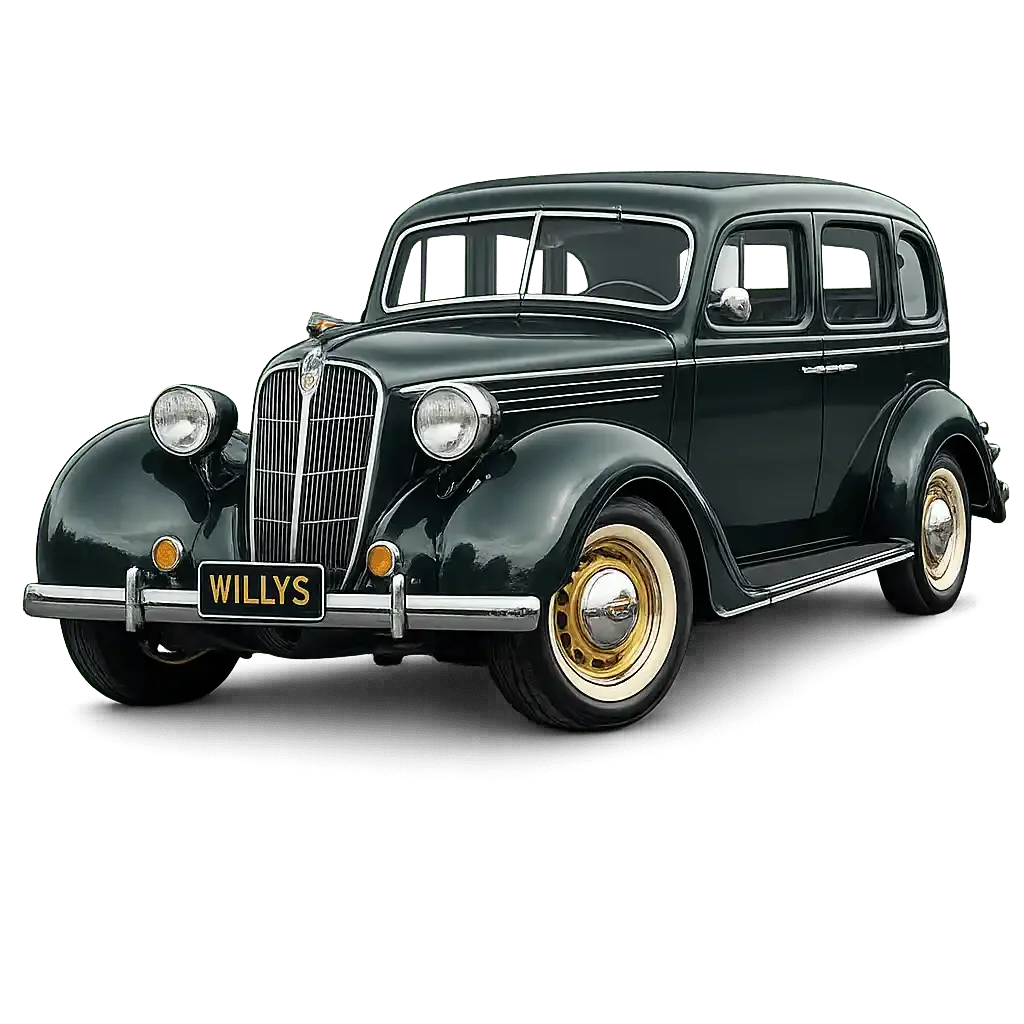
The Willys passenger car lineup from 1934 to 1942 looks simple on paper: one engine, one chassis, one brand. In practice, it is a maze of annually changing model designations, two different wheelbases running simultaneously in 1939, an engine that jumped from 48 to 61 horsepower mid-run, and a brake system transition from mechanical to hydraulic that does not align neatly with the model year changeover. Add the wartime MA and MB military Jeeps, which share the civilian engine but nothing else, and you have a parts catalog that punishes lazy listings. This guide maps every split from the Model 77 through the last CJ-2A so you can sell accurately and keep return rates down.
Brand and Platform Background
After Willys-Overland's bankruptcy and the death of founder John North Willys in 1935, the reorganized company emerged in 1936 as Willys-Overland Motors, Inc. From that point forward, the company built exactly one civilian platform: a compact, four-cylinder car that evolved through annual model designations and periodic restyling but always centered on the same basic architecture.
The database for this guide covers three distinct product families:
Willys Passenger Cars (1934-1942): Starting with the Model 77 and evolving through the Model 37, Model 38, Model 39/Overland, Model 48, the 440, the 441 Americar, and the 442 Americar. All share the same 134.2 cubic-inch L-head inline four, but the engine was significantly upgraded in 1939. The chassis went through two wheelbase changes. Trim levels multiplied from 1939 onward, with Speedway, Deluxe, and Plainsman lines running simultaneously in the final years.
Willys Military Vehicles (1941-1945): The MA (Military model A) and MB (the standardized mass-production Jeep). These use the same Go-Devil engine found in the upgraded civilian cars but on a completely different 80-inch wheelbase four-wheel-drive chassis. The MB alone accounts for over 361,000 units and was also built by Ford as the GPW.
Willys CJ-2A (1945): The first civilian Jeep, a stripped-down MB with blackout lighting removed and a tailgate added. Bridges the wartime and postwar eras.
Together, these vehicles span from Depression-era economy cars to the most iconic military vehicle of the 20th century, and they all trace back to one small flathead four-cylinder engine that started life in the 1926 Whippet.
Complete Model, Year, and Trim Breakdown
Model 77 (1934-1936)
Years in database: 1934, 1935, 1936
Wheelbase: 100 inches
Engine: 134.2 cu in (2,199 cc) L-head inline four, 48 hp at 3,200 rpm
Bore/stroke: 3-1/8 x 4-3/8 inches
Transmission: 3-speed manual (non-synchronized)
Brakes: Mechanical, four-wheel drums
Body styles: Coupe, sedan, pickup (1935 onward), panel delivery
Track width: 51 inches (narrow, a known handling limitation)
Key features: Tillotson downdraft carburetor, cable-operated clutch, all-steel body, fixed non-opening windscreen on 1936 closed models
Production note: Built in batches of approximately 10,000 units under court supervision during the receivership period
Model 37 (1937)
Wheelbase: 100 inches (carried over from Model 77)
Engine: Same 134.2 cu in L-head four, 48 hp
Transmission: 3-speed manual with synchromesh (new for 1937)
Brakes: Four-wheel hydraulic drums (new for 1937)
Body styles: Coupe, four-door sedan, pickup (standard and deluxe trim)
Track width: 55 inches front / 58 inches rear (widened significantly from Model 77's 51-inch track)
Styling: Complete restyle by Amos Northup. Fender-integrated headlamps, clamshell front-opening hood with stamped louvers instead of a traditional grille
Production: Approximately 63,467 units
Model 38 (1938)
Wheelbase: 100 inches
Engine: Same 134.2 cu in L-head four, 48 hp
Transmission: 3-speed manual with synchromesh
Brakes: Four-wheel hydraulic drums
Body styles: Coupe, two-door sedan, four-door sedan, pickup (standard and deluxe)
Changes from Model 37: Rocket-shaped radiator emblem, rain gutters added to all-steel roof, hood hinge configuration altered. Two-door sedans were four-door bodies with rear doors welded shut, seamed, and finished.
Note: Some Model 38 production carried into the 1939 model year, making serial numbers important for dating.
1939 Models: The Dual-Line Year
1939 is the most complicated year in this range. Willys sold two distinct lines simultaneously:
Model 48 (1939)
Wheelbase: 100 inches
Engine: 134.2 cu in L-head four, 48 hp (the old engine)
Brakes: Mechanical four-wheel drums on some units, hydraulic on others (transitional)
Trim levels: Speedway, Deluxe, and Special Speedway (coupe and sedan in each)
What it is: Essentially a carryover of the Model 37/38 with the old 48 hp engine and 100-inch wheelbase
Truck variant: Model 48 Truck
Model 39 / Overland (1939)
Wheelbase: 102 inches (two inches longer than Model 48)
Engine: 134.2 cu in L-head four, upgraded to 61 hp at 3,600 rpm (the Barney Roos engine upgrade: aluminum pistons, shell bearings, full-pressure lubrication)
Brakes: Bendix/Lockheed hydraulic brakes (standard)
Marketing: Sold as "Overland" or "Willys-Overland," not as "Willys." The Overland branding lasted only this one year.
Styling: Completely different front end from Model 48. Shark-nosed hood, lantern-style headlamps. One-year-only design.
Truck variant: Model 39 Truck
Model 38 Truck (1939 carryover)
Some 1938-spec trucks continued into the 1939 model year
439 (1939)
This designation appears in some databases for the Overland/Model 39 line
Model 440 (1940)
Wheelbase: 102 inches
Engine: 134.2 cu in L-head four, 61 hp
Transmission: 3-speed manual, column-mounted shift lever (new for 1940, replacing floor shifter on Deluxe models; Speedway retained floor shift)
Brakes: Hydraulic four-wheel drums (all models)
Trim levels: Speedway (base) and Deluxe
Styling: Split two-piece grille (the easy visual identifier for 1940). Another one-year-only front end design.
Body styles: Coupe, four-door sedan, station wagon (extremely rare, approximately 5 built by USHCO/USB&F on coupe chassis)
Production: 26,698 units
Model 441 Americar (1941)
Wheelbase: 104 inches (increased two inches from 440)
Engine: 134.2 cu in L-head four, 63 hp (slight increase from 61)
Transmission: 3-speed manual, column-mounted shift lever (now standard across all trim levels)
Brakes: Hydraulic four-wheel drums
Trim levels: Speedway (base), Deluxe (mid), Plainsman (top, with overdrive and finned high-compression aluminum head)
Body styles per trim: Speedway: coupe, sedan. Deluxe: coupe, sedan, three-door woody station wagon. Plainsman: coupe, sedan.
Styling: One-piece grille with fine vertical slats (vs. 1940's split two-piece). Wipers moved from top of windshield to cowl.
Name: "Americar" designation used for the first time
Fuel tank: 11.5 gallons (increased from previous years)
Production: Approximately 22,000 units
Station wagon note: Only about 5 built on 441 chassis by USHCO
Model 442 Americar (1942)
Wheelbase: 104 inches
Engine: 134.2 cu in L-head four, 63 hp
Trim levels: Speedway, Deluxe, Plainsman (same structure as 441)
Body styles: Same as 441 (coupe, sedan, station wagon on Deluxe only)
Production: Approximately 7,000 units before civilian production was halted for the war effort
Note: Last Willys civilian passenger car until the Willys Aero in 1952
Willys MA (1941)
Wheelbase: 80 inches
Engine: Go-Devil L-134, 134.2 cu in L-head four, 60 hp at 4,000 rpm (same engine family as civilian, but military-spec tuning)
Drivetrain: 3-speed manual, Dana 18 two-speed transfer case, four-wheel drive
Body: Open, flat-fender military reconnaissance car
Grille: Welded flat-iron slat grille
Production: 1,553 units total
Track width: 46 inches
Key differences from MB: Handbrake design, rounded door cutouts, column-mounted gear shift, two circular instrument clusters
Rarity: Approximately 30 known to survive. Most were shipped to the USSR and UK under Lend-Lease.
Willys MB (1941-1945)
Wheelbase: 80 inches
Engine: Go-Devil L-134, 134.2 cu in L-head four, 60 hp at 4,000 rpm
Drivetrain: 3-speed manual, Dana 18 transfer case, 4WD, Dana 25 front axle, Dana 27 rear axle
Grille: Slat grille (November 1941 through March 1942, approximately 25,808 units), then stamped 9-slot steel grille (March 1942 onward)
Tires: 6.00-16 non-directional tread
Electrical: 6-volt negative ground
Production: 361,339 units (November 18, 1941 through September 21, 1945)
Body evolution: ACM Type 1 body (November 1941 through December 1943), ACM Type 2 composite body (January 1944 through end of war)
Key production splits: Early MBs had Willys name stamped on left rear panel (removed spring 1942). First 3,500 units used MA-type frame with shorter cowl-to-glass measurement (4 inches vs. later 6 inches). Early gas tanks had rectangular lower corners, later models rounded.
Willys CJ-2A (1945)
Wheelbase: 80 inches
Engine: Go-Devil L-134, 134.2 cu in L-head four, 60 hp
What changed from MB: Blackout lighting removed, tailgate added, side-mounted spare tire, larger headlights, external fuel cap, "Willys" embossed on hood sides and windshield frame
Price: $1,090 MSRP
Step-by-Step Fitment Splits
Split 1: Civilian vs. Military Platform
This is the first and most important gate. Despite sharing the same engine family, civilian Willys cars and military MA/MB/CJ-2A vehicles share almost zero chassis, body, suspension, or drivetrain components.
Civilian cars (Model 77 through 442):
Rear-wheel drive only
100-inch, 102-inch, or 104-inch wheelbase
Conventional ladder frame with solid front axle and live rear axle, semi-elliptic leaf springs
Passenger car body styles (coupe, sedan, wagon, pickup)
Military vehicles (MA, MB, CJ-2A):
Four-wheel drive with transfer case
80-inch wheelbase
Military-spec frame, Dana axles front and rear
Open body, flat fenders, folding windshield
Do not cross-list any chassis, body, suspension, axle, transfer case, or driveline parts between these two families. The engine block and core internal components are related but not always identical due to military-spec tuning and production variations.
Split 2: Engine Generation (48 hp vs. 61/63 hp)
The 134.2 cu in L-head four went through a major upgrade in 1939. This creates two distinct engine generations:
Pre-upgrade (1934-1939 on Model 48): 48 hp at 3,200 rpm. Babbitt bearings, older lubrication system, heavier flywheel (57 pounds).
Post-upgrade (1939 Model 39 onward through 1942, plus all military): 61-63 hp at 3,600 rpm. Aluminum pistons, shell bearings, full-pressure lubrication, lighter flywheel (31 pounds). This is the engine that became the wartime Go-Devil.
Internal engine components (pistons, bearings, oil pump, flywheel) do not interchange between these two generations. External bolt-on accessories may or may not fit, depending on the specific component. Always verify.
Critical 1939 warning: Both engine generations were sold simultaneously in 1939. The Model 48 has the 48 hp engine. The Model 39/Overland has the 61 hp engine. A buyer ordering "1939 Willys engine parts" without specifying the model number will get the wrong parts 50% of the time.
Split 3: Wheelbase (100 / 102 / 104 inches)
Three civilian wheelbases existed across this run:
100-inch wheelbase:
Model 77 (1934-1936)
Model 37 (1937)
Model 38 (1938)
Model 48 (1939)
102-inch wheelbase:
Model 39 / Overland (1939)
Model 440 (1940)
104-inch wheelbase:
Model 441 Americar (1941)
Model 442 Americar (1942)
Frame rails, driveshafts, brake lines, body panels, running boards, and floor pans are specific to each wheelbase group. The 100-to-102-inch change happened mid-year in 1939 (between the Model 48 and Model 39). The 102-to-104-inch change happened between 1940 and 1941.
Split 4: Brake System (Mechanical vs. Hydraulic)
Mechanical brakes: Model 77 (1934-1936)
Hydraulic brakes: Model 37 (1937) onward for passenger cars, Model 39/Overland (1939) for the new-wheelbase line
Transitional complication in 1939: The Model 48 (100-inch wheelbase, 48 hp) was running alongside the Model 39 (102-inch wheelbase, 61 hp, hydraulic). Some sources indicate that Model 48 variants may have had mixed brake configurations during the transition. Always confirm with the buyer.
All brake master cylinders are different between mechanical and hydraulic systems. Wheel cylinders, brake lines, and hardware are non-interchangeable.
Split 5: Trim Level (1939-1942)
Starting in 1939, Willys offered multiple trim levels that affected interior components, exterior chrome, and in some cases mechanical specifications:
Speedway: Base trim. Minimal chrome, single windshield wiper (on some years), floor-mounted shift lever (1940 only; column shift standardized by 1941). The price leader.
Deluxe: Mid-level. Additional chrome strips on hood, vent windows in front doors (1941), bustled deck lid for more trunk volume (1941), improved interior. The only trim level that offered the station wagon.
Plainsman (1941-1942 only): Top trim. Came with overdrive and a finned high-compression aluminum cylinder head. The Plainsman's aluminum head is a significant fitment detail: gaskets, head bolts, and cooling system components may differ from standard iron-head Speedway and Deluxe models.
Split 6: Transmission Shift Location
1934-1936 (Model 77): Floor-mounted, non-synchronized
1937-1939: Floor-mounted, synchronized (new for 1937)
1940 Speedway: Floor-mounted
1940 Deluxe: Column-mounted (new for 1940)
1941-1942 (all trims): Column-mounted (standardized)
Shift linkage, steering column components, and transmission tunnel hardware differ between floor-shift and column-shift configurations.
Split 7: MB Production Phases
For military Jeep parts, the MB's production run divides into distinct phases that affect body panels, grille, frame, and detail hardware:
Slat-grille MB (November 1941 through March 1942): Approximately 25,808 units. Welded flat-iron slat grille, "Willys" stamped on left rear panel, MA-type frame on first 3,500 units.
Standard MB with stamped grille (March 1942 through December 1943): 9-slot stamped steel grille, Willys name removed from rear panel, ACM Type 1 body.
Composite MB (January 1944 through September 1945): ACM Type 2 composite body integrating features from both Willys and Ford production. Many body detail differences between Ford and Willys were finally reconciled in this phase.
Split 8: Styling Year Groups for Body Panels
Each front-end restyle means unique hood, fenders, grille (where applicable), and headlamp assemblies:
1934-1936: Model 77 body (narrow track, distinctive rounded front end)
1937-1938: Northup restyle (clamshell hood, integrated headlamps, wider track). Model 37 and 38 are nearly identical externally.
1939 Model 48: Carries over 37/38 front sheetmetal
1939 Model 39/Overland: Unique shark-nosed hood, lantern headlamps (one-year-only design)
1940 (440): Split two-piece grille (one-year-only)
1941-1942 (441/442): One-piece fine-slat grille, cowl-mounted wipers
Biggest Return Traps
Trap 1: 1939 Model 48 vs. Model 39 Engine Parts Confusion
Why they get returned: A buyer searches "1939 Willys engine bearing set" and your listing does not specify which 1939 model. The Model 48 uses babbitt bearings and the old 48 hp engine. The Model 39/Overland uses shell bearings and the upgraded 61 hp engine. The bearings are completely incompatible.
How to stop returns: For every engine-related part covering any 1939 Willys, list the model number (48 or 39) and the horsepower rating (48 hp or 61 hp). Never list a 1939 part as fitting "1939 Willys" without this distinction.
Trap 2: Model 77 Brake Parts Listed as Fitting Model 37
Why they get returned: Both models share a 100-inch wheelbase and the same engine. Sellers assume the brakes are the same. The Model 77 (1934-1936) uses mechanical brakes. The Model 37 (1937) uses hydraulic brakes. Wheel cylinders, master cylinders, brake lines, and adjustment hardware are entirely different systems.
How to stop returns: Always state "mechanical brakes" for Model 77 listings and "hydraulic brakes" for Model 37 and later. Never list brake parts as fitting "1934-1937 Willys" without specifying the brake system type.
Trap 3: Plainsman Aluminum Head Parts Listed as Universal 441/442
Why they get returned: The Plainsman trim level came with a finned high-compression aluminum cylinder head and overdrive. Gaskets, head bolts, and cooling system components for the aluminum head differ from the cast-iron head used on Speedway and Deluxe models. A buyer with a Plainsman receives an iron-head gasket set and it does not seal properly.
How to stop returns: For any head gasket, head bolt, or cylinder head-adjacent part covering 1941-1942 Americars, specify whether the part fits the standard cast-iron head (Speedway/Deluxe) or the aluminum high-compression head (Plainsman). List the compression ratio if available (standard vs. 7:1 aluminum).
Trap 4: Floor-Shift vs. Column-Shift Transmission Hardware
Why they get returned: The shift to column-mounted levers happened partway through 1940 (Deluxe only) and became universal for 1941. A buyer with a 1940 Speedway (floor shift) orders column-shift linkage listed as "1940 Willys transmission parts" and it does not fit. Or vice versa: a 1940 Deluxe owner orders floor-shift hardware that fits the Speedway but not their car.
How to stop returns: For any transmission linkage, shift lever, or steering column component covering 1940 models, specify whether it fits the floor-shift Speedway or the column-shift Deluxe. For 1937-1939, state "floor shift." For 1941-1942, state "column shift."
Trap 5: Civilian Go-Devil Parts Listed as Fitting Military MB
Why they get returned: The civilian 1939-1942 engine and the military Go-Devil are the same basic block, and sellers cross-list freely. However, the military engine has specific differences in accessories, mounting hardware, electrical system (6-volt military spec with suppression), air cleaner, exhaust manifold, and carburetor configuration. A civilian intake manifold will not clear the military chassis. A military starter may not match a civilian flywheel housing.
How to stop returns: Always separate civilian and military engine listings. Internal parts (pistons, rings, bearings, timing components) may cross, but specify "civilian application" or "military MB/GPW application" for every external and accessory component. When in doubt, list separately.
Trap 6: Slat-Grille MB Parts Listed as Fitting Later Stamped-Grille MB
Why they get returned: The first 25,808 MBs used a welded flat-iron slat grille and had several early-production differences (MA-type frame on the first 3,500, rectangular-cornered gas tank, windshield wipers on each side, Willys name on rear panel). Grille, frame, fuel tank, and body hardware from slat-grille MBs do not interchange with later stamped-grille production.
How to stop returns: For MB parts, always specify the production phase: slat-grille (November 1941 through March 1942), standard stamped-grille (March 1942 through December 1943), or composite body (January 1944 onward). Reference serial number ranges when possible.
Fitment Rules Block
Required attributes for every Willys (1934-1945) parts listing:
Model designation: 77, 37, 38, 39, 48, 439, 440, 441, 442, MA, MB, or CJ-2A
Model year(s)
Platform type: Civilian passenger car or military 4WD
Wheelbase: 80, 100, 102, or 104 inches
Engine generation: 48 hp (pre-upgrade) or 61-63 hp (post-upgrade) / Go-Devil (military)
Brake system: Mechanical (Model 77 only) or hydraulic (1937 onward)
Trim level (1939-1942 civilian): Speedway, Deluxe, or Plainsman
Cylinder head type (1941-1942): Cast-iron (Speedway/Deluxe) or aluminum (Plainsman)
Shift type (1940): Floor shift (Speedway) or column shift (Deluxe)
MB production phase (military): Slat-grille, standard stamped-grille, or composite body
Buyer Confirmation Prompts
Before shipping any part for a 1934-1945 Willys vehicle, confirm:
"Is your vehicle a civilian passenger car or a military Jeep (MA/MB/CJ-2A)?"
"What is the exact model number? (Example: 48, 39, 440, 441, MB)"
"What is your wheelbase? (100, 102, 104 inches for civilian; 80 inches for military)"
"For 1939 vehicles specifically: Is your engine the 48 hp or the 61 hp version?"
"For 1941-1942 Americars: What is your trim level: Speedway, Deluxe, or Plainsman? Does your engine have the standard cast-iron head or the aluminum high-compression head?"
"For military MBs: Does your Jeep have the slat grille or the stamped 9-slot grille? What is your chassis serial number?"
Quick Identification Guide
Model 77 (1934-1936): Small, narrow body (51-inch track). Distinctive rounded Depression-era styling. No traditional radiator grille on later versions. If the car looks noticeably narrower than a typical 1930s sedan, it is probably a 77.
Model 37/38 (1937-1938): Wider body (55/58-inch track). Clamshell front-opening hood with stamped louvers. Headlamps integrated into fenders. Rain gutters on the roof are a 1938 indicator, though this is not always reliable due to Willys' habit of using old stock across model years.
1939 Model 48 vs. Model 39/Overland: The easiest way to tell them apart is the front end. The Model 48 carries over the 37/38 look. The Model 39/Overland has a distinctive shark-nosed hood and lantern-style headlamps that look completely different. If it says "Overland" or "Willys-Overland" on the hood badging, it is a Model 39.
440 (1940): Split two-piece grille. One-year-only design, immediately recognizable. Single windshield wiper on Speedway models.
441/442 Americar (1941-1942): One-piece fine-toothed grille with vertical slats. Wipers mounted at cowl level (vs. top of windshield on earlier models). Vent windows in front doors on Deluxe and Plainsman. The 1941 and 1942 are very hard to tell apart visually.
MA vs. MB: The MA has a welded slat grille similar to early MBs, but the MA has a shorter overall length (128 inches vs. 132.3 inches), narrower track (46 vs. 49 inches), and lighter curb weight (2,150 vs. 2,450 lbs). Only 1,553 MAs were built, making them extremely rare.
Slat-grille MB vs. stamped-grille MB: The slat grille is welded flat iron bars. The stamped grille is pressed steel with 9 slots. If you see "WILLYS" stamped on the left rear body panel, it is an early slat-grille or very early stamped-grille MB (the name was removed in spring 1942).
Parts Sourcing Notes
The Willys civilian cars and military Jeeps occupy two very different parts markets:
Civilian cars (Model 77 through 442): The hot rod and gasser drag racing community drives demand and pricing for the 1937-1942 coupes especially. Many surviving coupes have been modified with V8 swaps, chopped tops, and custom frames. Finding a stock, uncut example is increasingly rare. Reproduction body panels, weatherstripping, and rubber parts are available through suppliers like Metro Moulded Parts, which catalogs the civilian Willys line model by model. NOS mechanical parts surface occasionally through Willys-specific swap meets and the WOKR (Willys Overland Knight Registry) network.
Military MA/MB/CJ-2A: The Jeep restoration community is large, well-organized, and well-supplied. Kaiser Willys (kaiserwillys.com) is a major reproduction parts source. The Jeep Database (jeepdatabase.com) provides serial number dating tools and production phase identification. Reproduction grilles, body tubs, fenders, and drivetrain components are widely available for the MB. The MA is a different story entirely: with only around 30 known survivors, reproduction MA-specific parts are essentially nonexistent and original parts command premium prices.
Cross-application awareness: The Go-Devil engine's production run extended well beyond this guide's scope. The same basic block powered the Willys 77 (1933-1936), the Model 37/38/48 (in 48 hp form), the Model 39 through 442 (in 61-63 hp form), the MA/MB military Jeep, the CJ-2A/CJ-3A/CJ-3B civilian Jeeps, and various Willys trucks through the early 1950s. Internal engine components (especially post-1939 upgraded internals) have wide cross-application, but external accessories, mounts, and breathing components vary by application. The engine was also converted from L-head to F-head configuration in 1950 (renamed Hurricane), which is a completely different head and intake setup.
Ford GPW cross-compatibility: The Ford-built GPW military Jeep is dimensionally identical to the Willys MB and most parts interchange, but there are known differences in body panel stampings, frame markings, and engine casting numbers. Ford GPW engines have casting number GPW-6015. Willys MB engines use Wilson Foundry castings. Some early Ford GPWs used Willys engines. Collectors pay attention to matching; parts sellers should note whether a component is from a Willys MB or Ford GPW when it matters for originality, even if it fits both.
Disclaimer: This guide is based on publicly available specifications, Willys press materials, and independent research. Part interchangeability should always be confirmed via VINand OEM part number lookup. Specifications may change without notice. This document does not constitute official Willys parts catalog data. Visuals and illustrations in this article were generated using AI for representative purposes and may not reflect exact technical schematics.