
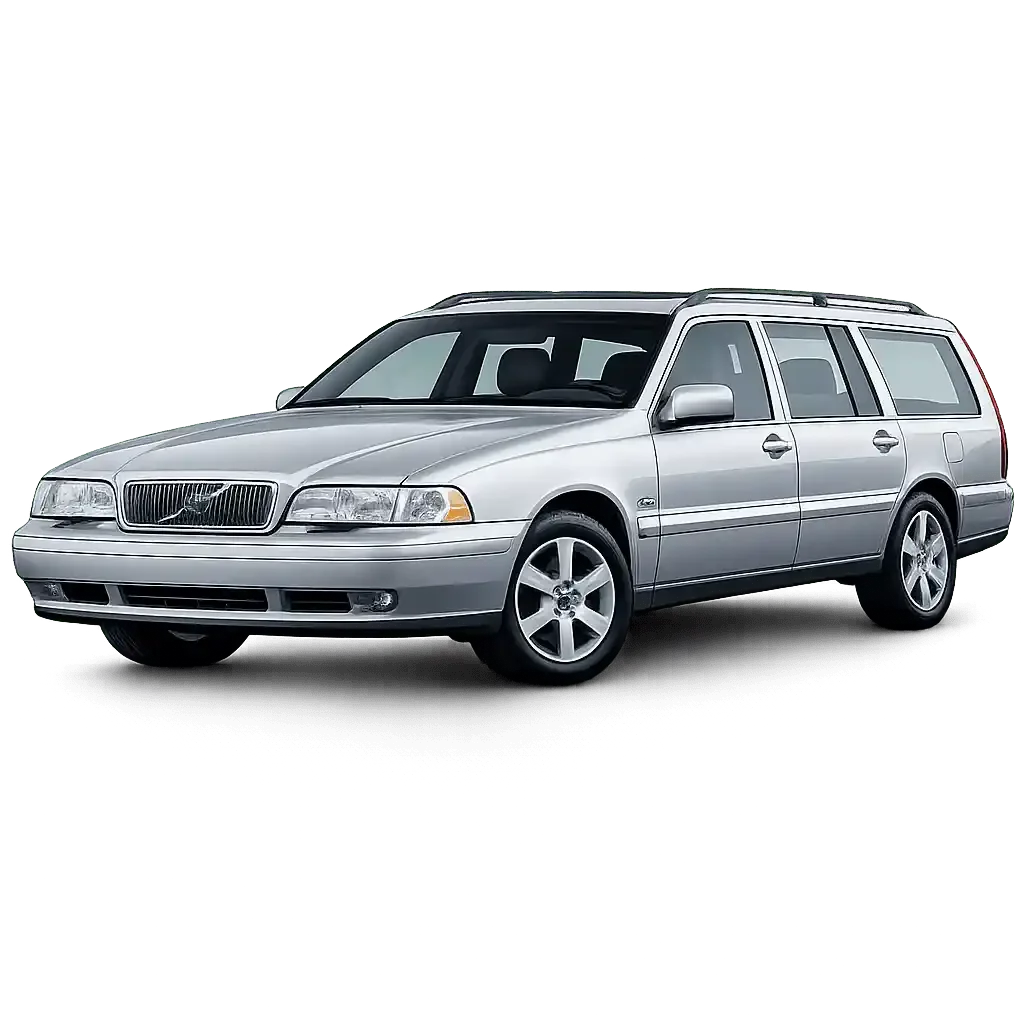
The Complete Fitment Guide
Returns destroy margins. The 1997-1998 Volvo V90 is a two-year-only estate wagon that was essentially a rebadged Volvo 960 wagon, and that rebadging creates the single biggest fitment headache for parts sellers: the V90 shares nearly all mechanical components with the 1995-1997 Volvo 960, but catalogs that fail to cross-reference the 960 will leave V90 owners unable to find parts, while catalogs that over-generalize to the entire 1991-1998 960 run will ship parts from the incompatible pre-facelift 960 (1991-1994). Adding to the confusion, the V90 nameplate was revived in 2017 for an entirely different, modern SPA-platform wagon with zero parts commonality. This guide maps every fitment split that matters for the classic 1997-1998 V90.
Generation Overview (1997-1998)
The 1997-1998 Volvo V90 is the estate (wagon) variant of the Volvo 900 Series, specifically the final evolution of the Volvo 960 wagon. Volvo renamed the 960 sedan as S90 and the 960 wagon as V90 for the 1997 model year to align with the new alphanumeric naming convention already used on the S40, V40, S70, and V70. The name change was accompanied by only minor updates - new interior and exterior color options, a revised center console, updated seat design with more rounded contours, and an improved air conditioning system. Mechanically, the V90 is virtually identical to the 1995-1997 Volvo 960 estate.
The V90 was the last rear-wheel-drive Volvo wagon. Production ended in February 1998 when the entire 900 Series was discontinued. Total V90 production across both model years was approximately 9,067 units worldwide. The V90 was indirectly replaced by the P2-generation V70, which served as the bridge between the outgoing 900 Series and the new S80 platform.
Key platform facts:
• Platform: 900 Series (evolved from 700 Series, originally designed for the 740/760)
• Production: Late 1996 to February 1998 (1997 and 1998 model years)
• Total production: Approximately 9,067 units (V90 wagon only)
• Assembly: Torslanda, Gothenburg, Sweden (1995-1998 960/S90/V90)
• Body style: 5-door estate (wagon) only - the sedan variant is the S90
• Engine: Volvo Modular inline-6 ("White Block") - B6304 family exclusively
• Transmission: Aisin-Warner AW30-43LE 4-speed automatic (US market, all models)
• Drive: Rear-wheel drive (RWD) exclusively - no AWD option
• Front suspension: MacPherson strut (redesigned for 1995 facelift to match 850 geometry)
• Rear suspension: Multi-link independent (Multilink II) with transverse fiberglass composite leaf spring
Why the 1997-1998 V90 Causes Catalog Errors
• Name reuse confusion: The V90 nameplate was revived in 2017 for Volvo's modern SPA-platform wagon. These two vehicles share absolutely zero parts. A buyer searching for "Volvo V90" parts must be routed to the correct generation or the part will be completely wrong.
• 960 cross-reference gap: The V90 is mechanically identical to the 1995-1997 Volvo 960 estate for nearly all components. Catalogs that list V90 parts without cross-referencing the 960 will show zero results for many components, sending V90 owners elsewhere.
• Pre-facelift vs. post-facelift 960: The 1995 model year brought a major facelift to the 960 with a completely redesigned front suspension, a new multi-link rear suspension, revised bodywork, and different wheel offsets. The 1991-1994 960 and the 1995-1998 960/V90 are fundamentally different vehicles in many areas. Parts from the early 960 often do not fit.
• 940 vs. 960/V90 confusion: The 940 and 960 share exterior dimensions and some body panels, but they have completely different engines (4-cylinder Red Block vs. 6-cylinder White Block), different transmissions, different front suspensions, and different rear suspensions. They are not interchangeable for drivetrain or suspension components.
• S90 vs. V90 body differences: The S90 sedan and V90 wagon share drivetrain and front suspension, but differ in rear body panels, tailgate, rear bumper, cargo area trim, and rear suspension spring rates. Nivomat self-leveling shocks and transverse leaf spring specifications differ between sedan and wagon.
• Wheel offset change: The 1995 facelift changed wheel offset from ET25 (pre-facelift 960 and all 940s) to ET43 (post-facelift 960, S90, V90). Pre-facelift and 940 wheels do not properly fit the V90.
Complete Powertrain Reference (US Market)
B6304FS2 - 2.9L Naturally Aspirated Inline-6 (US Market, 1997-1998)
• Engine family: Volvo Modular inline-6 ("White Block"), co-developed by Volvo and Porsche
• Engine code: B6304FS2 (catalyzed, US emissions specification, post-1995 camshaft profile)
• Displacement: 2,922cc (2.9L) inline-6
• Valvetrain: DOHC, 24-valve (4 valves per cylinder)
• Aspiration: Naturally aspirated (no turbo, no supercharger)
• Output: 181 hp at 5,200 rpm (US spec), 199 lb-ft torque at 4,100 rpm
• Compression ratio: 10.7:1
• Fuel system: Bosch LH-Jetronic 3.2 sequential multi-point fuel injection
• Ignition: Distributorless ignition system (DIS), coil-on-plug
• Block material: Aluminum alloy ("White Block")
• Transmission: Aisin-Warner AW30-43LE 4-speed automatic with electronic control (all US models)
• Drive: Rear-wheel drive
• Fuel economy: EPA approximately 18/26 MPG (city/highway)
Camshaft note: The pre-facelift 960 (1991-1994) used the B6304FS engine with higher-lift, longer-duration camshafts producing 204 hp. For 1995+, Volvo switched to the B6304FS2 with lower-lift camshafts (B6244FS profile) that reduced peak hp to 181 but improved mid-range torque and drivability. The camshafts are swappable for owners seeking the higher-power profile, but the V90 as delivered to US buyers always had the 181 hp specification.
Engine Cross-Reference Notes
The B6304FS2 engine in the US-market V90 is the same physical engine used in the following Volvo models: 1995-1997 Volvo 960, 1997-1998 Volvo S90. Engine internals, timing components, fuel injection parts, ignition components, and engine management are shared across these applications. The earlier B6304FS (1992-1994 960, 204 hp spec) shares the same block and head casting but uses different camshafts with higher lift and longer duration. Most engine hard parts (pistons, bearings, oil pump, water pump, gaskets) interchange, but camshafts and cam timing components should be verified by engine code.
Transmission
Aisin-Warner AW30-43LE 4-Speed Automatic
• Type: Electronically controlled 4-speed automatic with torque converter lockup
• Application: All US-market V90 models (no manual transmission available in US)
• Cross-reference: Same unit used in 1995-1997 960 and 1997-1998 S90 (US market)
• Notes: Electronic shift control. Known for generally reliable operation. Common wear items include the torque converter lockup clutch and shift solenoids. Fluid type: Dexron III/Mercon ATF.
European market note: Some European 960/V90 models were available with the M90 5-speed manual transmission (derived from the Volvo 850 gearbox). This transmission was never offered in the US market. US aftermarket sellers should not list M90 manual transmission parts as fitting US V90 models.
Suspension and Chassis
Front Suspension
The V90 uses MacPherson struts at the front, redesigned for the 1995 model year to more closely match the Volvo 850's front suspension geometry. This redesigned front suspension is shared with the 1995-1997 960 and 1997-1998 S90. It is NOT shared with the 1991-1994 960 or any 940 model. Struts, springs, control arms, and steering components from pre-1995 960 models and from the 940 do not fit.
Rear Suspension - Multilink II with Transverse Leaf Spring
The V90 uses the Multilink II independent rear suspension, introduced for the 1995 model year facelift. This system uses a single transverse fiberglass composite leaf spring mounted across the rear of the vehicle rather than conventional coil springs. The leaf spring sits beneath the multi-link control arms and supports both sides of the rear axle.
This is the most critical fitment area for the V90. The transverse leaf spring comes in multiple specifications depending on body style (sedan vs. wagon) and shock absorber type (standard dampers vs. Nivomat self-leveling). Shipping the wrong spring specification results in incorrect ride height, poor handling, and premature shock absorber failure.
• Wagon with Nivomat (most common V90 configuration): Light-duty leaf spring paired with Nivomat self-leveling shocks. The Nivomats supplement the spring in supporting the vehicle's weight.
• Wagon without Nivomat: Heavy-duty leaf spring paired with standard shock absorbers. The spring alone must support the full load.
• Sedan (S90): Different spring rate from wagon - lighter duty. Do not interchange sedan and wagon springs.
Nivomat shocks: These are self-leveling shock absorbers manufactured by Sachs-Boge. They are mechanical (no electronics, no air lines) and maintain ride height automatically by pumping internal fluid as the suspension cycles. They are significantly more expensive than standard shocks and must be paired with the correct leaf spring. Nivomat shocks from the sedan do not have the same length or rate as wagon Nivomats.
Brakes
• Type: Four-wheel disc brakes with ABS
• Front: Ventilated disc, sliding caliper (ATE, Bendix/DBA, or Girling depending on production date)
• Rear: Solid disc, sliding caliper
• Parking brake: Mechanically operated drum-in-disc (internal shoes inside rear rotor hat)
• Master cylinder: Tandem master cylinder with vacuum booster
• Caliper note: Three caliper manufacturers were used (ATE, Bendix/DBA, Girling). The caliper type must be identified before ordering pads or caliper rebuild kits. Pads and hardware are not universal across caliper brands.
Wheels and Tires
• Wheel bolt pattern: 5x108mm
• Wheel offset: ET43 (post-facelift 960, S90, V90)
• Hub bore: 65.1mm
• Factory wheel sizes: 15-inch and 16-inch options
• Critical note: Pre-facelift 960 (1991-1994) and all 940 models use ET25 offset wheels. These DO NOT properly fit the V90. The wider offset will push the wheel further inboard, potentially causing clearance issues with suspension components.
Catalog Accuracy - The Fitment Splits That Matter
Split 1: V90 (1997-1998) vs. V90 (2017-2026)
These are completely different vehicles with zero parts commonality. The 1997-1998 V90 is a rear-wheel-drive, inline-6, body-on-frame-derived 900 Series wagon built on a platform dating to the 1980s. The 2017-2026 V90 is a front/all-wheel-drive, 4-cylinder, SPA-platform wagon with modern safety systems. Every catalog must treat these as entirely separate vehicles. A search for "Volvo V90" without a year filter will return results from both generations.
Split 2: V90 / Post-Facelift 960 (1995-1998) vs. Pre-Facelift 960 (1991-1994)
The 1995 model year brought a major redesign to the 960 that carried through to the V90. The front suspension was completely redesigned (MacPherson strut geometry changed to match the 850). The rear suspension was replaced with the Multilink II system using a transverse composite leaf spring (replacing the earlier Multilink I). Wheel offset changed from ET25 to ET43. The body received updated front styling with a new grille, headlights, and body-colored panels. The engine camshafts changed from B6304FS (204 hp) to B6304FS2 (181 hp).
For drivetrain, front suspension, rear suspension, wheels, and front body panels, the V90 cross-references with the 1995-1997 960 and 1997-1998 S90 ONLY. For interior trim, some panels carry over from the pre-facelift 960, but seats and center console are different.
Split 3: 960/V90 vs. 940
The 940 and 960/V90 share the 900 Series platform and similar exterior dimensions. However, they differ in engine (940 uses 4-cylinder Red Block; 960/V90 uses 6-cylinder White Block), transmission (different units for 4-cylinder vs. 6-cylinder), front suspension (different geometry pre-1995; partially shared post-1995), rear suspension (940 uses rigid axle with coil springs; 960/V90 uses multi-link independent), and wheel offset (940 uses ET25; post-facelift 960/V90 uses ET43). Drivetrain and suspension components do not interchange.
Some body panels (doors, hood, roof) may interchange between 940 and 960/V90 of the same era, but bumpers, front fenders, grille, headlights, and interior trim differ significantly.
Split 4: V90 Wagon vs. S90 Sedan
The V90 wagon and S90 sedan share the same drivetrain (engine, transmission, driveshaft, differential), front suspension, front brakes, steering system, and most interior components forward of the B-pillar. However, they differ in rear body panels (everything behind the B-pillar), rear bumper, tailgate vs. trunk lid, cargo area trim, rear suspension spring rates (wagon spring is heavier duty or paired differently with Nivomats), and potentially rear shock absorber specifications. When listing suspension components, always specify sedan (S90) or wagon (V90).
Split 5: Brake Caliper Manufacturer
Three different brake caliper manufacturers supplied calipers for the 960/S90/V90: ATE, Bendix (DBA), and Girling. Brake pads and caliper rebuild kits are NOT universal across these three manufacturers. The caliper type must be identified (usually by visual inspection of the caliper casting) before ordering pads, hardware, or rebuild components. Listing brake pads as fitting all 960/V90 models without specifying caliper manufacturer will generate returns.
Split 6: Rear Suspension Spring and Shock Configuration
The transverse fiberglass composite leaf spring and shock absorber configuration varies by body style and equipment level. Wagon models (V90, 960 estate) with Nivomat self-leveling shocks use a different (lighter-duty) spring than wagon models with standard shocks (heavier-duty spring). Sedan models (S90, 960 sedan) use a different spring rate than wagons. Always specify: wagon with Nivomat, wagon without Nivomat, or sedan. The three primary leaf spring part numbers should not be cross-referenced.
Biggest Return Traps and How to Prevent Them
Trap 1: Modern V90 (2017+) Parts Shipped for Classic V90 (1997-1998)
What happens: A buyer searches "Volvo V90" and the catalog returns parts for the modern 2017+ SPA-platform V90 Cross Country. The part arrives and is completely wrong - different platform, different engine, different everything.
Prevention: Always require model year in any V90 search. If your catalog does not separate these two vehicles by generation, you will generate returns. These vehicles share a name and nothing else.
Trap 2: Pre-Facelift 960 (1991-1994) Parts for V90
What happens: A seller lists front struts, control arms, or wheel bearings as fitting "1991-1998 960" and ships pre-facelift parts to a V90 owner. The front suspension geometry changed completely for 1995. The parts do not fit.
Prevention: Always split 960 fitment at the 1994/1995 boundary. The V90 cross-references with the 1995-1997 960 ONLY for suspension, steering, wheels, and front body panels.
Trap 3: 940 Parts for 960/V90
What happens: The 940 and 960 look similar externally. A seller ships a 940 rear shock absorber (designed for a rigid axle with coil springs) to a V90 owner whose vehicle has a multi-link independent rear suspension with a transverse leaf spring. The part is completely incompatible.
Prevention: Never cross-reference 940 drivetrain, suspension, or brake components with the 960/V90 without verifying by OE part number.
Trap 4: S90 Sedan Rear Suspension for V90 Wagon
What happens: Rear springs or Nivomat shocks specified for the S90 sedan are shipped for a V90 wagon. The spring rate is wrong for the heavier wagon body, resulting in a sagging rear end, poor handling, and premature shock failure.
Prevention: Always specify: S90 sedan or V90 wagon for any rear suspension component. Leaf springs and Nivomat shock absorbers are NOT interchangeable between sedan and wagon.
Trap 5: Wrong Brake Caliper Parts
What happens: Brake pads or caliper hardware listed as fitting "all 960/V90" are shipped. The buyer has ATE calipers but receives pads profiled for Girling calipers. The pads do not seat correctly in the caliper bracket.
Prevention: Always specify caliper manufacturer: ATE, Bendix (DBA), or Girling. Require the buyer to identify their caliper before ordering.
Trap 6: ET25 Wheels Listed as Fitting V90
What happens: Wheels from a pre-facelift 960 or a 940 (ET25 offset) are listed as fitting the V90. The V90 requires ET43 offset. The wheel sits too far inboard, causing potential clearance issues and incorrect handling geometry.
Prevention: Always specify wheel offset when listing wheels. V90/S90 and post-facelift 960 require ET43. Pre-facelift 960 and 940 use ET25.
Data Quality Checklist for Catalog Managers
Required attributes for every 1997-1998 V90 parts listing:
• Model year(s): 1997, 1998
• Model: V90 (wagon) - distinguish from S90 (sedan)
• Generation: 900 Series / Classic (1997-1998) - MUST distinguish from 2017+ V90
• 960 cross-reference: Include 1995-1997 960 fitment where applicable
• Body style: Wagon (V90) vs. Sedan (S90) for rear suspension and body parts
• Brake caliper: ATE / Bendix (DBA) / Girling
• Rear suspension: Nivomat-equipped vs. standard shocks (for leaf spring and shock selection)
• Wheel offset: ET43 (V90 / S90 / post-facelift 960)
Buyer Confirmation Prompts
Before shipping any part for a 1997-1998 V90, confirm:
• "Is your vehicle the 1997-1998 V90 wagon or the 2017+ V90?" - Critical for any V90 search.
• "What is your exact model year?" - Ensures 1997 or 1998.
• "For brake parts: What brand of caliper do you have? (ATE, Bendix, or Girling)"
• "For rear suspension: Does your vehicle have Nivomat self-leveling shocks?"
• "For wheels: Your vehicle requires ET43 offset - please confirm."
Aftermarket Parts Cross-Reference Notes
Primary cross-reference vehicles: The V90 (1997-1998) cross-references most broadly with the Volvo 960 (1995-1997) and Volvo S90 (1997-1998). These three vehicles share the same drivetrain, front suspension, steering, front brakes, and most interior components forward of the B-pillar. Rear suspension components must be specified by body style (sedan vs. wagon) and shock absorber type.
Engine cross-reference: The B6304 engine family spans the entire 960/S90/V90 range from 1992-1998. Most engine hard parts (block internals, oil pump, water pump, gaskets, timing components) cross-reference across the full range. Camshafts differ between pre-facelift (B6304FS, 204 hp) and post-facelift (B6304FS2, 181 hp). Exhaust manifolds, intake manifolds, and engine management cross-reference within the same engine code.
Transmission cross-reference: The Aisin-Warner AW30-43LE 4-speed automatic is used across all US-market 960/S90/V90 models (1992-1998). Transmission internals, solenoid packs, and rebuild kits cross-reference broadly.
Body-specific components: The V90 wagon body (from B-pillar rearward) is unique from the S90 sedan. The V90 body is shared with the 960 estate (1995-1997) with minor trim differences. Tailgate, rear bumper, rear quarter panels, and cargo area trim from the 960 estate fit the V90.
Parts sourcing challenges: The 1997-1998 V90 is now nearly 30 years old with only 9,067 units produced. Some parts - particularly the transverse fiberglass composite rear leaf spring and Nivomat shock absorbers - are no longer available from Volvo. Aftermarket reproduction springs have become available from specialist suppliers like Skandix. FCP Euro and IPD (ipdusa.com) carry the broadest US aftermarket inventories for this platform. MatthewsVolvoSite.com forums maintain extensive DIY guides and parts sourcing threads.
The Business Case: Why Fitment Data Pays for Itself
The 1997-1998 V90 is an extremely low-volume vehicle (9,067 units worldwide) with a passionate owner community that keeps these cars running well past 200,000 miles. Parts orders are infrequent but often high-value (Nivomat shocks, leaf springs, engine timing components), and the owners tend to be knowledgeable enthusiasts who will immediately identify a wrong part. Return rates on incorrectly cataloged V90 parts are disproportionately high because the fitment nuances - brake caliper manufacturer, leaf spring specification, wheel offset, and the critical 960 facelift boundary - are not intuitive.
The single highest-impact catalog improvement for this vehicle is ensuring that the 1997-1998 V90 (900 Series) and the 2017+ V90 (SPA platform) are cleanly separated in search results. A single mis-routed order between these two completely incompatible vehicles is an automatic return with full shipping loss in both directions.
The V90 nameplate collision, the 960 facelift boundary, the 940 cross-reference confusion, the sedan-vs-wagon suspension split, and the brake caliper manufacturer variation are the minimum fitment splits required. If your catalog does not capture these, you are losing money on preventable returns and losing customers who cannot find the right part.
Disclaimer: This guide is based on publicly available specifications, Volvo press materials, and independent research. Part interchangeability should always be confirmed via VINand OEM part number lookup. Specifications may change without notice. This document does not constitute official Volvo parts catalog data. Visuals and illustrations in this article were generated using AI for representative purposes and may not reflect exact technical schematics.