
Volvo S90 (P90 Platform) 1997-1998
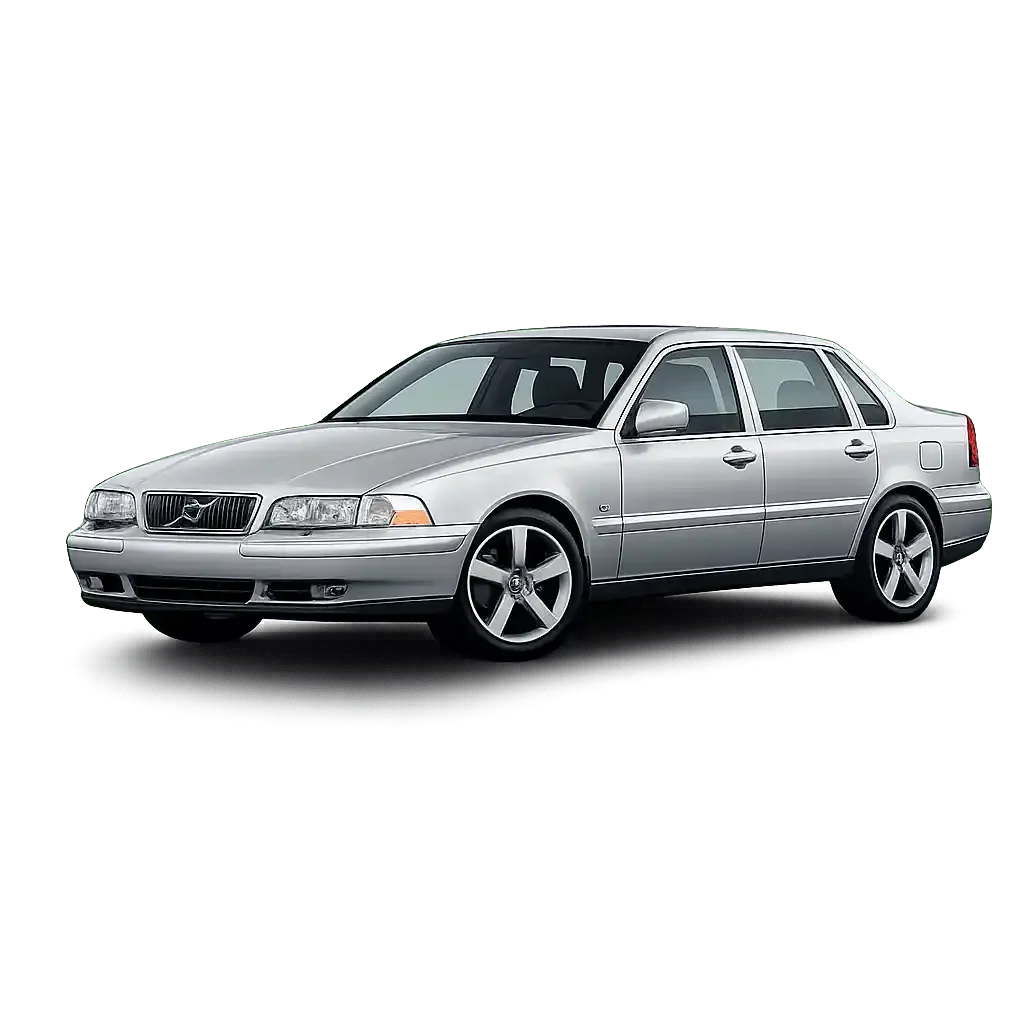
The Complete Fitment Guide
Returns destroy margins. The Volvo S90 (1997-1998) is a rebadged and mildly updated Volvo 960 sedan, produced for just two model years before Volvo ended its rear-wheel-drive executive car lineage entirely. The S90 is mechanically identical to the 1995-1997 facelifted 960 sedan (often called the "Mk2" 960), sharing the same platform, engine, transmission, suspension, and nearly all components. In the US market, it was powered exclusively by the 2.9-liter Whiteblock inline-six (B6304FS2) paired with a four-speed Aisin-Warner AW30-43LE automatic transmission and rear-wheel drive. The V90 is the estate (wagon) variant on the same platform. The S90 is one of the most straightforward Volvos to catalog, but its short production run, its near-total overlap with the 960, its nameplate collision with the 2017-present SPA-platform S90, and the Nivomat-versus-standard rear suspension split create persistent return traps. This guide maps every fitment split required to prevent returns on Volvo's last traditional rear-wheel-drive sedan.
Generation Overview (1997-1998)
The S90 nameplate was introduced in late 1996 for the 1997 model year as part of Volvo's transition from numeric model names (960) to the letter-and-number naming convention already used on the S40, S70, and V70. The S90 designation replaced "960" on the sedan, and "V90" replaced "960" on the estate/wagon. In North America, this renaming took effect for the 1997 model year.
The S90 is not a new model. It is a continuation of the 1995-onward facelifted Volvo 960, which itself was the top-of-range evolution of the 900 Series that originated in 1990 as a replacement for the 760. The 1995 facelift (often called "Mk2" in the community) was substantial: all-new front and rear body panels, redesigned front suspension (MacPherson strut, closer in geometry to the 850), a completely new multilink independent rear suspension with a single fiberglass composite transverse leaf spring replacing the earlier coil springs, revised interior with burled walnut trim and cupholders, and a reduction in engine output from 204 hp to 181 hp in the US market due to revised cam profiles for improved low-end torque and emissions compliance.
The 1997 S90 renaming brought relatively minor updates on top of this already-facelifted platform: new exterior color options, an improved air conditioning system, a restyled center console with a taller armrest, new upholstery options, new wheel designs, and the availability of a GPS navigation system. The 1998 model year brought additional new upholstery and a Limited Edition variant. Production of the S90, V90, and remaining 960 models ended on February 5, 1998.
The S90 was replaced by the Volvo S80 (1999-onward), which moved to a completely new front-wheel-drive platform with transversely mounted engines. The S90 nameplate was revived in 2016 for an entirely unrelated flagship sedan on the SPA (Scalable Product Architecture) platform.
Key platform facts:
Platform: P90 (Volvo 900 Series, evolution of 700 Series architecture)
US model years: 1997-1998
Assembly: Torslanda plant, Gothenburg, Sweden (1995-1998 production). Earlier 960 models (1992-1994) were built at the Kalmar plant.
Body style: Four-door sedan (S90). Five-door estate/wagon (V90).
Engine (US): Volvo Whiteblock 2.9L (2,922cc) DOHC 24-valve inline-six, B6304FS2. 181 hp at 5,200 rpm, 199 lb-ft (270 Nm) at 4,100 rpm.
Transmission (US): Four-speed Aisin-Warner AW30-43LE electronically controlled automatic with lockup torque converter. Economy, Sport, and Winter modes.
Drive: RWD exclusively. No AWD option.
Rear suspension: Multilink independent with fiberglass composite transverse leaf spring. Available with standard shocks or optional Nivomat self-leveling shocks.
Sibling: V90 (estate/wagon), mechanically identical.
Predecessor: Volvo 960 (1995-1997 Mk2 facelift models are mechanically identical to S90/V90)
Why the S90 Causes Catalog Errors
960/S90 nameplate overlap and VIN ambiguity: The 1997 model year was a split year. Early 1997 production cars were badged as 960 and late 1997 production cars were badged as S90, but some markets switched at different times. In the US, the changeover occurred for the 1997 model year. Critically, the VIN on all S90 and V90 models still shows the 960 platform code, not a unique S90 identifier. A VIN decode for a 1998 Volvo S90 will return 960-series codes. This causes confusion in catalog systems that use VIN-based lookup. The exterior badges ("S90" or "960") are the most visible identifier, but the mechanical content is the same from 1995 through 1998.
S90 (1997-1998) versus S90 (2017-present) nameplate collision: This is the most dangerous catalog error. The 1997-1998 S90 is a rear-wheel-drive inline-six sedan on the P90 platform. The 2017-present S90 is a front-wheel-drive or AWD four-cylinder sedan on the SPA platform. These vehicles share nothing. A parts search for "Volvo S90" without year or platform filtering will return results for both generations.
Mk1 960 (1992-1994) versus Mk2 960/S90 (1995-1998) suspension and body differences: The 1995 facelift was not cosmetic. It changed the entire front suspension geometry, replaced the rear suspension (coil springs to transverse leaf spring on sedans; live axle to multilink IRS on wagons), changed all front and rear body panels, introduced new headlights, a new grille, and new bumpers. Front suspension components, rear suspension components, and body panels do not interchange between Mk1 (1992-1994) and Mk2 (1995-1998) 960 models. The S90 (1997-1998) is exclusively Mk2.
Nivomat versus standard rear shocks and transverse leaf spring: The Mk2 960/S90/V90 multilink rear suspension was available in two configurations: standard shocks with a heavier-duty transverse leaf spring, or Nivomat self-leveling shocks with a lighter-duty transverse leaf spring. These are not interchangeable without converting the entire rear shock and spring setup. Installing standard shocks on a car equipped with the Nivomat leaf spring (or vice versa) will produce incorrect ride height and handling. The transverse leaf springs, shocks, and (on some part numbers) bump stops all differ between Nivomat and non-Nivomat configurations.
S90 sedan versus V90 wagon body and rear suspension differences: The S90 sedan and V90 wagon share the engine, transmission, front suspension, brakes, and all components forward of the B-pillar. Behind the B-pillar, every body panel differs (tailgate versus trunk, rear quarter panels, D-pillar, rear bumper, taillights, roof). The rear transverse leaf spring also differs between sedan and wagon: the wagon uses a stiffer spring rated for higher loads. Rear shocks differ between sedan and wagon as well. Nivomat shocks for the wagon (Monroe part 5979 cross-reference) are different from Nivomat shocks for the sedan (Monroe part 5978 cross-reference).
Rear brake pad size differences: The rear brake pads differ between the 960 and S90 in some applications. One set is taller than the other. This is a documented return trap where the wrong-height rear pads are installed and the pads either drag or fail to make full contact with the rotors.
Engine code confusion with European market variants: The US S90 used exclusively the B6304FS2 (181 hp, detuned for US emissions). European markets offered the full-power B6304S (204 hp) and earlier the 2.5-liter B6254FS (170 hp), as well as a detuned 3.0 B6304S2 (180 hp) for manual transmission applications. The B6304FS2 (US) has different cam profiles, different power output, and different engine management calibration than the European B6304S. Sensors and engine management components may differ.
Wheel offset change at 1995 facelift: The 1995-1998 Mk2 960/S90/V90 uses wheels with a 43mm offset, different from the 25mm offset on pre-1995 960 models and 940 models. Wheels from 940 and pre-1995 960 models do not fit correctly on the S90.
Complete Powertrain Reference (US Market)
2.9L Inline-Six (1997-1998) -- Volvo Whiteblock B6304FS2
Engine code: B6304FS2
Displacement: 2.9L (2,922cc) inline-six, longitudinally mounted
Block material: Aluminum block, aluminum head (Volvo Modular Engine / Whiteblock family)
Aspiration: Naturally aspirated
Valvetrain: DOHC, 24-valve (4 valves per cylinder)
Compression ratio: 10.7:1
Output (US): 181 hp (133 kW) at 5,200 rpm, 199 lb-ft (270 Nm) at 4,100 rpm
Output (European B6304S, for reference): 204 hp at 6,000 rpm, 197 lb-ft (267 Nm) at 4,300 rpm
Engine management: Bosch Motronic (OBD-II compliant from 1996 model year onward)
Timing: Timing BELT (interference engine). Replacement interval approximately 70,000 miles. This is a critical maintenance item. Belt failure causes valve-to-piston contact.
Transmission: Four-speed Aisin-Warner AW30-43LE electronically controlled automatic with lockup torque converter. Three selectable modes: Economy (E), Sport (S), Winter (W). The Winter mode starts in third gear for traction on slippery surfaces.
Drive: RWD only
US availability: 1997-1998 model years (continuation of the same powertrain used in the 1995-1997 960 Mk2 in the US)
Notes: The B6304FS2 is the US-emissions variant of the B6304 Whiteblock inline-six. The "FS" suffix denotes fuel system (catalyst equipped) and the "2" denotes the second revision, which has revised cam profiles (lower lift and duration compared to the original B6304S) for improved low-end torque and US emissions compliance. The detuning from 204 hp to 181 hp occurred for the 1995 US model year. The engine management system transitioned from OBD-I (1995 model year) to OBD-II (1996 onward). The S90 (1997-1998) is exclusively OBD-II.
Rear Suspension Reference
The Mk2 960/S90/V90 multilink independent rear suspension is one of the most complex areas for parts fitment. It uses a single fiberglass composite transverse leaf spring mounted on a large aluminum crossmember/subframe, with multilink control arms and CV-jointed halfshafts to each rear wheel.
Configuration 1: Standard (Non-Nivomat)
Shocks: Standard (non-self-leveling) shock absorbers
Transverse leaf spring: Heavy-duty fiberglass composite spring (stiffer rate, supports full vehicle weight without assistance)
Application: Base-specification sedans and some wagons
Notes: The heavy-duty spring alone supports the vehicle weight. Standard shocks provide damping only.
Configuration 2: Nivomat (Self-Leveling)
Shocks: Nivomat self-leveling shock absorbers (manufactured by Sachs/ZF). These are self-pumping: vehicle motion causes them to maintain ride height regardless of load.
Transverse leaf spring: Light-duty fiberglass composite spring (softer rate, relies on Nivomat shocks to supplement load support)
Application: Higher-specification sedans (typically CD trim with climate control, cruise, electric seats, wood trim) and most wagons
Notes: The light-duty spring does not fully support the vehicle weight on its own. If Nivomat shocks fail or are replaced with standard shocks without also changing to the heavy-duty spring, the rear of the vehicle will sag to the bump stops. Nivomat conversion (either direction) requires changing both shocks and the transverse leaf spring.
Sedan versus Wagon Rear Spring Differences
Even within the same Nivomat or non-Nivomat configuration, the transverse leaf spring part numbers differ between sedan and wagon. Wagons use stiffer springs rated for higher cargo loads. Sedan springs installed on a wagon will sag under load. Wagon springs installed on a sedan will produce a harsh ride.
Rear Shock Part Number Differences
Rear shocks differ by sedan versus wagon and by Nivomat versus non-Nivomat. There are four distinct rear shock configurations:
S90 sedan, non-Nivomat (standard shocks)
S90 sedan, Nivomat (self-leveling shocks)
V90 wagon, non-Nivomat (standard shocks)
V90 wagon, Nivomat (self-leveling shocks)
Critical Fitment Splits
Split 1: S90 (1997-1998, P90) vs. S90 (2017-present, SPA)
These are completely different vehicles on different platforms from different eras. The 1997-1998 S90 is a rear-wheel-drive inline-six sedan. The 2017-present S90 is a front/all-wheel-drive four-cylinder sedan. Zero components interchange. Any catalog system that does not enforce a hard generation boundary on the S90 nameplate will generate returns.
Split 2: Mk2 960/S90 (1995-1998) vs. Mk1 960 (1992-1994)
The 1995 facelift changed the front suspension, rear suspension, all body panels, headlights, grille, bumpers, wheel offset, and many electrical components. Front and rear suspension components, body panels, and wheels do not interchange across the 1994/1995 boundary. The S90 (1997-1998) is exclusively Mk2 and shares components only with the 1995-1997 facelifted 960.
Split 3: Nivomat vs. Non-Nivomat Rear Suspension
The transverse leaf spring, rear shocks, and (in some configurations) bump stops differ between Nivomat and non-Nivomat setups. These are not mix-and-match: installing Nivomat shocks on a non-Nivomat spring (or vice versa) produces incorrect ride height. Always confirm whether the vehicle has Nivomat or standard rear shocks before shipping rear suspension components.
Split 4: S90 Sedan vs. V90 Wagon
Body panels behind the B-pillar are completely different. Rear transverse leaf springs differ (wagon springs are stiffer). Rear shocks differ. Rear brake pads may differ in size.
Split 5: US Engine (B6304FS2, 181 hp) vs. European Engine (B6304S, 204 hp)
The US engine has different cam profiles, different power output, and different engine management calibration. Some sensors and engine accessories differ. Aftermarket parts suppliers shipping internationally must distinguish US-spec from European-spec engines.
Split 6: OBD-I (1995 960) vs. OBD-II (1996-1998 960/S90)
The 1995 960 Mk2 uses OBD-I diagnostics. The 1996-1998 960 and 1997-1998 S90 use OBD-II. Engine management sensors, oxygen sensor count (OBD-II added a second downstream O2 sensor), and diagnostic connectors differ.
Split 7: Wheel Offset (1995-1998 Mk2 vs. Pre-1995)
Mk2 960/S90/V90 wheels have a 43mm offset. Pre-1995 960 and 940 wheels have a 25mm offset. The pre-1995 wheels do not fit correctly on the S90.
Biggest Return Traps and How to Prevent Them
Trap 1: SPA-Platform S90 (2017+) Parts Shipped for P90-Platform S90 (1997-1998)
What happens: A 2017+ S90 brake rotor, air filter, or body panel ships to a 1998 S90 owner. These are completely different vehicles sharing only a nameplate.
Prevention: Always enforce generation/platform filtering on S90 searches. P90 S90 = 1997-1998, RWD, inline-six. SPA S90 = 2017-present, FWD/AWD, four-cylinder.
Trap 2: Mk1 960 (1992-1994) Suspension or Body Parts for Mk2 S90 (1997-1998)
What happens: A pre-1995 960 front control arm, rear coil spring, or headlight ships to an S90 owner. The Mk1 and Mk2 use completely different front suspension geometry, different rear suspension architecture, and different body panels.
Prevention: Always split at the 1994/1995 boundary. S90 (1997-1998) = Mk2 only. Parts cross-reference with 1995-1997 960 Mk2, not with 1992-1994 960 Mk1.
Trap 3: Nivomat Shocks Shipped Without Nivomat Leaf Spring (or Vice Versa)
What happens: A customer orders Nivomat replacement shocks for their S90, but their car was originally equipped with standard shocks and the heavy-duty non-Nivomat leaf spring. The Nivomat shocks install physically but the ride height is wrong because the heavy-duty spring is too stiff for the Nivomat damping characteristics. Or the reverse: standard shocks ship to a Nivomat-equipped car, and the rear sags because the light-duty Nivomat spring cannot support the vehicle weight without the self-leveling function.
Prevention: Always confirm Nivomat or non-Nivomat before shipping rear shocks or rear transverse leaf springs. Nivomat shocks are visually distinct (they have a rubber bellows/boot covering the telescopic section and are noticeably chunkier than standard shocks).
Trap 4: V90 Wagon Rear Parts Shipped for S90 Sedan (or Vice Versa)
What happens: V90 wagon rear shocks, rear transverse leaf spring, or rear body panels ship to an S90 sedan owner. The wagon and sedan use different spring rates, different shock valving, different body panels behind the B-pillar, and potentially different rear brake pad sizes.
Prevention: Always specify S90 (sedan) or V90 (wagon). Components forward of the B-pillar are shared. Everything behind the B-pillar requires body variant specification.
Trap 5: Wrong Rear Brake Pad Height
What happens: Rear brake pads of the wrong height ship to an S90 owner. There are documented cases of taller pads being installed on cars requiring shorter pads (or vice versa), causing the pads to either drag against the rotor edge or fail to make full contact.
Prevention: Verify the exact rear brake pad specification by part number lookup, not just by model year. The rear caliper and pad dimensions can vary by production date and market specification.
Trap 6: Pre-1995 Wheels (25mm Offset) for S90 (43mm Offset)
What happens: A set of Volvo 940 or pre-1995 960 wheels (25mm offset) ship to an S90 owner. The wheels bolt on but sit too far outward, causing clearance issues with the fenders and incorrect scrub radius geometry.
Prevention: Always specify wheel offset. S90/V90/Mk2 960 (1995-1998) = 43mm offset. 940 and Mk1 960 (pre-1995) = 25mm offset.
Aftermarket Parts Cross-Reference Notes
Platform cross-references: The S90 (1997-1998) is mechanically identical to the 1995-1997 Mk2 960 and shares all mechanical components. Any part listed for a 1995-1998 960 sedan will fit the S90 sedan, and any part listed for a 1995-1998 960 wagon will fit the V90 wagon. The VIN continues to identify these cars as 960-series even when badged S90/V90.
Engine cross-references: The B6304FS2 inline-six is a member of the Volvo Modular Engine (Whiteblock) family. It shares the same basic block architecture with the inline-five engines used in the 850/S70/V70 (same bore, different stroke and cylinder count). Some external accessories (alternator, power steering pump, water pump) may cross-reference between six-cylinder and five-cylinder Whiteblock applications, but always verify by engine code. The B6304 was also used in the S80 (first generation, 2.9L variant) and the C70.
Transmission cross-references: The AW30-43LE four-speed automatic was specific to the longitudinally mounted inline-six in the RWD 960/S90/V90 platform. It does not cross-reference with the AW55-51 used in the transversely mounted FWD 850/S70/V70.
Known maintenance items: Timing belt and tensioners (critical, 70,000-mile interval, interference engine), water pump (typically replaced with timing belt), Nivomat rear shocks (common failure item on equipped cars, expensive OEM, limited aftermarket), rear transverse leaf spring (fiberglass, can crack or weaken with age), front control arm bushings, tie rod ends, PCV system, transmission fluid and filter service, and brake components (with rear pad height verification) are the highest-volume parts orders.
Specialist sources: IPD (ipdusa.com) carries S90/V90/960 inventory under the "S90 (900)" category and distinguishes Mk2 (1995-1998) from earlier 960. VP Autoparts (vp-autoparts.com) stocks European-spec 960/S90/V90 parts. Skandix carries comprehensive catalogs with Nivomat versus non-Nivomat distinction. MatthewsVolvoSite forums maintain detailed 960/S90/V90 DIY and parts interchange information. TurboBricks forums cover the 900 Series in dedicated sections.
Data Quality Checklist for Catalog Managers
Required attributes for every S90 (1997-1998) parts listing:
Model year(s)
Platform generation: P90 (1997-1998, RWD, inline-six) versus SPA (2017-present, FWD/AWD, four-cylinder). This is the most critical split.
960 generation: Mk2 only (1995-1998). Do not cross-reference with Mk1 960 (1992-1994).
Engine code: B6304FS2 (US market, 181 hp, OBD-II)
OBD generation: OBD-II (1996-1998). Distinguish from OBD-I (1995 960 only).
Body type: S90 (sedan) or V90 (wagon)
Rear suspension configuration: Nivomat (self-leveling) or non-Nivomat (standard). Required for rear shocks, rear transverse leaf spring, and rear bump stops.
Wheel offset: 43mm (Mk2 960/S90/V90). Distinguish from 25mm (940, Mk1 960).
Buyer Confirmation Prompts
Before shipping any part for an S90 (1997-1998), confirm:
"Is your S90 from 1997 or 1998, or is it the newer 2017-onward S90?" The two generations share only a nameplate.
"Is your vehicle the S90 sedan or the V90 wagon?" Body panels behind the B-pillar, rear suspension springs, and rear shocks all differ.
"Does your rear suspension have Nivomat self-leveling shocks or standard shocks?" Nivomat shocks have a visible rubber bellows/boot and are visibly chunkier than standard shocks. This determines both shock and transverse leaf spring part numbers.
"What model year is your vehicle?" The S90/V90 (1997-1998) and the 1995-1997 Mk2 960 are mechanically identical. The 1992-1994 Mk1 960 is a different vehicle for suspension, body, and many other components.
The Business Case: Why Fitment Data Pays for Itself
The S90 is now 27-28 years old and deep into the enthusiast-maintained ownership cycle. These cars are kept alive by dedicated owners who value the last of Volvo's rear-wheel-drive executive sedans. Timing belt kits, Nivomat rear shocks, rear transverse leaf springs, front suspension bushings, and brake components are the highest-volume parts orders. The two most common return causes are the SPA-versus-P90 nameplate collision (shipping 2017+ S90 parts to a 1998 owner) and the Nivomat-versus-non-Nivomat rear suspension mismatch. The Mk1/Mk2 960 split at 1995 catches catalog systems that list "960" as a single vehicle without generation distinction. The rear brake pad height variation catches shops ordering by model name without verifying part number.
The S90's nameplate collision with the 2017-present S90, the Mk1/Mk2 960 split at 1995, the Nivomat versus non-Nivomat rear suspension configuration, the sedan versus wagon body and spring rate differences, the wheel offset change, and the OBD-I/OBD-II boundary are the minimum fitment attributes required. The S90 owner community is small, knowledgeable, and fiercely loyal to these cars. If your catalog does not enforce the P90/SPA generation boundary and the Nivomat/non-Nivomat rear suspension split, you are shipping wrong parts to the people least likely to forgive the error.
Disclaimer: This guide is based on publicly available specifications, Volvo press materials, and independent research. Part interchangeability should always be confirmed via VINand OEM part number lookup. Specifications may change without notice. This document does not constitute official Volvo parts catalog data. Visuals and illustrations in this article were generated using AI for representative purposes and may not reflect exact technical schematics.