
Volvo V40 Cross Country (2013-2019) Global Market
The Complete Fitment Guide
Returns destroy margins. The Volvo V40 Cross Country (2013-2019) is the raised, body-cladded variant of the standard Volvo V40 hatchback, built on the Ford Global C platform at Volvo's Ghent factory in Belgium. It shares every engine and transmission option with the standard V40 but adds unique body cladding, a suspension raised approximately 40mm over the standard car, larger wheels and tires, and -- on T4 and T5 petrol variants only -- optional Haldex Gen-5 all-wheel drive. The Cross Country was sold across Europe, Asia-Pacific, and other global markets but was never offered in the United States or Canada. Like the standard V40, it underwent the same sweeping mid-production powertrain transition from Ford-sourced and Volvo five-cylinder engines to Volvo VEA four-cylinder engines between 2014 and 2016, meaning the same badge-recycling problem (identical D2, D3, D4, T3, T4, T5 badge names applied to completely different engines from different manufacturers) carries over in full. But the Cross Country adds its own layer of catalog complexity: unique body panels that do not fit the standard V40, a delayed adoption of Thor's Hammer headlights compared to the standard car, the FWD-versus-AWD split on T4 and T5 models, and persistent mislabeling of FWD Cross Country models as AWD in online listings. This guide maps every Cross Country-specific fitment split on top of the powertrain splits inherited from the standard V40.
Generation Overview (2013-2019)
The V40 Cross Country debuted in 2013, one year after the standard V40 hatchback. It follows Volvo's long-running tradition of offering raised, rugged-styled variants of standard models, a practice that began with the V70 XC (later XC70) in 1997 and continued with the V60 Cross Country, S60 Cross Country, and V90 Cross Country.
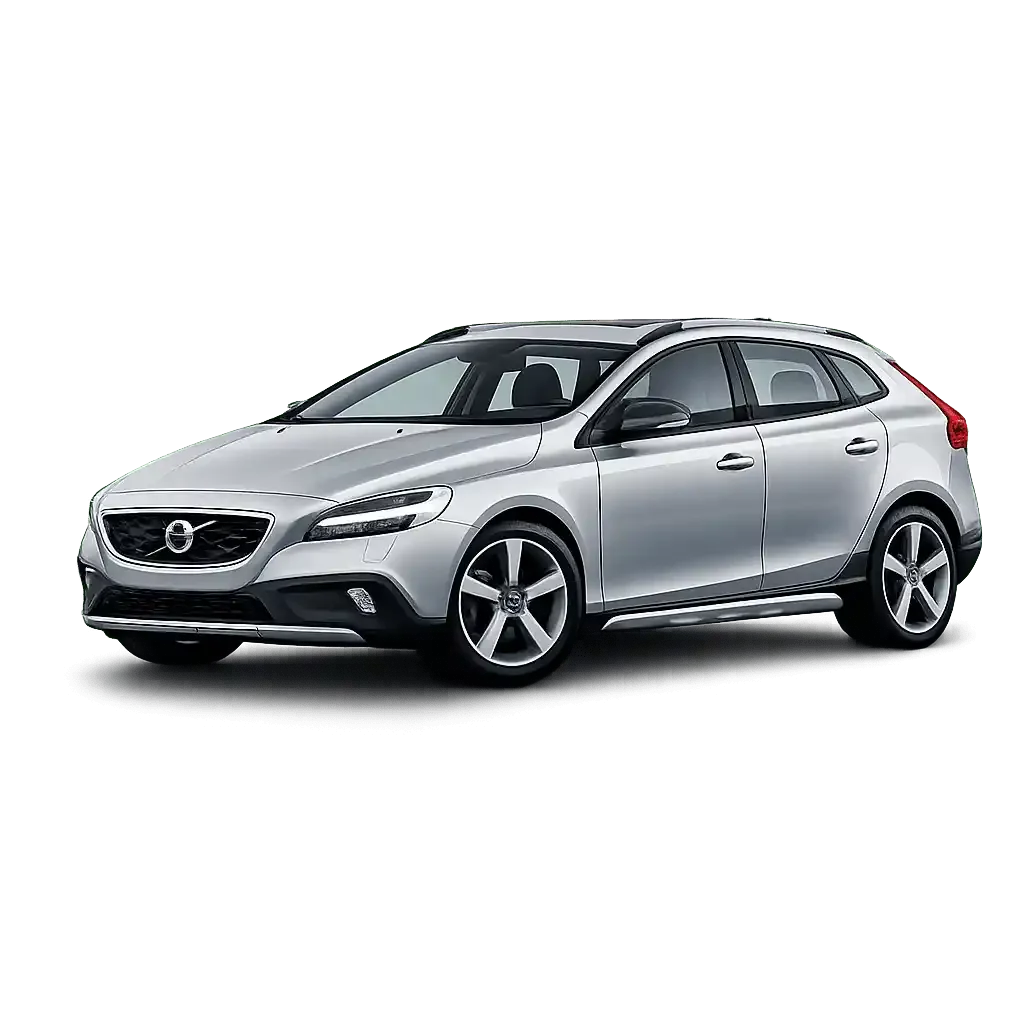
The Cross Country treatment on the V40 consists of a raised ride height (approximately 40mm over the standard V40, producing a ground clearance of approximately 145mm versus approximately 130mm on the standard car), unique front and rear bumpers with protective lower sections, black plastic body cladding on the lower doors and wheel arches, unique side skirts, silver-colored skid plate accents front and rear, roof rails, and larger wheel and tire packages. The suspension uses different springs and dampers calibrated for the increased ride height, with longer suspension travel than the standard V40.
The Cross Country was available with most of the same engine range as the standard V40, though it generally started at a higher power level. Entry-level models were typically the D2 diesel or T3 petrol, with D3, D4, T4, and T5 filling out the range. The key drivetrain distinction is that AWD (using a Haldex Gen-5 coupling) was available only on T4 and T5 petrol Cross Country models. All diesel Cross Country models were FWD only. Many T4 and T5 Cross Country models were also sold as FWD, making AWD an option rather than standard equipment. The standard V40 hatchback was FWD only across the entire range with no AWD option.
The Cross Country received the same 2016 facelift as the standard V40, introducing Thor's Hammer LED headlights, revised bumpers, a restyled grille, and updated taillights. However, the Cross Country variant adopted the Thor's Hammer headlights later than the standard V40, with many 2016 and 2017 Cross Country models still using the transitional pre-Thor's Hammer headlamp design. This delayed adoption makes headlight fitment particularly tricky on Cross Country models from this transition period.
Production ended in 2019 alongside the standard V40. The XC40 on the CMA platform effectively replaced both the V40 and V40 Cross Country in Volvo's lineup.
Key platform facts:
Platform: Ford Global C (shared with standard V40, Ford Focus Mk3, Ford C-Max, Ford Kuga/Escape)
Model years: 2013-2019
Assembly: Volvo Cars, Ghent, Belgium
Body style: Five-door raised hatchback with protective body cladding
Engine families: Three distinct families across the production run (Ford EcoBoost 1.6 petrol, Ford/PSA 1.6 diesel, Volvo five-cylinder petrol and diesel, Volvo VEA four-cylinder petrol and diesel, Volvo VEA 1.5 petrol)
Transmissions: Six-speed manual, six-speed Powershift dual-clutch auto (early models with Ford 1.6 engines), six-speed Aisin Geartronic torque converter auto, eight-speed Aisin Geartronic torque converter auto (D4 VEA and T5 VEA only)
Drive: FWD standard on all models. AWD (Haldex Gen-5) optional on T4 and T5 petrol variants only. All diesel models are FWD only.
Facelift: 2016 model year (Thor's Hammer LED headlights on standard V40; Cross Country adopted Thor's Hammer headlights later, with many 2016-2017 CC models retaining transitional headlamps)
Markets: Europe, UK, Asia-Pacific, Latin America, Middle East, Africa. Never sold in the US or Canada.
Why the V40 Cross Country Causes Catalog Errors
All of the catalog error sources from the standard V40 carry over to the Cross Country, because the two cars share the same powertrain lineup. These include badge recycling across different engine families, the Ford-to-VEA engine transition, the Powershift-to-Geartronic transmission change, the 1.5L versus 2.0L VEA displacement split on T2/T3, and the single-turbo versus twin-turbo distinction on VEA diesels. Refer to the Volvo V40 (2012-2019) guide for the complete powertrain reference.
The Cross Country adds its own layer of fitment traps:
Cross Country body panels do not fit the standard V40: The bumpers, lower body cladding, side skirts, wheel arch extensions, and roof rails are unique to the Cross Country. A standard V40 front bumper will not fit a Cross Country and a Cross Country front bumper will not fit a standard V40. The fender profiles differ to accommodate the wider wheel arch cladding.
Standard V40 suspension does not fit the Cross Country: The springs, dampers, and possibly subframe mounting points are calibrated differently for the raised ride height. Standard V40 suspension components installed on a Cross Country will lower the car to standard height and alter handling characteristics. Cross Country suspension installed on a standard V40 will raise it inappropriately.
FWD versus AWD is not reliably indicated by trim level: AWD was optional (not standard) on T4 and T5 petrol Cross Country models. Many T4 and T5 Cross Country cars were sold as FWD. Online listings frequently describe all Cross Country models as AWD, which is incorrect. AWD models have a Haldex Gen-5 coupling, propeller shaft, rear differential, and modified rear subframe that FWD models lack entirely. Axle shafts differ between FWD and AWD. The only reliable way to confirm drivetrain is by VIN decode or physical inspection.
Delayed Thor's Hammer headlight adoption: The standard V40 received Thor's Hammer LED headlights as part of the 2016 facelift, but the Cross Country variant adopted them later. Many 2016 and some 2017 Cross Country models were produced with transitional headlamps (the older curved DRL design, not the Thor's Hammer T-shape). This means the 2015/2016 facelift split for headlights is not clean on the Cross Country. Model year alone is not sufficient to determine headlight type on 2016-2017 Cross Country models. Visual inspection or VIN-based option code verification is required.
Cross Country wheel and tire sizes differ from standard V40: The Cross Country uses larger wheel and tire combinations as standard equipment. Wheel bearings are the same, but brake dust shields, wheel spacers (if equipped), and tire pressure monitoring sensor calibrations may differ.
Complete Powertrain Reference
The V40 Cross Country uses the same engine and transmission lineup as the standard V40. Rather than duplicate that information, this guide cross-references the Volvo V40 (2012-2019) guide for the full engine code, transmission, and powertrain reference.
The key points repeated here for Cross Country-specific context:
Pre-Facelift Cross Country Engines (2013-2015)
Petrol:
T3: Ford EcoBoost 1.6L (B4164T3, 150 hp). FWD only. Manual or Powershift auto.
T4: Ford EcoBoost 1.6L (B4164T, 180 hp) on FWD models with manual or Powershift auto. Volvo five-cylinder 2.0L (B5204T8/T9, 180-213 hp) on AWD models with Aisin Geartronic six-speed auto.
T5: Volvo five-cylinder 2.5L (B5254T12, 254 hp). FWD or AWD. Aisin Geartronic six-speed auto (AW TF-80SD) only.
Diesel:
D2: Ford/PSA 1.6L (D4162T, 115 hp). FWD only. Manual or Powershift auto.
D3: Volvo five-cylinder 2.0L (D5204T6, 150 hp). FWD only. Manual or Aisin Geartronic six-speed auto (AW TF-80SD).
D4: Volvo five-cylinder 2.0L (D5204T4, 177 hp) through 2014, then VEA four-cylinder 2.0L (D4204T14, 190 hp) from 2014. FWD only. Manual or Aisin Geartronic six-speed/eight-speed auto.
Post-Facelift Cross Country Engines (2016-2019)
All engines are Volvo VEA four-cylinder by this point:
Petrol:
T3: Volvo VEA 2.0L (B4204T37, 152 hp) with manual. Volvo VEA 1.5L (B4154T4, 152 hp) with automatic. FWD only.
T4: Volvo VEA 2.0L (B4204T19, 190 hp). FWD or AWD. Manual or six-speed Geartronic auto.
T5: Volvo VEA 2.0L (B4204T11, 245 hp). FWD or AWD. Eight-speed Geartronic auto (AW TG-81SC) only.
Diesel:
D2: Volvo VEA 2.0L (D4204T8, 120 hp). FWD only. Manual (M66, later M76) or six-speed Geartronic auto (AW TF-71SC).
D3: Volvo VEA 2.0L (D4204T9, 150 hp). FWD only. Manual (M66F, later M76) or six-speed Geartronic auto (AW TF-71SC).
D4: Volvo VEA 2.0L twin-turbo (D4204T14, 190 hp). FWD only. Manual (M66F) or eight-speed Geartronic auto (AW TG-81SC).
Critical Fitment Splits
Split 1: Engine Family (Ford 1.6 vs. Volvo Five-Cylinder vs. Volvo VEA Four-Cylinder)
Inherited from the standard V40. The badge name (D2, D3, D4, T3, T4, T5) is not a reliable fitment identifier. Engine code is mandatory. A "T5" from 2013 (B5254T12, 2.5L five-cylinder, 254 hp) and a "T5" from 2017 (B4204T11, 2.0L four-cylinder, 245 hp) share zero engine components.
Split 2: Transmission Type (Powershift vs. Geartronic vs. Manual)
Inherited from the standard V40. The Powershift dual-clutch auto (early Ford 1.6 engines), the Aisin Geartronic six-speed (TF-80SD for five-cylinders, TF-71SC or TF-81SC for VEA), the Aisin Geartronic eight-speed (TG-81SC for D4 VEA and T5 VEA), and the manual gearboxes (M66 variants, M76) are all different units with different service parts.
Split 3: VEA Petrol Displacement (2.0L vs. 1.5L on T3 Automatic)
Inherited from the standard V40. The T3 with automatic transmission uses the 1.5L destroked VEA (B4154T4). The T3 with manual uses the full 2.0L VEA (B4204T37). Same power, different displacement, different internal engine components.
Split 4: FWD vs. AWD (Cross Country Specific)
This is the most important Cross Country-specific split. AWD was optional on T4 and T5 petrol Cross Country models only. All diesel Cross Country models are FWD. Many petrol T4 and T5 Cross Country models were also sold as FWD. AWD adds a Haldex Gen-5 coupling, propeller shaft, rear differential, modified rear subframe, and different rear axle shafts. None of these components exist on FWD models. Front axle shafts also differ between FWD and AWD. Do not assume AWD based on trim level, engine badge, or "Cross Country" designation alone. VIN decode is required.
Split 5: V40 Standard vs. V40 Cross Country Body Panels
All exterior body panels below the beltline differ between the standard V40 and the Cross Country: front bumper (protective lower section with skid plate accent), rear bumper (protective lower section with skid plate accent), front fenders (wider to accommodate cladding), door cladding, side skirts, wheel arch extensions, and roof rails. Headlights, taillights, hood, and roof panel are shared between standard V40 and Cross Country (with the headlight timing caveat noted below).
Split 6: V40 Standard vs. V40 Cross Country Suspension
Springs, dampers, and ride height differ. Cross Country suspension is calibrated for approximately 40mm additional ride height and longer suspension travel. Standard V40 suspension components do not produce the correct ride height or handling characteristics on a Cross Country.
Split 7: Pre-Facelift (2013-2015) vs. Post-Facelift (2016-2019) Body Panels
The 2016 facelift changed headlights, front bumper, rear bumper, grille, and taillights on the Cross Country as well as the standard V40. However, the Cross Country adopted Thor's Hammer headlights on a delayed schedule. Many 2016 and some 2017 Cross Country models were built with the older transitional headlamp design. For headlights specifically, model year is not a reliable split on 2016-2017 Cross Country models. All other facelift panels (bumpers, grille, taillights) followed the same 2015/2016 boundary as the standard V40.
Split 8: Turbo Configuration on VEA Diesels (Single vs. Twin Sequential)
Inherited from the standard V40. The VEA D2 (D4204T8) and D3 (D4204T9) are single-turbo engines. The VEA D4 (D4204T14) uses a BorgWarner R2S sequential twin-turbo system. Turbo assemblies, exhaust manifolds, oil and coolant feed lines, and intercooler plumbing are completely different between single and twin-turbo configurations.
Split 9: Manual Gearbox Variant (M66 vs. M76)
Inherited from the standard V40. Around model year 2017, the M76 replaced the M66 on D2 and D3 diesel models. Clutch kit and flywheel components may differ.
Biggest Return Traps and How to Prevent Them
Trap 1: Standard V40 Body Panels Shipped for Cross Country (or Vice Versa)
What happens: A standard V40 front bumper ships to a Cross Country owner. The standard bumper lacks the protective lower section, the skid plate accent, and the mounting points for body cladding. It will not fit. Likewise, Cross Country bumpers shipped to standard V40 owners will not fit due to different mounting geometry and cladding attachment points.
Prevention: Always distinguish V40 (standard hatchback, model code 525/526) from V40 Cross Country (raised hatchback, model code 536/537). These are separate model codes. Every body panel listing must specify which variant.
Trap 2: FWD Drivetrain Parts Shipped for AWD Cross Country (or Vice Versa)
What happens: Front axle shafts, rear subframe components, or differential parts for a FWD Cross Country ship to an AWD owner, or vice versa. AWD models have a propeller shaft, Haldex coupling, rear differential, and different rear subframe that FWD models completely lack.
Prevention: Always confirm FWD or AWD by VIN decode. Do not assume AWD based on "Cross Country" designation, T4/T5 badge, or seller description. Many T4 and T5 Cross Country models are FWD.
Trap 3: Wrong Headlights for 2016-2017 Cross Country (Thor's Hammer vs. Transitional)
What happens: Thor's Hammer LED headlights ship to a 2016 or 2017 Cross Country owner whose car was built with the older transitional headlamp design, or vice versa. The two headlight designs have different housings, different electrical connectors, and different mounting geometry.
Prevention: On 2016-2017 Cross Country models, do not assume headlight type from model year. Require visual confirmation (photograph of existing headlight) or VIN-based option code verification.
Trap 4: VEA Engine Parts Shipped for Five-Cylinder Engine (or Vice Versa)
What happens: Inherited from the standard V40. A VEA four-cylinder turbo assembly ships to a 2013 Cross Country T5 owner with the B5254T12 five-cylinder, or vice versa. These are different engine architectures with different cylinder counts and physical dimensions.
Prevention: Always require engine code. Badge names are ambiguous across the entire Cross Country range.
Trap 5: Powershift Transmission Parts for Geartronic (or Vice Versa)
What happens: Inherited from the standard V40. A Powershift dual-clutch fluid or mechatronic unit ships to an owner with an Aisin Geartronic torque-converter automatic. These are fundamentally different architectures.
Prevention: Always specify transmission type and code.
Trap 6: Standard V40 Suspension for Cross Country (or Vice Versa)
What happens: Standard V40 springs or dampers ship to a Cross Country owner. Installation drops the ride height by approximately 40mm and eliminates the suspension travel characteristics the Cross Country was designed for. Cross Country springs shipped to a standard V40 raise the car inappropriately and alter handling.
Prevention: Always distinguish V40 standard from V40 Cross Country for springs, dampers, and any ride-height-related components.
Trap 7: Single-Turbo Diesel Parts for Twin-Turbo D4 (or Vice Versa)
What happens: Inherited from the standard V40. A single turbo assembly for the D2 or D3 ships to a D4 owner with the twin-turbo BorgWarner R2S system.
Prevention: Always distinguish D2/D3 (single turbo) from D4 (twin sequential turbo) on VEA diesel models.
Aftermarket Parts Cross-Reference Notes
Platform cross-references: The V40 Cross Country shares its platform with the standard V40, Ford Focus Mk3, Ford C-Max, and Ford Kuga/Escape. Some chassis components (wheel bearings, suspension bushings) may cross-reference. Engine and transmission components cross-reference with the standard V40 by engine code.
Cross Country body cross-references: The V40 Cross Country body panels are unique to the Cross Country and do not cross-reference with any other Volvo model. The "Cross Country" treatment on larger Volvos (V60 Cross Country, V90 Cross Country) uses different body panels on different platforms.
AWD system cross-references: The Haldex Gen-5 coupling used in the V40 Cross Country AWD is also used in other Volvo applications (XC40, V60 Cross Country of the same era) and in Volkswagen Group AWD vehicles (Golf R, Tiguan). Some Haldex service components (coupling fluid, filter) may cross-reference, but mounting hardware, propeller shafts, and differentials are vehicle-specific.
Known maintenance items: All standard V40 maintenance items apply (timing belt/chain service, DPF cleaning/replacement, turbo replacement, PCV/oil trap, transmission service, brake components). Cross Country-specific items include front and rear skid plate inspection/replacement, body cladding clip and fastener replacement (these break with age and UV exposure), roof rail inspection, and Haldex coupling fluid service on AWD models (typically every 60,000 km or three years). The Haldex fluid service is critical and often neglected on used Cross Country AWD models. A seized or failing Haldex coupling is an expensive repair that is often misdiagnosed as a transmission problem.
Specialist sources: Volvo V40 Club (volvov40club.com) is the most active owner forum with dedicated Cross Country sections. FCP Euro stocks V40 Cross Country parts with engine code and body variant identification. Skandix provides Cross Country-specific part numbers. IPD carries select performance and maintenance parts.
Data Quality Checklist for Catalog Managers
Required attributes for every V40 Cross Country parts listing:
Model year(s)
Engine code (never just the badge name)
Engine family: Ford EcoBoost 1.6, Ford/PSA 1.6 diesel, Volvo five-cylinder, Volvo VEA four-cylinder 2.0, or Volvo VEA four-cylinder 1.5
Transmission type and code: Powershift (MPS6-7), Geartronic six-speed (TF-80SD, TF-71SC, or TF-81SC), Geartronic eight-speed (TG-81SC), or manual (M66 variant or M76)
Body variant: V40 Cross Country (not standard V40)
Drivetrain: FWD or AWD (confirmed by VIN, not assumed from trim level)
Facelift era: Pre-facelift (2013-2015) or post-facelift (2016-2019) for body panels. For headlights on 2016-2017 Cross Country, verify Thor's Hammer vs. transitional independently.
Turbo configuration (VEA diesels): Single turbo (D2, D3) or twin sequential turbo (D4)
Displacement (VEA T3 automatic): 2.0L (manual) or 1.5L (automatic)
Buyer Confirmation Prompts
Before shipping any part for a V40 Cross Country, confirm:
"What is your engine code?" Found on the engine cam cover sticker or in vehicle documentation. Badge names (D2, D3, D4, T3, T4, T5) cover multiple different engines across the Cross Country's production run.
"Is your V40 the standard hatchback or the Cross Country?" Body panels, bumpers, suspension, and potentially drivetrain all differ.
"Is your Cross Country FWD or AWD?" AWD was optional on T4 and T5 petrol models only. Many Cross Country cars are FWD. VIN decode is the only reliable confirmation.
"Do you have a manual or automatic transmission?" Determines 1.5L vs. 2.0L engine on VEA T3, and determines Powershift vs. Geartronic vs. manual for all transmission-related parts.
"Do your headlights have the Thor's Hammer LED design (T-shaped DRL) or the older curved DRL design?" Particularly important on 2016-2017 Cross Country models where the facelift headlight transition was staggered.
"What model year is your vehicle?" Critical for engine family (Ford/five-cylinder vs. VEA) and facelift status.
The Business Case: Why Fitment Data Pays for Itself
The V40 Cross Country is now five to twelve years old and well into the independent-shop maintenance window. It shares every powertrain return trap with the standard V40 (badge recycling across three engine families, Powershift-versus-Geartronic confusion, the 1.5L/2.0L VEA split, single-versus-twin-turbo diesel distinction) but adds its own body and drivetrain traps. The most expensive Cross Country-specific return is shipping FWD drivetrain parts to an AWD owner or vice versa, because the parts are heavy, high-value, and the error is obvious only after the technician is underneath the car. The second most common error is shipping standard V40 body panels to Cross Country owners or the reverse. The third is the headlight ambiguity on 2016-2017 Cross Country models where Thor's Hammer adoption was staggered compared to the standard V40.
The V40 Cross Country's shared-but-distinct relationship to the standard V40, the FWD/AWD ambiguity on T4/T5 models, the staggered Thor's Hammer headlight adoption, and all inherited powertrain splits from the standard V40 are the minimum fitment attributes required. If your catalog does not distinguish Cross Country from standard V40 at the body variant level and FWD from AWD at the drivetrain level, you are guaranteeing returns on this vehicle.
Disclaimer: This guide is based on publicly available specifications, Volvo press materials, and independent research. Part interchangeability should always be confirmed via VINand OEM part number lookup. Specifications may change without notice. This document does not constitute official Volvo parts catalog data. Visuals and illustrations in this article were generated using AI for representative purposes and may not reflect exact technical schematics.