
Volvo S80 (P3 Platform) 2007-2016 Second Generation
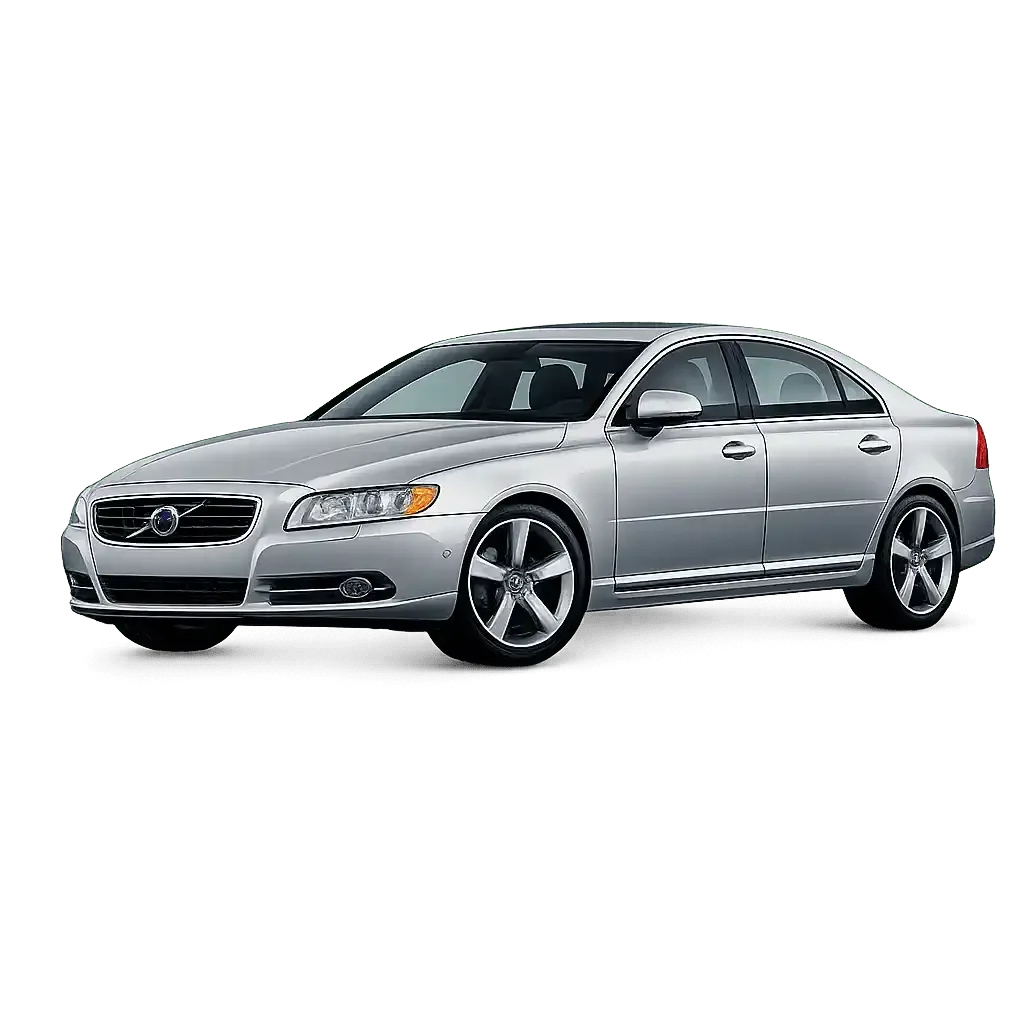
The Complete Fitment Guide
Returns destroy margins. The second-generation Volvo S80 (2007-2016 in the US market) was Volvo's flagship executive sedan on the P3 platform, and it sat at the intersection of three different ownership eras (Ford, transitional, Geely) and four completely different engine families over its production run. The P3 S80 launched with the new SI6 (Short Inline Six) engine family and a Yamaha-built V8, both of which were brand-new designs with no relationship to the Whiteblock engines in the P2 S80 they replaced. Then the V8 was dropped. Then the SI6 engines received a significant mid-production internal update that changed engine codes and accessory drive components. Then in the final years, Volvo introduced the VEA (Volvo Engine Architecture) 2.0L four-cylinder under the "T5 Drive-E" badge -- a completely different engine family paired with a completely different transmission. Throughout all of this, the "T6" badge appeared on two unrelated engines (3.0L SI6 turbo inline-six and, in some other P3 models, the 2.0L VEA four-cylinder), the "3.2" badge covered two different engine code revisions with different internal components, and FWD/AWD availability shifted by model year and engine. For the aftermarket catalog, the P3 S80 requires engine family, engine code revision, transmission type, drivetrain, and facelift status as minimum fitment attributes on every listing.
Generation Overview (2007-2016 US Market)
The second-generation S80 debuted at the 2006 Geneva Motor Show and went on sale in the US as a 2007 model. It replaced the P2 S80 (1999-2006) with a completely new platform, body, engine lineup, and transmission. The P3 platform was shared with the Ford S-Max, Ford Mondeo Mk4, and Ford Galaxy, reflecting Volvo's ownership by Ford at the time.
Key timeline:
2007 (MY2007): US launch. S80 3.2 (naturally aspirated SI6 inline-six, B6324S, 235 hp, FWD with AWD optional) and S80 V8 (Yamaha B8444S 4.4L V8, 311 hp, AWD standard). Both paired with Aisin-Warner TF-80SC six-speed automatic. T6 not yet available in US.
2008 (MY2008): S80 T6 added to US lineup. Turbocharged SI6 inline-six, B6304T2, 3.0L, 281 hp, AWD standard. Same TF-80SC six-speed automatic. S80 3.2 continues (FWD or optional AWD). S80 V8 continues (AWD standard).
2009 (MY2009): Continuation. 3.2 (FWD/AWD), T6 (AWD), V8 (AWD). All TF-80SC six-speed.
2010 (MY2010): Mid-cycle facelift. Revised exterior (lower/wider stance, more chrome trim on front, rear, and doors, updated grille, revised bumpers). Optional sport chassis. R-Design interior package available. V8 last year in US market (MY2010 is final year for B8444S in S80). California PZEV variant of 3.2 introduced (B6324S2 or B6324S4, 225 hp -- 10 hp less than standard due to additional emissions equipment).
2011 (MY2011): V8 discontinued. SI6 engine update: 3.2 becomes B6324S5 (DLC-coated valvetrain, ball bearing READ, electric power steering pump replacing belt-driven mechanical pump, revised spark plugs, aluminum water pump housing, revised engine mapping). T6 becomes B6304T4 (same DLC/spark plug/electric PS pump updates, power increases to approximately 300 hp and 325 lb-ft). New Denso engine management. Both continue with TF-80SC six-speed automatic. 3.2 FWD or AWD. T6 AWD standard.
2012-2013 (MY2012-2013): Continuation of updated SI6 engines. 3.2 (B6324S5) and T6 (B6304T4).
2014 (MY2014): Last year for 3.2 in US S80. Second facelift with revised front/rear bumpers, new lower fascia, new grille style, standard 7-inch infotainment, City Safety standard, optional digital gauge cluster. T6 AWD continues.
2015 (MY2015): Major powertrain addition. S80 T5 Drive-E replaces the 3.2 as base model. VEA 2.0L turbocharged four-cylinder (B4204T11, approximately 240 hp), paired with Aisin-Warner TG-81SC eight-speed automatic, FWD only. S80 T6 AWD continues with B6304T4 SI6 and TF-80SC six-speed. Two completely different engines and two completely different transmissions available in the same model year.
2016 (MY2016): Final year. T6 AWD discontinued. Only the T5 Drive-E FWD remains. 2.0L four-cylinder (B4204T11) with TG-81SC eight-speed. FWD only. Last S80 produced. Replaced by S90 (SPA platform) for MY2017.
Platform facts:
Platform: P3 (also called Ford EUCD platform). Shared architecture with Ford Mondeo Mk4, Ford S-Max, Ford Galaxy, and Volvo S60 (2011+), V60, V70 (2008+), XC60, XC70 (2008+).
Assembly: Torslanda plant, Gothenburg, Sweden.
Body style: Four-door sedan only. No wagon variant (V70 served that role on P3).
Engine families: SI6 (Short Inline Six, designed by Volvo, built by Ford Bridgend, Wales). Yamaha B8444S V8 (designed jointly by Volvo/Yamaha, built by Yamaha, Japan). VEA (Volvo Engine Architecture, 2.0L four-cylinder, designed and built by Volvo).
Transmissions: Aisin-Warner TF-80SC six-speed automatic (all SI6 and V8 engines). Aisin-Warner TG-81SC eight-speed automatic (VEA four-cylinder only).
Drive: FWD or Haldex AWD depending on engine/trim. AWD standard on T6 and V8. AWD optional on 3.2. FWD only on T5 Drive-E.
Why the P3 S80 Causes Catalog Errors
1. Four Completely Different Engine Families Under One S80 Badge
The P3 S80 used four distinct engine configurations in the US market across its production run:
3.2L naturally aspirated SI6 inline-six (B6324S 2007-2010, B6324S5 2011-2014). 235 hp (225 hp PZEV). TF-80SC six-speed. FWD or AWD.
3.0L turbocharged SI6 inline-six "T6" (B6304T2 2008-2010, B6304T4 2011-2016). 281 hp early, approximately 300 hp late. TF-80SC six-speed. AWD standard.
4.4L naturally aspirated Yamaha V8 (B8444S, 2007-2010). 311 hp. TF-80SC six-speed. AWD standard.
2.0L turbocharged VEA four-cylinder "T5 Drive-E" (B4204T11, 2015-2016). Approximately 240 hp. TG-81SC eight-speed. FWD only.
These span three different cylinder counts (four, six, eight), three different engine families with no shared components, and two completely different transmissions. The SI6 3.2 and SI6 3.0 T6 share the same basic block architecture (same engine family, different bore/stroke/aspiration), but the V8 and VEA are completely unrelated to each other and to the SI6.
2. SI6 Engine Code Revision at 2010/2011 Boundary
The SI6 engines received a significant update for the 2011 model year that changed engine codes and multiple physical components:
3.2 NA: B6324S (2007-2010) became B6324S5 (2011-2014)
3.0 T6: B6304T2 (2008-2010) became B6304T4 (2011-2016)
Changes included DLC (Diamond-like Carbon) coating on valve tappets, different Denso spark plugs, revised engine mapping with increased power output (T6 gained approximately 20 hp), ball bearings replacing needle bearings in the READ (Rear End Ancillary Drive) system, electric power steering pump replacing the belt-driven mechanical power steering pump, revised A/C compressor bracket, and aluminum water pump housing. The power steering pump change is particularly significant for catalog management because it changes the READ accessory belt drive configuration: early cars have a mechanical power steering pump driven by the READ belt at the rear of the engine, while late cars have an electric pump mounted separately. This means accessory belt routing, belt length, and READ pulleys differ between early and late SI6 engines.
3. Two Completely Different Transmissions in the Same Model
The TF-80SC (six-speed, used with SI6 and V8 engines) and TG-81SC (eight-speed, used with VEA four-cylinder) are completely different Aisin-Warner units. Different gear count, different fluid specification, different filters (the TF-80SC notably lacks a traditional user-serviceable filter), different solenoids, different torque converters, different TCM, different physical dimensions. A transmission component listed generically for "S80" without specifying six-speed or eight-speed is a guaranteed return.
4. TF-80SC Case Shape Varies by Engine
Within the TF-80SC six-speed family, the transmission case shape differs depending on which engine it is mated to. The V8 TF-80SC has a different bellhousing configuration than the SI6 TF-80SC. While many internal components are shared, the torque converter, bellhousing, and some external mounting points differ. The six-cylinder FWD and AWD versions also differ externally (AWD versions have a transfer case and provisions for a propeller shaft).
5. V8 Balance Shaft Issue and Model Year Sensitivity
The Yamaha B8444S V8 had a known design issue with its balance shaft bearings in the vee of the engine. The shaft bearings were not lubricated by engine oil and relied on grease. In early production engines, water could pool in the vee of the engine and wash out the grease, leading to bearing failure, which could then damage the timing chain and engine block. A drainage hole was added around 2006 production to allow water to escape. P3 S80 V8 models (built 2007+) generally have fewer failures than the earlier P2 XC90 V8 models, but the V8 remains a specialist engine. V8-specific components (engine mounts, exhaust manifolds with four catalytic converters, cooling system, engine management) do not cross-reference to any SI6 or VEA application.
6. P2 S80 (1999-2006) vs. P3 S80 (2007-2016) Generation Split
Zero components interchange between the P2 and P3 S80. Different platforms, different engines (P2 used Whiteblock RN modular inline-five and inline-six with GM 4T65E or Aisin AW55-51 transmissions; P3 uses SI6/V8/VEA with TF-80SC or TG-81SC). Different body, different chassis, different electrical architecture. The "S80" name is the only shared element.
7. Pre-Facelift (2007-2009) vs. Post-Facelift (2010-2013) vs. Late Refresh (2014-2016) Body Differences
The 2010 facelift revised the exterior for a lower, wider stance with more chrome trim, updated grille and bumper designs, and optional sport chassis. The 2014 refresh brought another round of bumper, grille, and fascia changes plus interior technology updates (standard infotainment screen, City Safety, optional digital gauges). Front bumper covers, grilles, and lower fascia panels do not interchange across these boundaries.
8. FWD vs. AWD Across Engine Options
AWD availability varied by engine:
3.2: FWD standard, AWD optional (2007-2014)
T6 (SI6 3.0): AWD standard (2008-2016, though T6 dropped for 2016)
V8: AWD standard (2007-2010)
T5 Drive-E (VEA 2.0): FWD only (2015-2016)
AWD models have a Haldex coupling, transfer case (integrated with TF-80SC), propeller shaft, rear differential, rear axle shafts, different rear subframe, and different suspension calibration. The T5 Drive-E was never offered with AWD in the S80.
Complete Powertrain Reference (US Market)
3.2 -- Naturally Aspirated SI6 Inline-Six
B6324S (2007-2010): Early 3.2
Displacement: 3.2L (3,192cc) inline-six, transversely mounted
Bore x stroke: 84mm x 96mm
Compression ratio: 10.8:1
Aspiration: Naturally aspirated
Valvetrain: DOHC, 24-valve, continuously variable cam timing (VCT), cam profile switching (CPS)
Output: 235 hp at 6,200 rpm, 236 lb-ft at 3,200 rpm (225 hp for PZEV variant B6324S2/S4)
Timing: Chain-driven (lifetime chain, no scheduled replacement interval)
Accessory drive: READ (Rear End Ancillary Drive) -- belt-driven power steering pump, A/C compressor positioned behind engine above transmission, driven via gears off rear of crankshaft. Spring-dampened water pump pulley.
Engine management: Denso
Transmission: Aisin-Warner TF-80SC six-speed automatic
Drive: FWD standard, Haldex AWD optional
B6324S5 (2011-2014): Updated 3.2
Same base specifications as B6324S
Output: 240 hp (approximately) -- slight increase from friction reduction
Changes: DLC-coated valve tappets, ball bearings in READ (replacing needle bearings), electric power steering pump (replacing belt-driven mechanical pump), different Denso spark plugs, revised engine mapping, aluminum water pump housing, revised A/C bracket
Transmission: TF-80SC six-speed automatic (unchanged)
Drive: FWD standard, Haldex AWD optional
Notes: The READ accessory belt drive configuration differs from the early B6324S due to the removal of the mechanical power steering pump from the belt circuit. Belt routing, belt length, and pulley count differ. Accessory belt kits, pulleys, and power steering components do not interchange between early (B6324S) and late (B6324S5) engines.
T6 -- Turbocharged SI6 Inline-Six
B6304T2 (2008-2010): Early T6
Displacement: 3.0L (2,953cc) inline-six, transversely mounted
Bore x stroke: 82mm x 93.2mm
Compression ratio: 9.3:1
Aspiration: Single twin-scroll turbocharger, intercooled
Valvetrain: DOHC, 24-valve, VCT
Output: 281 hp at 5,600 rpm, 295 lb-ft at 1,500-4,800 rpm
Timing: Chain-driven (lifetime chain)
Accessory drive: READ with belt-driven mechanical power steering pump
Engine management: Denso (unique PIN lock on ECU -- noted by tuning shops)
Transmission: Aisin-Warner TF-80SC six-speed automatic
Drive: Haldex AWD standard
B6304T4 (2011-2016): Updated T6
Same base specifications as B6304T2
Output: Approximately 300 hp at 5,600 rpm, 325 lb-ft at 2,100-4,200 rpm (approximately 20 hp and 30 lb-ft increase over B6304T2)
Changes: Same DLC/spark plug/electric PS pump/READ updates as the 3.2 update. Power increase from revised mapping and friction reduction.
Transmission: TF-80SC six-speed automatic (unchanged)
Drive: Haldex AWD standard
Notes: Same READ belt drive configuration change as the 3.2. Early and late T6 accessory belt kits do not interchange. The B6304T4 also appeared in Polestar/R-Design applications with higher power output (up to 325 hp in R-Design models via software tuning), but used the same engine code.
V8 -- Yamaha B8444S
B8444S (2007-2010)
Displacement: 4.4L (4,414cc) V8 (60-degree vee angle), transversely mounted
Valvetrain: DOHC, 32-valve, continuously variable valve timing
Output: 311 hp at 5,950 rpm, 325 lb-ft at 3,950 rpm
Timing: Chain-driven (primary chains from crankshaft to intake cams, secondary chains linking intake to exhaust cams)
Exhaust: Four catalytic converters (ULEV II compliant)
Engine management: Denso
Transmission: Aisin-Warner TF-80SC six-speed automatic (V8-specific bellhousing/torque converter configuration)
Drive: Haldex AWD standard
Notes: Built by Yamaha in Japan. Unique engine in the Volvo lineup, not shared with any other Volvo model except the P2/P3 XC90 V8. The compact transverse V8 design uses offset crank journals, alternator mounted directly to block without brackets, left cylinder bank offset by half a cylinder width from right bank. No relationship to SI6 or VEA engines. Discontinued after MY2010 as T6 offered similar performance with simpler packaging and lower cost.
T5 Drive-E -- VEA Four-Cylinder
B4204T11 (2015-2016)
Displacement: 2.0L (1,969cc) inline-four, transversely mounted
Bore x stroke: 82mm x 93.2mm
Compression ratio: 10.8:1
Aspiration: Single turbocharger, intercooled
Valvetrain: DOHC, 16-valve, continuously variable valve timing
Output: Approximately 240 hp at 5,500 rpm, 258 lb-ft at 1,500-4,800 rpm
Timing: Chain-driven
Engine management: Bosch (different from Denso-managed SI6/V8 engines)
Transmission: Aisin-Warner TG-81SC eight-speed automatic
Drive: FWD only
Notes: This is the VEA (Volvo Engine Architecture / Drive-E) family, the same 2.0L four-cylinder engine family used in the SPA-platform S90 (2017+). The VEA has no relationship to the SI6 or V8 engines. Different engine management (Bosch vs. Denso), different transmission (eight-speed vs. six-speed), different accessory drive layout, different cooling system. FWD only in S80 application -- AWD was never offered with the VEA in the S80.
Transmission Reference
Aisin-Warner TF-80SC Six-Speed (SI6 and V8, 2007-2016)
Architecture: Six-speed automatic with torque converter. "Geartronic" manual mode. Lockup function on all forward gears except first.
Variants: FWD and AWD versions. AWD version integrates transfer case on transmission. V8 variant has different bellhousing/torque converter than SI6 variants. Case shape varies by engine installed.
Fluid: Volvo-specified ATF. Volvo designated this as "lifetime fill" with no scheduled change interval. The transmission lacks a traditional user-serviceable filter -- it is programmed to shift more gently over time as fluid ages. Enthusiast community strongly recommends periodic fluid changes regardless.
TCM: Integrated on the transmission body (no external TCM wiring to fail).
Notes: Shared across the P3 lineup (S60, V60, V70, XC60, XC70, XC90 late models). The TF-80SC is generally more reliable than the P2's GM 4T65E but can still develop valve body and solenoid issues at higher mileages.
Aisin-Warner TG-81SC Eight-Speed (VEA Four-Cylinder, 2015-2016)
Architecture: Eight-speed automatic with torque converter. "Geartronic" manual mode.
Fluid: Volvo-specified ATF (different specification than TF-80SC).
Notes: This is the same transmission family used in SPA-platform Volvos (S90, XC90, etc.). No internal components interchange with the TF-80SC six-speed. Filters, solenoids, valve bodies, torque converters, and fluid specifications are all unique.
Key Transmission Catalog Trap
Any "S80 transmission" listing without specifying six-speed (TF-80SC) or eight-speed (TG-81SC) will generate returns. Furthermore, within the TF-80SC family, the torque converter and bellhousing differ between V8 and SI6 applications, and between FWD and AWD configurations.
Critical Fitment Splits
Split 1: P2 S80 (1999-2006) vs. P3 S80 (2007-2016)
Different platforms, different engines, different transmissions, different bodies. Zero interchange. Hard generation boundary required.
Split 2: Engine Family -- SI6 vs. V8 vs. VEA
Three completely unrelated engine families. Nothing interchanges between them: engine mounts, exhaust, cooling, engine management, filters, belts, pulleys, sensors, and all engine-specific components are unique to each family. The SI6 3.2 and SI6 3.0 T6 share the same block architecture and many internal components but differ in bore, stroke, aspiration system (NA vs. turbo), and specific accessory configurations.
Split 3: Early SI6 (B6324S / B6304T2, 2007-2010) vs. Late SI6 (B6324S5 / B6304T4, 2011+)
The 2011 engine update changed valve tappets, spark plugs, READ bearing type, power steering system (mechanical to electric), A/C bracket, water pump housing, and engine mapping. Accessory belt kits, READ pulleys, power steering pumps, and water pump assemblies do not interchange between early and late SI6 engines. Always specify engine code, not just "3.2" or "T6."
Split 4: TF-80SC Six-Speed vs. TG-81SC Eight-Speed Transmission
Completely different transmissions. All transmission components are unique to each. The six-speed pairs with SI6 and V8 (2007-2016 T6). The eight-speed pairs with VEA four-cylinder (2015-2016 T5 Drive-E) only.
Split 5: FWD vs. AWD
AWD models have Haldex coupling, transfer case, propeller shaft, rear differential, rear axle shafts, different rear subframe, and different suspension calibration. AWD availability by engine: 3.2 (optional), T6 (standard), V8 (standard), T5 Drive-E (not available -- FWD only).
Split 6: PZEV vs. Non-PZEV 3.2 (2010+)
California-market PZEV versions of the 3.2 (engine codes B6324S2 or B6324S4) have reduced power output (225 hp vs. 235 hp), additional emissions equipment, and in some cases different pistons and oil control rings. Emissions-related components do not interchange between PZEV and non-PZEV variants.
Split 7: Pre-Facelift (2007-2009) vs. Mid Facelift (2010-2013) vs. Late Refresh (2014-2016)
Body exterior changes at each boundary. Front bumper, grille, lower fascia, and trim components do not interchange across these boundaries. The 2014 refresh also added new interior technology (standard infotainment screen, City Safety, optional digital gauges).
Split 8: V8-Specific Components (2007-2010 Only)
The Yamaha V8 has unique engine mounts, exhaust manifolds, catalytic converters (four total), cooling system layout, transmission bellhousing, torque converter, and engine management calibration. No cross-reference to any SI6 or VEA component. V8 parts have a very small application window (2007-2010 S80 and 2005-2014 XC90 V8 only within the Volvo lineup).
Split 9: READ Accessory Belt Drive -- Early vs. Late, Chassis Number Breaks
The READ belt drive system on SI6 engines has fitment that breaks not just by engine code (early vs. late) but by chassis number within some model years. IPD and other specialist suppliers document specific chassis number breaks for READ belt kit fitment. For example, early S80 six-cylinder models use a spring-dampened water pump pulley coupling that was deleted on later production. Always verify chassis number (last six digits of VIN) against supplier fitment guides when ordering READ components.
Biggest Return Traps and How to Prevent Them
Trap 1: P2 S80 (1999-2006) Parts for P3 S80 (2007-2016)
What happens: A P2 S80 Whiteblock engine component or GM 4T65E transmission part ships to a P3 S80 owner.
Prevention: Hard generation boundary. P2 S80 = 1999-2006. P3 S80 = 2007-2016.
Trap 2: VEA Four-Cylinder Parts for SI6 Six-Cylinder (or Vice Versa)
What happens: A 2016 S80 T5 owner (VEA 2.0L four-cylinder) receives SI6 six-cylinder engine components, or an eight-speed transmission filter ships to a six-speed vehicle.
Prevention: Always confirm engine type (four-cylinder vs. six-cylinder vs. V8) or transmission (six-speed vs. eight-speed) before shipping.
Trap 3: Early SI6 READ Belt Kit for Late SI6 (or Vice Versa)
What happens: An accessory belt kit designed for the early SI6 with mechanical power steering pump ships to a 2012 S80 with the updated electric power steering pump. Belt routing and pulley count differ.
Prevention: Specify engine code (B6324S vs. B6324S5, or B6304T2 vs. B6304T4) and verify chassis number against READ fitment breaks.
Trap 4: V8 TF-80SC Torque Converter for SI6 TF-80SC (or Vice Versa)
What happens: A TF-80SC torque converter from a V8 application ships to a T6 SI6 owner. Bellhousing configuration differs.
Prevention: Always specify engine (V8, 3.2, or T6) when ordering TF-80SC transmission components that touch the bellhousing or torque converter.
Trap 5: AWD Components for FWD Vehicle (or Vice Versa)
What happens: A Haldex coupling, propeller shaft, or rear differential ships to a FWD 3.2 or T5 Drive-E owner. Or a FWD-specific rear subframe ships to an AWD vehicle.
Prevention: Always confirm FWD or AWD. VIN decode required for 3.2 models where AWD was optional.
Trap 6: PZEV 3.2 Engine Parts for Non-PZEV (or Vice Versa)
What happens: PZEV-specific pistons or emissions components ship to a non-PZEV 3.2, or standard 3.2 emissions components ship to a California PZEV vehicle.
Prevention: Verify PZEV status via VIN or state of original sale. PZEV engine codes (B6324S2, B6324S4) differ from standard.
Trap 7: SPA S90 (2017+) Parts for P3 S80 (2007-2016)
What happens: The S90 replaced the S80, so search queries for "Volvo flagship sedan" may cross-reference the wrong generation. An SPA-platform S90 body panel or SPA-specific component ships to a P3 S80 owner.
Prevention: S80 (P3, 2007-2016) and S90 (SPA, 2017+) are completely different platforms with no interchange. Enforce model name boundary.
Trap 8: Wrong Facelift Body Parts
What happens: A 2008 (pre-facelift) front bumper cover ships to a 2012 (post-2010-facelift) vehicle, or a 2010-2013 grille ships to a 2015 (post-2014-refresh) vehicle.
Prevention: Distinguish pre-facelift (2007-2009), mid-facelift (2010-2013), and late-refresh (2014-2016) for all front-end body components.
P3 Platform Cross-Reference Notes
The P3 S80 shares its platform with several other Volvo models. Cross-reference potential:
Engine: The SI6 3.2 (B6324S/S5) was also used in the P3 V70, XC60, and XC70. The SI6 T6 (B6304T2/T4) was also used in the P3 S60, V60, XC60, XC70, and late P2 XC90. Many engine components cross-reference within the same engine code. The Yamaha V8 was shared with the P2/P3 XC90 V8 only. The VEA 2.0L four-cylinder is shared across P3 S60, V60, and other late P3 models, plus SPA-platform vehicles.
Transmission: The TF-80SC six-speed is shared across the P3 lineup with the same engine-specific bellhousing/case variations. The TG-81SC eight-speed is shared with late P3 models that received VEA engines and SPA-platform vehicles.
Suspension: Front MacPherson strut and rear multilink architecture is shared across P3. Spring rates, damper valving, and anti-roll bar specifications differ by model, engine, and FWD/AWD configuration.
Body: Not shared between P3 models. S80 body panels do not fit S60, V60, V70, etc.
Brakes: Some brake components are shared across P3 models with the same wheel size and weight class. Always verify by specific application.
Data Quality Checklist for Catalog Managers
Required attributes for every S80 (2007-2016) parts listing:
Model year(s)
Platform generation: P3 (2007-2016) vs. P2 (1999-2006) vs. SPA S90 (2017+). Hard boundaries, no cross-reference.
Engine family and code: SI6 3.2 (B6324S early, B6324S5 late), SI6 T6 (B6304T2 early, B6304T4 late), Yamaha V8 (B8444S), or VEA T5 Drive-E (B4204T11). Required for all engine, transmission, and accessory drive components.
Transmission: Aisin-Warner TF-80SC six-speed (SI6/V8) or Aisin-Warner TG-81SC eight-speed (VEA). Required for all transmission components.
Drivetrain: FWD or AWD. AWD standard on T6 and V8, optional on 3.2, not available on T5 Drive-E.
SI6 engine revision: Early (B6324S/B6304T2, through 2010) or late (B6324S5/B6304T4, 2011+). Required for READ accessory belt drive components, power steering components, spark plugs, and water pump assemblies. Verify by chassis number for mid-year production transitions.
PZEV status: Required for 3.2 engine in California and other PZEV-mandate states (2010+).
Facelift status: Pre-facelift (2007-2009), mid-facelift (2010-2013), or late-refresh (2014-2016). Required for front bumper, grille, lower fascia, and other exterior body components.
Buyer Confirmation Prompts
Before shipping any part for an S80 (2007-2016), confirm:
"Is your S80 from 2007-2016, or is it the 1999-2006 model?" These are completely different platforms.
"What engine does your S80 have: 3.2 (six-cylinder), T6 (turbo six-cylinder), V8, or T5 Drive-E (four-cylinder turbo)?" This determines engine family, transmission type, and all engine/transmission component fitment.
"What model year is your S80?" The SI6 engines changed significantly at the 2010/2011 boundary (different engine codes, different READ accessory drive, different power steering system).
"Is your S80 FWD or AWD?" AWD availability varies by engine/year.
"If ordering READ/accessory belt components for a six-cylinder S80: what are the last six digits of your VIN?" Chassis number breaks determine specific READ belt kit fitment.
The Business Case: Why Fitment Data Pays for Itself
The P3 S80 is now 10-19 years old and has settled into the affordable used luxury market. The SI6 engines are generally robust but have specific age-related service needs (READ belt drive components, PCV system, oil consumption on pre-2011 engines, cooling system). The TF-80SC transmission, while more reliable than the P2's GM 4T65E, still generates service demand for valve body, solenoid, and fluid change components.
The single most common return cause is the early vs. late SI6 engine split at 2010/2011. The change from mechanical to electric power steering alone invalidates the entire accessory belt kit if the wrong revision is shipped. The second most common return cause is the TF-80SC vs. TG-81SC transmission split at 2015, when the VEA four-cylinder arrived with its completely different eight-speed. The third is the FWD/AWD split on 3.2 models, where AWD was optional and cannot be determined from trim level alone.
The V8 generates specialist parts demand but in very low volume, as these are rare vehicles (approximately four years of US production, low take rate). VEA T5 Drive-E S80 models are also relatively uncommon, as they were sold for only two model years before the S90 replaced the S80 entirely. The SI6-powered models (3.2 and T6) represent the vast majority of P3 S80 parts demand.
The minimum required attributes are platform generation, engine code (not just displacement or badge), transmission type, drivetrain, SI6 revision status, and facelift period. Omit any one and you are shipping the wrong part to a customer who knows exactly what engine code badge is on their valve cover.
Disclaimer: This guide is based on publicly available specifications, Volvo press materials, and independent research. Part interchangeability should always be confirmed via VINand OEM part number lookup. Specifications may change without notice. This document does not constitute official Volvo parts catalog data. Visuals and illustrations in this article were generated using AI for representative purposes and may not reflect exact technical schematics.