
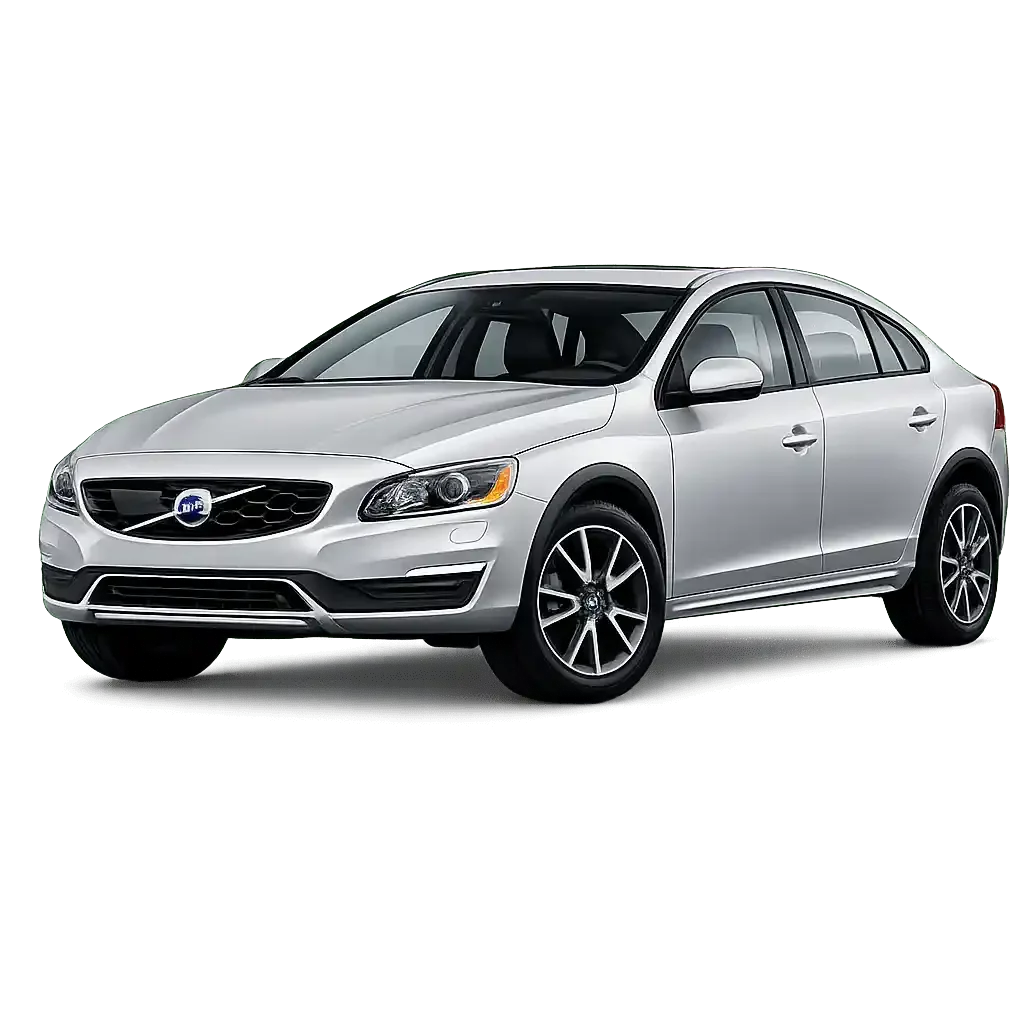
The Complete Fitment Guide
Returns destroy margins. The Volvo S60 Cross Country (2016-2018 in the US market) was an oddball: a raised, cladded, all-wheel-drive sedan based on the P3 S60, produced in very low volumes across only three model years. It shares its concept with the V60 Cross Country wagon but carries its own unique body cladding, suspension calibration, and ground clearance tuning. For aftermarket parts suppliers, the S60 Cross Country generates returns at a rate far out of proportion to its sales volume because of one enormous trap: the 2016 model year uses a completely different powertrain than 2017-2018. The 2016 S60 Cross Country has a 2.5-liter turbocharged inline-five cylinder engine (B5254T12) with a six-speed automatic transmission (TF-80SC) and hydraulic power steering. The 2017-2018 S60 Cross Country has a 2.0-liter turbocharged inline-four cylinder Drive-E engine (B4204T11) with an eight-speed automatic transmission (TG-81SC) and electric power steering. These two powertrains share the "T5 AWD" badge. They share the same P3 chassis. They share the same Cross Country body cladding. And they share almost zero engine, transmission, or power steering components with each other. The "T5" badge means two completely different things depending on which side of the 2016/2017 model year boundary you are standing on.
Generation Overview (2016-2018 US Market)
The S60 Cross Country debuted as a 2016 US model year vehicle, a full year after the V60 Cross Country wagon. Volvo took the standard P3 S60 sedan and added approximately 65mm (2.5 inches) of additional ride height for a total of 200mm (7.9 inches) of ground clearance, protective underbody skid plates, unique lower body cladding with black fender extensions, scuff plates along the rocker panels, a honeycomb grille, front and rear lower skid plates, glossy black window trim, and Cross Country-specific 18-inch alloy wheels. AWD was standard on all S60 Cross Country models -- it was never available as FWD. The S60 Cross Country was sold only in a single, well-equipped trim level ("Platinum" for 2016, then "T5 AWD" for 2017-2018).
Key timeline:
2016 (MY2016): US launch as "S60 Cross Country T5 AWD Platinum." Engine: 2.5L turbocharged inline-five (B5254T12), 250 hp, 266 lb-ft. Transmission: Aisin-Warner TF-80SC six-speed automatic. AWD: Haldex electronically controlled, standard. Power steering: Hydraulic (speed-sensitive). This is the only S60 Cross Country model year with the five-cylinder engine.
2017 (MY2017): Powertrain swap. Engine changes to 2.0L turbocharged inline-four Drive-E (B4204T11), 240 hp, 258 lb-ft. Transmission changes to Aisin-Warner TG-81SC eight-speed automatic. Power steering changes to electric (EPAS). AWD remains standard (Haldex). Badge remains "T5 AWD." Suspension ride height, body cladding, and Cross Country exterior treatment unchanged from 2016.
2018 (MY2018): Final year. Continuation of 2017 powertrain (B4204T11 four-cylinder, TG-81SC eight-speed, EPAS). No significant changes. S60 Cross Country discontinued after 2018 alongside the entire P3 S60 line, replaced by the SPA-platform third-generation S60.
Platform facts:
Platform: P3 (Ford EUCD derivative, shared with P3 S60, V60, S80, V70, XC60, XC70)
Assembly: Torslanda plant, Gothenburg, Sweden
Body style: Four-door sedan with raised suspension and Cross Country cladding. Not a wagon -- the wagon version is the V60 Cross Country.
Engine family (2016): Volvo Modular Engine (Whiteblock) inline-five turbo
Engine family (2017-2018): Volvo Engine Architecture (VEA) inline-four turbo
Transmissions: TF-80SC six-speed (2016), TG-81SC eight-speed (2017-2018)
Drive: AWD standard, all years. No FWD option.
Why the S60 Cross Country Causes Catalog Errors
1. The 2016 vs. 2017 Powertrain Hard Boundary -- Same Badge, Different Everything
This is the highest-return-rate trap on the S60 Cross Country. Both years carry the "T5 AWD" badge. Both are sold as "S60 Cross Country." But they have completely different engines, different transmissions, and different power steering systems.
2016 (Five-Cylinder Powertrain):
Engine: B5254T12, 2.5L (2,497cc) turbocharged inline-five. Bore 83mm, stroke 92.3mm, compression 9.5:1. 250 hp at 5,400 rpm, 266 lb-ft at 1,800-4,200 rpm.
Transmission: Aisin-Warner TF-80SC, six-speed automatic ("Geartronic").
Power steering: Hydraulic, speed-sensitive. Belt-driven pump, fluid reservoir, hydraulic lines to rack.
Engine management: Denso.
Timing system: Timing belt (Whiteblock architecture).
Cylinder count: Five.
2017-2018 (Four-Cylinder Drive-E Powertrain):
Engine: B4204T11, 2.0L (1,969cc) turbocharged inline-four. Compression 10.8:1. 240 hp at 5,500 rpm, 258 lb-ft at 1,500-4,800 rpm.
Transmission: Aisin-Warner TG-81SC, eight-speed automatic ("Geartronic").
Power steering: Electric power assist steering (EPAS). No hydraulic pump, no fluid, no lines. Electric motor on rack.
Engine management: Bosch.
Timing system: Timing chain (VEA architecture).
Cylinder count: Four.
Components that do NOT interchange across the 2016/2017 boundary:
Engine (five-cylinder vs. four-cylinder -- different family entirely)
Transmission (six-speed vs. eight-speed -- different unit entirely)
Transmission fluid (different specifications)
All engine-specific components: turbocharger, exhaust manifold, intake manifold, timing belt/chain kit, spark plugs, ignition coils, engine mounts, oil filter, air filter
Power steering system: Hydraulic pump, reservoir, lines, and fluid (2016) vs. electric rack motor and EPAS control module (2017-2018). The steering racks themselves differ due to the hydraulic vs. electric assist architecture.
Accessory belt system (five-cylinder has different belt routing than four-cylinder; 2016 includes PS pump on belt drive, 2017-2018 does not)
Engine wiring harness
ECM/engine control module
Components that generally DO interchange across 2016/2017:
Cross Country body cladding, skid plates, fender extensions, scuff plates
Interior components (seats, dashboard, trim)
Brakes (same specifications across all three years)
Rear suspension components (same Cross Country raised calibration)
Wheels and tires (same 18-inch Cross Country specification)
Lighting (headlights, taillights)
Glass
2. S60 Cross Country vs. Standard S60 -- Unique Suspension and Body
The S60 Cross Country is not a trim level of the S60. It has unique suspension components calibrated for 65mm additional ride height: different springs (longer/softer), different shock absorbers (longer travel), different bump stops, and different wheel alignment specifications. The standard S60 sits approximately 65mm lower. Cross Country springs, struts, and shock absorbers do NOT interchange with standard S60 components -- they are physically different lengths and rates.
Cross Country-unique body panels include:
Lower front fascia/bumper with integrated skid plate
Black fender arch extensions (wheel arch cladding)
Rocker panel scuff plates
Rear lower fascia with integrated skid plate
Honeycomb grille insert (different from standard S60)
Glossy black window trim and mirror caps
None of these body cladding pieces fit the standard S60. Conversely, standard S60 front bumper covers and side trim do not fit the Cross Country due to different mounting provisions for the cladding.
3. S60 Cross Country vs. V60 Cross Country
The S60 Cross Country (sedan) and V60 Cross Country (wagon) share the Cross Country concept and much of the same raised suspension calibration. Forward of the B-pillar, many components interchange between the two -- engine, transmission, front suspension, steering, front brakes, and front body panels (they share the same front fascia and Cross Country cladding treatment). Behind the B-pillar, everything differs: the V60 Cross Country is a wagon with a liftgate, different rear body structure, different rear bumper, and different rear suspension tuning for cargo capacity.
Important: The V60 Cross Country was also available in the US with the five-cylinder powertrain in its earlier years and transitioned to the four-cylinder Drive-E, but the model year of the transition may differ slightly from the S60 Cross Country. Always confirm engine code when cross-referencing parts between S60 CC and V60 CC.
4. S60 Cross Country vs. Other P3 T5 AWD Models
The "T5 AWD" badge appears across the entire P3 S60 line, but it means different things depending on model year and model variant:
2011-2016 S60 T5 AWD (standard sedan): Five-cylinder B5254T12, TF-80SC six-speed, hydraulic PS
2015-2016 S60 T5 Drive-E (standard sedan): Four-cylinder B4204T11, TG-81SC eight-speed, electric PS, FWD only
2016 S60 Cross Country T5 AWD: Five-cylinder B5254T12, TF-80SC six-speed, hydraulic PS
2017-2018 S60 T5 AWD (standard sedan): Four-cylinder B4204T11, TG-81SC eight-speed, electric PS
2017-2018 S60 Cross Country T5 AWD: Four-cylinder B4204T11, TG-81SC eight-speed, electric PS
Notice the 2016 S60 Cross Country T5 AWD and the 2016 S60 T5 AWD (standard sedan) share the same powertrain (five-cylinder, six-speed, hydraulic PS). They differ in suspension height and body cladding only. Engine and transmission components interchange between them.
Similarly, the 2017-2018 S60 Cross Country T5 AWD and the 2017-2018 S60 T5 AWD (standard sedan) share the same four-cylinder powertrain. Engine and transmission components interchange. Suspension and body components do not.
5. P3 S60 Cross Country (2016-2018) vs. SPA S60 (2019+)
The third-generation S60 launched in 2019 on the completely new SPA (Scalable Product Architecture) platform. Zero components interchange between the P3 S60 Cross Country and the SPA S60. There was no SPA-based S60 Cross Country -- the raised sedan concept was discontinued. The SPA V60 Cross Country wagon continued, but no sedan version.
6. Haldex AWD Generation Differences
The S60 Cross Country uses a Haldex electronically controlled AWD system, but the Haldex generation differs by powertrain:
2016 (five-cylinder): Uses the Haldex generation associated with the TF-80SC drivetrain. The AWD coupling, propeller shaft, and rear differential are matched to the six-speed transmission output.
2017-2018 (four-cylinder): Uses the Haldex generation associated with the TG-81SC drivetrain. Different transfer case/PTU (power take-off unit) to match the eight-speed transmission.
The PTU (front-mounted power take-off unit) differs between the TF-80SC six-speed and TG-81SC eight-speed transmissions because the output shaft position and angle change with the different transmission housing. PTU parts do not interchange between the six-speed and eight-speed applications.
Complete Powertrain Reference (US Market)
2016: 2.5L Turbocharged Inline-Five
B5254T12: 2.5L Whiteblock Turbo Five-Cylinder
Displacement: 2.5L (2,497cc) inline-five
Bore x stroke: 83mm x 92.3mm
Compression ratio: 9.5:1
Aspiration: Single turbocharger, intercooled
Valvetrain: DOHC, 20-valve, dual CVVT (intake and exhaust)
Output: 250 hp at 5,400 rpm, 266 lb-ft at 1,800-4,200 rpm
Engine management: Denso
Timing: Belt-driven (traditional Whiteblock timing belt service interval)
Oil filter: Cartridge-style
Notes: Final iteration of the Volvo Whiteblock five-cylinder turbo. The B5254T12 was the standard T5 engine across the P3 S60/V60/XC60/XC70 line for several years. It shares bore and general architecture with earlier B5254T variants but has a de-stroked crankshaft (92.3mm vs. 93.2mm on the B5254T2/T3/T4/T5) and higher compression (9.5:1 vs. 9.0:1). Some internal parts cross-reference with other B5254T-series engines; others do not due to the compression and stroke differences.
Transmission: Aisin-Warner TF-80SC Six-Speed Automatic
Architecture: Six-speed automatic, torque converter, "Geartronic" manual mode
Fluid: Volvo-specified ATF (not Dexron)
Notes: Same basic TF-80SC unit used across P3 T5 AWD models. The AWD version integrates with the front-mounted PTU. This is a different physical unit from the TG-81SC eight-speed used in 2017-2018.
2017-2018: 2.0L Turbocharged Inline-Four (Drive-E / VEA)
B4204T11: 2.0L VEA Turbo Four-Cylinder
Displacement: 2.0L (1,969cc) inline-four
Bore x stroke: 82mm x 93.2mm
Compression ratio: 10.8:1
Aspiration: Single turbocharger, intercooled
Valvetrain: DOHC, 16-valve, dual CVVT
Output: 240 hp at 5,500 rpm, 258 lb-ft at 1,500-4,800 rpm
Engine management: Bosch
Timing: Chain-driven (no scheduled timing chain replacement interval)
Oil filter: Cartridge-style
Notes: Part of the Volvo Engine Architecture (VEA) family, shared across all new-generation Volvo models (SPA XC90, SPA S90, SPA V90, SPA XC60, and late-production P3 models). The VEA four-cylinder is a completely different engine family from the Whiteblock five-cylinder -- different block material specification, different bore count, different displacement, different engine management system (Bosch vs. Denso), different timing system (chain vs. belt), and different mounting configuration. PZEV variant (B4204T12, slightly different power rating) may appear in California-market vehicles.
Transmission: Aisin-Warner TG-81SC Eight-Speed Automatic
Architecture: Eight-speed automatic, torque converter, "Geartronic" manual mode with paddle shifters
Fluid: Different specification from TF-80SC
Notes: Completely different transmission from the TF-80SC six-speed. Different case, different internal components, different fluid, different filter, different solenoids, different torque converter. The AWD version integrates with a different PTU matched to the eight-speed output.
Suspension and Chassis Reference
Cross Country Raised Suspension
All S60 Cross Country models (2016-2018) share the same raised suspension concept:
Ride height: Approximately 200mm (7.9 inches) ground clearance, up from approximately 135mm on the standard S60
Front: MacPherson strut with Cross Country-specific springs and strut assemblies (longer, softer rate than standard S60)
Rear: Multilink with Cross Country-specific springs and shock absorbers (longer travel)
Stabilizer bars: Cross Country-specific calibration
Hill Descent Control: Standard
Underbody protection: Skid plates front and rear
The Cross Country suspension components are physically different from the standard S60, the S60 R-Design (which has a sport-lowered suspension), and the V60 Cross Country (which may have different rear spring rates for wagon cargo loading). Always specify "S60 Cross Country" as the model, not just "S60."
Power Steering Systems
2016: Hydraulic power steering with speed-sensitive assist. Includes belt-driven hydraulic pump, fluid reservoir, high-pressure and return lines, and hydraulic rack and pinion. Requires power steering fluid.
2017-2018: Electric Power Assist Steering (EPAS). No hydraulic components. Electric motor integrated into or attached to the steering rack. Controlled by Power Steering Control Module (PSCM). No power steering fluid.
The steering racks are physically different between 2016 (hydraulic) and 2017-2018 (electric). They do not interchange. The mounting points are similar (same subframe), but the rack assemblies themselves have different assist mechanisms.
Brakes
Front and rear brake specifications remained consistent across all three model years of the S60 Cross Country. Front disc size matches the standard S60 T5, not the T6 or R-Design (which may have larger front rotors). Rear discs are the same across most P3 60-series models.
Critical Fitment Splits
Split 1: 2016 (Five-Cylinder / Six-Speed / Hydraulic PS) vs. 2017-2018 (Four-Cylinder / Eight-Speed / Electric PS)
The most important split. Affects every engine component, transmission component, and power steering component. Both years carry "T5 AWD" badge. Enforce hard year boundary for all powertrain and steering listings.
Split 2: S60 Cross Country vs. Standard S60
Different suspension (raised vs. standard or sport), different body cladding, different front and rear fascias, different wheel arch trim. Suspension components do not interchange. Engine and transmission components DO interchange with the standard S60 of the same model year and powertrain.
Split 3: S60 Cross Country (Sedan) vs. V60 Cross Country (Wagon)
Forward of B-pillar: most components interchange. Behind B-pillar: nothing interchanges. Body panels, liftgate, rear bumper, taillights, rear suspension tuning all differ.
Split 4: Hydraulic Steering Rack (2016) vs. Electric Steering Rack (2017-2018)
Different rack and pinion assemblies. Different assist mechanisms. The 2016 rack requires hydraulic lines, pump, reservoir, and fluid. The 2017-2018 rack requires EPAS control module and wiring. Zero interchange between the two.
Split 5: TF-80SC Six-Speed (2016) vs. TG-81SC Eight-Speed (2017-2018)
Different transmissions. Different fluid. Different filter. Different solenoids. Different torque converter. Different PTU (power take-off unit for AWD). Zero interchange.
Split 6: P3 S60 Cross Country (2016-2018) vs. SPA S60 (2019+)
Different platforms. Zero interchange. No SPA S60 Cross Country exists.
Split 7: PZEV vs. Non-PZEV (California Market)
The four-cylinder B4204T11 has a PZEV variant (B4204T12) for California and similar states. Different emissions equipment, slightly different power rating (240 vs. 237 hp). Some exhaust and emissions components differ.
Split 8: B5254T12 vs. Other B5254T-Series Engines
The B5254T12 (92.3mm stroke, 9.5:1 compression) differs from earlier B5254T variants (B5254T2/T3/T4/T5, typically 93.2mm stroke, 9.0:1 compression) in crankshaft, pistons, and possibly connecting rods. While many external components (turbo, accessories, sensors) cross-reference within the B5254T family, internal rotating assembly parts may not. The B5254T14 is the final revision of the five-cylinder that replaced the T12 in some non-CC applications for MY2016 -- same bore and stroke but slightly different tune.
Biggest Return Traps and How to Prevent Them
Trap 1: 2017-2018 Drive-E Engine Parts for 2016 Five-Cylinder (or Vice Versa)
What happens: A four-cylinder timing chain kit, Bosch ignition coil set (four coils), or VEA oil filter ships to a 2016 owner with a five-cylinder engine that uses a timing belt, Denso ignition, and a different oil filter. Or a five-cylinder timing belt kit (five-cylinder kit with five spark plugs) ships to a 2017-2018 owner with a four-cylinder chain-driven engine.
Prevention: Hard year boundary. 2016 = five-cylinder Whiteblock. 2017-2018 = four-cylinder VEA Drive-E. Always confirm model year for any engine component.
Trap 2: TG-81SC Eight-Speed Transmission Parts for TF-80SC Six-Speed (or Vice Versa)
What happens: Eight-speed transmission filter or fluid ships to a 2016 owner with a six-speed. Different fluid specification, different filter, different everything.
Prevention: Confirm model year. 2016 = TF-80SC six-speed. 2017-2018 = TG-81SC eight-speed.
Trap 3: Standard S60 Suspension Parts for S60 Cross Country
What happens: Standard-height S60 struts or springs ship to a Cross Country owner. The car sits 65mm too low and the ride quality is completely wrong. Or R-Design sport-lowered springs ship -- even worse, the car sits approximately 80mm too low relative to Cross Country height.
Prevention: Always specify "S60 Cross Country" (or S60 CC) as the model. Cross Country springs and struts are unique part numbers with longer free length and different spring rates.
Trap 4: Hydraulic Steering Components for 2017-2018 (or Electric for 2016)
What happens: A power steering pump or hydraulic line ships to a 2017-2018 owner whose car has electric steering and has no pump. Or an EPAS control module ships to a 2016 owner with hydraulic steering.
Prevention: Hard year boundary for all steering components. 2016 = hydraulic. 2017-2018 = electric. These are fundamentally different systems.
Trap 5: V60 Cross Country Rear Body Parts for S60 Cross Country
What happens: A V60 Cross Country tailgate, rear bumper cover, or wagon-specific rear quarter panel trim ships to an S60 Cross Country owner. The S60 CC is a sedan with a trunk, not a wagon with a liftgate.
Prevention: Always distinguish "S60 Cross Country" from "V60 Cross Country." They share front-end parts but nothing behind the B-pillar.
Trap 6: SPA S60 (2019+) Parts for P3 S60 Cross Country (2016-2018)
What happens: An SPA-platform S60 component ships to a P3 S60 Cross Country owner. Completely different platforms.
Prevention: P3 S60 Cross Country = 2016-2018. SPA S60 = 2019+. Hard generation boundary.
Trap 7: Wrong PTU (Power Take-Off Unit) for the Transmission
What happens: A PTU matched to the TF-80SC six-speed ships to a 2017-2018 owner with a TG-81SC eight-speed, or vice versa. The PTU mounts differently to the different transmission housings.
Prevention: Confirm model year and transmission type. 2016 = TF-80SC PTU. 2017-2018 = TG-81SC PTU.
Data Quality Checklist for Catalog Managers
Required attributes for every S60 Cross Country (2016-2018) parts listing:
Model year: 2016, 2017, or 2018. This is the most critical attribute due to the powertrain swap at 2016/2017.
Engine family: Five-cylinder Whiteblock (2016 only) or four-cylinder VEA Drive-E (2017-2018). This determines every engine component, timing system (belt vs. chain), ignition, engine management, and oil filter.
Transmission: TF-80SC six-speed (2016) or TG-81SC eight-speed (2017-2018). Required for all transmission components, fluid, filters, and PTU.
Power steering type: Hydraulic (2016) or electric EPAS (2017-2018). Required for steering rack, pump (2016 only), lines (2016 only), and fluid (2016 only).
Model variant: "S60 Cross Country" specifically -- not "S60" (standard sedan), not "V60 Cross Country" (wagon), not "S60 R-Design" (sport sedan). Required for all suspension and body cladding components.
PZEV status (2017-2018): California-market vehicles may have PZEV variant engine (B4204T12) with different emissions components.
Buyer Confirmation Prompts
Before shipping any part for an S60 Cross Country (2016-2018), confirm:
"What model year is your S60 Cross Country: 2016, 2017, or 2018?" The 2016 has a 2.5-liter five-cylinder engine with a six-speed automatic and hydraulic power steering. The 2017-2018 has a 2.0-liter four-cylinder engine with an eight-speed automatic and electric power steering. Even though all three years say "T5 AWD" on the badge, the powertrains are completely different.
"Is your vehicle the S60 Cross Country (raised sedan) or the V60 Cross Country (raised wagon)?" They share front-end parts but everything behind the B-pillar differs.
For suspension components: "Is this for the S60 Cross Country (raised ride height with body cladding) or the standard S60 sedan?" Cross Country suspension components are unique -- they are taller and softer than standard S60 parts.
The Business Case: Why Fitment Data Pays for Itself
The S60 Cross Country was a niche product -- Volvo sold far fewer S60 Cross Country sedans than V60 Cross Country wagons, standard S60 sedans, or XC60 crossovers. The low production volume means every return hurts disproportionately, and the five-cylinder-to-four-cylinder powertrain swap at the 2016/2017 boundary guarantees returns if model year is not enforced on every powertrain listing.
The "T5 AWD" badge is the single biggest problem. A customer searching for "S60 Cross Country T5 AWD" parts will find listings that span both the five-cylinder and four-cylinder eras. Without model year filtering, they will receive the wrong engine, transmission, or steering components roughly half the time.
The secondary trap is the Cross Country suspension confusion. Standard S60 springs and struts are the most commonly stocked P3 60-series suspension components. Cross Country parts are less commonly stocked but physically different. If a customer orders "S60 front struts" without specifying Cross Country, they will receive standard-height components that sit 65mm too low.
Minimum required attributes: model year (with hard 2016/2017 boundary), model variant (Cross Country vs. standard vs. R-Design vs. Inscription), and power steering type (hydraulic vs. electric). Without model year enforcement, you are guaranteed to ship the wrong powertrain.
Disclaimer: This guide is based on publicly available specifications, Volvo press materials, and independent research. Part interchangeability should always be confirmed via VINand OEM part number lookup. Specifications may change without notice. This document does not constitute official Volvo parts catalog data. Visuals and illustrations in this article were generated using AI for representative purposes and may not reflect exact technical schematics.