
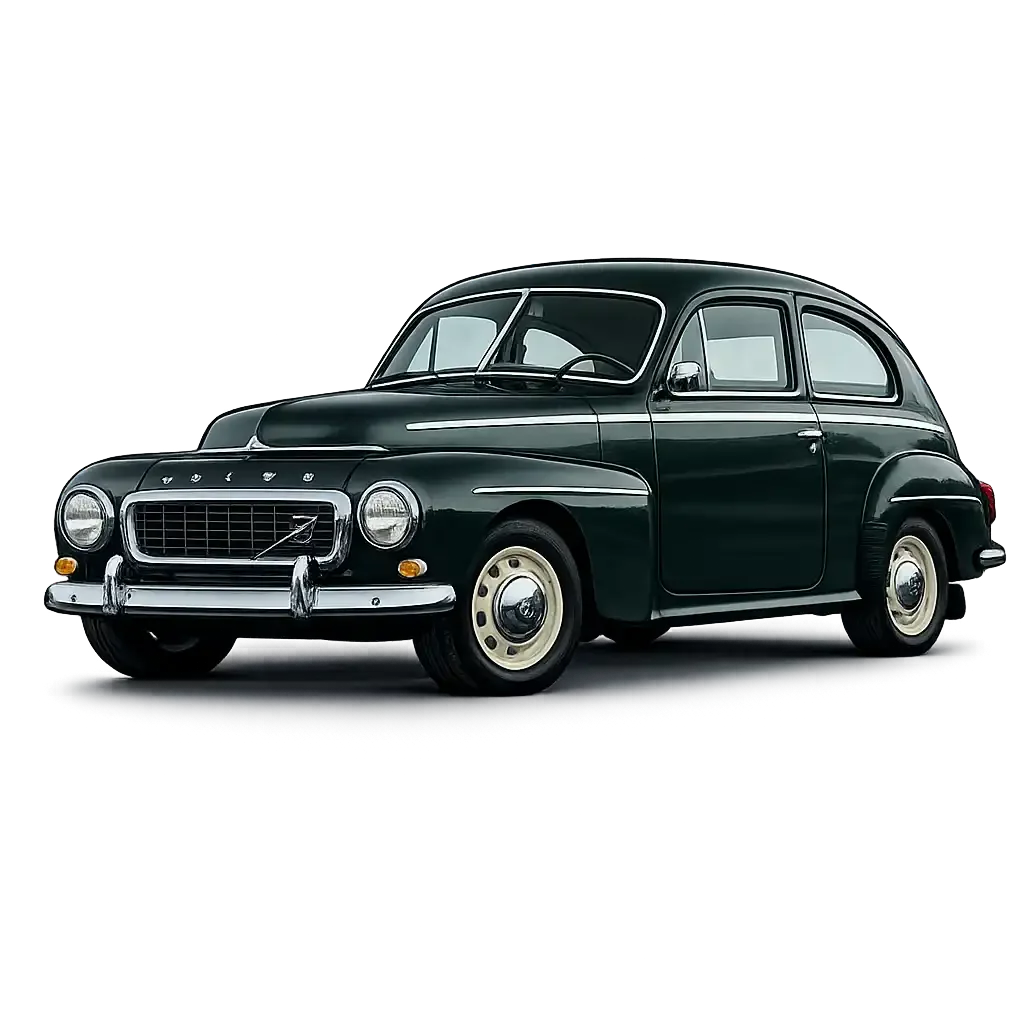
The Volvo PV444 is a 2-door, 4-passenger fastback sedan produced from 1947 to 1958, the car that established Volvo's reputation for rugged, reliable passenger vehicles. Designed during World War II by Helmer Pettersson and Erik Jern with a team of 40 engineers, the PV444 was Volvo's first unitary (monocoque) body construction and its first four-cylinder passenger car in nearly 20 years. This guide covers 1950 to 1958, spanning from the PV444 B-series through the final PV444 L-series before it was succeeded by the PV544 in August 1958. Volvo designated PV444 production in letter-coded series: A (1947 to 1950), B (1950), C (1951), D/DS (1952), E/ES (1953 to 1954), H/HS (1954 to 1955), K/KS (1956), and L/LS (1957 to 1958). Letters F, G, I, and J were skipped. The PV444 went through three engine families during its run: B4B (1.4L, 1947 to 1955), B14A (1.4L twin SU, 1956, export/sport), and B16 (1.6L, 1957 to 1958). All PV444s used a 6-volt electrical system and 3-speed manual transmission (with a 4-speed option arriving in 1957). Total production: approximately 196,005 PV444 units. Assembly: Gothenburg (Hisingen plant), Sweden. US sales began in early 1956.
Generation Overview (1950 to 1958)
PV444 B (September 1950)
Engine output increased from 40 hp to 44 hp via modified camshaft profiles and valve mechanisms. B4B engine, single downdraft Carter carburetor. 6-volt. 3-speed manual.
PV444 C (1951)
Improved instrument panel, steering wheel, and bumpers. Early C-models had a flasher unit mounted centrally on the roof, later moved to roof sides. B4B engine at 44 hp continues.
PV444 D/DS (1952)
15-inch wheels replace earlier 16-inch wheels. More powerful generator. Modified steering. Heater available as optional extra. The "Fixlight" disappearing direction indicators replaced by conventional side indicators. Additional colors added to range (originally black only). 25,000th PV444 produced in January. DS denotes export specification.
PV444 E/ES (1953 to 1954)
Available in maroon with red and beige upholstery (first non-black/grey colors). ES available in pearl grey. Price reduced. Better heater and door locks. B4B at 44 hp continues. 3-speed manual.
PV444 H/HS (Late 1954 to 1955)
The most extensive changes since the model's introduction. Windscreen made slightly larger with narrower A-pillars (still two-piece split flat glass). Rear window made wider and relocated higher (single pane). Rear lamps raised from wings to body. Spare wheel repositioned from under-floor to standing vertically in the boot. Interior light moved to underneath rear-view mirror. Improved rust prevention with coated floor and inner wings. HS is the export version.
PV444 K/KS (1956)
Major engine upgrade: B4B output increased to 51 hp (single Zenith carburetor, 7.3:1 compression). For the US/export market, the new B14A engine with twin side-draft SU carburetors produces 70 hp (7.8:1 compression). New "mouth organ" type grille. Plated wing strips now standard. Rear lamps/indicators relocated to wings. US sales begin. KS is the export version.
PV444 L/LS (1957 to 1958)
Final PV444 variant. New B16 engine (1,583 cc), replacing the 1,414 cc B4B/B14 family. Two versions: B16A (single Zenith carburetor, 60 hp, 7.5:1 compression) and B16B (twin SU carburetors, 85 hp, 8.2:1 compression). New 4-speed manual gearbox (M40) available alongside the 3-speed. Better insulation and soundproofing. New carburetors and exhaust system. New air cleaner and oil filter. Front turn signals repositioned further out on fenders. Electrically driven windshield wipers replace vacuum system. Tidier grille with finer mesh and gold "V" center emblem. Rear indicators combined with brake lights and rear lights in new unit. Seat belt anchorage points standard (1957). Top half of dashboard padded (1957). The PV444 is succeeded by the PV544 in August 1958.
Platform and Engineering
Key Platform Facts
• Body: 2-door fastback sedan, unitary (monocoque) construction
• Architecture: Rear-wheel drive, longitudinal engine, front-mounted
• Front suspension: Independent, coil springs, telescopic shock absorbers (Delco)
• Rear suspension: Live (solid) rear axle (Spicer), coil springs
• Steering: Ross worm and nut (early), later changed to Gemmer cam and roller
• Brakes: Wagner hydraulic drums on all four wheels
• Wheels (1950 to 1951): 16-inch
• Wheels (1952 onward): 15-inch
• Wheelbase: 102.4 inches (260 cm)
• Electrical system: 6-volt (all PV444 models)
• Propeller shaft: One-piece
• Assembly: Gothenburg (Hisingen), Sweden
• Total production: 196,005 units (1947 to 1958)
Engine Reference (Detailed)
B4B: 1.4L Inline-4, Single Carburetor (1947 to 1956)
The original PV444 engine. Cast-iron block, overhead valves, pushrod, 3 main bearings. Underwent three power upgrades across its life.
• Displacement: 1,414 cc (1.4 liters)
• Bore x stroke: 75 mm x 80 mm
• Main bearings: 3
• Carburetion: Single downdraft (Carter, later Zenith)
• Power (1947 to 1949): 40 hp (6.4:1 compression)
• Power (1950 to 1955): 44 hp (modified cam/valves)
• Power (late 1955 to 1956): 51 hp (redesigned head, cam, valve springs, pushrods, 7.3:1 compression)
• Ignition suppliers: Autolite or Bosch distributors and generators
• Electrical: 6-volt
B14A: 1.4L Inline-4, Twin SU Carburetors (1956, Export/Sport)
A twin-carburetor version of the 1.4L engine created primarily for the US market. Brief production run of approximately one year. Also used in the Volvo P1900 Sport roadster (67 units built, 1956 to 1957).
• Displacement: 1,414 cc
• Bore x stroke: 75 mm x 80 mm
• Carburetion: Twin side-draft SU HS2 carburetors (1.5-inch bore)
• Power: 70 hp at 5,500 rpm (7.8:1 compression)
• Main bearings: 3
• Electrical: 6-volt
• Rarity: Very rare in Europe; uncommon even in the US. One-year production run.
B16A: 1.6L Inline-4, Single Carburetor (1957 to 1958)
The bored-out replacement for the B4B. Standard engine for the final PV444 L-series.
• Displacement: 1,583 cc (1.6 liters)
• Bore x stroke: 79.37 mm x 80 mm
• Compression ratio: 7.5:1
• Carburetion: Single Zenith carburetor
• Power: 60 hp at 4,500 rpm
• Main bearings: 3
• Oil filter: Relocated to housing under intake/exhaust manifold side (B14 had it next to water pump)
• Electrical: 6-volt
B16B: 1.6L Inline-4, Twin SU Carburetors (1957 to 1958)
The high-performance version of the B16, with twin SU HS4 carburetors (notably larger than the B14A's HS2 units). Standard on US-market PV444 L-series.
• Displacement: 1,583 cc (1.6 liters)
• Bore x stroke: 79.37 mm x 80 mm
• Compression ratio: 8.2:1
• Carburetion: Twin side-draft SU HS4 carburetors
• Power: 85 hp at 5,500 rpm
• Main bearings: 3
• Exhaust manifold: Exit towards rear (B14A exhaust manifold dumped centrally)
• Electrical: 6-volt
Critical engine family boundaries: The B4B, B14A, and B16 share the same 80 mm stroke and basic OHV pushrod architecture, but the B4B/B14A (75 mm bore) and B16 (79.37 mm bore) are different displacement engines with different bore sizes. Pistons, rings, cylinder liners, and head gaskets do NOT interchange between 1.4L (B4B/B14A) and 1.6L (B16) engines. External differences: the B14A had its oil filter next to the water pump; the B16 relocated it under the intake/exhaust manifold. The B14A used SU HS2 (1.5-inch bore) carburetors; the B16B used larger SU HS4 carburetors.
Transmission Reference
3-Speed Manual (Various Designations: M3, H3, H4, H5, H6)
The sole transmission on the PV444 from 1947 through 1956. Floor-mounted gear lever. Synchromesh on 2nd and 3rd gears. Multiple internal designations across production years.
4-Speed Manual (M4/M40)
Introduced with the L-series in 1957. Available alongside the 3-speed on the final PV444 models.
Transmission note: The 3-speed and 4-speed are completely different gearboxes with different cases, gear sets, and shift linkage. Within the 3-speed family, there are multiple internal revisions (M3, H3, H4, H5, H6) across production years; not all internal components interchange between 3-speed revisions. Verify the exact variant code when sourcing 3-speed internals.
Catalog Accuracy: The Fitment Splits That Matter
Split 1: B4B (1.4L, 1950 to 1956) vs. B16 (1.6L, 1957 to 1958)
The most critical fitment split. Different bore sizes (75 mm vs. 79.37 mm) mean different pistons, rings, cylinder liners, and head gaskets. The blocks look similar externally but are dimensionally different internally. External differences include oil filter location (B4B: various positions; B16: under intake/exhaust manifold), exhaust manifold routing, and carburetor specifications. All engine-internal components are non-interchangeable between the two families.
Split 2: B14A (Twin SU, 1956) as Transitional Engine
The B14A is a one-year transitional engine sharing the B4B's 1,414 cc displacement and 75 mm bore but fitted with twin SU HS2 carburetors for 70 hp. Internally very similar to the late B4B (51 hp) but with different carburetion. Extremely rare, even in the US where it was standard. Parts specific to the B14A twin-carburetor setup (intake manifold, carburetors, air cleaners, fuel lines) are unique and do not interchange with either the B4B single-carburetor or the B16 twin-carburetor configurations. The B14A SU HS2 carburetors are smaller than the B16B's SU HS4 units.
Split 3: Single Carburetor vs. Twin Carburetors
Within each engine family, single-carburetor (B4B with Zenith/Carter; B16A with Zenith) and twin-carburetor (B14A with SU HS2; B16B with SU HS4) versions have completely different intake manifolds, carburetor(s), air filter assemblies, fuel line routing, and potentially different exhaust manifolds.
Split 4: 16-Inch Wheels (1950 to 1951) vs. 15-Inch Wheels (1952 Onward)
In 1952, the PV444 switched from 16-inch to 15-inch wheels. Tires, wheel bolts, and hubcaps differ between the two wheel sizes. This split also affects brake drum specifications.
Split 5: 3-Speed (1950 to 1958) vs. 4-Speed (1957 to 1958)
The 4-speed manual was introduced on the L-series in 1957. Different gearbox case, gear sets, and shift linkage. Most PV444s have the 3-speed, but the final L/LS models could have either.
Split 6: PV444 (Sedan) vs. PV445 (Duett/Wagon)
The PV445 Duett shares all components forward of the A-pillar with the PV444. Behind the A-pillar: the PV445 has a separate conventional chassis frame (not monocoque), leaf spring rear suspension (not coil springs), wagon/van body, and commercial-duty cargo area. Engine, transmission, front suspension, steering, and front brakes interchange. Rear suspension, body panels, rear glass, and interior do not.
Split 7: PV444 (Two-Piece Flat Windshield) vs. PV544 (One-Piece Curved)
The PV544 replaced the PV444 in August 1958 with a curved one-piece windshield, larger taillights, padded dashboard, wider rear seat, and relocated handbrake. While many mechanical components (engine, transmission, front suspension, rear axle) carry over directly from late PV444 L-series to early PV544 A-series, body glass, dashboard, taillights, interior trim, and handbrake components do NOT interchange. Parts catalogs listing "PV" without specifying 444 or 544 will cause errors on any body or interior component.
Split 8: Variant Letter (B through L) for Trim and Body Components
The PV444's letter-coded series (B, C, D, E, H, K, L) each introduced specific trim, body, and lighting changes: grille designs evolved continuously, taillights relocated from wings to body to wings again, rear window sizes changed, spare wheel position changed, windshield wipers went from vacuum to electric, and dashboard padding was added. When ordering exterior trim, grille, taillights, or interior components, the variant letter is essential. The most significant body change occurred with the H-series (late 1954): larger windscreen, wider single-pane rear window, and repositioned spare wheel.
Common Wear Items and Fitment Notes
• Carburetor rebuild kits: Five different setups: B4B early (single Carter), B4B later (single Zenith), B14A (twin SU HS2), B16A (single Zenith), B16B (twin SU HS4). Specify exact engine variant.
• Ignition components: All 6-volt. Points, condenser, coil, distributor cap, rotor. Ignition suppliers varied: Autolite or Bosch. Verify which brand is fitted.
• Generator: 6-volt throughout. Different generator specifications between model years (D/DS received a more powerful unit in 1952).
• Starter motor: 6-volt. May differ by engine family.
• Headlight bulbs: 6-volt. 6V bulbs are increasingly scarce.
• Brake drums and shoes: Wagner hydraulic drums all around. Verify 16-inch (1950 to 1951) vs. 15-inch (1952+) wheel size, as drum specifications may differ.
• Water pump: Differs between B4B/B14A and B16 engine families.
• Exhaust manifold: Differs between single-carb and twin-carb versions and between B14A (center exit) and B16 (rear exit) engines.
• Windshield wipers: Vacuum-driven (pre-1957) vs. electrically driven (1957 L-series). Different motor, linkage, and control mechanism.
• Grille: Changed with nearly every variant letter. Specify the exact series (B, C, D, E, H, K, L) when ordering.
• Taillights: Relocated and redesigned across multiple variants. Specify the exact series.
• Rear window: H-series (1954) brought a wider single-pane rear window, replacing the earlier smaller unit. Not interchangeable.
• Seat belt anchors (1957 L-series): Standard from 1957. Earlier models may lack factory anchor points.
Ordering Quick-Reference Checklist
• Variant letter: B, C, D/DS, E/ES, H/HS, K/KS, or L/LS?
• Engine: B4B (40/44/51 hp), B14A (70 hp twin SU, 1956 only), B16A (60 hp single Zenith, 1957+), or B16B (85 hp twin SU, 1957+)?
• Carburetor type: Single downdraft (Carter or Zenith) or twin side-draft (SU HS2 or HS4)?
• Electrical: 6-volt (all PV444). Confirm not a post-1962 12-volt PV544.
• Wheel size: 16-inch (1950 to 1951) or 15-inch (1952 onward)?
• Transmission: 3-speed or 4-speed (1957+ only)?
• PV444 vs. PV544: Confirm PV444 (two-piece flat windshield) vs. PV544 (curved one-piece, August 1958+).
• Ignition supplier: Autolite or Bosch distributor/generator?
Three Questions to Always Ask
• "Which engine: B4B, B14A, B16A, or B16B?" Three engine families across the PV444's life (1.4L B4B at 40 to 51 hp, 1.4L B14A twin SU at 70 hp, and 1.6L B16 at 60 to 85 hp). The B4B and B16 have different bore sizes and zero internal interchange. The B14A is a rare transitional one-year engine. Within each family, single-carb and twin-carb versions differ in intake, exhaust, and fuel system. If the customer says "1957 or 1958," the engine is a B16. If 1956, it could be B4B or B14A. If 1950 to 1955, it is a B4B.
• "What variant letter?" The PV444's variant letter (B through L) determines the grille, taillights, rear window, wheel size, wiper type, and many trim details. Grilles changed with nearly every series. Taillights moved from body to wings and back. The H-series (1954) is the biggest body change. Without the variant letter, exterior and interior parts orders are guesswork.
• "PV444 or PV544?" The PV444 ended in August 1958, replaced by the PV544. Late PV444 L-series and early PV544 A-series share the B16 engine and many mechanical components, but the windshield (two-piece flat vs. one-piece curved), dashboard, taillights, rear seat, and handbrake are all different. A parts listing for "PV" without specifying 444 or 544 will cause returns on any body, glass, or interior component.
Disclaimer: This guide is based on publicly available specifications, Volvo press materials, and independent research. Part interchangeability should always be confirmed via VIN and OEM part number lookup. Specifications may change without notice. This document does not constitute official Volvo parts catalog data. Visuals and illustrations in this article were generated using AI for representative purposes and may not reflect exact technical schematics.