
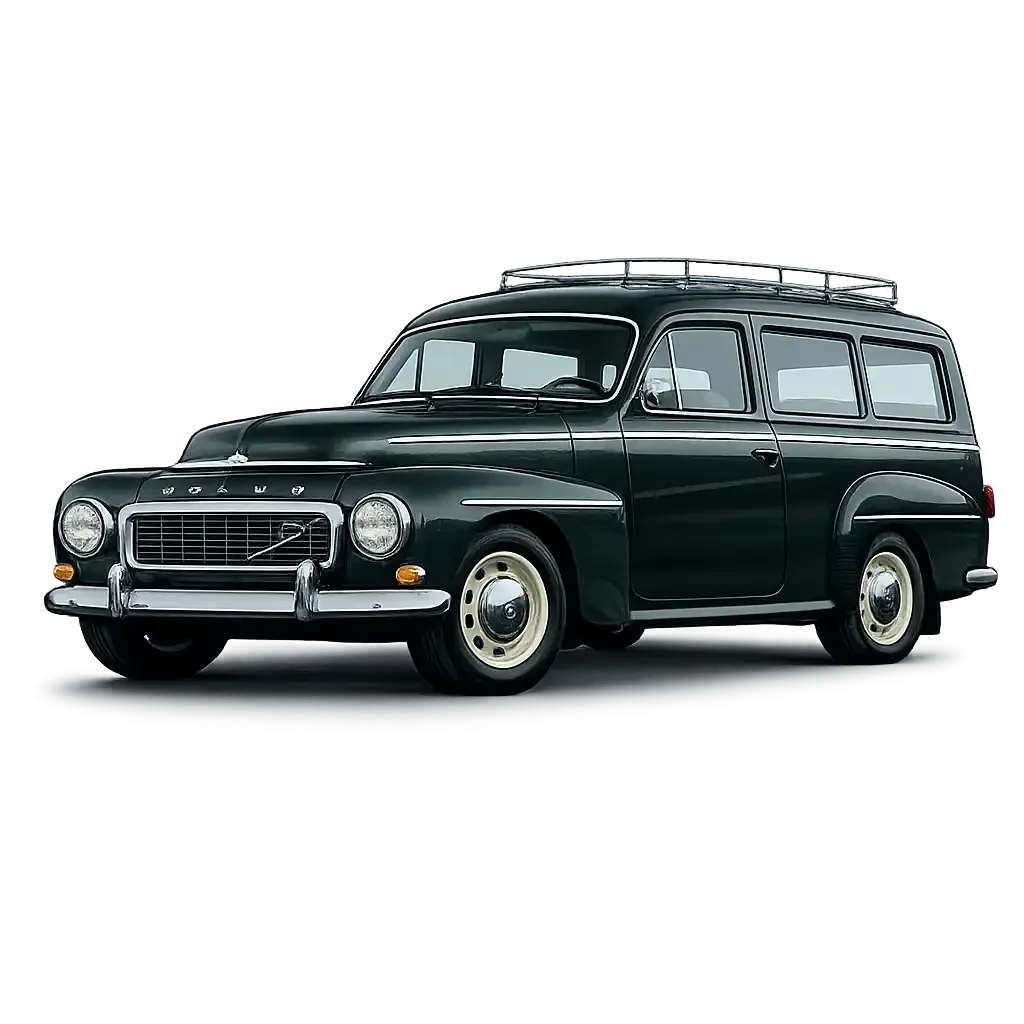
The Volvo PV445 is the chassis-based commercial and estate derivative of the PV444 sedan, produced from 1949 to 1960. Unlike the PV444's unitary (monocoque) body construction, the PV445 used a separate conventional chassis frame with rear leaf springs (replacing the PV444's coil springs) to support heavier commercial loads. Forward of the A-pillar, all components were shared with the PV444. The PV445 formed the base for pickups, vans, estate cars, ambulances, and a few coachbuilt convertibles. In 1953, Volvo introduced its own factory-built wagon on the PV445 platform: the legendary Duett (named for its dual-purpose concept as both family and work vehicle). This guide covers the 1956 to 1961 model years, spanning the late PV445 Duett era through the transition to the P210 Duett designation in autumn 1960. The 1960 redesignation from PV445 to P210 coincided with the adoption of the PV544's curved one-piece windshield and new dashboard. The PV445/P210 Duett was sold primarily on Nordic markets but was also exported to North America. Total PV445 production: approximately 29,409 units (1949 to 1960). The P210 continuation produced approximately 60,100 units (1960 to 1969).
Generation Overview (1956 to 1961)
This guide's coverage window begins in 1956 when the engine was upgraded from 44 hp to 51 hp, and extends through 1961, capturing the PV445-to-P210 transition and the final year before the critical B18 engine and 12-volt electrical system arrived in winter 1962.
Year-by-Year Changes
1956
Engine power increased from 44 hp to 51 hp (B4B engine, single Zenith carburetor, 7.3:1 compression ratio). Plated wing strips now standard. Rear lamps/indicators in wings. "Mouth organ" type grille adopted (shared with PV444 of same year). 6-volt electrical system. 3-speed manual transmission.
1957
Major engine change: the B4B (1,414 cc) is replaced by the new B16 engine (1,583 cc). Two versions available: B16A (single Zenith carburetor, 60 hp at 4,500 rpm, 7.5:1 compression) and B16B (twin SU carburetors, 85 hp at 5,500 rpm, 8.2:1 compression). The B16 was a bored-out version of the earlier engine with improved breathing. A 4-speed manual gearbox (M40) becomes available as an alternative to the 3-speed (M30/H6). Tidier grille design. 6-volt electrical system continues.
1958
The PV444 sedan is renamed PV544 with its curved windshield and interior updates, but the PV445 Duett continues with its existing body configuration (flat two-piece windshield on wagon body). B16A and B16B engines continue. 6-volt electrical. Minor trim updates.
1959
Seat belts become optional (later standard). B16A and B16B engines continue. 6-volt electrical. 3-speed or 4-speed manual. Minor updates.
1960 (PV445 to P210 Transition)
The PV445 designation is retired and replaced by P210 Duett in autumn 1960. The P210 receives the PV544's curved one-piece windshield (replacing the flat two-piece glass) and new dashboard from the PV544. The floorpan is updated with a welded chassis construction. B16A (60 hp) engine continues as the standard powerplant. 6-volt electrical system. 4-speed manual gearbox (M40) standard. This transition year bridges the PV445 and P210 identities; early 1960 production is PV445, late 1960 production is P210.
1961
The P210 Duett continues with the B16 engine and 6-volt electrical system (the B18/12-volt transition would not arrive until winter 1962). The P210 designation is now fully established. 4-speed manual standard. This is the last year of the B16 engine and 6-volt electrical system in the Duett. From winter 1962, the P210 would receive the B18 engine (75 hp) and 12-volt electrics, matching the PV544 C-model transition.
Platform and Engineering
Key Platform Facts
• Designation: PV445 (1949 to 1960); P210 (1960 to 1969)
• Body: Wagon (estate) and delivery van, 2-door with rear Dutch doors (split horizontally)
• Construction: Separate conventional chassis frame (NOT the PV444/544's unitary monocoque)
• Architecture: Rear-wheel drive, longitudinal engine, front-mounted
• Front suspension: Independent, coil springs (shared with PV444/544)
• Rear suspension: Live (solid) rear axle with LEAF springs (not coil springs like PV444/544 sedan)
• Steering: Cam and roller (Gemmer type)
• Brakes: Hydraulic drums on all four wheels
• Wheelbase: 102 inches (2,600 mm)
• Electrical system (1956 to 1961): 6-volt throughout this guide's coverage
• Assembly: Gothenburg, Sweden
Engine Reference (Detailed)
B4B: 1.4L Inline-4, Single Carburetor (Through 1956)
The original PV engine, carried from the PV444 into the early PV445. By 1956, the B4B produced 51 hp. Replaced by the B16 in 1957.
• Displacement: 1,414 cc (1.4 liters)
• Bore x stroke: 75 mm x 80 mm
• Main bearings: 3
• Carburetion: Single downdraft Zenith carburetor
• Power (1956): 51 hp at 4,500 rpm (7.3:1 compression)
• Electrical: 6-volt
B14A: 1.4L Inline-4, Twin SU Carburetors (1955 to 1957, Export/Sport)
A twin-carburetor version of the 1.4L engine, primarily for the US/export market PV444. May appear on some late PV445 Duett configurations.
• Displacement: 1,414 cc
• Carburetion: Twin side-draft SU carburetors
• Power: 70 hp at 5,500 rpm (7.8:1 compression)
• Main bearings: 3
• Electrical: 6-volt
B16A: 1.6L Inline-4, Single Carburetor (1957 to 1961)
The standard Duett engine from 1957 through the end of the B16 era in 1961. The B16 was a bored-out derivative of the earlier B4B/B14 with improved displacement and breathing.
• Displacement: 1,583 cc (1.6 liters)
• Bore x stroke: 79.37 mm x 80 mm
• Compression ratio: 7.5:1
• Carburetion: Single Zenith carburetor
• Power: 60 hp at 4,500 rpm
• Main bearings: 3
• Electrical: 6-volt
B16B: 1.6L Inline-4, Twin SU Carburetors (1957 to 1961)
The performance version of the B16, with twin side-draft SU carburetors. Available on Sport-spec Duetts and standard on many US-market cars.
• Displacement: 1,583 cc (1.6 liters)
• Bore x stroke: 79.37 mm x 80 mm
• Compression ratio: 8.2:1
• Carburetion: Twin side-draft SU carburetors
• Power: 85 hp at 5,500 rpm
• Main bearings: 3
• Electrical: 6-volt
Engine family transitions: The Duett went through three engine families during its full production run: B4B/B14 (1.4L, 1949 to 1957), B16 (1.6L, 1957 to 1961), and B18 (1.8L, 1962 to 1969). This guide covers only the B4B tail-end (1956) and the B16 era (1957 to 1961). The B18 engine with 12-volt electrics arrived in winter 1962, falling outside this guide's scope. All engines in this guide's range use the 6-volt electrical system and have 3 main bearings.
Transmission Reference
3-Speed Manual (M30/H6)
The original transmission carried from the PV444/445 era. Standard on early models. Floor-mounted gear lever. Synchromesh on 2nd and 3rd gears.
4-Speed Manual (M40)
Introduced as an option in 1957, becoming standard by the P210 era. Floor-mounted gear lever. Improved highway cruising over the 3-speed.
Transmission identification: Count the forward gears. The 3-speed and 4-speed are different units with different gear sets, cases, and shift linkage. No parts interchange between M30/H6 and M40.
Catalog Accuracy: The Fitment Splits That Matter
Split 1: B4B/B14 (1.4L, Through 1956) vs. B16 (1.6L, 1957 to 1961)
The transition from the 1.4L engine family to the 1.6L B16 in 1957 is a critical fitment boundary. The B4B/B14 and B16 have different bore sizes (75 mm vs. 79.37 mm), different pistons, different blocks, and different carburetor specifications. While they share the same basic architecture (inline-4, OHV, pushrod, 3 main bearings, 80 mm stroke), internal components do NOT interchange. External accessories may differ in mounting configuration. Verify whether the car has the 1.4L or 1.6L engine before ordering any engine component.
Split 2: Single Carburetor (B4B/B16A) vs. Twin Carburetors (B14A/B16B)
Within each engine family, single-carburetor and twin-carburetor versions require different intake manifolds, carburetors, air filter housings, fuel line routing, and potentially different exhaust manifolds. The single-carburetor versions use a Zenith downdraft; the twin-carburetor versions use twin side-draft SU carburetors. Rebuild kits, jets, needles, and float specifications are all carburetor-type-specific.
Split 3: PV445 (Through Autumn 1960) vs. P210 (Autumn 1960 Onward)
The most important body-related split. In autumn 1960, the PV445 was redesignated P210 and received the PV544's curved one-piece windshield (replacing the flat two-piece glass from the PV444 era) and a new dashboard matching the PV544. The floorpan was updated to a welded construction. The windshield, windshield surround/trim, dashboard, and some interior components are NOT interchangeable between PV445 (flat two-piece windshield) and P210 (curved one-piece windshield). Early 1960 production may be PV445; late 1960 production is P210. Verify by VIN or visual inspection of the windshield.
Split 4: 3-Speed (M30/H6) vs. 4-Speed (M40)
Different transmissions with no parts interchange. The 3-speed was standard on earlier models; the 4-speed became standard from 1957 onward. Shifter linkage, gearbox case, internal gear sets, and potentially crossmember mounting differ.
Split 5: PV445 Duett (Wagon/Van) vs. PV444/PV544 (Sedan)
The PV445 Duett shares all components forward of the A-pillar with the PV444 (and later PV544): engine, transmission, front suspension, steering, brakes (front), and front body panels. Behind the A-pillar, the Duett is a completely different vehicle: separate chassis frame (vs. PV444/544 monocoque), leaf spring rear suspension (vs. PV444/544 coil spring rear), wagon/van body, rear Dutch doors, raised roofline, and commercial-duty cargo area. Rear springs, rear axle mounting, rear body panels, rear glass, and interior trim are all Duett-specific.
Split 6: Body Variants (Van vs. Estate vs. Passenger Estate)
The PV445 was produced in multiple body configurations built on the same chassis: Van (DS, GS, LS series: delivery/commercial configuration with panel sides, no rear windows), Estate (DH, GL, LL series: wagon with windows and rear seating), and Passenger Estate (PH, GP, LP series: higher-trim passenger wagon). Interior trim, side glass, rear seating, and cargo area configuration differ between these variants. Some structural panels may also differ between the panel-sided van and the windowed estate. Always verify the exact body variant when ordering interior, glass, or rear body components.
Split 7: Coachbuilt (Pre-1953) vs. Factory Duett (1953 Onward)
Before Volvo introduced the factory Duett in 1953, the PV445 bare chassis was used by independent Swedish coachbuilders (Valbo, Grip, Nordbergs, and others) to produce pickups, vans, estate cars, ambulances, and convertibles. These coachbuilt bodies were all unique and have zero parts interchange with the factory Duett for any body component behind the A-pillar. While the guide's coverage begins in 1956, some coachbuilt PV445s from earlier years remain in service and can create confusion in parts catalogs. If the car has a non-standard body configuration, it is likely a coachbuilt PV445 and will require custom or NOS sourcing for body-specific parts.
Split 8: All B16/6V (This Guide) vs. B18/12V (Post-1962)
All cars covered in this guide (1956 to 1961) use the 6-volt electrical system and either the B4B/B14 (1956) or B16 (1957 to 1961) engine with 3 main bearings. From winter 1962, the P210 Duett received the B18 engine (1,778 cc, 75 hp, 5 main bearings) and 12-volt electrics, matching the PV544 C-model transition. No 6-volt electrical components interchange with 12-volt components. No B16 engine internals interchange with B18 engine internals. This is the single most important boundary when a parts catalog lists "P210 Duett" without specifying the engine or electrical system: pre-1962 and post-1962 P210 Duetts are mechanically very different under the hood.
Common Wear Items and Fitment Notes
• Carburetor rebuild kits: Four different setups across the range: B4B (single Zenith), B14A (twin SU), B16A (single Zenith), B16B (twin SU). Specify the exact engine variant.
• Ignition components: All 6-volt in this guide's range. Points, condenser, coil, distributor cap, and rotor are 6-volt specific. Do not order 12-volt components (post-1962 P210).
• Generator: 6-volt generator throughout. Not interchangeable with 12-volt alternator from post-1962 models.
• Starter motor: 6-volt. Different from post-1962 12-volt starter.
• Headlight bulbs: 6-volt throughout this guide's range.
• Rear leaf springs: Duett-specific. These are commercial-rated leaf springs, NOT the coil springs used on the PV444/544 sedan. Replacement springs must be sourced for the PV445/P210 Duett application.
• Windshield: PV445 (pre-autumn 1960): flat two-piece glass. P210 (autumn 1960 onward): curved one-piece glass from PV544. Not interchangeable between the two.
• Brake drums and shoes: Hydraulic drums all around. Generally shared with PV444/544 sedan of the same era, but verify fitment.
• Water pump: Specific to engine family (B4B/B14 vs. B16). Verify displacement before ordering.
• Dutch door hinges and latches: The rear doors split horizontally. Hinges, latches, and weather seals are Duett-specific and not shared with any sedan model.
• Rear cargo floor: Commercial-duty flooring rated for load carrying. Duett-specific.
• Engine bearings: All engines in this range have 3 main bearings. B4B/B14 and B16 use different bearing sets due to different bore sizes. Do not interchange.
Ordering Quick-Reference Checklist
• Model designation: PV445 (pre-autumn 1960) or P210 (autumn 1960 onward)?
• Engine: B4B (51 hp, 1956 only), B14A (70 hp twin SU, rare), B16A (60 hp single Zenith, 1957 to 1961), or B16B (85 hp twin SU, 1957 to 1961)?
• Electrical system: 6-volt (all models in this guide). Confirm not a post-1962 B18/12-volt car.
• Transmission: 3-speed (M30/H6) or 4-speed (M40)?
• Windshield: Flat two-piece (PV445) or curved one-piece (P210)?
• Body variant: Van (panel sides), estate (windowed), or passenger estate (higher trim)?
• Factory Duett or coachbuilt: Factory Volvo-built Duett (1953+) or earlier coachbuilt body?
• Duett vs. sedan: Confirm the car is a Duett (wagon/van), not a PV444/544 sedan. Rear suspension (leaf vs. coil), body from A-pillar back, and chassis construction all differ.
Three Questions to Always Ask
• "Which engine: B4B, B14, B16A, or B16B?" Two different engine families across this range (1.4L through 1956, 1.6L from 1957), each with single-carburetor and twin-carburetor variants. Internal components do not interchange between the 1.4L and 1.6L families. Within each family, carburetor-related parts differ between single and twin configurations. If the customer says "it's a 1957 or later," the engine is a B16. If it's a 1956, it's a B4B (or possibly B14A). Visual check: count the carburetors.
• "PV445 or P210 (flat or curved windshield)?" The transition from PV445 to P210 in autumn 1960 brought a new curved one-piece windshield and new dashboard. Cars straddling the 1960 model year could be either designation. The quickest identification is the windshield: flat two-piece glass = PV445; curved one-piece = P210. This determines windshield, dashboard, and some interior trim compatibility.
• "Duett or sedan?" The Duett shares everything forward of the A-pillar with the PV444/544 sedan, but behind the A-pillar it is a completely different vehicle with a separate chassis frame, leaf spring rear suspension, wagon body, and commercial-duty cargo area. Listing a part as "PV444" when the customer has a PV445 Duett will be correct for engine, transmission, and front suspension components, but wrong for anything body, rear suspension, or cargo-related.
Disclaimer: This guide is based on publicly available specifications, Volvo press materials, and independent research. Part interchangeability should always be confirmed via VIN and OEM part number lookup. Specifications may change without notice. This document does not constitute official Volvo parts catalog data. Visuals and illustrations in this article were generated using AI for representative purposes and may not reflect exact technical schematics.