
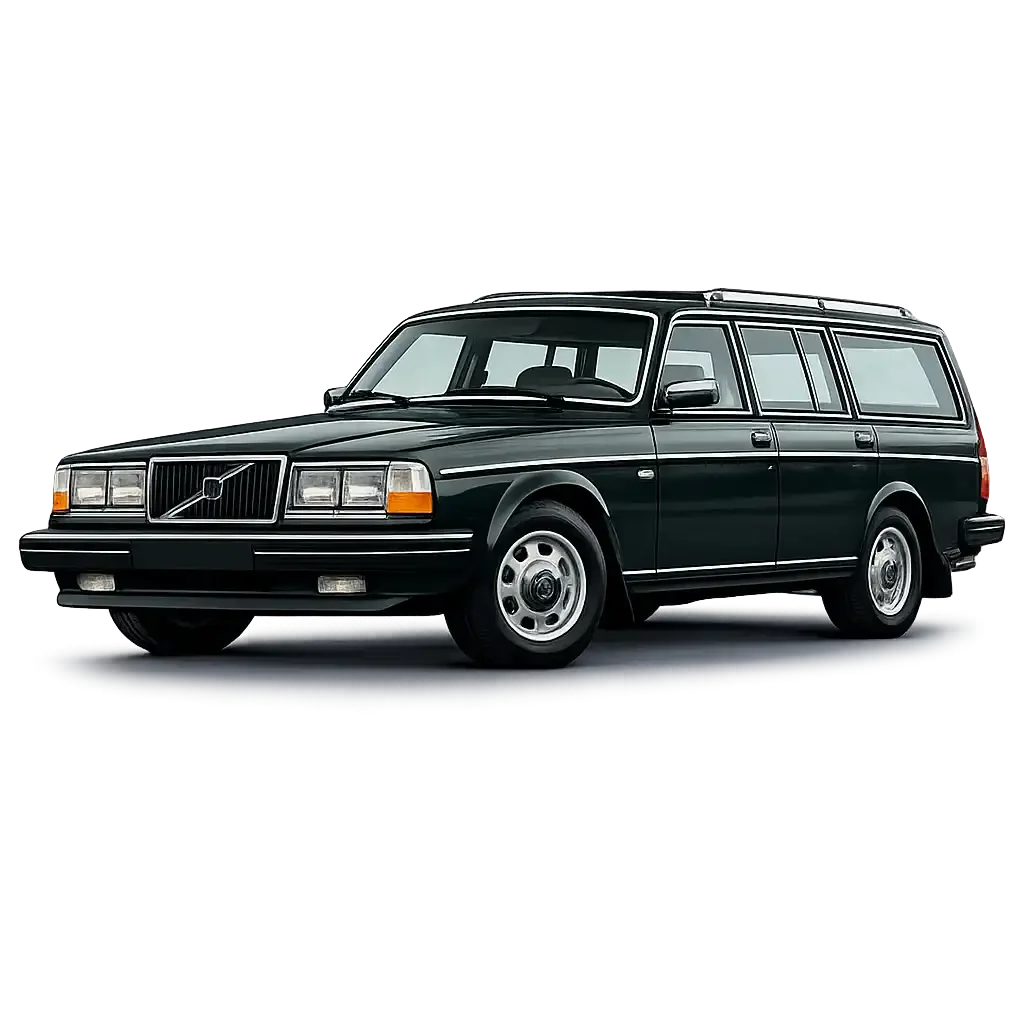
The Volvo 265 is the 5-door wagon (estate) variant of the Volvo 260 series, powered by the PRV V-6 engine(Peugeot-Renault-Volvo). Introduced for the 1976 US model year (autumn 1975 production), the 265 was Volvo's first production estate to be powered by a six-cylinder engine. The 265 shares the Volvo 200-series platform with the 240-series four-cylinder wagons (245) and the 260-series sedans (262 two-door, 264 four-door). The 260 series accounted for only approximately 10% of all 200-series sales, and the combination of low production volume with the PRV V-6's known top-end oiling troubles and premature camshaft wear means few of these cars remain on the road today. This guide covers the Volvo 265 for the 1976 to 1981 US model years, spanning from the model's US debut through the end of the 265 designation in the US market. The 265 shares nearly its entire body structure with the 245 four-cylinder wagon; from the firewall forward, the 260 series used different fenders, bumpers, grilles, and headlights than the 240 series. The critical engine transition during this period was the B27 (2.7L, 1976 to 1979) to B28 (2.8L, 1980 to 1981)displacement increase, which also brought a change from 4 to 7 main bearings.
Generation Overview (1976 to 1981 US Market)
Year-by-Year Changes
1976 Model Year (US Debut)
The 265 DL estate debuts for the US market alongside the 264 sedan and 262 two-door sedan. Engine: B27F 2.7L PRV V-6 with Bosch K-Jetronic (CIS) continuous fuel injection, producing 130 hp for the US market. All-aluminum alloy block with wet cylinder liners. 4 main bearings. 90-degree V-6 configuration. Transmission: Borg-Warner 3-speed automatic (BW35 or BW55) standard; 4-speed manual with electric overdrive available. Trim levels: 265 DL.
1977 Model Year
Lambda Sond oxygen sensor and three-way catalytic converter introduced on California emissions vehicles only. B27F continues at 130 hp. Minor trim updates. 49-state vehicles do not yet have Lambda Sond.
1978 Model Year
Grille altered with chrome surround. Rear-view mirrors changed to black. Front seats revised. New emblems. Interval wipers introduced. New paint formula to address severe rust problems from earlier model years. B27F continues.
1979 Model Year (Major Facelift)
Full front and rear facelift. GL and GLE sedans receive rectangular headlamps and new grille. Modified front suspension with stiffer shock absorbers, heavier anti-roll bars, and altered caster angle on power-steering models. Modified trunk lid (on sedan; may affect wagon tailgate trim) and new wrap-around taillights visible from the side. B27F continues at 130 hp. 265 GLE trim level available.
1980 Model Year (Engine Displacement Increase)
Major engine change: B27 (2.7L) replaced by B28 (2.8L). Displacement increased from 2,664 cc to 2,849 cc via bore increase from 88 mm to 91 mm. Main bearings increased from 4 to 7. Compression ratio increased from 8.2:1 to 8.8:1. US power rating: 130 hp (B28F with Bosch K-Jetronic fuel injection). The B28 is prone to top-end oiling troubles and premature camshaft wear. Dashboard facelift. Headlights and indicators changed. Narrower bumpers with black plastic coating. 265 GLE dropped from most markets. The 244/245 GLT model debuts with the V-6 as an option in wagons. Lambda Sond standard on 49-state vehicles.
1981 Model Year
B28F continues. The new B28E variant appears on some configurations (European injection calibration). Carburetted B28A engine (non-US) discontinued. Minor updates. The 265 designation approaches its end in the US market as the 260 range is gradually consolidated. The PRV V-6 would continue in the subsequent 760 series.
Platform and Engineering
Key Platform Facts
• Platform: Volvo 200 series (shared with 240 and other 260 variants)
• Body style: 5-door wagon (estate)
• Architecture: Rear-wheel drive, longitudinal engine, front-mounted
• Assembly: Torslanda, Gothenburg, Sweden
• Front suspension: MacPherson struts (new for 200 series vs. predecessor 140 series)
• Rear suspension: Live (solid) rear axle, coil springs, trailing arms, Panhard rod
• Steering: Rack-and-pinion (new for 200 series)
• Brakes: Power-assisted disc brakes front (ventilated), solid disc rear
• Wheelbase: 104.3 inches (2,650 mm)
• Wheel bolt pattern: 5x10⁸
Engine Reference (Detailed)
B27F: 2.7L SOHC V-6 PRV (1976 to 1979 US)
The original PRV V-6 for the US-market 265. All-aluminum alloy block with wet cylinder liners. 90-degree V-6 configuration. Developed jointly by Peugeot, Renault, and Volvo.
• Displacement: 2,664 cc (2.7 liters)
• Bore x stroke: 88 mm x 73 mm
• Compression ratio: 8.2:1
• Main bearings: 4
• Fuel injection: Bosch K-Jetronic (CIS, continuous injection system)
• Power (US): 130 hp
• Block material: Aluminum alloy with wet cylinder liners
• Configuration: 90-degree V-6, SOHC per bank
B28F: 2.8L SOHC V-6 PRV (1980 to 1981 US)
The enlarged PRV V-6 with bored-out cylinders and additional main bearings. Known for top-end oiling problems and premature camshaft wear.
• Displacement: 2,849 cc (2.8 liters)
• Bore x stroke: 91 mm x 73 mm
• Compression ratio: 8.8:1
• Main bearings: 7 (up from 4 on B27)
• Fuel injection: Bosch K-Jetronic (CIS)
• Power (US): 130 hp
• Block material: Aluminum alloy with wet cylinder liners
• Known issues: Top-end oiling troubles, premature camshaft wear. Regular oil changes critical.
B27 vs. B28: Critical fitment boundary. The B27 (2.7L, 4 main bearings, 88 mm bore) and B28 (2.8L, 7 main bearings, 91 mm bore) are dimensionally different engines. Pistons, cylinder liners, crankshaft, main bearing sets, and many internal components do NOT interchange. The B28's larger bore requires different liners and pistons. The crankshaft is completely different (4-bearing vs. 7-bearing). External accessories (alternator, power steering pump, water pump) are generally shared, but always verify. Motor mounts may differ due to the B28's slightly different weight distribution.
Transmission Reference
Borg-Warner 3-Speed Automatic (BW35/BW55)
The primary transmission for the US-market 265. The BW55 replaced the BW35 during the production run.
• Type: 3-speed automatic, torque converter
• Fluid: Dexron ATF
4-Speed Manual with Electric Overdrive
Available but uncommon on US-market 265s. Most US buyers chose the automatic. A 4-speed manual with electrically engaged overdrive on 4th gear.
Transmission note: The vast majority of US-market 265 wagons were equipped with the 3-speed automatic. Manual-transmission 265s are rare. By 1981, the manual option may have been discontinued for the US market. Always verify the transmission before ordering parts.
Catalog Accuracy: The Fitment Splits That Matter
Split 1: B27 (2.7L, 1976 to 1979) vs. B28 (2.8L, 1980 to 1981)
The most critical fitment split. The B27 and B28 are dimensionally different engines despite sharing the PRV architecture. The bore increase (88 mm to 91 mm) and the main bearing change (4 to 7) affect pistons, liners, crankshaft, bearings, and potentially the block itself. Head gaskets differ. Camshafts and cam-related components may differ between generations. The B28's known oiling and camshaft wear issues create additional parts demand specific to the 2.8L. Always determine displacement before ordering any engine internal component.
Split 2: Pre-Facelift (1976 to 1978) vs. Post-Facelift (1979 to 1981)
The 1979 model year brought a major front and rear facelift. Rectangular headlamps and new grille replaced the earlier round-headlamp design on GL/GLE models. Wrap-around taillights replaced the earlier flat-face units. Front bumpers, rear bumpers, grille, headlights, taillights, and associated trim are all different between pre-1979 and 1979+ models. The 1980 facelift further changed the dashboard, headlights, indicators, and introduced narrower black plastic-coated bumpers.
• 1976 to 1978: Round headlamps (most models), earlier grille, flat taillights, chrome bumpers.
• 1979: Rectangular headlamps on GL/GLE, new grille, wrap-around taillights, modified front suspension.
• 1980 to 1981: Further dashboard update, revised headlights/indicators, narrow black bumpers.
Split 3: 265 Wagon vs. 264 Sedan vs. 262 Two-Door
The 265, 264, and 262 share the same platform, engine, and transmission. From the B-pillar forward, the 265 wagon and 264 sedan are essentially identical. From the B-pillar back: completely different. The 265 has the wagon body (tailgate, raised roofline, rear cargo area, wagon-specific taillights, rear wiper, different rear springs rated for cargo). The 262 two-door sedan and the Bertone-built 262C coupe have unique body panels. When ordering any component from the B-pillar back, always specify the body style.
Split 4: 265 (PRV V-6) vs. 245 (Redblock Inline-4)
The 265 and 245 share the same wagon body from the firewall back. From the firewall forward, they are different vehicles: different engine, different fenders, different bumpers, different grille, different headlights, different radiator, different motor mounts, different exhaust system. The 260 series has a wider and deeper engine bay to accommodate the V-6. The 240 and 260 also have different front sheetmetal (fenders, hood, grille surround). A listing for "Volvo 245" will be correct for rear body, tailgate, cargo trim, rear suspension, and interior from the B-pillar back, but wrong for everything forward of the firewall.
Split 5: Lambda Sond (Oxygen Sensor) Variations
Lambda Sond and three-way catalytic converter were introduced on California emissions vehicles only for 1977. 49-state vehicles received Lambda Sond in 1980. This creates exhaust system and engine management differences between California and 49-state cars from 1977 to 1979. When ordering exhaust components, catalytic converters, or engine sensors for a 1977 to 1979 model, determine whether the car is California-emissions or 49-state.
Split 6: Rust Prevention Era (Pre-1978 vs. 1978+)
1978 models received a new paint formula to address severe rust problems on earlier model years. Pre-1978 265s (1976 to 1977) are significantly more prone to structural rust, particularly in the fenders, rocker panels, and wheel arches. When sourcing body panels for a 1976 to 1977 model, the panels themselves interchange with 1978+ cars, but the underlying rust damage may require additional repair. Be aware that early 265s may have extensive hidden corrosion.
Split 7: Automatic (BW35/BW55) vs. Manual with Overdrive
The vast majority of US-market 265s have the 3-speed automatic. Manual-equipped 265s are rare. Different transmission, shifter, crossmember, driveshaft, pedal assembly, and flywheel vs. flex plate. Within the automatic range, the BW35 was replaced by the BW55 during the production run; these have different internal components.
Split 8: 260 Series (PRV V-6) vs. 700 Series (Later PRV)
The PRV V-6 continued into the Volvo 760/780 as the B28F/B280F. While the engine family is shared, the 700-series PRV applications received progressive updates including the even-fire crankshaft and improved oiling (B280F/B280E), which the 200-series B27/B28 did not receive. Motor mounts, exhaust manifolds, wiring harnesses, and engine management calibrations differ between 200-series and 700-series applications. Do not assume cross-compatibility between 260 and 760 PRV engine components without verifying part numbers.
Common Wear Items and Fitment Notes
• Camshaft and cam followers (B28): The B28 is prone to premature camshaft wear due to top-end oiling design. Replacing camshafts and followers is a common repair. B28-specific; do not use B27 camshafts.
• Cylinder liners (wet liners): The PRV V-6 uses wet cylinder liners that can leak coolant into the crankcase if liner seals fail. B27 liners (88 mm bore) and B28 liners (91 mm bore) are NOT interchangeable.
• Fuel injection (Bosch K-Jetronic): The CIS (Continuous Injection System) uses a fuel distributor, warm-up regulator, cold-start valve, and auxiliary air valve. All are PRV-specific; do not order Redblock inline-4 K-Jetronic components.
• Exhaust manifolds: V-6-specific. Two manifolds (one per bank). Not shared with inline-4 240 models.
• Water pump: PRV V-6-specific. Different from inline-4 water pump.
• Alternator: Generally shared across 200-series V-6 and inline-4, but verify mounting bracket configuration.
• Front fenders/hood/grille: 260-series-specific. Different from 240-series front sheetmetal.
• Headlights: Changed with the 1979 and 1980 facelifts. Round (1976 to 1978 base), rectangular (1979+ GL/GLE), revised rectangular (1980+). Specify year.
• Taillights (wagon): Changed with the 1979 facelift (wrap-around). Pre-1979 and 1979+ wagon taillights are different.
• Rear suspension: Live rear axle shared with 245 wagon. Spring rates may differ between 240 and 260 due to different engine weight.
• Brake rotors/pads: Generally shared with 240 of the same model year. Verify ABS (if equipped on very late models).
• Tailgate struts (wagon): Gas struts that weaken with age. Shared with 245 wagon of the same year.
Ordering Quick-Reference Checklist
• Model year: 1976, 1977, 1978, 1979, 1980, or 1981?
• Engine: B27F 2.7L (1976 to 1979) or B28F 2.8L (1980 to 1981)?
• Facelift era: Pre-facelift (1976 to 1978), 1979 facelift, or 1980+ update?
• Emissions: California or 49-state? (Affects exhaust/sensors, 1977 to 1979.)
• Transmission: 3-speed automatic (BW35 or BW55) or 4-speed manual with overdrive?
• 265 wagon vs. 264 sedan vs. 262: Confirm body style. From B-pillar back, all different.
• 265 (V-6) vs. 245 (inline-4): Everything forward of the firewall differs. Rear body shared.
• VIN: Always verify by VIN.
Three Questions to Always Ask
• "B27 (2.7L) or B28 (2.8L)?" The most important question. These are dimensionally different engines: different bore (88 vs. 91 mm), different main bearing count (4 vs. 7), different crankshaft, different pistons, different liners, different head gaskets. The B28 (1980+) is also known for its camshaft wear issues, creating specific parts demand. The quickest identification: 1976 to 1979 = B27; 1980 to 1981 = B28.
• "What year for headlights and taillights?" Three phases of front-end styling (1976 to 1978, 1979, 1980 to 1981) and two taillight generations (pre-1979 flat vs. 1979+ wrap-around). Headlights, grille, bumpers, and taillights are all year-specific. Ordering a 1977 headlight for a 1980 car will result in a return.
• "265 wagon or 245 wagon?" The V-6 265 and inline-4 245 share the wagon body from the firewall back (tailgate, cargo area, rear suspension, rear glass, taillights). But from the firewall forward they are different vehicles: different engine, fenders, hood, grille, bumpers, radiator, motor mounts, and exhaust. A parts listing for "Volvo 245" will work for rear body components but fail for anything engine-related or forward of the firewall.
Disclaimer: This guide is based on publicly available specifications, Volvo press materials, and independent research. Part interchangeability should always be confirmed via VIN and OEM part number lookup. Specifications may change without notice. This document does not constitute official Volvo parts catalog data. Visuals and illustrations in this article were generated using AI for representative purposes and may not reflect exact technical schematics.