
Volvo EC40 (CMA Platform) 2025-2026 US Market Fitment Guide
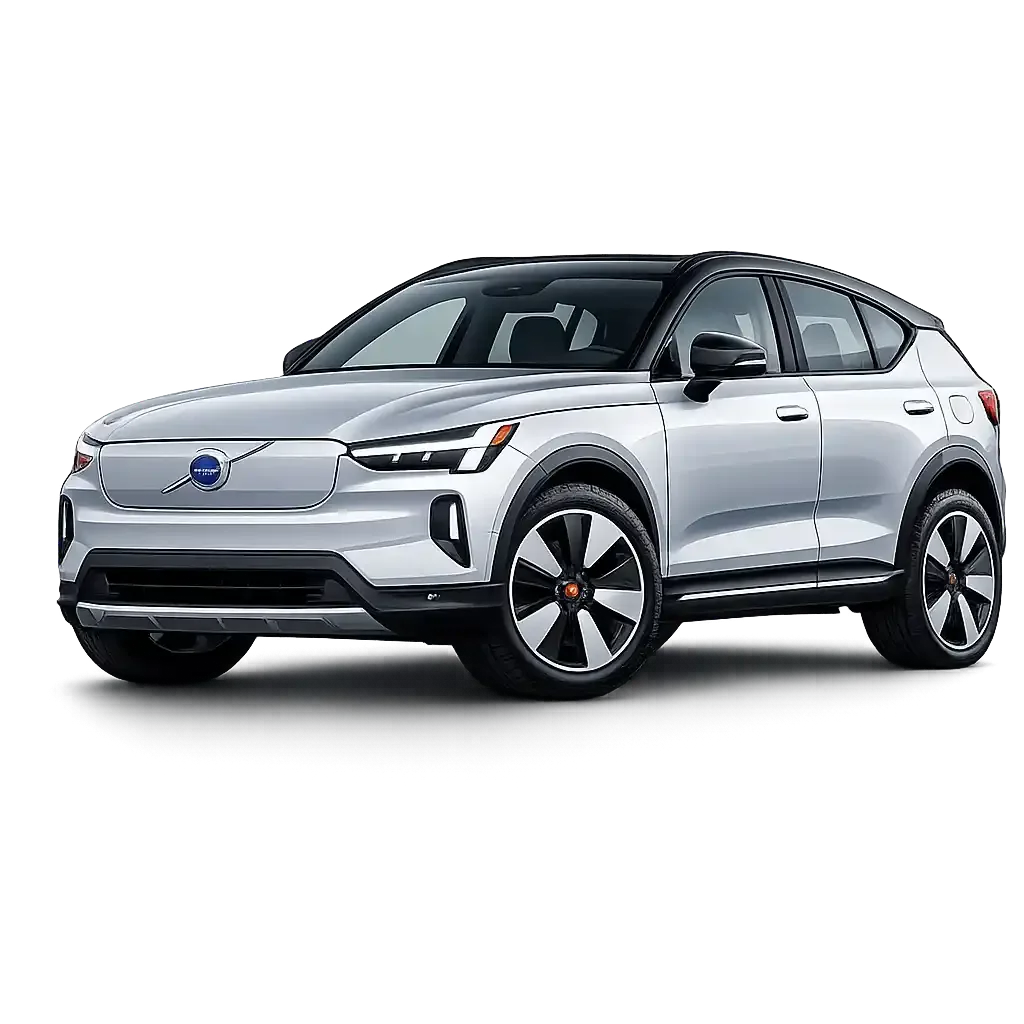
The Complete Fitment Guide
Returns destroy margins. The Volvo EC40 is the coupe-styled sibling of the EX40, built on the Compact Modular Architecture (CMA) platform shared with the EX40, the gasoline XC40, and the Polestar 2. Originally sold as the C40 Recharge (2022-2024), it was renamed EC40 under Volvo’s new EV naming convention starting with the 2025 model year. However, the EC40 skipped the US market for 2025 (Volvo confirmed it would return as a 2026 model). As a result, US-market EC40 availability effectively covers the pre-rename C40 Recharge (2022-2024) and the returning EC40 (2026). The EC40 shares its platform, powertrain, electrical architecture, and most structural components with the EX40. The key difference is the body: the EC40 has a lower, sloping roofline (fastback/coupe styling), a different rear hatch, unique rear glass, and a revised rear bumper. The EC40 is NOT related to the EX30 (SEA2 platform) or the EX90 (SPA2 platform). They share no structural, electrical, or powertrain components. This guide maps every fitment split required to prevent returns on Volvo’s electric coupe crossover.
Generation Overview (2025-2026 US Market)
The C40 Recharge launched in the US for the 2022 model year as Volvo’s first EV-only nameplate. Built on the CMA platform, it shares its architecture with the XC40 Recharge (now EX40). The EC40 is distinguished by its coupe-like roofline, which slopes more aggressively than the EX40’s upright SUV profile. This results in slightly less rear headroom and cargo space, but a more aerodynamic and visually distinctive design.
For 2024, the C40 Recharge was renamed EC40 globally as part of Volvo’s new naming convention. However, Volvo confirmed the EC40 would skip the 2025 US model year, returning for 2026. When it returns, the 2026 EC40 is expected to carry the same powertrain options as the EX40: Single Motor Extended Range RWD (248 hp) and Twin Motor AWD (402 hp, 436 hp with Performance pack). The 2025 CCS-to-NACS adapter is included as standard equipment, and 2026 models may feature a native NACS port.
The CMA platform has been used since 2018 (XC40) and supports both ICE and BEV configurations. The EC40 uses only the BEV variant of CMA with a 82 kWh gross (79 kWh usable) NMC lithium-ion battery pack, identical to the EX40.
Key Platform Facts
• Platform: CMA (Compact Modular Architecture), co-developed by Volvo and Geely
• US model years: 2022-2024 (as C40 Recharge), 2026+ (as EC40). Skipped 2025 US market.
• Assembly: Ghent, Belgium (Volvo factory)
• Battery: 82 kWh gross / 79 kWh usable, NMC lithium-ion. 400V architecture.
• Voltage: 400V system (not 800V)
• Powertrain options: Single Motor Extended Range RWD (248 hp, 310 lb-ft) and Twin Motor AWD (402 hp, 546 lb-ft; 436 hp with Performance pack)
• DC Fast Charging: Up to 200-205 kW. 10-80% in approximately 28-34 minutes.
• Charge port: CCS1 (2022-2025 models), NACS adapter included for 2025 MY. 2026 models expected to have native NACS.
• Shared platform: EX40, XC40 (gasoline/MHEV), Polestar 2. Same CMA architecture.
• NOT shared with: EX30 (SEA2 platform), EX90 (SPA2 platform). Zero interchangeable parts with these models.
• Body type: 5-door coupe/fastback crossover. Lower roofline than EX40.
• Ground clearance: 6.7 inches (vs. 8.1 inches for EX40)
• Dimensions: Length: 174.8”, Width: 73.3”, Height: 62.2”, Wheelbase: 106.4”
Naming History (US Market)
• 2022-2024 US: Volvo C40 Recharge
• 2025 US: Skipped (EC40 not sold in US this year)
• 2026 US: Volvo EC40 (returns to US market)
Parts catalogs may list under either name. The vehicle is mechanically identical across the name change. When ordering parts, confirm by VIN.
Critical Fitment Warnings
• EC40 vs. EX40: Same platform, same powertrain, same battery. BUT body panels, rear hatch, rear glass, rear bumper, roof, and some interior trim are UNIQUE to the EC40. Do not assume body parts interchange.
• EC40 vs. EX30: Completely different platforms (CMA vs. SEA2). Zero parts interchange. Common confusion due to similar naming.
• EC40 vs. EX90: Completely different platforms (CMA vs. SPA2). Zero parts interchange.
• Single Motor vs. Twin Motor: All front drivetrain components (front motor, front drive unit, front half-shafts) are exclusive to the Twin Motor. Suspension calibration may differ.
• CCS1 vs. NACS charge port: Charge port assembly, door, and wiring differ between configurations.
• C40 Recharge vs. EC40 name: Same vehicle. Parts interchange freely. Catalog may use either name depending on source.
Complete Powertrain Reference (US Market)
Powertrain
Drive
HP / Torque
Motor(s)
Years (US)
Single Motor Extended Range RWD
RWD
248 hp / 310 lb-ft
1 rear permanent magnet motor
2022-2024 (as C40), 2026 (as EC40)
Twin Motor AWD
AWD
402 hp / 546 lb-ft
1 front + 1 rear permanent magnet
2022-2024 (as C40), 2026 (as EC40)
Twin Motor Performance AWD
AWD
436 hp / 546 lb-ft
1 front + 1 rear (Performance tune)
2024 (as C40), 2026 (as EC40)
Trim Levels (US Market)
Year
Trims Available
Notes
2022-2024 (C40 Recharge)
Core, Plus, Ultimate
Single Motor and Twin Motor available across trims
2026 (EC40)
Plus, Ultra (expected)
Returning to US. Expected same trim structure as EX40. Ultra replaces Ultimate naming.
Catalog Accuracy: The Fitment Splits That Matter
The following splits are the most critical for preventing incorrect parts shipments and costly returns. Each split represents a point where parts do NOT interchange.
Split 1: EC40 (CMA) vs. EX30 (SEA2) vs. EX90 (SPA2)
These three Volvo EVs are on completely different platforms. Nothing interchanges between them. The EC40 uses the CMA platform; the EX30 uses Geely’s SEA2; the EX90 uses Volvo’s SPA2. Different battery packs, different motors, different suspension, different electrical architecture, different body structures. The only commonality is the Volvo badge and some infotainment software.
Split 2: EC40 (Coupe) vs. EX40 (SUV)
This is the most nuanced split. The EC40 and EX40 share the same CMA platform, same battery, same powertrain options, same electrical architecture, and most suspension and underbody components. However, the EC40 has a unique coupe/fastback body with a lower, sloping roofline. The following parts are UNIQUE to the EC40 and do NOT fit the EX40:
• Roof panel and roof rails
• Rear hatch/tailgate (different shape and angle)
• Rear glass (wraparound design, different curvature)
• Rear bumper and rear bumper trim
• C-pillar and D-pillar trim
• Rear spoiler/lip
• Some rear interior trim (headliner shape, rear cargo area)
Parts that generally DO interchange between EC40 and EX40:
• Powertrain components (motors, inverters, drive units, battery pack)
• Suspension components (struts, springs, control arms, stabilizer bars)
• Brakes (calipers, rotors, pads)
• Front body panels (hood, front bumper, fenders, headlights)
• Wheels and tires (same bolt pattern and sizing)
• Doors (front doors interchange; rear doors may differ due to roofline)
• Electrical/wiring (most harnesses and modules)
Always verify by VIN. Even shared components may have running production changes or assembly-date-specific revisions.
Split 3: Single Motor RWD vs. Twin Motor AWD
The Single Motor has one rear-mounted permanent magnet motor. The Twin Motor adds a front motor and front drive unit for AWD. All front drivetrain components (front motor, front drive unit, front half-shafts, front cooling lines) are exclusive to the Twin Motor. The Single Motor weighs less, and suspension calibration may differ to account for the weight distribution difference.
Split 4: CCS1 Charge Port vs. NACS Charge Port
The C40 Recharge (2022-2024) and early EC40 models have a CCS1 DC fast charging port. Volvo began including NACS adapters as standard equipment for 2025 model year vehicles (EX40, EX90). The 2026 EC40 is expected to feature either a native NACS port or an included NACS adapter. Charge port assembly, charge port door, and associated wiring differ between CCS1 and NACS configurations.
Split 5: C40 Recharge (2022-2024) vs. EC40 (2026)
The name changed but the vehicle is fundamentally the same CMA-based coupe crossover. Mechanical parts should interchange freely. However, the 2026 model may include:
• Updated infotainment system (Qualcomm Snapdragon Cockpit Platform, faster processing)
• New Volvo Car UX interface
• NACS charging port (vs. CCS1 on earlier models)
• Potential minor supplier changes to interior trim or software modules
• New Black Edition package availability
For parts ordering, always verify by VIN. The model year and production date matter more than the marketing name.
Split 6: EC40 vs. CMA Platform Siblings (Polestar 2)
The EC40, EX40, XC40, and Polestar 2 all share the CMA platform. While platform-level components (battery architecture, some suspension geometry) are related, body panels, interior trim, software, and many specific components are NOT interchangeable between brands. The Polestar 2 has its own unique body, interior, and tuning. Do not cross-reference Polestar 2 parts for the EC40 without explicit part number confirmation.
Ordering Quick-Reference Checklist
Before ordering any part for an EC40 / C40 Recharge, confirm:
• Model: EC40 or C40 Recharge (same vehicle, different name by year)
• Model year: 2022-2024 (C40 Recharge) or 2026 (EC40)
• Body style: EC40 coupe/fastback (NOT the EX40 SUV)
• Powertrain: Single Motor RWD or Twin Motor AWD (or Twin Motor Performance)
• Charge port: CCS1 (2022-2024) or NACS (2026)
• Trim level: Core, Plus, Ultimate (2022-2024) or Plus, Ultra (2026)
• VIN: Always verify. Running production changes are common.
Three Questions to Always Ask
• “Is this the EC40 (coupe) or the EX40 (SUV)?” Body panels differ. Powertrain and underbody are shared.
• “What is the model year?” (2022-2024 = C40 Recharge name, CCS port. 2026 = EC40 name, likely NACS port.)
• “Single Motor or Twin Motor?” All front drivetrain components are exclusive to the Twin Motor.
Disclaimer: This guide is based on publicly available specifications, Volvo press materials, and independent research. Part interchangeability should always be confirmed via VINand OEM part number lookup. Specifications may change without notice. This document does not constitute official Volvo parts catalog data. Visuals and illustrations in this article were generated using AI for representative purposes and may not reflect exact technical schematics.