
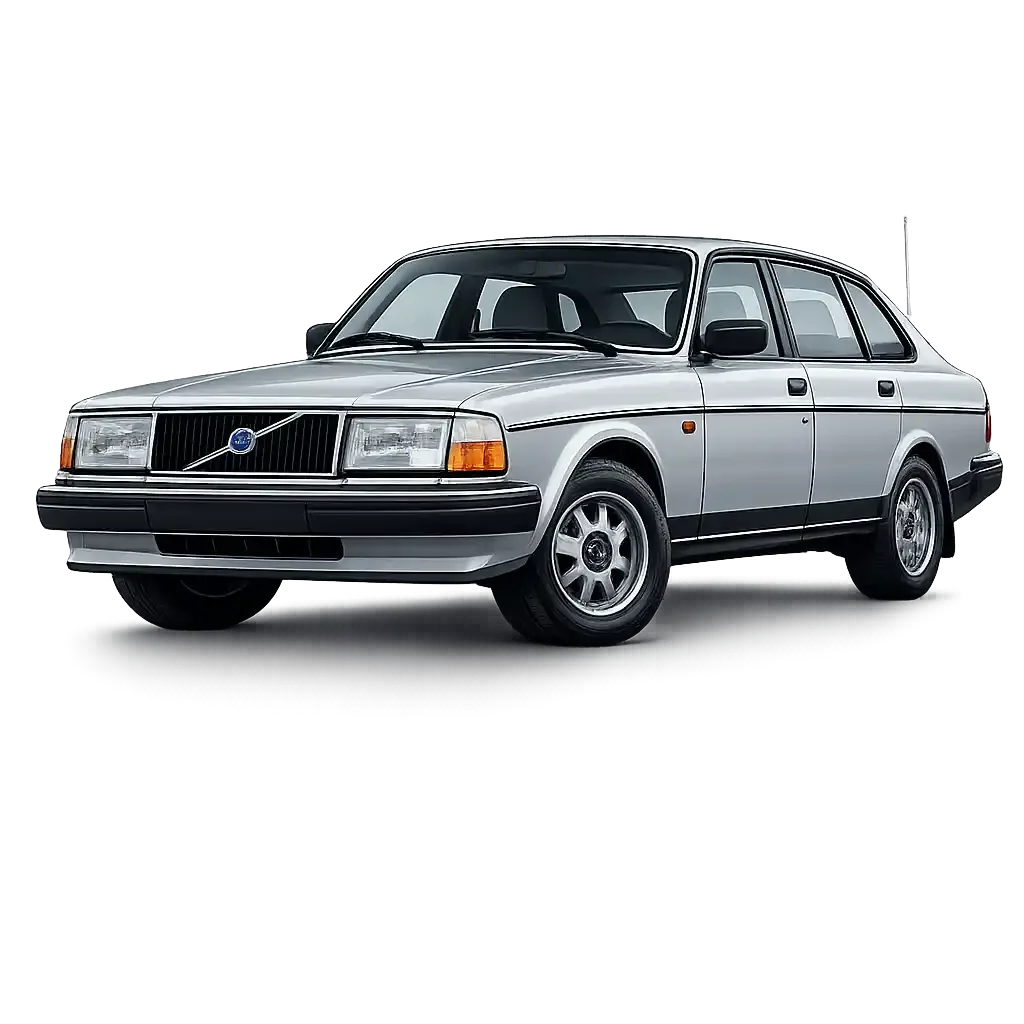
The Complete Fitment Guide
Returns destroy margins. The 1984 Volvo 240 DL is part of Volvo’s legendary 200 Series, produced from 1974 to 1993. The 240 was built on Volvo’s rear-wheel-drive platform derived from the earlier 140 Series, incorporating safety innovations from Volvo’s VESC experimental safety vehicle program. The “DL” designation represents the base trim level of the 240 for 1984. In the US market, the 1984 240 DL was available as a 4-door sedan (244 DL) and a 5-door wagon (245 DL). For 1984, the DL used the B23F 2.3-liter fuel-injected inline-four (“Redblock”) engine. 1984 was a transitional year: DL and GL trim grades returned after being dropped for 1983, and a new manual gearbox arrived. The 240 DL shares its platform and most mechanical components with the 240 GL and 240 GLT Turbo, but trim level, equipment, and some engine/transmission combinations differ. The 240 is NOT the same as the 260 (which used the PRV V6 engine) or the 700 Series (760/740), though the 740 shares some components with the 240. This guide maps every fitment split required to prevent returns on the 1984 Volvo 240 DL.
Generation Overview (1984 Volvo 240 DL, US Market)
The Volvo 200 Series launched in 1974 as a modernized evolution of the 140 Series. By 1984, the 240 was well into its production life with over a decade of incremental improvements. The 200 Series featured rack-and-pinion steering, MacPherson strut front suspension, a live rear axle with trailing arms and Panhard rod, and a longitudinally-mounted inline engine driving the rear wheels. Over 2.8 million 200 Series cars were built during the 19-year production run.
For 1984, Volvo reintroduced the DL and GL trim badges after selling all 240s as simply “240” in 1983. The 1984 DL was the base model, sitting below the GL and the GLT Turbo. Key changes for 1984 included a new manual gearbox option, the AW71 4-speed automatic becoming available for the GL, and modifications to the B23F engine’s cylinder head. The 240 GLT Turbo received a taller grille. The 260 Series (with the PRV V6) was discontinued after 1984, replaced by the 700 Series.
Key Platform Facts
• Platform: Volvo 200 Series (derived from 140 Series), rear-wheel drive, longitudinal engine
• Assembly: Torslanda, Sweden (primary); also assembled in Ghent, Belgium and Halifax, Canada
• Body styles (1984 DL): 4-door sedan (244) and 5-door wagon (245)
• Engine (1984 DL, US): B23F - 2.3L SOHC inline-4 (“Redblock”), fuel-injected (Bosch LH-Jetronic 2.2), 111 hp SAE net, 136 lb-ft torque
• Transmission options: M46 4-speed manual with electric overdrive, or AW70/AW71 4-speed automatic (3-speed BW55 also possible on earlier cars)
• Drive: Rear-wheel drive (RWD)
• Fuel system: Bosch LH-Jetronic 2.2 electronic fuel injection with Lambda-Sond (oxygen sensor) and three-way catalytic converter
• Steering: Rack-and-pinion, power-assisted optional
• Front suspension: MacPherson struts with coil springs, lower control arms, stabilizer bar
• Rear suspension: Live rear axle with trailing arms, Panhard rod, coil springs
• Brakes: Front disc / rear disc (some markets rear drum). Dual-circuit hydraulic.
• Wheelbase: 104.3 inches (2,650 mm)
• Curb weight: Approximately 2,910 lbs (sedan), 3,040 lbs (wagon)
• Fuel tank: 15.8 US gallons
1984 US 240 Trim Levels
Trim
Engine
Body Styles
Key Features
DL
B23F 2.3L I4 (111 hp)
Sedan, Wagon
Base model. Manual or automatic. Cloth interior, basic equipment.
GL
B23F 2.3L I4 (111-114 hp)
Sedan, Wagon
Mid-level. Added: A/C standard, alloy wheels, upgraded interior, tachometer.
GLT Turbo
B21FT 2.1L Turbo I4 (131-162 hp)
Coupe, Sedan, Wagon
Sport/performance. Turbocharged, intercooler (mid-1984+), taller grille, sport seats.
Complete Engine Reference (1984 US 240)
Engine
Displacement
Fuel System
Output
Used In
B23F
2.3L (2,316 cc)
Bosch LH-Jetronic 2.2 EFI
111 hp / 136 lb-ft (manual) 114 hp / 133 lb-ft (auto)
240 DL, 240 GL
B21FT
2.1L (2,127 cc)
Bosch K-Jetronic CIS + Turbo
131 hp (non-intercooled) 162 hp (intercooled, mid-1984+)
240 GLT Turbo
Note: The B23F in 1984 had two compression ratio variants. Automatic-transmission cars used a higher-compression version (10.3:1, 114 hp). Manual-transmission cars (M46) used a lower-compression version (9.5:1, 111 hp) with more torque (136 lb-ft). This is a critical fitment split for engine components like pistons, cylinder heads, and ECU calibrations.
Transmission Reference
Code
Type
Speeds
Notes
M46
Manual + electric overdrive
4 + OD
Standard manual option for DL/GL. Overdrive engaged electrically on 4th gear.
AW70
Automatic
4-speed
Earlier 240 automatic. Replaced by AW71.
AW71
Automatic
4-speed
Updated automatic, shared with 760. Available 1984+ on GL and some DL.
BW55
Automatic
3-speed
Older 3-speed auto. Possible on earlier-production 1984 DL units.
Catalog Accuracy: The Fitment Splits That Matter
The following splits are the most critical for preventing incorrect parts shipments and costly returns.
Split 1: 240 (4-Cylinder) vs. 260 (PRV V6)
The 240 and 260 share the same body shell, suspension, and many interior components. However, the 260 uses the PRV (Peugeot-Renault-Volvo) B28F V6 engine, which requires completely different engine mounts, exhaust manifolds, cooling system, fuel system, and transmission bell housing. The V6 engine bay is wider and the accessories are differently arranged. Never cross-reference 260 engine or drivetrain parts for a 240 (or vice versa). Body panels, doors, glass, interior trim, suspension, and brakes generally DO interchange between 240 and 260 of the same year.
Split 2: 240 DL vs. 240 GL vs. 240 GLT Turbo
These are trim levels on the same 240 platform. Mechanical parts (engine, transmission, suspension, brakes) interchange between DL and GL when the same engine/transmission combination is specified. However:
• DL vs. GL: Different interior trim, different wheel options (GL had alloy wheels), different grille trim, different standard equipment. Some electrical harness differences for additional GL features (A/C standard, etc.).
• DL/GL vs. GLT Turbo: Completely different engine (B21FT turbo vs. B23F naturally aspirated). Different exhaust system, different fuel system, different cooling system, different engine mounts. The GLT Turbo also has a taller grille (1984+), sport seats, and unique badging. Do NOT interchange engine, exhaust, or fuel system parts between turbo and non-turbo models.
Split 3: B23F Engine Variants (Manual vs. Automatic)
This is a commonly missed split. The 1984 B23F engine came in two compression ratios depending on transmission:
• Manual (M46): 9.5:1 compression, 111 hp, 136 lb-ft at 2,750 rpm. Lower compression pistons.
• Automatic (AW70/AW71): 10.3:1 compression, 114 hp, 133 lb-ft at 3,500 rpm. Higher compression pistons.
Pistons, cylinder heads, and ECU calibration may differ between these variants. Always confirm transmission type when ordering engine internals or electronic components.
Split 4: Sedan (244) vs. Wagon (245)
The 244 (sedan) and 245 (wagon) share the same platform from the firewall forward. Engine, transmission, front suspension, steering, brakes, front body panels, dashboard, and front interior trim interchange freely. Parts that do NOT interchange:
• Rear body panels (quarter panels, rear floor, cargo area)
• Tailgate/trunk lid (wagon has a top-hinged liftgate; sedan has a conventional trunk)
• Rear glass and rear window seal
• Rear bumper and bumper trim
• Rear springs and shock absorbers (wagon has heavier-duty rear suspension for load carrying)
• Rear wiring harness (wagon has additional wiring for rear wiper, tailgate latch, etc.)
• Headliner and rear interior trim
Split 5: M46 Manual vs. AW70/AW71 Automatic Transmission
Beyond the engine compression difference noted above, the transmission itself determines:
• Transmission crossmember and mounts
• Driveshaft length and U-joints
• Clutch assembly, flywheel, clutch hydraulics (manual only)
• Torque converter (automatic only)
• Shifter mechanism and console trim
• Speedometer cable or electronic sender
• Pedal assembly (manual has clutch pedal)
The AW70 and AW71 are similar but not identical. The AW71 has an updated converter housing and electronics from the 760. Verify exact transmission code when ordering parts.
Split 6: 1984 240 vs. Other 240 Model Years
The 240 was produced for 19 years (1975-1993) with continuous changes. The 1984 model year sits in a transitional period. Key year-specific considerations:
• Pre-1983 vs. 1983+: 1983 introduced the B23F engine (replacing the B21F for non-turbo US models), larger taillights, and wider side trim. Pre-1983 models use B21 engines with different fuel injection and different engine accessories.
• 1984 vs. 1985+: 1985 introduced the B230F “low-friction” engine replacing the B23F. Different pistons, connecting rods, fuel injection (LH 2.2 updated), and some accessories. 1985+ parts do NOT directly fit 1984 engines.
• Ignition system: 1984 B23F uses a Bosch ignition system (distributor and coil). Earlier 1983 B23F models used a Chrysler/Volvo ignition system. These are NOT interchangeable.
• Taillights: 1983+ 240s have the larger taillights. Pre-1983 have smaller units. Not interchangeable without modification.
• Grille and front-end trim: Changed several times throughout the 200 Series run. 1984 DL/GL have a specific grille; the GLT Turbo has a taller grille. Not all years interchange.
Split 7: 240 vs. 740 (700 Series)
The 740 (introduced 1982) shares some components with the 240 but is a different, more modern platform. Some parts that DO interchange include the B23F and later B230F engines, some transmission units, and certain driveline components. However, body panels, interior trim, suspension geometry, electrical systems, and dashboard are completely different. Do not assume 740 parts fit the 240 without explicit part number confirmation.
Ordering Quick-Reference Checklist
Before ordering any part for a 1984 Volvo 240 DL, confirm:
• Model: 240 (NOT 260, NOT 740/760)
• Year: 1984 specifically (engine and components changed in 1983 and 1985)
• Trim: DL (NOT GL or GLT Turbo - engine and equipment differences)
• Body: Sedan (244) or Wagon (245) - rear body and suspension differ
• Engine: B23F 2.3L naturally aspirated (NOT B21FT turbo)
• Transmission: M46 manual or AW70/AW71 automatic - affects engine compression and drivetrain parts
• Assembly location: Sweden, Belgium, or Canada - minor supplier variations possible
• VIN: Always verify. The 200 Series had extensive running production changes over its 19-year life.
Three Questions to Always Ask
• “Is this a 240 or a 260?” The 260 has a V6 engine. Engine bay and drivetrain parts do not interchange.
• “Manual or automatic transmission?” Affects engine compression ratio, driveshaft, crossmember, pedals, and flywheel/torque converter.
• “Sedan or wagon?” Rear body, rear suspension, tailgate/trunk, and rear wiring differ.
Disclaimer: This guide is based on publicly available specifications, Volvo press materials, and independent research. Part interchangeability should always be confirmed via VIN and OEM part number lookup. Specifications may change without notice. This document does not constitute official Volvo parts catalog data. Visuals and illustrations in this article were generated using AI for representative purposes and may not reflect exact technical schematics.