
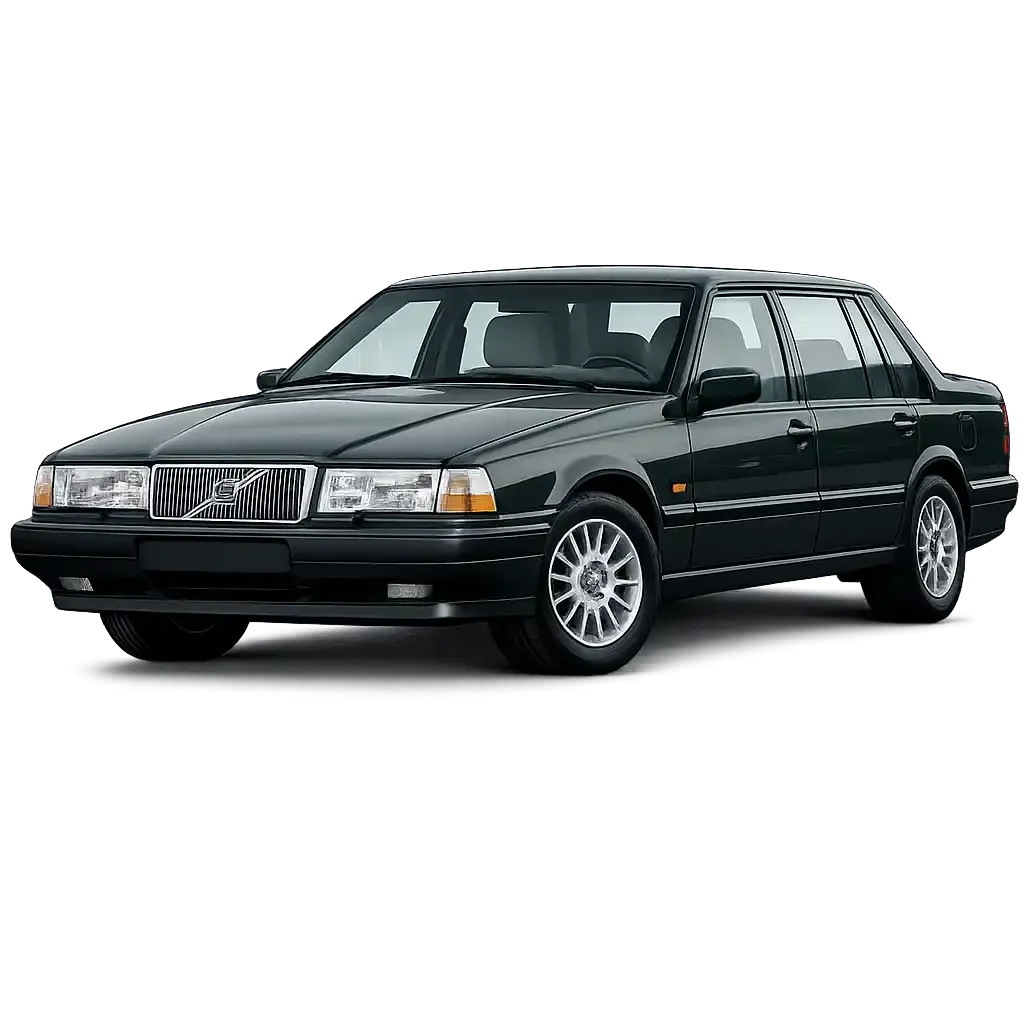
The Volvo 940 (1990 to 1998) is a 4-door rear-wheel-drive sedan (944) and 5-door wagon (945) that replaced the Volvo 740 as Volvo's entry-level large car. Built on the same basic rear-wheel-drive platform as the 740, the 940 was essentially a cosmetic reskin from the C-pillar back (sedan) with a new dashboard and seats, while sharing drivetrain choices and sheetmetal from the A-pillar forward with its predecessor. Unlike the 960, which was an evolution of the upscale 760, the 940 was the "working" Volvo: powered exclusively by Redblock inline-4 engines, available with both manual and automatic transmissions, and offered with a solid rear axle across all body styles. This guide covers the US-market Volvo 940 for the 1991 to 1995 model years. US sales ended after 1995 in favor of the Volvo 850 and 960 series, though the 940 continued production in other markets through February 5, 1998 (badged as "940 Classic" in its final years in some countries). The 940 did not receive a second generation or facelift. It carried its original design throughout its entire production run. This guide maps every fitment split required to prevent returns on Volvo's entry-level RWD sedan and wagon.
Generation Overview (1991 to 1995 US Market)
The 940 was introduced in the autumn of 1990 for the 1991 model year as a direct replacement for the 740. The redesign was concentrated at the rear of the sedan (new trunk with taller opening, redesigned C-pillar and rear glass, new taillights) and the interior (completely new dashboard, new seats with improved ergonomics, integrated child booster seat option in the rear bench). From the A-pillar forward, the 940 shared essentially the same sheetmetal as the late-model 740, including hood, fenders, grille, bumper, and headlights. The 940 wagon (estate), introduced in May 1991, was almost visually identical to the 740 wagon it replaced.
The 940 was packed with safety features for its era, including SIPS (Side Impact Protection System) integrated into the B-pillars and door panels, a driver's airbag, and the same reinforced body cage design as the 960. All 940 models used Redblock inline-4 engines (the "Redblock" name referring to the red-painted cast-iron block), paired with automatic or manual transmissions, and a solid (live) rear axle. No independent rear suspension was offered on any standard 940 model (the 940 SE is a special case discussed separately).
Assembly of US-market 940s took place at Volvo's factory in Kalmar, Sweden and at the Halifax, Nova Scotia, Canada plant. In 1993, 940s built at the Halifax plant received special roundels at the rear window celebrating the plant's 30th anniversary. Production volume totaled 246,704 sedans and 231,677 wagons across all markets over the full production run.
Year-by-Year Changes (US Market, 1991 to 1995)
1991 Model Year
First model year. Three trim levels in the US: 940 GLE with the B234F DOHC 16-valve 2.3L engine (153 hp, 6,000 rpm redline); 940 Turbo with the B230FT turbocharged 2.3L engine (162 hp); and 940 SE, a premium turbocharged model that actually used the 960 body shell (different dashboard, firewall, hood, recessed windscreen wipers, and multi-link independent rear suspension). The 940 SE badge was chosen to maintain the naming convention linking the first digit to the number of cylinders. Available as sedan and wagon.
1992 Model Year
The 940 GLE was downgraded and renamed 940 GL, now equipped with the B230FD 8-valve 2.3L engine producing only 114 hp (85 kW). The DOHC 16-valve B234F was discontinued from the US lineup after one year. The 940 Turbo continued with the B230FT. The 940 SE continued as a 960-bodied turbo. This is the last year for the 940 SE in the US market.
1993 Model Year
940 Turbo models received the 960's front-end design (more swept-back nose with headlights extending inward to meet the grille), while the base 940 retained the blunter, more vertical nose design and received a revised front end more in line with the new 850. This creates a critical exterior parts split within the same model year. Halifax, Nova Scotia plant commemorated its 30th anniversary with special roundels on 940s built there.
1994 Model Year
Continued with the B230FD (base) and B230FT (Turbo) engine lineup. Dual front airbags became standard. The front-end styling split between base and Turbo continued from 1993. Minor interior and equipment updates.
1995 Model Year (Final US Year)
Final model year for the 940 in the United States. US sales ended after 1995 in favor of the 850 (which had become Volvo's volume leader) and the 960. The 940 continued in European and other markets through 1998, receiving the M90 5-speed manual gearbox (replacing the M46/M47) from 1995, and the B230FK low-pressure turbo engine option in some markets. In certain countries, a well-equipped limited series was badged "940 Classic" for the final production years.
Platform and Engineering
The 940 is built on the same basic rear-wheel-drive platform as the Volvo 740, which itself evolved from the 240-series architecture. It is a longitudinally-mounted engine, rear-wheel-drive car with a solid (live) rear axle on all standard 940 models. The 940 shares its sheetmetal from the A-pillar forward with the late-model 740. Differences from the 740 are concentrated in the rear of the sedan (new trunk, C-pillar, rear glass, taillights) and the interior (new dashboard, seats). The 940 wagon is almost identical to the 740 wagon externally.
Key Platform Facts
• Platform: 700/900-series RWD. Longitudinal engine, rear-wheel drive. Solid rear axle. Evolution of the 240-series architecture.
• Assembly: Kalmar, Sweden and Halifax, Nova Scotia, Canada (US-market cars).
• Body styles: 4-door sedan (944), 5-door wagon/estate (945)
• US engine (1991 GLE): B234F 2.3L (2,316 cc) DOHC 16-valve inline-4. 153 hp at 5,700 rpm. Naturally aspirated. Bosch LH Jetronic fuel injection. One year only in the US.
• US engine (1992 to 1995 base/GL): B230FD 2.3L (2,316 cc) SOHC 8-valve inline-4. 114 hp (85 kW). Naturally aspirated. Cast-iron block (Redblock). May have Bosch LH Jetronic or Bendix Regina/Rex engine management depending on production date.
• US engine (1991 to 1995 Turbo): B230FT 2.3L (2,316 cc) SOHC 8-valve inline-4. Turbocharged (Mitsubishi or Garrett turbo). Approximately 162 to 165 hp. Intercooled. Bosch LH Jetronic fuel injection.
• Turbo+ chip upgrade: Volvo sold a factory chip tuning kit called Turbo+ that boosted the B230FT to approximately 190 hp (140 kW). Dealer-installed ECU modification. No hardware changes.
• Transmissions (automatic): Aisin-Warner AW70L/AW71L/AW72L 4-speed automatic with lockup torque converter (3-speed + overdrive). The AW72L was used with the B234F 16-valve engine (slightly different ratios). ZF 4HP22 4-speed automatic available on some B230FB/E and diesel configurations. If the shifter has a "3" position, it is a ZF unit.
• Transmissions (manual): M47 5-speed manual or M46 4-speed manual with electrically engaged overdrive. The M90 5-speed manual (based on 850 M56) replaced the M46/M47 from 1995 in European markets. Manual transmissions were not commonly sold in the US market.
• Front suspension: MacPherson struts with coil springs, lower control arms, stabilizer bar. Rack-and-pinion steering.
• Rear suspension: Solid (live) rear axle with trailing arms, coil springs, stabilizer bar, and track rod (Panhard rod). Self-leveling Nivomat shock absorbers available/standard on some configurations.
• Brakes: 4-wheel disc brakes. Ventilated front discs, solid rear discs. ABS available/standard depending on trim.
• Wheelbase: 109.1 inches (2,770 mm)
• Overall length (sedan): 191.7 inches (487 cm)
• Overall length (wagon): 190.5 inches (484 cm)
• Width: 68.9 inches (175 cm)
• Height: 56.5 inches (143 cm)
• Curb weight: Approximately 3,185 to 3,350 lbs depending on body style and engine
• GVWR: Sedan approximately 4,150 to 4,210 lbs; wagon approximately 4,350 to 4,390 lbs
• Wheel bolt pattern: 5x10⁸
• Trunk capacity (sedan): 16.8 cu ft
• Cargo capacity (wagon): 39.3 cu ft seats up, 74.9 cu ft seats folded
• Fuel capacity: Approximately 19.8 gallons
• Shared platform: Volvo 740 (from A-pillar forward). NOT shared with 960 (different front sheetmetal, dashboard, engine, transmission, and rear suspension on sedans).
Engine Reference (Detailed)
B234F: 2.3L DOHC 16-Valve Inline-4 (1991 GLE Only)
The B234F is a dual-overhead-cam, 16-valve version of the Redblock 2.3L inline-4. Displacement is 2,316 cc. Output is approximately 153 hp with a 6,000 rpm redline. Naturally aspirated with Bosch LH Jetronic fuel injection. This engine was offered only for the 1991 model year in the US 940 GLE. It was dropped for 1992 when the GLE was downgraded to the 8-valve B230FD and rebadged 940 GL. The B234F requires a timing belt replacement every 40,000 miles (critical: this is an interference engine). The B234F uses different camshafts, cylinder head, intake manifold, and ECU from the 8-valve B230 engines. Do not cross-reference B234F cylinder head or valve train components with B230 parts.
B230FD: 2.3L SOHC 8-Valve Inline-4 (1992 to 1995 Base/GL)
The B230FD is the base naturally aspirated Redblock engine for the US-market 940 from 1992 onward. Displacement is 2,316 cc. SOHC, 8-valve, cast-iron block and head. Output is 114 hp (85 kW). This is the same basic engine family used in the 740 and 240 series. Fuel injection may be either Bosch LH Jetronic or Bendix Regina/Rex depending on production date and market. This matters when ordering ignition components, fuel injection parts, and ECU modules. Always confirm the fuel injection system type before ordering. Timing belt replacement interval is approximately 50,000 miles. Interference engine.
B230FT: 2.3L SOHC 8-Valve Turbocharged Inline-4 (1991 to 1995 Turbo)
The B230FT is the turbocharged version of the Redblock 2.3L. Same basic block and head as the B230FD but with the addition of a turbocharger (Mitsubishi or Garrett depending on production date), intercooler, boost-related plumbing, wastegate, and a different ECU calibration with higher-flow fuel injectors. Output is approximately 162 to 165 hp (121 kW). The Turbo+ dealer-installed chip upgrade raises output to approximately 190 hp (140 kW) through revised boost and fuel mapping. The B230FT uses different exhaust manifold (turbo-specific), downpipe, intercooler, boost plumbing, fuel injectors, and ECU calibration from the naturally aspirated B230FD. Do not cross-reference turbo-specific components with NA parts.
Fuel Injection System Split: Bosch LH Jetronic vs. Bendix Regina
Some B230 engines (both NA and turbo) were equipped with Bosch LH Jetronic fuel injection, while others received the Bendix Regina (also called Rex) system. These are completely different fuel injection systems with different ECUs, wiring, sensors, injectors, and diagnostic protocols. They are NOT interchangeable. When ordering ignition, fuel injection, or engine management components, always confirm whether the car has Bosch LH Jetronic or Bendix Regina. Visual identification: the Bosch system uses a cylindrical air mass meter (hot-wire MAF), while the Bendix system uses a different sensor configuration.
Transmission Reference
Aisin-Warner AW70L / AW71L / AW72L 4-Speed Automatic
The Aisin-Warner AW70/71/72 series is the primary automatic transmission for the 940. It is a 4-speed automatic (3-speed plus overdrive) with a lockup torque converter (the "L" suffix). The AW71L was used with the B230FT turbo engine (without lockup on some early configurations). The AW72L was a slightly re-ratioed version used with the B234F 16-valve engine. These are extremely durable transmissions, shared with Toyota trucks and 4Runners of the era. TCM calibration and torque converter specifications differ by engine application. Fluid specification is Dexron-IIE ATF.
ZF 4HP22 4-Speed Automatic
The ZF 4HP22 was available on some B230FB/E and diesel configurations. It can be identified by the presence of a "3" position on the shift gate (the Aisin-Warner units do not have this). The ZF 4HP22 was notorious in both BMW and Volvo applications for pump damage if revved excessively in neutral (the pump is at the rear of the transmission). Some shops refused to emissions-test ZF-equipped cars due to this liability. The ZF was phased out for gasoline engines by 1995, remaining only for diesel applications. ZF and Aisin-Warner transmissions are NOT interchangeable. Different bellhousing, output shaft, cooler lines, electronics, and shifter linkage.
Manual Transmissions: M46, M47, and M90
The M47 is a conventional 5-speed manual gearbox. The M46 is a 4-speed manual with an electrically engaged Laycock de Normanville overdrive unit bolted to the rear. From 1995 (European markets), the M90 5-speed manual (based on the 850's M56 gearbox) replaced the M46/M47. Manual transmissions were not commonly sold in the US-market 940 but may appear in used inventory. Each manual gearbox requires its own specific clutch, flywheel, shifter linkage, and (for the M46) overdrive relay and wiring. Do not cross-reference manual transmission components between the M46, M47, and M90.
Catalog Accuracy: The Fitment Splits That Matter
Split 1: 940 vs. 960 (Different Cars, Same Era)
This is the most critical split and the most common source of returns. The 940 and 960 look similar but are fundamentally different vehicles:
• Front sheetmetal: 960 has a unique hood, fenders, grille, bumper, and headlights that do NOT fit the 940. The 960 front end is exclusive to the 760/960 lineage. The 940 shares its front sheetmetal with the late-model 740.
• Dashboard: 960 has a completely different dashboard, firewall, and instrument cluster. Not interchangeable with the 940.
• Engine: 960 uses the Whiteblock inline-6 (B6304F). 940 uses Redblock inline-4 engines (B230/B234). Completely different engine families. Zero engine parts interchange.
• Transmission: 960 uses the AW30-43LE 4-speed auto. 940 uses AW70/71/72 or ZF 4HP22 automatics, or M46/M47/M90 manuals. Different transmissions, not interchangeable.
• Rear suspension (sedan): 960 sedan has multi-link independent rear suspension. 940 sedan has a solid rear axle. Different systems entirely.
• 940 SE exception: The 1991 to 1992 940 SE actually used the 960 body shell with a B230FT turbo-4 engine. For body and interior parts, the 940 SE is a 960. For engine and drivetrain parts, it is a 940 Turbo.
Parts that DO interchange between 940 and 960: Wheels (same 5x10⁸ bolt pattern). Some body panels from the A-pillar rearward may interchange on certain configurations (doors, roof on sedans). Some brake components on matching axle types. Always confirm by part number.
Split 2: 940 vs. 740 (Closely Related)
The 940 and 740 share far more than the 940 and 960. From the A-pillar forward, the 940 and late-model 740 share the same sheetmetal (hood, fenders, grille, bumper, headlights). Engine and drivetrain components interchange freely between 940 and 740 models with the same engine code. Key differences:
• Rear body (sedan): 940 sedan has a completely redesigned rear from the C-pillar back: new trunk lid, new C-pillar, new rear glass, new taillights. These do NOT fit the 740 sedan.
• Rear body (wagon): 940 wagon is almost identical to the 740 wagon externally. Most rear body panels and tailgate components interchange. Confirm by part number for running production changes.
• Dashboard: 940 has a new dashboard design with different instrument cluster, center console, and seat designs. NOT interchangeable with the 740 dashboard.
• Front sheetmetal: Shared between 940 and late-model 740. Interchange freely.
• Engine and drivetrain: Same Redblock engines, same transmissions, same rear axle. Parts interchange freely between 940 and 740 with matching engine and transmission codes.
Split 3: Sedan (944) vs. Wagon (945)
Both use the same solid rear axle, so the rear suspension split between sedan and wagon is less dramatic than on the 960. However:
• Rear body: Completely different from the B-pillar rearward. Wagon has a longer roof, liftgate/tailgate, unique rear quarter panels, different taillights, and different rear bumper.
• Rear springs: Wagon uses heavier-duty rear springs to accommodate cargo weight. Spring rates differ between sedan and wagon.
• Self-leveling shocks: Nivomat self-leveling rear shocks were more commonly equipped on wagons. If equipped, the Nivomats must be replaced with matching Nivomats or the entire rear shock/spring setup must be converted to standard components.
• Third-row seat (wagon): Some wagons had a rear-facing third-row seat in the cargo area.
Parts that interchange: Front suspension, front brakes, engine, transmission, front sheetmetal, dashboard, front seats, rear axle housing, and most mechanical components.
Split 4: B234F 16-Valve (1991) vs. B230FD NA 8-Valve (1992+) vs. B230FT Turbo 8-Valve
Three distinct engines were offered in the US-market 940. They share the Redblock 2.3L displacement but differ significantly:
• B234F (1991 GLE only): DOHC 16-valve. Different cylinder head, camshafts, valve train, intake manifold, and ECU from all 8-valve engines. 40,000-mile timing belt interval. Higher redline (6,000 rpm). One year only.
• B230FD (1992 to 1995 base/GL): SOHC 8-valve. Naturally aspirated. 114 hp. No turbo, intercooler, or boost plumbing. 50,000-mile timing belt interval.
• B230FT (1991 to 1995 Turbo): SOHC 8-valve. Turbocharged with intercooler. 162 to 165 hp. Turbo-specific exhaust manifold, downpipe, intercooler, boost plumbing, fuel injectors, and ECU calibration. 50,000-mile timing belt interval.
The B230FD and B230FT share the same basic block and head casting. The B234F has a unique head. When ordering parts, always confirm the exact engine code.
Split 5: Bosch LH Jetronic vs. Bendix Regina Fuel Injection
Both naturally aspirated and turbocharged B230 engines may have either Bosch LH Jetronic or Bendix Regina (Rex) fuel injection systems. These are completely different systems with different ECUs, wiring harnesses, sensors, injectors, and diagnostic protocols. They are NOT cross-compatible. Always confirm the fuel injection system before ordering any ignition, fuel injection, or engine management component. This is one of the most frequently overlooked fitment splits on the 940.
Split 6: Aisin-Warner vs. ZF Automatic Transmission
The Aisin-Warner AW70/71/72 and ZF 4HP22 are completely different transmissions. They require different bellhousings, torque converters, cooler lines, shift linkage, electronics, and fluid (though both use Dexron-type ATF). The ZF can be identified by the "3" position on the shifter. The two units are not interchangeable. Always confirm which automatic transmission is installed before ordering any transmission-related component.
Split 7: 1993+ Front-End Styling Split (Base vs. Turbo)
Starting with the 1993 model year, the 940 Turbo received the 960's front-end design (more swept-back nose with headlights extending inward to meet the grille), while the base 940 retained a blunter, more vertical nose aligned with the new 850's design language. This means that for 1993 to 1995:
• 940 Turbo: Uses the 960-style front grille, headlights, and bumper. Parts may interchange with the 960 front end of the same era (confirm by part number).
• 940 Base/GL: Uses a different, blunter front grille, headlights, and bumper. Does NOT interchange with the 940 Turbo or 960 front end.
For 1991 to 1992, all 940 models (except the 940 SE) shared the same blunter front-end design. Always confirm model year and trim level before ordering front-end exterior components.
Split 8: 940 SE (1991 to 1992) vs. Standard 940
The 940 SE is a unique case. It is actually a 960 body with a B230FT turbo-4 engine installed. This means the 940 SE has: the 960's dashboard, firewall, hood, front sheetmetal, recessed windscreen wipers, and multi-link independent rear suspension (NOT the solid axle used in all other 940 models). For body, interior, and suspension parts, the 940 SE should be treated as a 960, not a 940. For engine, fuel system, ignition, and turbo components, it should be treated as a 940 Turbo. This is one of the most confusing fitment situations in the entire Volvo lineup and a guaranteed source of returns if not properly identified.
Common Wear Items and Fitment Notes
• Timing belt: All Redblock engines are interference designs. The B234F requires replacement every 40,000 miles. The B230FD and B230FT require replacement every 50,000 miles. Always replace the belt, tensioner, idler (if equipped), and water pump together. Failure destroys valves and possibly pistons.
• Fuel injection system components: Always confirm Bosch LH Jetronic or Bendix Regina before ordering any fuel injection, ignition, or engine management part. These are completely different systems.
• Turbo-specific components: The B230FT's turbocharger (Mitsubishi or Garrett), intercooler, wastegate, and boost plumbing are unique to the turbo application. Do not cross-reference with NA B230FD parts.
• Rear axle bushings and mounts: Trailing arm bushings, track rod bushings, and rear axle mounts wear over time causing clunking, axle hop, and imprecise handling. Common replacement item on high-mileage cars.
• Front strut mounts and bushings: MacPherson strut upper mounts wear and cause clunking over bumps. Lower control arm bushings also wear. Shared with 740.
• Nivomat rear shocks (if equipped): Self-leveling units wear out and the rear sags. Expensive to replace with OEM Nivomats. Conversion to standard shocks with appropriate springs is common.
• Overdrive relay (M46 manual): The M46 overdrive uses an electrical relay that can fail, preventing overdrive engagement. Confirm manual transmission type (M46 vs. M47 vs. M90) before ordering.
• AW70/71/72 transmission: These are generally very reliable units. When they do fail, it is usually the lockup torque converter or valve body solenoids. Confirm Aisin-Warner vs. ZF before ordering any transmission part.
• Flame trap / PCV system: The Redblock PCV system (flame trap in the intake manifold) clogs with oil deposits, causing crankcase pressure buildup, oil leaks, and rough idle. Clean or replace regularly.
• Heater core: The Redblock-era heater core can develop leaks, causing coolant loss and fogged windshield. Replacement requires significant dashboard disassembly.
• Brake rotors and pads: Front and rear disc sizes are generally shared across 940 and 740 models with the same axle type. Confirm by part number.
Ordering Quick-Reference Checklist
Before ordering any part for a 1991 to 1995 Volvo 940, confirm all of the following:
• NOT a 960: 940 and 960 have different front sheetmetal, dashboard, engine (Redblock I4 vs. Whiteblock I6), transmission (AW70/71/72 vs. AW30-43LE), and rear suspension (solid axle vs. IRS on sedan). The 940 SE is the exception (960 body, 940 engine).
• Body style: Sedan (944) or wagon (945). Rear body, springs, and potentially shock absorbers differ.
• Engine code: B234F (1991 GLE, 16-valve), B230FD (1992 to 1995 base/GL, 8-valve NA), or B230FT (1991 to 1995 Turbo, 8-valve turbo). Cylinder head, intake, exhaust, fuel injection, and ECU differ by engine.
• Fuel injection system: Bosch LH Jetronic or Bendix Regina? These are completely different systems. Check before ordering ignition, fuel, or engine management parts.
• Transmission type: Aisin-Warner AW70/71/72L (no "3" on shifter) or ZF 4HP22 ("3" on shifter)? Or manual M46/M47/M90? Each is a different unit.
• Trim level and model year: 1993 to 1995 Turbo models use 960-style front end. 1993 to 1995 base/GL models use a different front end. 1991 to 1992 models all share the blunter front end.
• 940 SE status: If the car is a 940 SE, it uses 960 body/interior/suspension parts and 940 Turbo engine/drivetrain parts. Confirm by VIN.
• Nivomat or standard rear shocks: Spring and shock absorber specifications differ.
• VIN: Always verify by VIN. Running production changes are common across the 940's long production run.
Three Questions to Always Ask
• "940 or 960?" They look similar but share almost nothing for front sheetmetal, dashboard, engine, or transmission. The 940 SE is the exception: it uses the 960 body with a 940 turbo engine. Getting this wrong means almost every part will be incorrect.
• "Which engine?" B234F (1991 only, 16-valve), B230FD (NA 8-valve), or B230FT (turbo 8-valve). The 16-valve head does not interchange with 8-valve heads. Turbo components do not interchange with NA. And within the 8-valve engines, always confirm Bosch vs. Bendix fuel injection.
• "Which transmission?" Aisin-Warner, ZF, or manual (M46/M47/M90)? Each is a completely different unit. The ZF can be identified by the "3" on the shifter. The M46 has an overdrive relay. The M90 is only found on 1995+ European-market cars.
Disclaimer: This guide is based on publicly available specifications, Volvo press materials, and independent research. Part interchangeability should always be confirmed via VIN and OEM part number lookup. Specifications may change without notice. This document does not constitute official Volvo parts catalog data. Visuals and illustrations in this article were generated using AI for representative purposes and may not reflect exact technical schematics.