
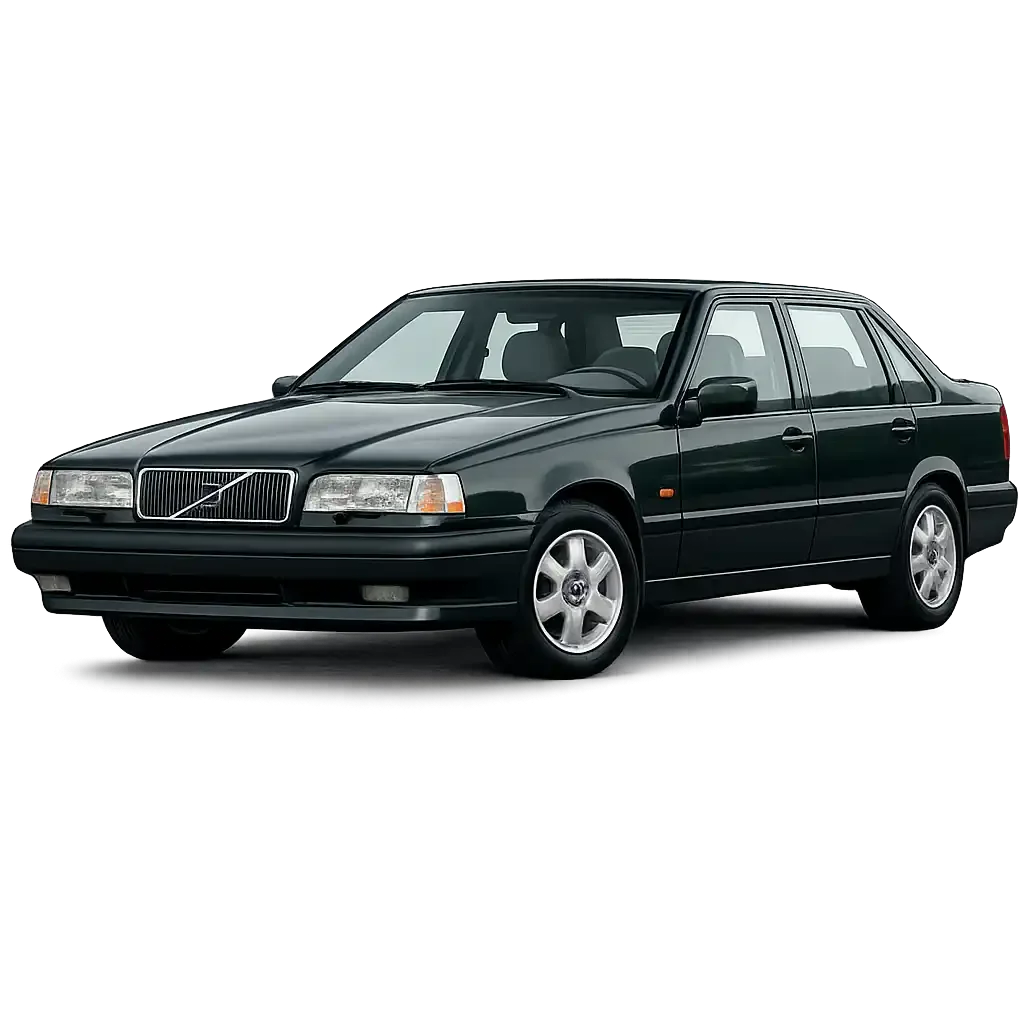
The Volvo 850 (1991 to 1997) is a 4-door front-wheel-drive sedan and 5-door wagon (estate) that represented the single biggest engineering departure in Volvo's history. Developed under the internal codename "Project Galaxy"beginning in 1978, the 850 was the result of the most expensive industrial development project ever undertaken in Sweden at the time. It was Volvo's first front-wheel-drive car for the North American market, the first to use the new Whiteblock-family all-aluminum 5-cylinder engine mounted transversely, the first with the patented Delta-link rear suspension, and the first with the SIPS (Side Impact Protection System) that would become standard across the entire Volvo range. The 850 replaced the aging 240 and supplemented the 940/960 lineup, shifting Volvo decisively from rear-wheel-drive to front-wheel-drive architecture. This guide covers the initial launch phase of the Volvo 850, spanning the European 1992 model year (June 1991 debut) through the end of the 1993 US model year. This period represents the pre-facelift 850 before the 1994 model year updates (new bumpers, headlights, turbo models, 5-bolt hubs). The sedan was available from launch; the wagon (estate) arrived in February 1993 for all markets. This guide maps every fitment split required to prevent returns on Volvo's revolutionary FWD platform during its critical first two years.
Generation Overview (Initial Launch, 1991 to 1993)
The Volvo 850 GLT was shown for the first time in June 1991 at the European launch, entering the market as a 1992 model year car in Europe. Volvo marketed the car under the slogan "A dynamic car with four world-beating breakthroughs," referring to: the transverse 5-cylinder engine driving the front wheels, the Delta-link rear axle, the SIPS integrated side-impact protection system, and the self-adjusting front seat belt mechanism. Initially, only the sedan was available, badged as the 850 GLT. The 5-door wagon (estate) followed in February 1993 for all markets.
In the United States, the 850 arrived as a 1993 model year car, becoming Volvo's first FWD offering in North America. The US-market 850 was available exclusively with the 2.5-liter 20-valve naturally aspirated inline-5 (B5254F/B5254FS) producing 168 hp. Full power equipment was standard on all 1993 US models, including power windows, power locks, power mirrors, sunroof, and a built-in child booster seat integrated into the rear bench armrest. No turbo models were available during this initial launch phase in the US; the 850 Turbo (T-5) would not arrive until the 1994 model year.
The 850 was assembled at Volvo's Torslanda plant in Gothenburg, Sweden. Total production across the full 850 run (1991 to 1997) reached 390,835 sedans and 326,068 wagons worldwide. The 850 was succeeded by the Volvo S70 (sedan) and V70 (wagon) for the 1998 model year, though the transition began with the 1997 models.
Year-by-Year Changes (1991 to 1993)
1992 Model Year (European Launch)
The 850 GLT sedan debuted in Europe in June 1991 for the 1992 model year. Available with the B5254F 2.5L 20-valve inline-5 (170 hp European rating) or the B5204FS 2.0L 20-valve inline-5 (143 hp, not available in North America). European models were offered with the M56 5-speed manual or AW50-42 4-speed automatic transmission. The 850 was sedan-only for this model year. Equipment included driver's airbag, SIPS (Side Impact Protection System), self-adjusting front seatbelts, and the V-VIS (Volvo Variable Intake System) on the 20-valve engines. The 850 used 4-bolt wheel hubs for this model year.
1993 Model Year (US Launch / Wagon Introduced)
The 850 arrives in the US market for the first time as a 1993 model. US models received the B5254FS 2.5L 20-valve inline-5 rated at 168 hp (US specification) with Bosch LH 3.2 fuel injection. Both sedan and wagon body styles were now available. The M56 5-speed manual and AW50-42 4-speed automatic were offered in the US. Full power equipment was standard. A sunroof and integrated child booster seat were included. The 850 still used 4-bolt wheel hubs (the switch to 5-bolt hubs occurred for the 1994 model year). ABS was optional, not standard. No turbo models were available. The 850 wagon went on sale in February 1993 for all markets, featuring the signature vertical tailgate design. The wagon earned the Japanese "1994 Good Design Grand Prize" award.
Platform and Engineering
Key Platform Facts
• Platform: P80 (Volvo's designation for the 850/S70/V70/C70 family)
• Architecture: Front-wheel drive (FWD), transverse engine, front-mounted
• Body styles: 4-door sedan (1992+), 5-door wagon/estate (1993+)
• Assembly: Torslanda plant, Gothenburg, Sweden
• Design: Jan Wilsgaard (exterior)
• Development: Project Galaxy (began 1978), highest-cost industrial project in Swedish history at the time
• Wheelbase: 2,660 mm (104.7 inches)
• Overall length (sedan): 4,660 mm (183.5 inches)
• Overall length (wagon): 4,720 mm (185.8 inches)
• Width: 1,760 mm (69.3 inches)
• Height (sedan): 1,400 mm (55.1 inches)
• Height (wagon): 1,425 mm (56.1 inches)
• Curb weight (sedan, 2.5L auto): Approximately 1,370 kg (3,020 lbs)
• Curb weight (wagon, 2.5L auto): Approximately 1,425 kg (3,142 lbs)
• Drag coefficient: 0.32 (sedan), 0.34 (wagon)
• Turning circle: 10.2 m (33.5 ft) - notably tight for a car of this size
• Fuel tank: 73 liters (19.3 US gallons)
• Wheel bolt pattern: 4x10⁸ (1992 to 1993 initial launch models)
• Interior volume (sedan): 2.80 cubic meters (99 cu ft)
• Trunk capacity (sedan): Approximately 450 liters (15.9 cu ft)
• Cargo capacity (wagon): 793 liters (28 cu ft) behind rear seats, 1,585 liters (56 cu ft) with seats folded
Critical note on wheel bolt pattern: The initial launch 850 (1992 to 1993 model years) used 4-bolt hubs (4x10⁸). Starting with the 1994 model year, Volvo switched to 5-bolt hubs (5x10⁸). This is one of the most important fitment splits on the 850. Wheels, brake rotors, hubs, and related components from 4-bolt and 5-bolt years do NOT interchange.
Suspension
Front: MacPherson strut independent front suspension with coil springs, lower control arms, anti-roll bar. The entire front suspension and powertrain are mounted on a separate subframe that is isolated from the body by rubber bushings, reducing NVH transmission to the cabin.
Rear: Delta-link semi-independent rear suspension. This was a Volvo-patented design that combined elements of independent and beam-axle suspension. The rear axle uses a U-shaped beam connecting the two trailing arms, with a Watt's linkage providing lateral location. The bushings are designed to compress under cornering loads, creating a passive rear-steering effect that improves stability. Volvo held a US patent on this bushing design. The Delta-link system provided ride comfort approaching true independent rear suspension while maintaining the robustness and lower cost of a beam-axle arrangement.
Brakes: Ventilated disc brakes front, solid disc brakes rear. ABS was optional on the initial launch 850 (not standard until later model years).
Engine Reference (Detailed)
B5254F / B5254FS: 2.5L DOHC 20-Valve Inline-5 (US Market Engine)
This is the primary engine for the initial launch 850 in North America. It is part of the Volvo Modular Engine family (also known as "Whiteblock" due to the bare aluminum block). The 5-cylinder design was derived from the same engine family as the 6-cylinder used in the 960, sharing many identical internal components. The engine is mounted transversely driving the front wheels through the transmission, with the total powertrain length of only 948 mm, a remarkable feat of compact packaging.
• Designation: B5254F (1992 European), B5254FS (1993+ US)
• Displacement: 2,435 cc (2.5 liters)
• Bore x stroke: 83 mm x 90 mm
• Compression ratio: 10.5:1
• Valvetrain: DOHC, 4 valves per cylinder (20-valve total)
• Block material: Aluminum alloy (Whiteblock)
• Head material: Aluminum alloy
• Power output (US): 168 hp (125 kW) at 6,200 rpm
• Power output (European): 170 PS (125 kW) at 6,200 rpm
• Torque: 162 lb-ft (220 Nm) at 3,300 rpm
• Fuel injection: Bosch LH 3.2 with EZ-129K ignition management
• Variable intake: V-VIS (Volvo Variable Intake System) for improved response between 1,500 and 4,100 rpm
• Emissions: Three-way catalytic converter, meets US and European standards
• Timing belt interval: 70,000 miles (manufacturer recommendation)
• Engine oil capacity: 6.1 US quarts (5.8 liters) including filter
Timing belt note: The B5254F/FS is an interference engine. If the timing belt fails, the pistons will contact the valves, causing catastrophic internal damage. The manufacturer-recommended interval is 70,000 miles, but many Volvo specialists recommend replacement at 50,000 to 60,000 miles as a safety margin, particularly in high-mileage or hard-driven cars. Always replace the tensioner and idler pulleys with the belt.
B5204FS: 2.0L DOHC 20-Valve Inline-5 (European Markets Only)
A smaller-displacement version of the Whiteblock inline-5, available in European markets but never offered in North America. Included here because European-spec 850s occasionally appear as grey-market imports.
• Displacement: 1,984 cc (2.0 liters)
• Bore x stroke: 81 mm x 77 mm
• Power output: 143 PS (105 kW) at 6,100 rpm
• Torque: 190 Nm (140 lb-ft) at 3,300 rpm
• Fuel injection: Bosch LH 3.2 with EZ-129K
• Variable intake: V-VIS (same as 2.5L)
Fitment note: The 2.0L and 2.5L 20-valve engines share the same block architecture and many external components (alternator, water pump, power steering pump, timing belt system), but internal components (crankshaft, pistons, connecting rods) are displacement-specific. The intake manifold is shared. European 2.0L cars may have slightly different ECU calibrations and exhaust systems compared to the 2.5L.
Transmission Reference
AW50-42 (Aisin-Warner) 4-Speed Automatic
The standard automatic transmission for the 850 across all markets. This is a transversely mounted, electronically controlled 4-speed automatic with torque converter lockup. It is integrated with the final drive (transaxle configuration). The AW50-42 was specifically designed for the 850's transverse layout and was used across the entire 850 production run, as well as in the subsequent S70/V70.
• Type: 4-speed automatic transaxle with torque converter lockup
• Final drive ratio (NA): 2.74:1
• Gear ratios: 1st: 3.61, 2nd: 2.06, 3rd: 1.37, 4th: 0.98, Reverse: 3.95
• Fluid type: Dexron IIE or Mercon ATF
• Fluid capacity (dry fill): 8.1 quarts (7.6 liters)
• Features: Economy/Sport mode selector switch, Winter mode (starts in 3rd gear for traction on slippery surfaces)
Common issue: The AW50-42 is generally reliable but sensitive to fluid condition. Regular fluid changes (every 30,000 to 40,000 miles) are strongly recommended. Overheating from towing or aggressive driving can cause premature failure. The transmission ECU communicates with the engine ECU; fault codes in one system can affect the other.
M56 5-Speed Manual
The M56 manual transmission was available in the US-market 850 GLT during the initial launch phase. It was a cable-shifted 5-speed manual integrated with the final drive. The M56 was later revised (M56H for heavier-duty applications), but during the 1992 to 1993 period the original M56 was standard.
• Type: 5-speed manual transaxle
• Final drive ratio: 3.77:1 (2.5L NA)
• Fluid type: Volvo Synthetic Gear Oil (P/N 1161423) or Type F/G ATF
• Fluid capacity: 2.2 US quarts (2.1 liters)
Fitment note: The M56 transmission went through revisions during the 850's production run. The early M56 (designated "M56 -1994" in Volvo parts catalogs) differs from the later "M56 1995" and "M56 1996-" versions. Internally, the gear ratios and some components changed. The shift cables, shifter assembly, and clutch hydraulics are compatible across all M56 versions in the 850, but the transmission cases themselves are not identical. When ordering a replacement M56, always specify the model year.
Catalog Accuracy: The Fitment Splits That Matter
The Volvo 850 looks like one car on the surface, but underneath it is divided by body style, model year, hub bolt count, engine displacement, transmission type, and market specification. These are the splits that generate returns when catalogs, part listings, or customers get them wrong. If you remember only one thing from this guide: the 4-bolt to 5-bolt hub change in 1994 is the single most common source of incorrect parts orders on the 850.
Split 1: 4-Bolt Hubs (1992 to 1993) vs. 5-Bolt Hubs (1994+)
This is the most critical fitment split on the entire 850 platform. For the 1992 and 1993 model years (the initial launch covered by this guide), the 850 used 4-bolt wheel hubs with a 4x10⁸ bolt pattern. Beginning with the 1994 model year, Volvo switched to 5-bolt hubs with a 5x10⁸ bolt pattern. This change affects: wheels, brake rotors, wheel hubs, wheel bearings, and any associated hardware. A 5-bolt rotor will not fit a 4-bolt hub. A 5-bolt wheel will not fit a 4-bolt hub. This is not a question of adapter plates or workarounds; the components are fundamentally different. ABS sensor rings may also differ between 4-bolt and 5-bolt configurations.
• Always ask: "What model year?" and "4-bolt or 5-bolt?" before ordering any wheel, rotor, hub, or bearing for an 850.
• Visual identification: Count the lug bolts. Four bolts = 1992 to 1993. Five bolts = 1994 and later.
Split 2: Pre-Facelift (1992 to 1993) vs. Facelift (1994+)
The 850 received a facelift for the 1994 model year that introduced new front and rear bumpers, new headlights and indicators, new switchgear inside, and numerous mechanical changes (5-bolt hubs, standard ABS, new turbo models). Exterior body panels from the B-pillar back are shared between pre-facelift and facelift models, but the front bumper cover, headlight assemblies, front indicator lenses, rear bumper cover, and interior switch panels are all different between pre-facelift (1992 to 1993) and facelift (1994+) models.
• Bumpers: Pre-facelift has a more angular front bumper and airdam. Facelift has smoother, more integrated bumpers.
• Headlights: Different housings, different mounting points. Not interchangeable without modification.
• Rear bumper: Different profile between pre-facelift and facelift.
• Interior switches: New switchgear design for 1994+.
• Hood, fenders, doors: Shared between pre-facelift and facelift. These DO interchange.
Split 3: Sedan vs. Wagon (Estate)
The sedan was available from the 1992 model year (1993 in the US). The wagon arrived in February 1993 for all markets. From the B-pillar forward, sedan and wagon share identical sheetmetal, suspension, drivetrain, dashboard, and interior components. From the B-pillar back, they are completely different vehicles.
• Shared (sedan and wagon): Hood, fenders, front bumper, headlights, doors, dashboard, seats (front), engine, transmission, front suspension, rear suspension (Delta-link), brakes, wheels, steering components.
• NOT shared: Rear quarter panels, roof panel, C-pillar trim, tailgate/trunk lid, taillights, rear bumper, rear glass, rear wiper (wagon only), rear seat configuration, cargo area trim, rear body wiring harness.
• Taillight note: Sedan taillights and wagon taillights are completely different in shape and mounting. No interchange.
• Rear suspension: The Delta-link rear suspension itself IS shared between sedan and wagon, but the rear springs may differ to account for the wagon's higher typical load.
Split 4: 2.5L 20-Valve (B5254F/FS) vs. 2.0L 20-Valve (B5204FS)
In North America, this split is irrelevant because only the 2.5L was sold. However, European-market 850s with the 2.0L engine do exist and occasionally appear as imports. The 2.0L and 2.5L share the same Whiteblock block architecture and many external accessories, but differ in bore, stroke, displacement-specific internals, and some ECU calibrations.
• Shared between 2.0L and 2.5L: Timing belt system (belt, tensioner, idler), water pump, alternator, power steering pump, valve cover gaskets, intake manifold, throttle body, most sensors, V-VIS system.
• NOT shared: Pistons, connecting rods, crankshaft, head gasket (bore diameter differs: 81 mm vs. 83 mm), exhaust manifold (may differ), ECU calibration.
Split 5: Automatic (AW50-42) vs. Manual (M56)
Both transmissions were available in the initial launch 850 in the US, though the automatic was far more common. The drivetrain differences extend beyond the transmission itself.
• Transmission-specific: Torque converter/flex plate (auto) vs. flywheel/clutch/pressure plate (manual), shift cables, center console (different opening for shifter), pedal assembly (auto has brake and gas only; manual adds clutch pedal and clutch master cylinder).
• Axle shafts: The FWD axle shafts (half-shafts) are compatible between AW50-42 automatic and M56 manual transmissions. The splines that engage the differential are the same for both transmissions.
• Engine accessories: Shared regardless of transmission choice.
• Final drive ratio: Differs between auto (2.74:1) and manual (3.77:1). The final drive is integrated into the transaxle.
• ECU: Engine management ECU may have different calibrations for auto vs. manual (the auto ECU communicates with the transmission TCU).
Split 6: European Specification vs. US Specification
European-market 850s differ from US-market cars in several ways that affect parts ordering, particularly for lighting, emissions, and instrumentation.
• Headlights: European models used different headlight beam patterns (right-hand traffic pattern for LHD European cars vs. US DOT-compliant units). Housings may differ.
• Side markers: US models have amber side marker lights on the fenders, required by FMVSS regulations. European models do not.
• Instrument cluster: European models may use km/h primary speedometer; US models use mph primary.
• Bumper impact absorbers: US models have 5 mph impact-absorbing bumper systems per FMVSS 215. European bumpers may differ in internal reinforcement.
• Engine tune: The B5254FS (US) is rated at 168 hp; the B5254F (European) at 170 PS (168 hp). The difference is primarily in emissions calibration and measurement standards, but the ECU mapping may differ slightly.
• Catalytic converter: US models have a specific catalytic converter configuration to meet EPA and CARB standards.
Split 7: ABS vs. Non-ABS
During the initial launch phase (1992 to 1993), ABS was optional, not standard on the 850. This is a critical distinction for brake component ordering. ABS-equipped and non-ABS 850s use different brake master cylinders, different brake line routing, and different rear calipers (ABS models may have different caliper specifications to work with the ABS modulator). The wheel hubs on ABS-equipped cars include ABS sensor rings (tone rings), which are absent on non-ABS cars. The front knuckles may also differ to accommodate the ABS wheel speed sensor.
• Brake master cylinder: Different part numbers for ABS vs. non-ABS.
• Brake lines: ABS models route lines through the ABS hydraulic unit. Non-ABS models have direct lines.
• Wheel hubs: ABS hubs include tone ring; non-ABS hubs do not. Physically different parts.
• Always ask: "Does the car have ABS?" before ordering any brake hydraulic component, master cylinder, or wheel hub.
Split 8: B5252S 10-Valve (1993+ European) vs. B5254FS 20-Valve
Starting in 1993 in European markets, Volvo offered a budget-oriented 10-valve SOHC version of the inline-5, the B5252S, producing 144 hp. This engine used the Siemens Fenix 5.2 engine management system rather than the Bosch LH 3.2 used on 20-valve models. The 10-valve engine was never offered in North America but appears in European-sourced parts listings.
• Engine management: Siemens Fenix 5.2 (10-valve) vs. Bosch LH 3.2 (20-valve). Completely different systems.
• Valvetrain: SOHC 2-valve-per-cylinder (10V) vs. DOHC 4-valve-per-cylinder (20V). Different cylinder heads, camshafts, valve covers, intake manifold.
• V-VIS: Not present on 10-valve engines (20-valve only).
• External accessories: Many are shared (alternator, power steering pump, water pump, timing belt), but verify by part number because the 10-valve head may use different water outlet routing.
Common Wear Items and Fitment Notes
• Timing belt kit: Replace belt, tensioner, and idler pulleys together. Interference engine; failure is catastrophic. Whiteblock 5-cylinder belt is shared between 2.0L and 2.5L 20-valve engines. 70,000-mile recommended interval (many specialists recommend 50,000 to 60,000 miles). Always verify 4-valve (20V) vs. 2-valve (10V) before ordering; the 10-valve uses a different head configuration.
• Water pump: Typically replaced with the timing belt as a preventative measure. The water pump is driven by the timing belt on the Whiteblock 5-cylinder.
• Front struts: MacPherson strut design. Shared between sedan and wagon. Verify ABS vs. non-ABS if ordering complete strut assemblies with integrated knuckles.
• Rear shocks: Delta-link rear uses conventional shock absorbers. Some wagon models may have self-leveling (Nivomat) rear shocks. Standard and Nivomat shocks are NOT interchangeable.
• Brake rotors: CRITICAL: 4-bolt (1992 to 1993) vs. 5-bolt (1994+). Wrong bolt count = wrong rotor. No crossover.
• Brake pads: Front and rear pads are generally consistent across all initial launch 850 models regardless of ABS, but verify by part number if the car has any non-standard brake upgrades.
• CV axle shafts (half-shafts): FWD only for this guide period. Compatible between auto and manual transmissions. Left and right sides are different lengths. Verify ABS ring presence on the shaft if applicable.
• Control arm bushings (front): Common wear item on the front lower control arms. Shared across all initial launch 850 variants.
• Delta-link bushings (rear): The rear axle bushings are a common wear item and directly affect the passive rear-steering behavior. Worn bushings cause vague handling and uneven rear tire wear. Shared between sedan and wagon.
• PCV system: The positive crankcase ventilation system on the Whiteblock 5-cylinder is prone to clogging and oil leaks if not maintained. The PCV system is shared between 2.0L and 2.5L 20-valve engines.
• Heater core: Known failure item on early 850s. Replacement requires significant dashboard disassembly. Shared between sedan and wagon.
• ETM (Electronic Throttle Module): Not applicable to initial launch 850s (ETM was introduced on later models with Motronic 4.4 engine management). Initial launch 850s use a cable-operated throttle.
Ordering Quick-Reference Checklist
• Model year: 1992 or 1993? (European vs. US launch years. Most US parts are 1993.)
• Body style: Sedan or wagon?
• Hub bolt count: 4-bolt (1992 to 1993) or 5-bolt (1994+)? This is the number one source of errors.
• Engine: B5254F/FS 2.5L 20-valve (standard US), B5204FS 2.0L 20-valve (European), or B5252S 2.5L 10-valve (European budget)?
• Fuel injection system: Bosch LH 3.2 (20-valve engines) or Siemens Fenix 5.2 (10-valve B5252S)?
• Transmission: AW50-42 automatic or M56 5-speed manual?
• ABS: Equipped or not? Affects master cylinder, hubs, brake lines.
• Pre-facelift vs. facelift: 1992 to 1993 = pre-facelift. 1994+ = facelift. Bumpers, headlights, switchgear differ.
• Market: US-spec (DOT lighting, 5 mph bumpers, side markers) or European-spec?
• Nivomat rear shocks: Standard shocks or self-leveling? (Primarily a wagon concern.)
• VIN: Always verify by VIN. Running production changes are common on Volvo vehicles.
Three Questions to Always Ask
• "4-bolt or 5-bolt?" The 850's wheel hub bolt count changed from 4x10⁸ to 5x10⁸ for the 1994 model year. This single split affects wheels, rotors, hubs, bearings, and ABS tone rings. It is the most common source of incorrect 850 parts orders. For the initial launch models covered by this guide (1992 to 1993), the answer is always 4-bolt, but many customers do not know their model year with certainty, and the 1993.5 production overlap means some late-1993 cars may be early 1994 production with 5-bolt hubs.
• "Pre-facelift or facelift?" The 1994 model year facelift changed bumpers, headlights, switchgear, added the turbo option, standardized ABS, and switched to 5-bolt hubs. For the cars covered by this guide (initial launch 1992 to 1993), they are all pre-facelift, but always confirm because model year and production date do not always align perfectly.
• "Does it have ABS?" ABS was optional during 1992 to 1993. This affects brake master cylinder, brake lines, wheel hubs (tone ring), and potentially front knuckles. The presence or absence of ABS is not always obvious from the exterior. Check for an ABS warning light on the dashboard or look for the ABS hydraulic unit in the engine bay.
Disclaimer: This guide is based on publicly available specifications, Volvo press materials, and independent research. Part interchangeability should always be confirmed via VIN and OEM part number lookup. Specifications may change without notice. This document does not constitute official Volvo parts catalog data. Visuals and illustrations in this article were generated using AI for representative purposes and may not reflect exact technical schematics.