
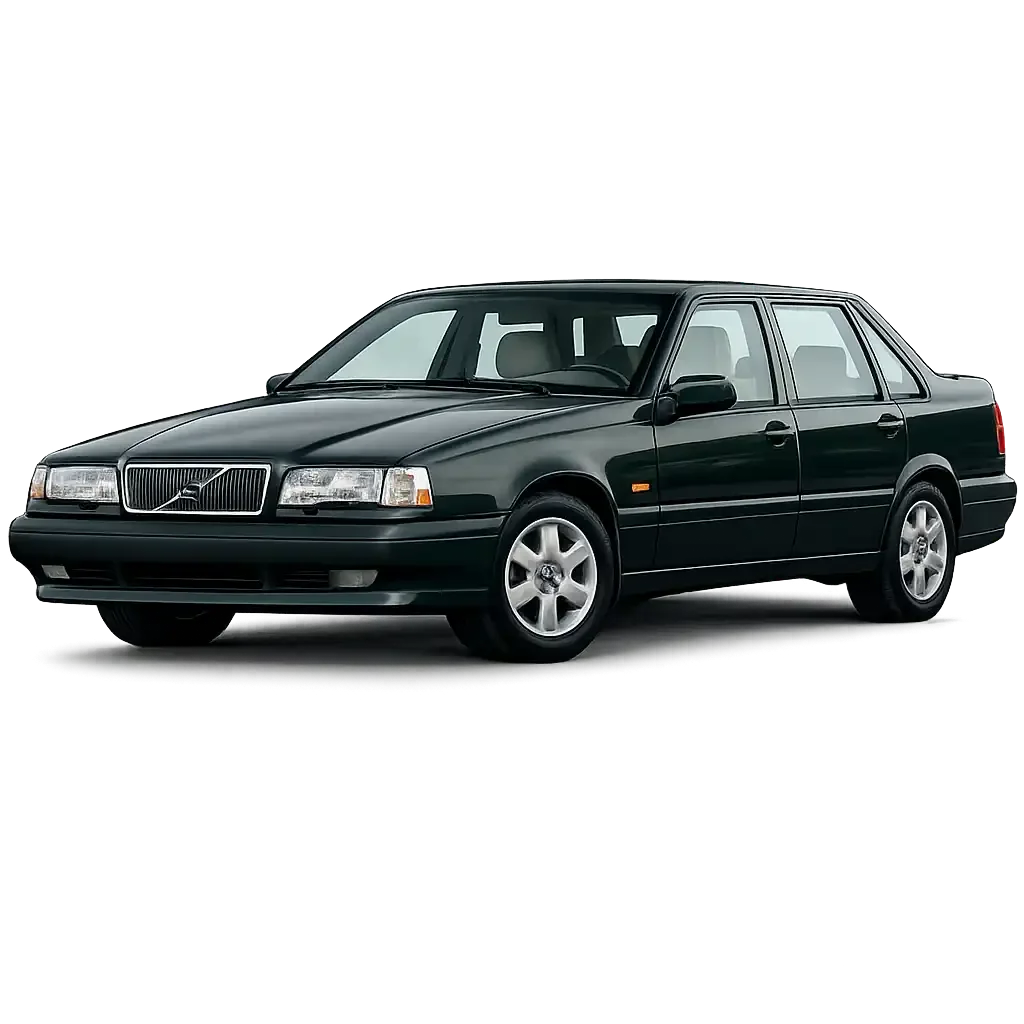
The Volvo 850 (1991 to 1997) is a 4-door front-wheel-drive sedan and 5-door wagon (estate) built on the P80 platform. For the 1994 model year, Volvo introduced a comprehensive facelift that transformed the 850 from a single-engine, naturally-aspirated-only lineup into a multi-tier performance range spanning 168 hp to 240 hp. The facelift brought revised exterior styling (new bumpers, headlights, and indicators), a critical switch from 4-bolt to 5-bolt wheel hubs, standard ABS across all models, the introduction of turbocharged engines, side-impact airbags (SIPS bags, a world first), a new A/C system, and a progression of increasingly powerful performance variants: the 850 Turbo (1994), T-5R (1995), 850 R (1996), and finally the 850 AWD (1997). The engine management system also evolved during this period, transitioning from Bosch LH 3.2 to Bosch Motronic 4.3 and eventually Motronic 4.4, coinciding with the industry-wide shift to OBD-II diagnostics. This guide covers the facelift Volvo 850 for the 1994 through 1997 model years. The 850 was succeeded by the Volvo S70 (sedan) and V70 (wagon) beginning with the 1998 US model year, though the S70/V70 shared approximately 90% of the 850's architecture and most parts interchange freely within the same model year range. This guide maps every fitment split required to prevent returns on Volvo's facelifted FWD platform across its four most complex production years.
Generation Overview (Facelift, 1994 to 1997)
The 1994 facelift was the most significant update in the 850's production run. Externally, the car received new front and rear bumpers with smoother profiles, new headlight assemblies with integrated indicators, and revised rear indicators on the sedan. Mechanically, the switch to 5-bolt wheel hubs (5x10⁸) from the previous 4-bolt (4x10⁸) was the single most important change for parts fitment. ABS became standard on all models. A new A/C system replaced the earlier design. Inside, new switchgear replaced the 1993-era controls.
The turbo era began in 1994 with the 850 Turbo producing 222 hp from the 2.3-liter B5234T engine. In 1995, the limited-edition T-5R raised the bar to 240 hp with upgraded ECU tuning, stiffer suspension, and unique styling (available in Cream Yellow, Black, and Dark Olive Green). The 1995 T-5R also became the first production car in the world with side-impact airbags (SIPS bags), mounted in the front seat bolsters. Side airbags became standard on all Turbo models for 1995 and a $500 option on non-turbo models, then standard across the entire 850 lineup for 1996. The 850 R replaced the T-5R for 1996 as a non-limited-edition performance model. For the final 1997 model year, the lineup expanded to include: base 850 (168 hp), GLT (190 hp light-pressure turbo), T-5 (222 hp), and R (240 hp), plus the wagon-only 850 AWD with a unique 2.5-liter turbo engine (193 hp) and 5-speed manual.
Year-by-Year Changes (US Market, 1994 to 1997)
1994 Model Year
Major facelift year. New front and rear bumpers, new headlights, new switchgear. Switch from 4-bolt to 5-bolt wheel hubs (5x10⁸). ABS now standard on all models. New A/C system. Introduction of the 850 Turbo with B5234T 2.3L turbocharged inline-5 producing 222 hp and 221 lb-ft of torque. The Turbo was initially available only with the AW50-42 4-speed automatic in the US. Base 850 continues with the B5254FS 2.5L NA engine at 168 hp. Both sedan and wagon available in base and Turbo trims. Base sedan initially retained some 1993-era exterior components (headlights, front valance) while all other models received the full facelift treatment.
1995 Model Year
Introduction of the 850 T-5R limited edition: B5234T5 2.3L turbo with special ECU (#628 US, #629 EU) producing 240 hp (225 hp normal, 240 hp overboost) and 250 lb-ft of torque. Available in three colors worldwide: Cream Yellow (2,537 units), Black (2,516 units), Dark Olive Green (1,911 units), totaling 6,964 units globally. Approximately 1,000 T-5Rs were imported to North America, all with automatic transmission. The T-5R featured 17-inch 5-spoke "Titan" wheels, stiffer suspension, unique front spoiler, and the motorsport badge on the trunk. The T-5R was the first production car with SIPS side-impact airbags. Side airbags became standard on all Turbo models and a $500 option on non-turbo models. New tail-lights for sedans. GLT reintroduced as a separate trim level above the base 850 (both still NA 168 hp, differing in equipment). The T-5R also featured the OBD-II diagnostic system a year before it became an industry standard. Note: 1995 was a split year for OBD; some 1995 850s have OBD-I only (under-hood diagnostic box), some have OBD-II only, and some have both.
1996 Model Year
Full OBD-II compliance across the entire 850 lineup. The T-5R is discontinued and replaced by the 850 R, which is now a regular production model (not limited edition). The 850 R uses the B5234T5 engine with 240 hp automatic (same as T-5R) or the B5234T4 engine with larger TD04HL-16T turbo producing 250 hp in manual-equipped cars (manual 850 R not available in US). US-market 850 R was automatic-only at 240 hp. Revised power door lock system. New exterior colors. Platinum Limited Edition offered: 1,400 units for US (1,000 sedans, 400 wagons) with metallic pearl platinum paint, unique 16-inch alloy wheels, leather seats, and burled walnut accents, powered by the 222 hp turbo engine. SIPS side-impact airbags now standard on all 850 models. Engine management transition: NA 2.5L models begin transition from Bosch LH 3.2 to Bosch Motronic 4.4 (both systems found in 1996 production).
1997 Model Year (Final Year)
The most complex model year for the 850, with the widest range of trim levels and engine options. Lineup: base 850 (168 hp NA), 850 GLT (190 hp light-pressure turbo, B5254T 2.5L), 850 T-5 (222 hp high-pressure turbo, B5234FT 2.3L), and 850 R (240 hp, B5234T5 2.3L). The Turbo model is officially rebranded as "T-5" for 1997. All sedan and wagon body styles available across all trims. Introduction of the 850 AWD: wagon-only, with the new B5254T 2.5L turbo engine (193 hp), 5-speed manual only, increased ride height, multilink rear axle with self-leveling suspension, and viscous coupling AWD system. The AWD was a precursor to the XC70/Cross Country line. All 1997 models use Bosch Motronic 4.4 engine management exclusively (LH 3.2 discontinued). All turbochargers are now Mitsubishi-sourced (earlier years used Garrett on some models). This is the final year for the 850 nameplate; the S70 and V70 replace it for 1998.
Platform and Engineering
Key Platform Facts
• Platform: P80 (shared with S70, V70, C70, V70-XC)
• Architecture: Front-wheel drive (FWD) standard, all-wheel drive (AWD) available 1997 wagon only
• Body styles: 4-door sedan, 5-door wagon (estate)
• Assembly: Torslanda plant, Gothenburg, Sweden
• Wheelbase: 2,660 mm (104.7 inches)
• Overall length (sedan): 4,660 mm (183.5 inches)
• Overall length (wagon): 4,720 mm (185.8 inches)
• Width: 1,760 mm (69.3 inches)
• Height (sedan): 1,400 mm (55.1 inches)
• Height (wagon): 1,425 mm (56.1 inches)
• Curb weight range: 1,370 to 1,575 kg (3,020 to 3,472 lbs) depending on trim and body style
• Turning circle: 10.2 m (33.5 ft)
• Fuel tank: 73 liters (19.3 US gallons)
• Wheel bolt pattern: 5x10⁸ (all 1994 to 1997 facelift models)
• Front suspension: MacPherson strut, coil springs, lower control arms, anti-roll bar, isolated subframe
• Rear suspension: Delta-link semi-independent with patented passive rear-steering bushings (FWD); multilink independent with self-leveling (AWD)
• Brakes: Ventilated disc front, solid disc rear, ABS standard (all 1994+)
Engine Reference (Detailed)
B5254FS: 2.5L DOHC 20-Valve Inline-5 NA (Base 850, 1994 to 1997)
The naturally aspirated 2.5-liter continues as the base engine throughout the facelift period. It is unchanged mechanically from the pre-facelift version but the engine management system transitions during this period.
• Displacement: 2,435 cc (2.5 liters)
• Bore x stroke: 83 mm x 90 mm
• Compression ratio: 10.5:1
• Valvetrain: DOHC, 20-valve (4 per cylinder)
• Power: 168 hp (125 kW) at 6,200 rpm
• Torque: 162 lb-ft (220 Nm) at 3,300 rpm
• Fuel injection: Bosch LH 3.2 (1994 to 1995), transitional LH 3.2 or Motronic 4.4 (1996), Motronic 4.4 only (1997)
• V-VIS: Volvo Variable Intake System, present on all 20-valve NA engines through 1996, discontinued 1997
Critical fuel injection split: The transition from Bosch LH 3.2 to Bosch Motronic 4.4 on the NA 2.5L engine is a major fitment concern. These are completely different engine management systems with different sensors, wiring harnesses, ECU connectors, and diagnostic protocols. A 1994 or 1995 NA 850 uses LH 3.2. A 1997 NA 850 uses Motronic 4.4. A 1996 NA 850 can have either system depending on production date. Always verify by checking the ECU or the diagnostic connector configuration before ordering any engine management component for a 1996 model.
B5234T / B5234FT: 2.3L DOHC 20-Valve Turbo Inline-5 (850 Turbo / T-5, 222 hp)
The high-pressure turbo engine that powers the 850 Turbo (1994 to 1996) and the rebranded T-5 (1997). This engine uses a smaller bore (81 mm vs. 83 mm) and shorter stroke crankshaft to achieve 2.3 liters, optimized for turbocharging.
• Displacement: 2,319 cc (2.3 liters)
• Bore x stroke: 81 mm x 90 mm
• Compression ratio: 8.5:1
• Power: 222 hp (166 kW) at 5,200 rpm
• Torque: 221 lb-ft (300 Nm) at 2,100 rpm
• Turbocharger: Garrett or Mitsubishi TD04 (early); all Mitsubishi from 1997
• Boost pressure: Approximately 9.6 psi
• Engine management: Bosch Motronic 4.3
• Intercooled: Yes, air-to-air intercooler
US transmission restriction: In the US market, the 850 Turbo/T-5 was available only with the AW50-42 4-speed automatic transmission. The M56 5-speed manual was not offered with the turbo engine in the US (it was available in other markets). First gear in the automatic included a torque limiter to manage wheelspin, as the 222 hp going through the front wheels alone could overwhelm traction.
B5234T5: 2.3L DOHC 20-Valve Turbo Inline-5 (T-5R / 850 R, 240 hp)
The high-performance variant of the 2.3-liter turbo, used in the T-5R (1995) and 850 R (1996 to 1997). This engine shares the B5234T block and head but features a modified ECU with higher boost pressure for additional power.
• Displacement: 2,319 cc (2.3 liters)
• Power (automatic): 240 hp (177 kW) at 5,600 rpm (overboost; 225 hp normal)
• Torque (automatic): 250 lb-ft (340 Nm) at 2,100 to 5,280 rpm (overboost); 221 lb-ft (300 Nm) normal
• ECU: Special Bosch ECU #628 (US) / #629 (EU) with additional 2 psi (0.1 bar) boost over standard Turbo
• Turbocharger: TD04 series (same housing as standard Turbo; ECU calibration is the primary difference)
• US availability: Automatic transmission only. Manual 850 R with B5234T4 engine (250 hp, larger turbo) was not available in the US.
B5254T: 2.5L DOHC 20-Valve Light-Pressure Turbo Inline-5 (1997 GLT / AWD)
New for the 1997 model year, this engine bridges the gap between the 168 hp NA and the 222 hp high-pressure turbo. It uses the larger 2.5-liter block (83 mm bore) with a low-pressure turbo installation running approximately 4 to 5 psi of boost.
• Displacement: 2,435 cc (2.5 liters)
• Power (GLT): 190 hp (142 kW)
• Power (AWD): 193 hp (142 kW)
• Engine management: Bosch Motronic 4.4
• Turbocharger: Mitsubishi, low-pressure configuration
Fitment note: The B5254T light-pressure turbo shares its 2.5-liter block dimensions with the NA B5254FS but has different internals (lower compression pistons), a turbo manifold, intercooler plumbing, different intake manifold, and different ECU calibration. It also differs from the 2.3-liter B5234T high-pressure turbo in bore, stroke, crankshaft, pistons, connecting rods, and turbo sizing. Do not interchange internal components between the 2.3L HPT and 2.5L LPT engines.
Transmission Reference
AW50-42 (Aisin-Warner) 4-Speed Automatic
The primary automatic transmission across all facelift 850 models (base, GLT, Turbo, T-5, T-5R, and R). Used in both FWD and the standard (non-AWD) configurations.
• Type: 4-speed automatic transaxle with torque converter lockup
• Final drive ratio (NA): 2.74:1
• Final drive ratio (Turbo): 2.54:1
• Gear ratios: 1st: 3.61, 2nd: 2.06, 3rd: 1.37, 4th: 0.98, Reverse: 3.95
• Fluid: Dexron IIE or Mercon ATF
• Capacity (dry): 8.1 quarts (7.6 liters)
• Features: Economy/Sport mode, Winter mode (3rd gear start), first gear torque limiter (turbo models)
Final drive ratio split: The final drive ratio differs between NA (2.74:1) and turbo (2.54:1) applications. These are different internal ring and pinion sets within the transaxle. This matters when ordering a replacement or rebuilt AW50-42: always specify NA or turbo application.
M56 5-Speed Manual
Available in the US only with NA engines (base and GLT). The M56 went through revisions during the facelift period.
• M56 -1994: Early version, final drive 3.77:1 (NA)
• M56 1995: Revised version, final drive 4.00:1 (standard) or 3.77:1 (some NA applications)
• M56 1996-: Further revised, verify ratio by application
• Fluid: Volvo Synthetic Gear Oil (P/N 1161423) or Type F/G ATF
Fitment critical: The three M56 versions (-1994, 1995, and 1996-) have different internal specifications. Cases are not identical. Shift cables and shifter assemblies interchange between all three, but always specify the exact model year when ordering a replacement transmission.
AWD Transfer Case and Rear Drive (1997 AWD Only)
The 1997 850 AWD is a completely unique drivetrain configuration that exists only in this single model year for the 850 platform. It uses the M56 5-speed manual mated to a viscous coupling transfer case that sends power to the rear wheels via a rear driveshaft and a newly developed multilink independent rear suspension (replacing the Delta-link beam used on all FWD 850s). The AWD system also features self-leveling rear suspension. This drivetrain does not share components with the FWD 850's Delta-link rear end. The AWD 850 is the direct predecessor to the V70 XC / XC70 line.
Catalog Accuracy: The Fitment Splits That Matter
The facelift 850 (1994 to 1997) is the most complex period of the 850's production run, with multiple engine options, evolving engine management systems, performance trims, and the addition of AWD. These are the splits that generate returns. The engine management system transition (LH 3.2 vs. Motronic 4.3 vs. Motronic 4.4) and the turbo vs. NA split are the most frequent sources of incorrect parts orders during this period.
Split 1: Facelift (1994+) vs. Pre-Facelift (1992 to 1993)
5-bolt hubs (1994+) vs. 4-bolt hubs (1992 to 1993) is the fundamental dividing line. Wheels, brake rotors, hubs, bearings, and ABS tone rings are all different and do not interchange between 4-bolt and 5-bolt applications. Additionally, bumpers, headlights, front indicators, rear indicators (sedan), and interior switchgear changed with the facelift. Hood, fenders, doors, and rear body panels (from B-pillar back) are shared between pre-facelift and facelift.
Split 2: NA 2.5L vs. Turbo 2.3L HPT vs. LPT 2.5L Turbo vs. R-Spec 2.3L
The facelift 850 was offered with up to four distinct engine configurations in the US market, each with different parts requirements. This is the most common source of confusion in the facelift era.
• NA 2.5L (B5254FS, 168 hp): Base and GLT (1994 to 1996). No turbo, no intercooler, 83 mm bore. Fuel injection: LH 3.2 (1994 to 1995), transitional (1996), Motronic 4.4 (1997).
• HPT 2.3L (B5234T/FT, 222 hp): Turbo (1994 to 1996) and T-5 (1997). High-pressure turbo, intercooler, 81 mm bore. Engine management: Motronic 4.3.
• R-Spec 2.3L (B5234T5, 240 hp): T-5R (1995) and R (1996 to 1997). Same block as HPT but special ECU with higher boost. Motronic 4.3.
• LPT 2.5L (B5254T, 190/193 hp): GLT (1997) and AWD (1997) only. 83 mm bore with low-pressure turbo. Engine management: Motronic 4.4.
Key rule: Bore diameter (81 mm for 2.3L vs. 83 mm for 2.5L) determines which internal parts fit. Head gaskets, pistons, rings, and cylinder liners do not cross between 2.3L and 2.5L. External accessories (alternator, power steering pump, water pump, timing belt) are generally shared across all Whiteblock 5-cylinder variants, but always verify by part number because mounting brackets and accessory drive configurations can differ between NA and turbo installations.
Split 3: Engine Management System (LH 3.2 vs. Motronic 4.3 vs. Motronic 4.4)
This is the second most important split on the facelift 850. Three different engine management systems were used, and they are not cross-compatible. Each system uses different ECUs, different sensor configurations, different wiring harnesses, and different diagnostic protocols.
• Bosch LH 3.2 (with EZ-129K ignition): Used on NA 2.5L engines in 1994 and 1995. Also found on some 1996 NA production. Uses the V-VIS variable intake system. Diagnostics via under-hood OBD-I box.
• Bosch Motronic 4.3: Used on all turbo engines (2.3L HPT and R-spec) throughout the facelift period (1994 to 1997). Integrated fuel injection and ignition management.
• Bosch Motronic 4.4: Used on all NA 2.5L and LPT 2.5L engines from 1997. Also found on some late-1996 NA production. OBD-II compliant. Does not use V-VIS variable intake.
1996 is the danger year: A 1996 NA 850 can have either LH 3.2 or Motronic 4.4 depending on production date. Before ordering any sensor, ECU, mass airflow meter, throttle position sensor, or ignition component for a 1996 NA 850, identify the engine management system by inspecting the ECU or checking the diagnostic connector configuration. Turbo models are not affected by this split (they use Motronic 4.3 throughout).
Split 4: Sedan vs. Wagon
Same split as the pre-facelift: shared from the B-pillar forward, different from the B-pillar back. Taillights, tailgate/trunk, rear bumper, roof, rear quarter panels, rear glass, rear wiper (wagon only), cargo trim, and rear wiring harness all differ. New for the facelift era: 1995+ sedan taillights are different from 1994 sedan taillights (updated design for 1995). Wagon taillights remained consistent throughout the facelift period.
Split 5: FWD vs. AWD (1997 Wagon Only)
The 1997 850 AWD is a completely different vehicle from the rear axle back compared to the FWD 850. The AWD uses a multilink independent rear suspension with self-leveling shocks, a rear driveshaft, a transfer case, a different rear subframe, different rear axle shafts, and a unique exhaust routing (right-side exit). The FWD 850 uses the Delta-link beam rear suspension. No rear suspension, drivetrain, or exhaust components interchange between FWD and AWD models. The front suspension, engine, and body panels are shared. The AWD was offered only as a wagon with the B5254T 2.5L LPT engine and M56 5-speed manual.
Split 6: Turbocharger Brand (Garrett vs. Mitsubishi)
Early facelift turbo 850s (1994 to 1996) used either Garrett or Mitsubishi TD04-series turbochargers. Starting with the 1997 model year, all turbo 850s used Mitsubishi turbochargers exclusively. The Garrett and Mitsubishi turbochargers have different oil feed and return line connections, different wastegate actuator configurations, and different mounting hardware. They are not direct bolt-on replacements for each other without also changing the associated oil lines and potentially the exhaust manifold. Always verify the turbocharger brand on the existing car before ordering a replacement turbo, wastegate actuator, oil feed line, or oil return line.
Split 7: T-5R vs. 850 R vs. Standard Turbo
These three turbo trims share the same basic 2.3-liter block and many components, but differ in ECU calibration, suspension tuning, wheel/tire specifications, and cosmetic details.
• Standard Turbo (222 hp): Standard 850 suspension, 15 or 16-inch wheels, standard body trim. Motronic 4.3 ECU.
• T-5R (240 hp, 1995 only): Stiffer suspension, 17-inch "Titan" 5-spoke wheels, unique front spoiler, motorsport badge, special ECU #628 with higher boost. Limited to Cream Yellow, Black, or Dark Olive Green paint. Leather interior with unique trim.
• 850 R (240 hp, 1996 to 1997): Stiffer suspension (slightly softer than T-5R), 17-inch wheels, aggressive styling cues, upgraded brakes (some European models had 302 mm front rotors), unique interior with graphite grey leather and dark alcantara inserts, burled walnut trim. Special ECU with higher boost.
Suspension note: T-5R and 850 R suspension components (springs, struts, anti-roll bars) are stiffer than standard 850 parts and are not recommended as replacements for standard models unless the owner specifically wants a firmer ride. Conversely, standard 850 suspension components will fit the T-5R/R but will soften the handling characteristics that define those models.
Split 8: OBD-I vs. OBD-II Diagnostics
The transition from OBD-I to OBD-II diagnostics is relevant for engine management sensors and diagnostic tools. 1994: OBD-I only (under-hood diagnostic box). 1995: Split year (some cars have OBD-I only, some have OBD-II only, some have both). 1996 to 1997: Full OBD-II. All turbo models used Motronic 4.3 throughout, which is inherently OBD-II capable. The transition primarily affects NA models on LH 3.2 (OBD-I) vs. Motronic 4.4 (OBD-II). When ordering oxygen sensors, catalytic converters, or emissions-related components, verify whether the car is OBD-I or OBD-II compliant.
Common Wear Items and Fitment Notes
• Timing belt kit: Interference engine on ALL Whiteblock 5-cylinder variants (NA and turbo). Replace belt, tensioner, and idler pulleys together. Water pump typically replaced at the same time (driven by timing belt). 70,000-mile recommended interval (50,000 to 60,000 miles recommended by many specialists). Timing belt system is shared between 2.3L and 2.5L 20-valve engines.
• Turbo oil lines: Oil feed and return lines to the turbocharger are common failure items due to heat cycling. Verify Garrett vs. Mitsubishi turbo before ordering (different line fittings).
• Intercooler and hoses (turbo models): Intercooler hoses deteriorate with heat and age. The intercooler is shared between the 2.3L HPT and R-spec engines but differs from the 2.5L LPT intercooler (1997 GLT/AWD).
• Brake rotors: ALL facelift 850s (1994 to 1997) use 5-bolt rotors. Standard front rotors are typically 280 mm. Some 850 R models (European spec) had 302 mm front rotors. Verify rotor diameter before ordering for R models.
• Front struts and rear shocks: Standard, T-5R, and 850 R use different spring rates and damper settings. Order according to the specific trim level. AWD models have a unique rear suspension with self-leveling shocks (not interchangeable with FWD Delta-link shocks).
• CV axle shafts: FWD axle shafts are compatible between auto and manual transmissions and across all FWD engine options. AWD models have unique rear axle shafts that do not apply to FWD cars. Left and right front axle shafts differ in length.
• PCV system: Prone to clogging on all Whiteblock 5-cylinder engines. A clogged PCV system causes oil leaks, increased oil consumption, and rough running. Shared across all 5-cylinder variants.
• ETM (Electronic Throttle Module): Applicable to 1997 models with Motronic 4.4 engine management. Known failure item. Earlier models with LH 3.2 or Motronic 4.3 use cable-operated throttle and are not affected.
• Mass airflow sensor: Different between LH 3.2 (hot-wire type) and Motronic 4.3/4.4 (different connector and calibration). Not interchangeable between engine management systems.
• Delta-link bushings: Common wear item on ALL FWD 850s. Worn bushings cause vague handling and uneven rear tire wear. Shared across all FWD facelift models regardless of engine or trim. Not applicable to AWD (different rear suspension).
• Heater core: Known failure item. Replacement requires extensive dashboard disassembly. Shared between all 850 variants.
• Side airbag modules (1995+): Mounted in front seat bolsters. Seat-specific (driver vs. passenger). If replacing seats on a 1995+ model, verify whether the replacement seats have the SIPS airbag provisions.
Ordering Quick-Reference Checklist
• Model year: 1994, 1995, 1996, or 1997? Each year has distinct equipment and engine management configurations.
• Body style: Sedan or wagon?
• Hub bolt count: All facelift models are 5-bolt (5x10⁸). If someone claims a 1994+ 850 has 4-bolt hubs, verify the model year; it may actually be a late-production 1993.
• Engine: NA 2.5L (168 hp), HPT 2.3L Turbo/T-5 (222 hp), R-spec 2.3L (240 hp), or LPT 2.5L GLT/AWD (190/193 hp, 1997 only)?
• Engine management: Bosch LH 3.2 (NA 1994 to 1995, some 1996), Motronic 4.3 (all turbo), or Motronic 4.4 (NA/LPT 1997, some 1996)?
• Turbocharger brand: Garrett or Mitsubishi? (All 1997 are Mitsubishi; earlier years can be either.)
• Transmission: AW50-42 auto (specify NA or turbo final drive ratio) or M56 manual (specify year version)?
• FWD or AWD: AWD only available on 1997 wagon with B5254T engine and M56 manual.
• Trim level: Base, GLT, Turbo/T-5, T-5R, R, or Platinum? Suspension and brake components may differ by trim.
• SIPS side airbags: Present or absent? Standard on all 1996+; standard on 1995 Turbo; optional on 1995 non-turbo; not available 1994.
• OBD standard: OBD-I (1994, some 1995), OBD-II (1996+, some 1995).
• VIN: Always verify by VIN. Running production changes are common, especially during the 1996 engine management transition year.
Three Questions to Always Ask
• "What engine and engine management system?" The facelift 850 was sold with four different engine configurations and three different engine management systems. Getting the wrong engine management system is the most common error. A mass airflow sensor for LH 3.2 will not work on Motronic 4.4, and vice versa. For 1996 NA models specifically, there is no shortcut: you must identify the system on the car before ordering. Check the ECU, check the diagnostic connector, or ask the customer to read the label on the ECU box.
• "Turbo or naturally aspirated?" This determines not only the engine internals and turbo-specific components, but also the automatic transmission final drive ratio (2.74:1 for NA vs. 2.54:1 for turbo), intercooler presence, exhaust system configuration, and many under-hood accessories. The 1997 GLT adds a third category: light-pressure turbo with the 2.5-liter block, which shares the NA bore size but has turbo-specific internals and plumbing.
• "FWD or AWD?" This question only applies to 1997 wagons, but when it applies, it changes everything from the rear axle back. The AWD 850 uses a completely different rear suspension (multilink independent vs. Delta-link beam), has a rear driveshaft and transfer case, different exhaust routing, and unique axle shafts. No rear suspension, drivetrain, or exhaust components interchange between FWD and AWD. If the customer says '1997 wagon,' always ask this question.
Disclaimer: This guide is based on publicly available specifications, Volvo press materials, and independent research. Part interchangeability should always be confirmed via VIN and OEM part number lookup. Specifications may change without notice. This document does not constitute official Volvo parts catalog data. Visuals and illustrations in this article were generated using AI for representative purposes and may not reflect exact technical schematics.